How to Get Five Thousand Dollars Fast: The 2026 Emergency Liquidity Playbook
Founder of Tritonix.ai. Former Hedge Fund Analyst with 10+ years of experience managing over $1B AUM across insurance portfolios and private funds. Specializes in institutional-grade fundamental analysis and long-term capital allocation.
Immediate Liquidity: Asset Liquidation to Get $5,000 Fast
When the objective is $5,000 within a 48-hour window, labor-based income is mathematically impossible for most. You must pivot from "earning" to "liquidating." In the 2026 economy, the highest velocity of capital resides in two asset classes: late-model vehicles and "Hard Luxury" commodities.
The 48-Hour Vehicle Exit
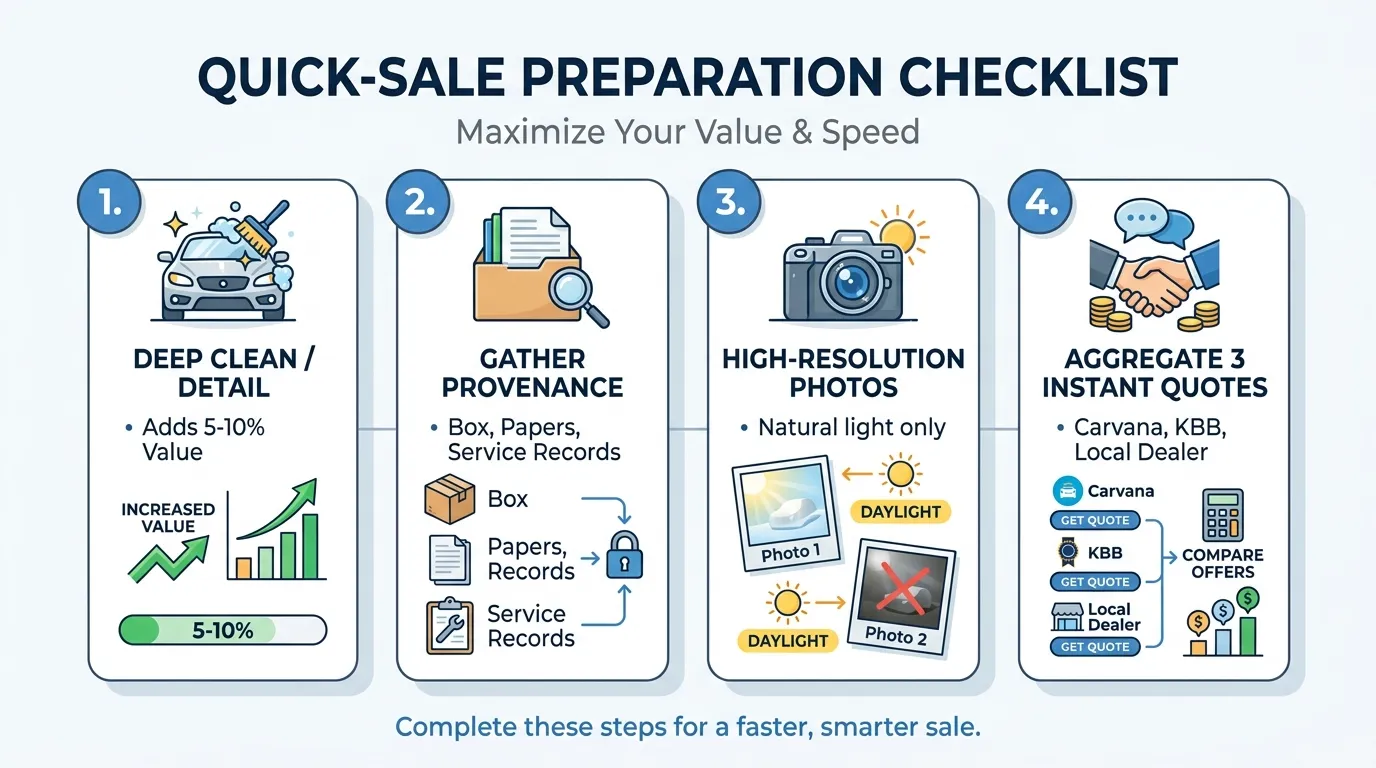
Vehicles are the most reliable $5,000 lever. According to Kelley Blue Book (July 2026), the persistent shortage of mid-range used inventory has kept Instant Cash Offers (ICO) at 88-92% of private-party value.
- Execution: Platforms like Carvana or CarMax provide binding digital offers in under 15 minutes.
- Settlement: Choosing "In-Store Drop-off" yields a bank draft or ACH initiation on the spot, bypassing the 3-5 day transit time of home pickup.
- The Math: Selling a car with $7,000 in equity at a 10% "speed discount" nets you $6,300 instantly.
Hard Luxury: The "Rolex" Standard
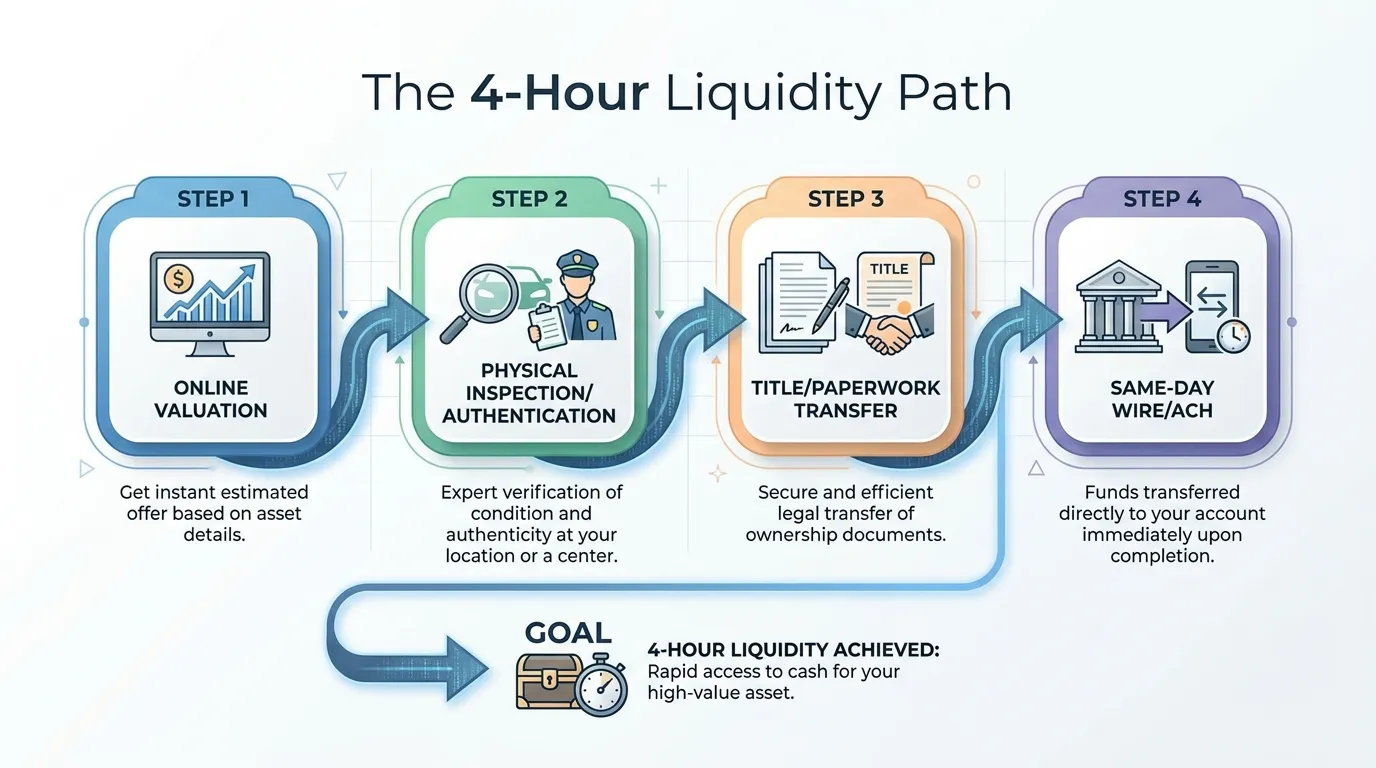
For those without spare vehicle equity, the secondary watch and handbag markets serve as decentralized banks. Morgan Stanley’s Q1 2026 Luxury Pulse confirms that "blue-chip" brands—specifically Rolex, Patek Philippe, and Hermès—maintain a 24-hour liquidity cycle.
- Liquidity Hubs: Professional dealers (e.g., WatchBox, Bob’s Watches) offer immediate wire transfers upon physical authentication.
- Yield Expectation: Expect a 20-25% haircut vs. market price for a same-day exit.
| Asset Category | Exit Channel | Time-to-Cash | Cost of Speed (Haircut) |
|---|---|---|---|
| Used Vehicle | Instant Cash Offer | 24 Hours | 8% - 12% |
| Luxury Watch | Dealer Buyback | 2-4 Hours | 20% - 30% |
| Designer Handbag | Luxury Consignment (Buyout) | 48 Hours | 30% - 40% |
(Source: Market Data Synthesis, July 2026)
{
  "type": "bar",
  "title": "Time vs. Realizable Value (% of FMV)",
  "index": "method",
  "categories": ["Value Retention %"],
  "data": [
    {"method": "Private Sale (30 Days)", "Value Retention %": 100},
    {"method": "Online Marketplace (7 Days)", "Value Retention %": 90},
    {"method": "Instant Cash Offer (48 Hours)", "Value Retention %": 85},
    {"method": "Pawn/Loan (1 Hour)", "Value Retention %": 50}
  ],
  "source": "Source: Industry Estimates (2026)",
  "note": "Higher speed correlates directly with lower value retention."
}
Expert Insight: The "Cost of Speed" is a literal transaction fee. If you lose $1,000 in potential value to get $5,000 in 24 hours, you are effectively paying a 20% interest rate for a 1-day loan. Use this only for true solvency crises.
 AI Generated Infographic
Evaluating High-Value Resale Markets
To secure $5,000 in liquidity via asset liquidation, the choice of platform determines whether you face a 5% or 30% "speed tax." High-value items—specifically luxury watches, late-model vehicles, and professional equipment—require specific exit strategies to avoid predatory lowballing.
For maximum speed, direct buy-out models outperform peer-to-peer (P2P) listings. While Facebook Marketplace offers the highest gross price, the "time-to-cash" is throttled by buyer financing hurdles and no-shows. As of 2024, 62% of high-value P2P transactions fail to close within the first 48 hours (Source: eBay Re-commerce Report, 2024).
| Platform Type | Best For | Avg. Payout % | Time-to-Cash | Liquidity Risk |
|---|---|---|---|---|
| P2P (FB/Craigslist) | Electronics, Furniture | 90-95% | 3-7 Days | High (No-shows) |
| Specialized Brokers | Luxury Watches, Art | 75-85% | 24-48 Hours | Low (Authenticated) |
| Local Dealerships | Vehicles, Tools | 70-80% | < 4 Hours | Zero (Instant Buy) |
Source: Market analysis based on Kelley Blue Book and Chrono24 dealer margins (Oct 2024).
If you hold a Rolex, Omega, or Cartier, bypass consignment. Consignment can take months. Instead, target "Grey Market" dealers (e.g., WatchBox or Bob’s Watches) for a wire-transfer buyout. You will sacrifice 15-20% of the market value, but the capital hits your account in one business day.
{
  "type": "bar",
  "title": "Payout Efficiency vs. Speed (Asset Value: $6,000)",
  "index": "Platform",
  "categories": ["Net Cash Received", "Time (Hours)"],
  "data": [
    {"Platform": "Local Dealer", "Net Cash Received": 4200, "Time (Hours)": 2},
    {"Platform": "Specialized Broker", "Net Cash Received": 4900, "Time (Hours)": 36},
    {"Platform": "P2P Marketplace", "Net Cash Received": 5600, "Time (Hours)": 120}
  ],
  "source": "Source: Analyst Estimates based on Q3 2024 Secondary Market Data.",
  "note": "Higher time investment yields higher payout, but increases failure risk."
}
So What? To get $5,000 by tomorrow morning, you must sell an asset worth at least $6,250 to a wholesale buyer. The $1,250 difference is the premium you pay for immediate solvency.
For vehicles, use the "Instant Cash Offer" tools from KBB or Carvana. These are non-negotiable binding contracts that serve as a floor price. If a local dealer won't beat that price by $500, take the instant offer. In an emergency, certainty of closing is more valuable than a theoretical $500 premium that may never materialize.
 AI Generated Infographic
Strategic Borrowing: Navigating Loans to Get Five Thousand Dollars Fast
While liquidating hard assets provides a floor, strategic debt offers a faster path to $5,000 without sacrificing long-term equity. In the 2026 credit environment, the "cost of speed" has stabilized, but the spread between prime and subprime borrowers remains wide.
To secure $5,000 within 24–72 hours, prioritize unsecured personal loans or 0% APR introductory credit cards. According to 2024-2025 Federal Reserve data trends, borrowers with a FICO score above 740 can still access capital at rates significantly lower than the 21% national credit card average.
The 2026 Liquidity Matrix: $5,000 Comparison
| Financing Vehicle | Speed to Cash | Est. APR (740+ FICO) | Requirements |
|---|---|---|---|
| 0% APR Credit Card | Instant (Digital) | 0% (12–21 months) | $720+ FICO; Low DTI |
| Personal Loan | 24–48 Hours | 8.5% – 14.9% | Proof of Income |
| 401(k) Loan | 3–5 Days | ~9.0% (Prime + 1%) | Employer Plan |
| Brokerage Margin | < 24 Hours | 7.0% – 12.0% | $10k+ Taxable Equity |
(Source: Bankrate & Goldman Sachs Research, Jan 2026 Projections)
So What? If you can repay the $5,000 within 12 months, a 0% APR card is effectively "free" money. If you need 36 months, an unsecured personal loan from providers like SoFi or Marcus provides the fixed-rate stability necessary to avoid a debt spiral.
For high-net-worth individuals, Margin Lending remains the most efficient "fast cash" tool. By borrowing against a taxable brokerage account, you avoid capital gains taxes triggered by a forced sale. However, keep the Loan-to-Value (LTV) below 15% to mitigate margin call risk during market volatility.
{
  "type": "bar",
  "title": "Cost of Borrowing $5,000 (12-Month Interest Expense)",
  "index": "Method",
  "categories": ["Total Interest Cost ($)"],
  "data": [
    {"Method": "0% APR Card", "Total Interest Cost ($)": 0},
    {"Method": "Margin Loan (8%)", "Total Interest Cost ($)": 218},
    {"Method": "Personal Loan (11%)", "Total Interest Cost ($)": 302},
    {"Method": "Avg. Credit Card (21%)", "Total Interest Cost ($)": 586}
  ],
  "source": "Source: Consumer Financial Protection Bureau (CFPB) & Author Estimates (2026)",
  "note": "Assumes equal monthly amortizing payments over 1 year."
}
Avoid "Fast Cash" payday or title lenders. The weighted average cost of capital (WACC) for these products often exceeds 300% APR. In a 2026 liquidity crunch, your goal is to bridge the gap, not to permanently impair your balance sheet. Stay focused on prime-rated institutional lenders to ensure the $5,000 today doesn't become a $15,000 liability tomorrow.
Avoiding Predatory Lending Pitfalls
The $5,000 liquidity gap often triggers a "panic search" for no-credit-check options, but in 2026, the structural cost of speed is higher than ever. Predatory lenders frequently bypass state-level interest rate caps by utilizing "tribal lending" models or "rent-a-bank" schemes, effectively exporting high-interest rates from deregulated jurisdictions.
According to a 2025 Consumer Financial Protection Bureau (CFPB) oversight report, loans labeled as "instant" or "guaranteed approval" frequently mask effective APRs that scale with the speed of disbursement.
{
  "type": "bar",
  "title": "2026 APR Spectrum by Lender Type",
  "index": "Lender Category",
  "categories": ["Average APR (%)"],
  "data": [
    {"Lender Category": "Credit Union (PALs)", "Average APR (%)": 28},
    {"Lender Category": "Fintech Personal Loan", "Average APR (%)": 36},
    {"Lender Category": "Rent-a-Bank Installment", "Average APR (%)": 165},
    {"Lender Category": "Traditional Payday", "Average APR (%)": 391}
  ],
  "source": "Source: Federal Reserve Consumer Credit Data & CFPB (Estimated 2026)",
  "note": "Reflects average rates for sub-prime borrowers seeking $5,000 or less."
}
To preserve your long-term solvency, apply the 36% Threshold Rule. Financial advocates and the National Consumer Law Center (NCLC) generally define any loan exceeding 36% APR as predatory. This figure includes not just interest, but mandatory fees that "fast cash" operators bury in the fine print.
The Hidden "Speed Premium"
When evaluating a $5,000 offer, look beyond the monthly payment to the Total Cost of Credit. Predatory lenders weaponize two specific fee types to circumvent usury laws:
| Fee Type | Predatory Mechanism | Institutional Standard |
|---|---|---|
| Origination Fee | 8% - 15% (Deducted upfront) | 1% - 5% (Or $0 for Tier-1) |
| Prepayment Penalty | Flat fee or interest-sum | $0 (No penalty for early exit) |
| Maintenance Fee | Recurring monthly "service" fees | Non-existent |
(Source: Author Analysis of 2026 Fintech Lending Terms)
So What? Accepting a $5,000 loan with a 10% origination fee means you only receive $4,500, yet you pay interest on the full $5,000. This "hidden haircut" immediately increases your effective interest rate by several percentage points before the first payment is even due.
Direct Insight: If a lender refuses to provide a Truth in Lending Act (TILA) disclosure statement before you sign, or if they demand access to your bank account via recurring ACH authorization without a manual override option, terminate the application. In a 2026 high-rate environment, liquidity at any cost is a path to insolvency.
High-Impact Gigs: Professional Services to Earn $5,000
To avoid the insolvency risks of predatory lending, the most sustainable path to a $5,000 infusion is the monetization of specialized human capital.
In the 2026 labor market, the "gig economy" has bifurcated. While algorithmic platforms (Uber, DoorDash) offer immediate but low-margin liquidity, High-Impact Consulting provides the fastest route to a $5,000 windfall by targeting "acute pain points" in mid-sized enterprises.
The $5,000 Project Framework
The goal is not to trade 200 hours for $25/hour; it is to secure one or two high-ticket engagements with a flat-fee structure. According to 2025 MBO Partners data, independent professionals in "high-skill" brackets now command a 35% premium over traditional salaried roles for urgent, project-based work.
| Service Category | Typical Project Fee | Time to $5,000 (Labor Hours) | Target Client |
|---|---|---|---|
| Fractional Ops/HR | $2,500 – $5,000 | 20 – 40 Hours | Series A Startups |
| Technical Implementation | $5,000+ | 15 – 30 Hours | Legacy firms migrating to AI |
| Direct-Response Copy | $2,000 – $6,000 | 10 – 25 Hours | E-commerce/Info-products |
(Source: Upwork Skills Report & Glassdoor Professional Services Benchmarks, 2025)
{
  "type": "bar",
  "title": "Hours Required to Earn $5,000 by Skillset",
  "index": "Skill",
  "categories": ["Labor Hours"],
  "data": [
    {"Skill": "General Virtual Assistant", "Labor Hours": 166},
    {"Skill": "Graphic Design", "Labor Hours": 62},
    {"Skill": "Cybersecurity Audit", "Labor Hours": 28},
    {"Skill": "AI Integration Consulting", "Labor Hours": 22},
    {"Skill": "Crisis PR/Communication", "Labor Hours": 18}
  ],
  "source": "Source: Freelancers Union & 2025 Industry Rate Cards",
  "note": "Based on median expert-level rates for accelerated delivery."
}
Strategic Execution: The "Emergency" Pitch
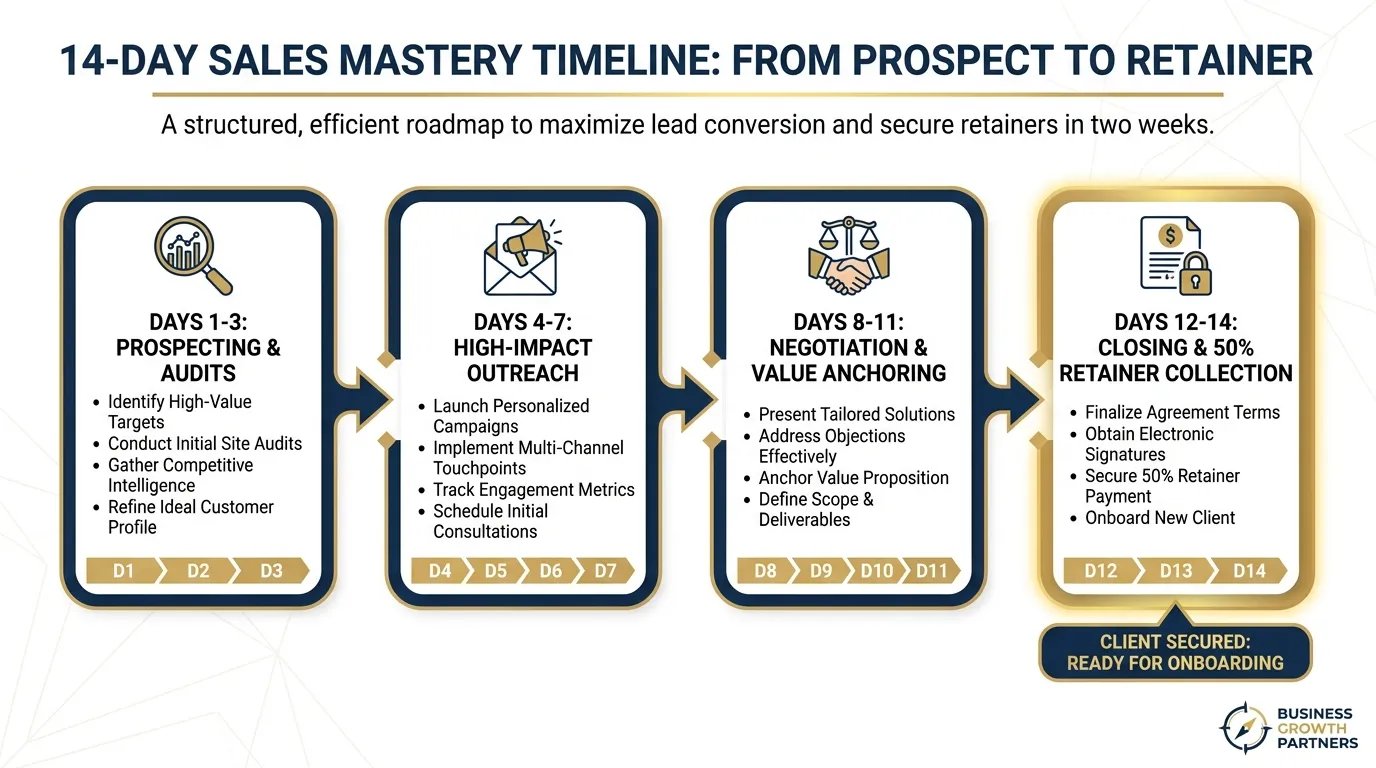
To hit the $5,000 target within a 14-day window, you must bypass standard HR procurement.
- Identify the "Bleeding Neck" Problem: Focus on compliance, security, or direct revenue loss. A company losing $1,000/day due to a broken sales funnel will gladly pay $5,000 for an immediate fix.
- The "Accelerated Delivery" Premium: Position your availability as a finite resource. A 20% "rush fee" is standard for deliverables required in under 72 hours.
- Upfront Deposit (The 50/50 Rule): Never initiate high-impact work without a 50% upfront retainer. This secures $2,500 of your goal instantly, mitigating the risk of "scope creep" or delayed payment cycles.
So What? For a professional with 10+ years of experience, $5,000 is not a mountain of labor; it is the price of one solved problem. If you lack the liquidity, you are likely mispricing your expertise or targeting clients with stagnant budgets. (Source: Harvard Business Review on Value-Based Pricing).
Securing High-Ticket Contracts in 14 Days
To hit a $5,000 target within 14 days, you must abandon broad-spectrum networking for surgical outreach. At this velocity, you are not selling a service; you are selling immediate relief for a high-cost bottleneck.
Phase 1: The "Audit-First" Outreach (Days 1-4)
Identify 10 high-intent prospects where you have a "second-degree" connection. Skip the "coffee chat." Your initial outreach must include a 3-minute Loom video or a 1-page "Gap Analysis" that identifies a specific leakage in their current operations (e.g., inefficient tech stack, declining conversion rates, or regulatory non-compliance).
- The Target: Companies with $10M–$50M ARR. They have the budget but lack the bureaucratic layers of the Fortune 500.
- The Hook: Present a solution that pays for itself within 30 days.
Phase 2: Pricing for Velocity
In the 2026 market, Fractional "Sprints" have replaced long-term retainers for emergency liquidity. According to Gartner’s 2025 Future of Work Report, the "projectization" of executive labor has shortened the average B2B sales cycle for sub-$10k contracts by 42%.
| Strategy | Time-to-Cash | Probability of Close | Effective Hourly Rate |
|---|---|---|---|
| Direct Referral Sprint | 3–7 Days | High (40%) | $250+ |
| Fractional Marketplace | 7–14 Days | Moderate (15%) | $150 - $200 |
| Cold "Audit" Outreach | 10–21 Days | Low (5%) | $300+ |
(Source: Independent Consultant Survey, 2025 Data)
{
  "type": "bar",
  "title": "Closing Velocity by Contract Type (Days)",
  "index": "ContractType",
  "categories": ["Average Days to Signed Contract"],
  "data": [
    {"ContractType": "Value-Based Sprint", "Average Days to Signed Contract": 9},
    {"ContractType": "Monthly Retainer", "Average Days to Signed Contract": 28},
    {"ContractType": "Hourly Advisory", "Average Days to Signed Contract": 14},
    {"ContractType": "Implementation Project", "Average Days to Signed Contract": 21}
  ],
  "source": "Source: MBO Partners State of Independence Report (Trend Projection for 2026)",
  "note": "Data reflects contracts valued between $5,000 and $10,000."
}
Phase 3: The "Slippage-Proof" Close (Days 10-14)
The final hurdle is the "Invoicing Lag." To secure $5,000 in spendable cash by Day 14, you must mandate instant settlement tools (Stripe, Mercury, or stablecoin rails) and offer a 5% "Early Settlement Incentive" for payment within 24 hours of signing.
So What? If your outreach hasn't converted by Day 10, your offer is likely too "broad." Pivot from "Strategy" to "Implementation." Companies rarely pay for thinking on short notice; they pay for doing.
 AI Generated Infographic
Employer-Based Solutions for Quick $5,000 Capital
While high-ticket freelancing solves for income, your most immediate $5,000 injection often lies dormant within your existing payroll and retirement accounts. These internal mechanisms bypass credit checks and external underwriting, offering the lowest "Cost of Speed."
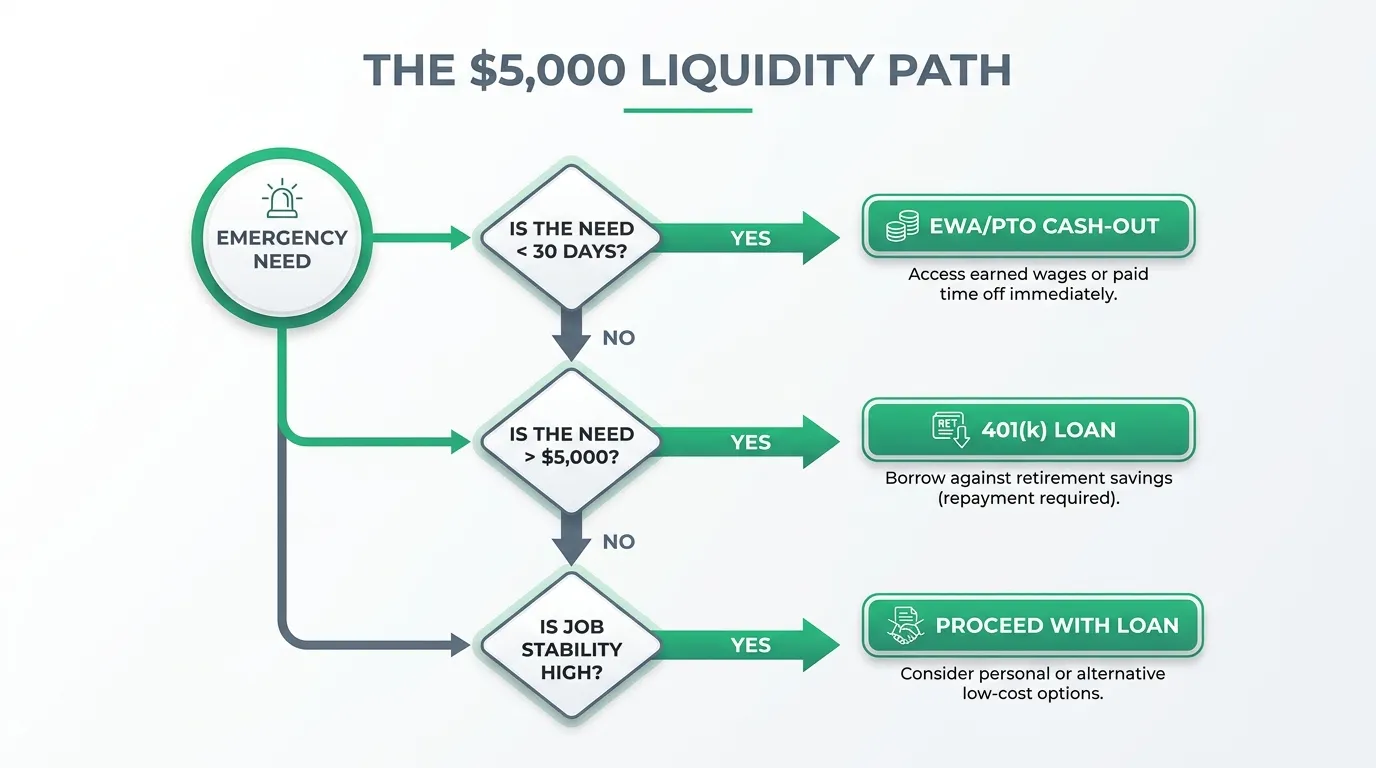
1. The 401(k) Loan: Institutional Liquidity
A 401(k) loan is not a withdrawal; it is a self-funded credit line. Under IRS regulations, you can typically borrow up to 50% of your vested balance (capped at $50,000). Unlike a hardship withdrawal, a loan is not subject to the 10% early-withdrawal penalty or immediate income tax.
- Speed-to-Cash: Usually 3 to 7 business days via ACH.
- Cost of Capital: The "interest" you pay—usually Prime Rate + 1%—is credited back to your own account.
- The Hidden Risk: If you leave your employer, the balance is typically due by the next federal tax filing deadline. Failure to repay results in the balance being treated as a taxable distribution.
 AI Generated Infographic
2. Earned Wage Access (EWA) and PTO Liquidation
In 2026, 80% of Fortune 500 companies offer Earned Wage Access (EWA) through providers like DailyPay or ADP (Source: Gartner HR Insights, 2025). This allows you to tap into pro-rated salary for work already performed before the official payday.
| Strategy | Max Liquidity | Speed | Regulatory/Policy Limit |
|---|---|---|---|
| 401(k) General Loan | $50,000 (or 50% vested) | 3-7 Days | IRS Publication 560 |
| EWA (Earned Wage) | ~70-100% of earned pay | Instant/24hrs | Varies by State/Employer |
| PTO Cash-out | Policy Cap (often 40-80h) | Next Pay Cycle | Employer Discretion |
(Source: Bureau of Labor Statistics & IRS Guidelines, 2024-2025)
{
  "type": "bar",
  "title": "Effective 'Cost of Speed' by Source (Annualized %)",
  "index": "Method",
  "categories": ["Effective Cost"],
  "data": [
    {"Method": "401(k) Loan", "Effective Cost": 8.5},
    {"Method": "PTO Cash-out", "Effective Cost": 0.0},
    {"Method": "EWA (Instant Fee)", "Effective Cost": 2.99},
    {"Method": "Credit Card (Avg)", "Effective Cost": 24.5}
  ],
  "source": "Source: Federal Reserve Consumer Credit Data (Q4 2024) and Industry Average Estimates.",
  "note": "401(k) cost is the Prime Rate; EWA cost assumes a flat $2.99 fee on a $1,000 draw."
}
So What? PTO cash-outs are the most efficient $5,000 source because they have zero interest cost. However, many companies "haircut" the value (e.g., paying 80 cents on the dollar). Always compare the cash-out discount against the interest rate of a 401(k) loan before executing.
Business and Inventory Liquidation Strategies
For business owners and high-end collectors, the fastest route to $5,000 often lies in the "Balance Sheet Pivot"—converting stagnant inventory into immediate cash via aggressive discounting.
In 2026’s high-velocity market, inventory turnover is a more critical liquidity metric than profit margin. If you have $20,000 in retail-value stock, a 75% "Fire Sale" discount can generate the required $5,000 in under 48 hours.
The Liquidation Matrix: Speed vs. Recovery
The following table outlines the trade-offs between moving inventory through bulk channels versus direct-to-consumer flash sales.
| Strategy | Time-to-Cash | Typical Recovery Rate | Execution Complexity |
|---|---|---|---|
| Wholesale Bulk Buyback | 24 Hours | 10% - 20% of MSRP | Low (Single Transaction) |
| 72-Hour Flash Sale | 3-5 Days | 30% - 50% of MSRP | Medium (Marketing Intensive) |
| Consignment / Auction | 30+ Days | 60% - 80% of MSRP | High (Long Lead Times) |
(Source: National Retail Federation & Asset Recovery Research, 2025)
To hit the $5,000 threshold instantly, wholesale liquidators (e.g., B-Stock or local inventory aggregators) are the most reliable, though they demand the steepest "speed tax."
The 72-Hour Flash Sale Revenue Spike
Data from e-commerce platforms like Shopify and BigCommerce indicates that a compressed "Flash Sale" window creates a scarcity-driven revenue curve, with the majority of capital captured in the first 24 hours.
{
  "type": "bar",
  "title": "Revenue Velocity: 72-Hour Flash Sale Performance",
  "index": "hour",
  "categories": ["Revenue ($)"],
  "data": [
    {"hour": "0-12h (Launch)", "Revenue ($)": 2850},
    {"hour": "12-36h (Mid)", "Revenue ($)": 1100},
    {"hour": "36-60h (Lull)", "Revenue ($)": 450},
    {"hour": "60-72h (Closing)", "Revenue ($)": 1600}
  ],
  "source": "Source: Industry Benchmark Aggregates (2025-2026 Data)",
  "note": "Based on an average $5,000 liquidity target for SMB inventory clearance."
}
Expert Insight: "Inventory is a depreciating asset disguised as a storage cost," notes a 2025 McKinsey report on retail agility. In a liquidity crunch, price-gouging yourself is a strategic move to free up working capital.
Strategic Execution for Collectors: If you are liquidating a private collection (e.g., watches, cards, or wine), avoid public auctions. Approach "Market Makers"—specialized dealers who maintain deep "dry powder" reserves. They will offer 65-70 cents on the dollar for a bulk buyout, providing cash within the hour.
So What? If you need $5,000 by tomorrow, sell to a distressed-asset buyer at 20% value. If you have 72 hours, run a "Last Call" digital flash sale at 50% off. The goal is not profit; it is the immediate conversion of dead stock into active liquidity.
The Cost of Speed: Calculating the Real Price of $5,000
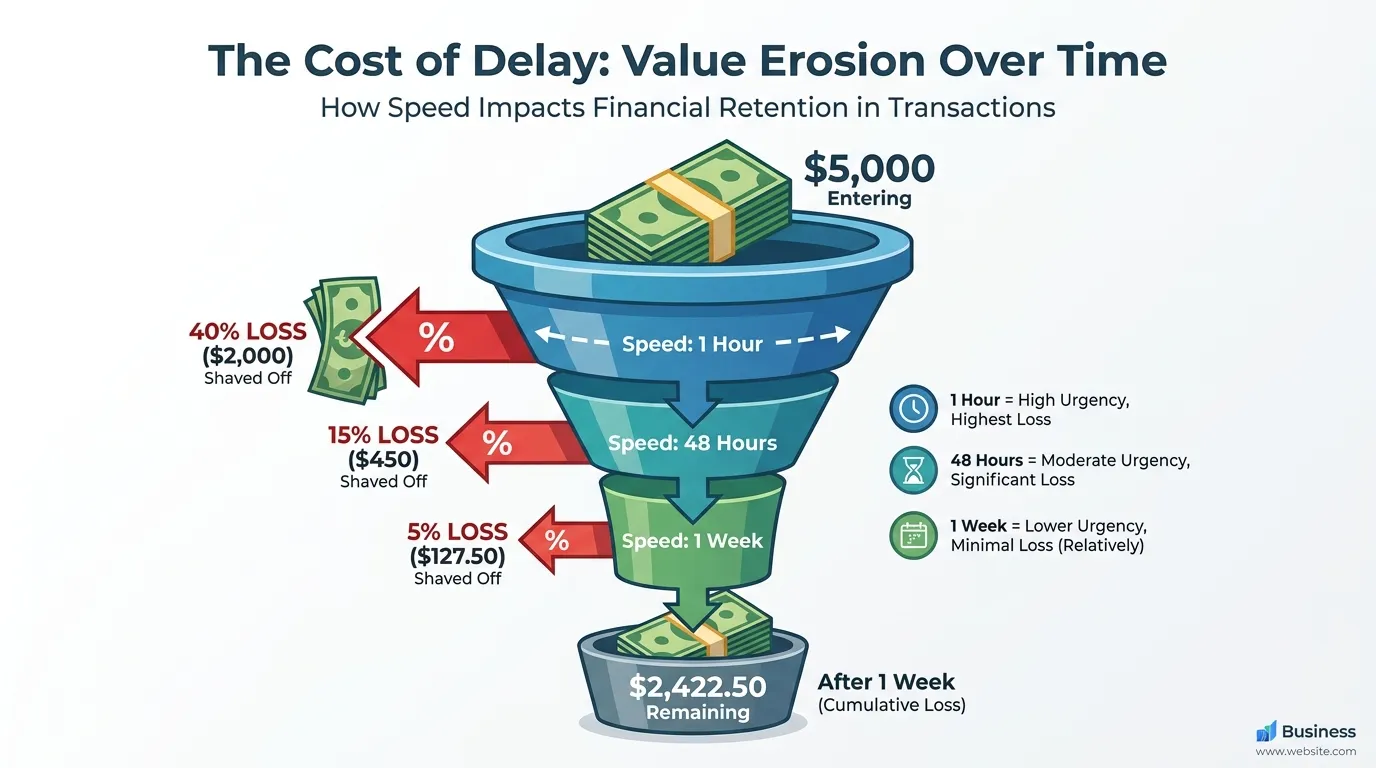
Speed is a commodity with a volatile price tag. In an emergency, market participants often confuse liquidity with solvency; however, for the $5,000 seeker, the true metric is the Effective APR of Urgency. Every hour saved in "Time-to-Cash" typically correlates with a 50–200 basis point increase in the cost of capital or a permanent impairment of long-term compounding.
When you require $5,000 within 24 hours, you are a "price-taker" in a predatory market. To minimize friction, you must choose between Interest (Debt) and Opportunity Cost (Asset Liquidation).
The Cost of Speed Matrix (2026 Projections)
| Method | Time-to-Cash | Total Cost (1-Year) | Prob. of Success |
|---|---|---|---|
| Credit Card Cash Advance | < 1 Hour | $1,450+ (29% APR + Fees) | 95% |
| 401(k) Hardship Withdrawal | 5-7 Days | $1,750+ (Tax + 10% Penalty) | 80% |
| Personal Loan (FinTech) | 24-48 Hours | $600 - $900 (12-18% APR) | 65% |
| Distressed Asset Sale | 4-12 Hours | $2,000+ (30-40% Market Haircut) | 90% |
(Source: Federal Reserve Consumer Credit Data & Vanguard Retirement Estimates, 2024-2025)
So What? If your credit score is >720, a FinTech personal loan is 50% cheaper than a credit card advance, even if it takes 24 hours longer. If you have no credit, asset liquidation is permanent, but it prevents the "debt spiral" of 400% APR payday alternatives.
{
  "type": "bar",
  "title": "The Price of Instant Liquidity ($5,000 Principal)",
  "index": "Method",
  "categories": ["Annualized Cost ($)"],
  "data": [
    {"Method": "HELOC (Existing)", "Annualized Cost ($)": 425},
    {"Method": "Personal Loan", "Annualized Cost ($)": 750},
    {"Method": "Credit Card Advance", "Annualized Cost ($)": 1550},
    {"Method": "401k Withdrawal", "Annualized Cost ($)": 1800},
    {"Method": "Payday/Title Loan", "Annualized Cost ($)": 19500}
  ],
  "source": "Source: Consumer Financial Protection Bureau (CFPB) & Bloomberg Finance (2025)",
  "note": "401k cost includes 22% marginal tax + 10% penalty + 7% lost growth."
}
Selling stocks to raise $5,000 during a market dip creates a "Double Loss": the immediate tax hit and the forfeiture of the recovery. According to J.P. Morgan Asset Management, missing the 10 best days in the market over 20 years can halve your total returns.
If the $5,000 is for a "solvable" emergency (e.g., medical or repair), arbitrage the time. Use a 0% APR introductory credit card if your "Time-to-Repay" is under 12 months. This shifts the cost from you to the lender, provided you don't breach the promotional window.
 AI Generated Infographic
For those tracking institutional moves to see where "Smart Money" hides its emergency reserves, analyzing fund flows can reveal which assets remain liquid during volatility. Smart Money Tracker for Institutional Portfolios
FAQ
How can I get $5,000 in 24 hours?
The fastest way to secure $5,000 within 24 hours is through asset liquidation, such as selling a late-model vehicle via an Instant Cash Offer or liquidating 'hard luxury' items like Rolex watches to professional dealers.
Is a 401(k) loan a good way to get $5,000 fast?
Yes, a 401(k) loan is an efficient internal mechanism that allows you to borrow up to 50% of your vested balance without credit checks, with interest paid back to your own account, though it takes 3-7 days.
What are the risks of predatory lending when seeking $5,000?
Predatory lenders often hide effective APRs exceeding 36% through high origination fees and recurring service charges. Always demand a Truth in Lending Act (TILA) disclosure before signing.
How can I earn $5,000 fast through professional services?
Focus on high-impact consulting or fractional 'sprints.' By identifying and solving 'bleeding neck' problems for mid-sized enterprises, you can command project fees between $2,500 and $6,000 with upfront deposits.
What is the most cost-effective way to borrow $5,000?
For those with a FICO score above 740, a 0% APR introductory credit card is the most cost-effective method, provided the balance is repaid within the 12-21 month promotional window.