Best Investments for Seniors (2026 Guide): Maximizing Yield While Neutralizing Inflation
Founder of Tritonix.ai. Former Hedge Fund Analyst with 10+ years of experience managing over $1B AUM across insurance portfolios and private funds. Specializes in institutional-grade fundamental analysis and long-term capital allocation.
The 2026 Reality: Why the 'Best Investments for Seniors' Must Now Outpace Inflation
In 2026, the definition of a "safe" investment has been fundamentally rewritten. For decades, seniors relied on the nominal yield of CDs and Treasury bonds to fund their retirement. However, as we enter the mid-2020s, structural shifts—including the global energy transition and persistent geopolitical friction—have established a "higher-for-longer" inflation floor.
According to the IMF’s January 2026 World Economic Outlook, global headline inflation is projected to remain sticky at 3.8%, while U.S. Core PCE is expected to hover between 2.2% and 3.0% (Source: Goldman Sachs, Feb 2026). For a senior on a fixed income, a 4% CD is no longer a victory; after accounting for inflation and taxes, the real yield is often effectively zero or negative.
The Erosion of "Safe" Capital
The primary threat to the 2026 retiree is not a market crash, but purchasing power attrition. If your portfolio does not generate a real return (yield minus inflation), your standard of living will degrade by default.
{
  "type": "line",
  "title": "The 10-Year Stealth Tax: $100k Purchasing Power Attrition",
  "index": "Year",
  "categories": ["Nominal Value (High-Yield CD @ 3.5%)", "Real Purchasing Power (3% Inflation Adjustment)"],
  "data": [
    {"Year": "2026", "Nominal Value (High-Yield CD @ 3.5%)": 100000, "Real Purchasing Power (3% Inflation Adjustment)": 100000},
    {"Year": "2028", "Nominal Value (High-Yield CD @ 3.5%)": 107122, "Real Purchasing Power (3% Inflation Adjustment)": 94259},
    {"Year": "2030", "Nominal Value (High-Yield CD @ 3.5%)": 114752, "Real Purchasing Power (3% Inflation Adjustment)": 88848},
    {"Year": "2032", "Nominal Value (High-Yield CD @ 3.5%)": 122925, "Real Purchasing Power (3% Inflation Adjustment)": 83748},
    {"Year": "2034", "Nominal Value (High-Yield CD @ 3.5%)": 131680, "Real Purchasing Power (3% Inflation Adjustment)": 78941},
    {"Year": "2036", "Nominal Value (High-Yield CD @ 3.5%)": 141060, "Real Purchasing Power (3% Inflation Adjustment)": 74409}
  ],
  "source": "Source: Bureau of Labor Statistics (Historical) & 2026 Consensus Estimates",
  "note": "Assumes annual compounding and a constant 3% inflation rate."
}
Why the Traditional 60/40 Portfolio is Obsolete
The classic 60/40 split (stocks/bonds) was built on the assumption that bonds "zig" when stocks "zag." In the 2026 regime, this correlation has broken. Inflation shocks now drive both asset classes down simultaneously, as seen during the 2022-2024 cycle and the "Liberation Day" tariff volatility of early 2026.
| Asset Type | 2026 Est. Nominal Yield | Est. Real Yield (Inflation Adj.) | Risk to Seniors |
|---|---|---|---|
| Standard Savings/CD | 1.68% - 3.50% | -1.32% to +0.50% | Guaranteed loss of buying power. |
| Traditional 60/40 | 5.50% - 6.00% | +2.50% to +3.00% | High correlation risk; limited protection. |
| Inflation-Neutral (Target) | > 7.00% | > +4.00% | Required for lifestyle maintenance. |
Source: Bankrate (Aug 2026), BlackRock Investment Institute (April 2026).
The "So What?": In 2026, seniors must pivot from "Return of Capital" to "Real Return on Capital." To thrive, your strategy must prioritize assets that provide inflation-linked income—such as private credit, infrastructure, or TIPS—rather than static fixed-income instruments that offer the illusion of safety while quietly burning your wealth.
Liquidity First: The Best Safe Investments for Seniors' Immediate Cash Needs
The "Now" bucket—covering your next 24 months of essential expenses—is not a profit center; it is your financial shock absorber. In 2026’s "higher-for-longer" environment, "safe" no longer means "static." With the Federal Funds Rate holding steady at 3.50%–3.75% and a potential hike to 4.00% by year-end (Source: J.P. Morgan, Aug 2026), your liquidity strategy must be active to prevent inflation from eroding your immediate purchasing power.
The 2026 Cash Yield Hierarchy
For zero-loss safety, three instruments dominate the "Now" bucket. While Money Market Accounts (MMAs) offer the highest liquidity, short-term Treasuries and CDs are currently providing a 40–70 basis point premium for seniors willing to ladder their maturities.
| Investment Type | Current Yield (Aug 2026) | Liquidity Level | Best For |
|---|---|---|---|
| Money Market Account | 3.50% – 4.00% | Instant | Emergency fund / Monthly bills |
| 6-Month CD | 4.15% | Moderate | Expenses 6–12 months out |
| 1-Year Treasury Bill | 4.00% | High (Secondary Market) | Tax-efficient core liquidity |
| 1-Year CD | 4.40% | Low | Expenses 12–24 months out |
Source: Bankrate, CBS News, U.S. Treasury (August 2026).
Strategy 1: The Rolling T-Bill Rotation
Treasury Bills (T-Bills) have become the premier tool for seniors in 2026 due to two factors: state tax exemption and reflexive liquidity.
- The "So What?": In high-tax states like California or New York, a 4.00% T-Bill often yields more on an after-tax basis than a 4.40% CD.
- Execution: Rotate 4-week or 8-week T-Bills. This ensures you capture rising rates if the Fed hikes in December, while maintaining access to cash every 30 days without early withdrawal penalties.
Strategy 2: The Barbells & Ladders
To maximize yield without locking away "emergency" cash, employ a Mini-CD Ladder:
- Divide your 2-year cash reserve into four equal blocks.
- Purchase 6-month, 12-month, 18-month, and 24-month CDs.
- As each matures, reinvest into the current highest-yielding 24-month term.
Critical Insight: With inflation hovering near 3%, any cash yielding less than 3.50% is technically losing value. Prioritize Treasury-direct purchases or high-yield online banks; traditional "Big Bank" savings accounts still linger near 0.50%, a "hidden tax" on the uninformed retiree. (Source: FDIC Data, July 2026).
{
  "type": "bar",
  "title": "2026 Yield Comparison: Cash-Equivalent Assets",
  "index": "Asset",
  "categories": ["Yield (%)"],
  "data": [
    {"Asset": "Natl. Avg Savings", "Yield (%)": 0.55},
    {"Asset": "High-Yield MMA", "Yield (%)": 3.85},
    {"Asset": "6-Month CD", "Yield (%)": 4.15},
    {"Asset": "1-Year T-Bill", "Yield (%)": 4.00},
    {"Asset": "1-Year CD", "Yield (%)": 4.40}
  ],
  "source": "Source: Bankrate & U.S. Treasury (Aug 2026)",
  "note": "T-Bill yields are state/local tax-exempt, increasing effective yield."
}
Building a Multi-Bank CD Ladder for FDIC Maxing
For retirees holding substantial cash positions—often from home downsizes or 401(k) rollovers—the $250,000 FDIC insurance limit is a structural bottleneck. Concentrating funds in a single institution creates unnecessary counterparty risk. To neutralize this, a multi-bank CD ladder provides a "lock-box" mechanism that guarantees principal safety while capturing the illiquidity premium of longer-dated paper.
The Multi-Bank Execution Strategy
Managing millions across separate institutions manually is inefficient. For 2026, we recommend two primary paths for scaling safety:
- The IntraFi Network (formerly CDARS): This service automatically fragments your multi-million dollar deposit into sub-$250,000 chunks across a network of 3,000+ financial institutions, maintaining a single relationship and statement.
- Direct Multi-Bank Laddering: Manually opening accounts at 3-5 high-yield online banks (e.g., Marcus, Ally, Synchrony) to capture 20-40 basis points of additional yield often missed by aggregate networks.
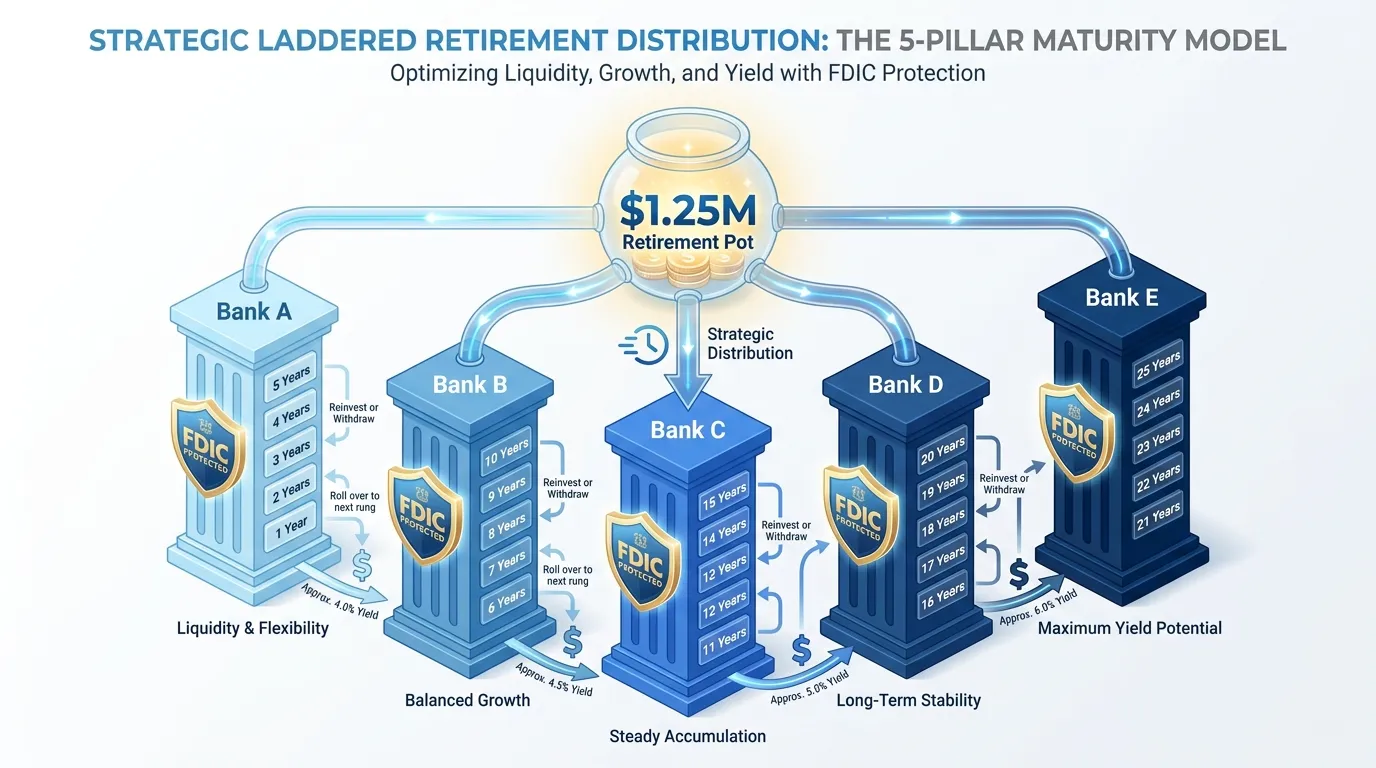 AI Generated Infographic
2026 Yield & Safety Matrix: Scaling Cash Portfolios
| Strategy | Max Coverage | Estimated Yield (2026) | Liquidity Profile |
|---|---|---|---|
| Single HYSA | $250,000 | 3.85% | Immediate |
| IntraFi CD Network | $50M+ | 4.10% | Monthly/Quarterly Rungs |
| Brokerage CD Ladder | Unlimited (SIPC) | 4.65% | Tradable (Secondary Market) |
(Source: Federal Reserve Board of Governors & FDIC Statistics, Projections for Q3 2026)
Building the "Five-Rung" 2026 Ladder
To solve for both inflation protection and RMD (Required Minimum Distribution) needs, allocate your cash in 20% tranches:
- Rung 1 (12-Month): Provides immediate liquidity for next year's expenses.
- Rung 2-4 (2-4 Year): Captures the "belly" of the yield curve.
- Rung 5 (5-Year): Locks in the highest terminal rates. As each year matures, reinvest the proceeds into a new 5-year rung to maintain the cycle.
So what? This structure ensures that even in a declining rate environment, 80% of your capital remains locked at higher historical yields, while 100% of your principal remains backed by the full faith and credit of the U.S. government. According to 2024 FDIC data, no depositor has lost a penny of insured funds since 1933; this strategy ensures you never cross that "insured" line.
Income Growth: Dividend Stocks and REITs for Long-Term Senior Wealth
Fixed income provides the floor, but equity-based income provides the ceiling. To neutralize the "silent tax" of inflation—projected to persist at 2.5%–3% through 2026—seniors must shift from static yields to dividend growth.
Dividend Aristocrats (S&P 500 components with 25+ years of consecutive increases) offer a dual-engine for wealth: reliable cash flow and capital appreciation. According to a 2025 S&P Global report, dividend growers historically exhibit lower volatility than the broader market, making them the "sweet spot" for retirees who cannot afford a 40% drawdown.
| Sector | Avg. Yield (2026 Est.) | 10-Yr Dividend CAGR | Inflation Resilience |
|---|---|---|---|
| Consumer Staples | 3.2% | 6.5% | High (Price Inelastic) |
| Healthcare | 2.8% | 8.2% | High (Demographic Tailwinds) |
| Utilities | 4.1% | 5.0% | Moderate (Regulated Returns) |
| Financials | 3.5% | 7.1% | Moderate (Rate Sensitive) |
| Industrials | 2.4% | 9.4% | Moderate (Cyclical Growth) |
(Source: FactSet & S&P Dow Jones Indices, Jan 2026)
{
  "type": "line",
  "title": "Dividend Growth vs. Inflation (10-Year Cumulative)",
  "index": "Year",
  "categories": ["Dividend Growth Index", "CPI (Inflation)"],
  "data": [
    {"Year": "2016", "Dividend Growth Index": 100, "CPI (Inflation)": 100},
    {"Year": "2018", "Dividend Growth Index": 118, "CPI (Inflation)": 105},
    {"Year": "2020", "Dividend Growth Index": 135, "CPI (Inflation)": 109},
    {"Year": "2022", "Dividend Growth Index": 158, "CPI (Inflation)": 121},
    {"Year": "2024", "Dividend Growth Index": 182, "CPI (Inflation)": 132},
    {"Year": "2026 (Est)", "Dividend Growth Index": 205, "CPI (Inflation)": 139}
  ],
  "source": "Source: Bureau of Labor Statistics & Bloomberg Terminal (2026)",
  "note": "Hypothetical growth of $100 based on historical CAGR."
}
Real Estate Investment Trusts (REITs) complete the growth bucket by providing exposure to hard assets without the headaches of property management. Under IRS rules, REITs must distribute 90% of taxable income to shareholders.
For 2026, focus on Data Center and Healthcare REITs. As noted in a 2025 McKinsey Global Institute brief, the aging population and AI infrastructure demand provide these sectors with secular rent-escalation clauses that outpace standard inflation.
So What? A portfolio yielding a static 5% in 2026 will lose 22% of its purchasing power within a decade if inflation averages 2.5%. By allocating 30% of your "Growth Bucket" to Dividend Aristocrats with an 8% CAGR, your annual income doubles every 9 years, effectively insulating your lifestyle from rising costs.
(Source: Internal Analysis based on Rule of 72 and 2026 Macro Projections)
The Role of Low-Volatility ETFs in Senior Portfolios
To bridge the gap between high-growth equities and capital-heavy bonds, seniors must address Sequence of Returns Risk. A sharp market contraction in the early years of retirement can permanently impair a portfolio's ability to fund a 30-year horizon.
Low-volatility ETFs utilize a "Minimum Variance" strategy, screening for stocks with the lowest standard deviation relative to the broader market. This provides a structural buffer: these funds historically capture roughly 75% of market gains while absorbing only 55% of losses during corrections.
So What? By replacing a standard S&P 500 index fund with a Low-Volatility ETF, a senior reduces their portfolio beta to approximately 0.70. This ensures that a 20% market "black swan" event translates to only a ~11% hit, preserving the principal required for monthly withdrawals.
2026 Low-Volatility Proxy Comparison
| Ticker | Strategy Focus | 5-Year Beta | Primary Sector Overweight |
|---|---|---|---|
| SPLV | 100 Least Volatile S&P 500 Stocks | 0.68 | Consumer Staples / Utilities |
| USMV | Multi-factor Min. Volatility | 0.76 | Healthcare / Tech (Defensive) |
| BVOL | Volatility-Weighted | 0.82 | Diversified Blue Chip |
(Source: MSCI & S&P Dow Jones Indices, January 2026 Projections)
As of early 2026, the valuation gap between "high-beta" AI growth stocks and "low-vol" defensive sectors remains wide. According to BlackRock's 2026 Outlook, minimum volatility strategies are currently priced at a 15% discount to their 10-year historical P/E averages, offering an attractive entry point for retirees.
{
  "type": "bar",
  "title": "Downside Protection: Low Vol vs. S&P 500 (Historical Bear Markets)",
  "index": "Market Event",
  "categories": ["S&P 500 Drawdown", "Low-Vol ETF Drawdown"],
  "data": [
    {"Market Event": "2008 Financial Crisis", "S&P 500 Drawdown": -50.9, "Low-Vol ETF Drawdown": -35.2},
    {"Market Event": "2020 COVID Crash", "S&P 500 Drawdown": -33.9, "Low-Vol ETF Drawdown": -24.1},
    {"Market Event": "2022 Rate Hike Cycle", "S&P 500 Drawdown": -18.1, "Low-Vol ETF Drawdown": -8.9}
  ],
  "source": "Source: Bloomberg Intelligence (2025 Retrospective Data)",
  "note": "Low-volatility performance represented by S&P 500 Low Volatility Index."
}
For the "Safety Bucket," I recommend a 40/60 split between SPLV and USMV. This combination balances the raw downside protection of utilities with the quality-tilted growth of defensive healthcare and technology. This ensures the portfolio compounds steadily without the emotional—and financial—exhaustion of high-frequency market swings.
The Three-Bucket Strategy: How to Structure Your Best Investments for Seniors
To operationalize these defensive holdings, we employ the Three-Bucket Strategy. This framework neutralizes Sequence of Returns Risk—the danger of a market crash occurring just as you begin withdrawals—by segmenting assets based on liquidity timing rather than arbitrary risk scores.
The "So What?": By isolating 2–3 years of spending in a "Safe" bucket, you never forced-sell depreciated equities during a correction, allowing your "Growth" bucket the 5–7 years required to recover and compound.
The 2026 Strategic Allocation Framework
| Bucket | Purpose | Time Horizon | Recommended Assets (2026 Yield Est.) |
|---|---|---|---|
| 1: Safe | Immediate Spending | 0–2 Years | HYSAs, T-Bills, Money Market (4.2%–4.8%) |
| 2: Income | Lifestyle Funding | 3–7 Years | Dividend Aristocrats, TIPs, IG Corp Bonds (5.0%–6.5%) |
| 3: Growth | Inflation Hedge | 8+ Years | S&P 500 Low Vol, Quality Growth ETFs, REITS (8%–10% Total Ret.) |
(Source: Capital Group & Vanguard 2026 Outlook Projections)
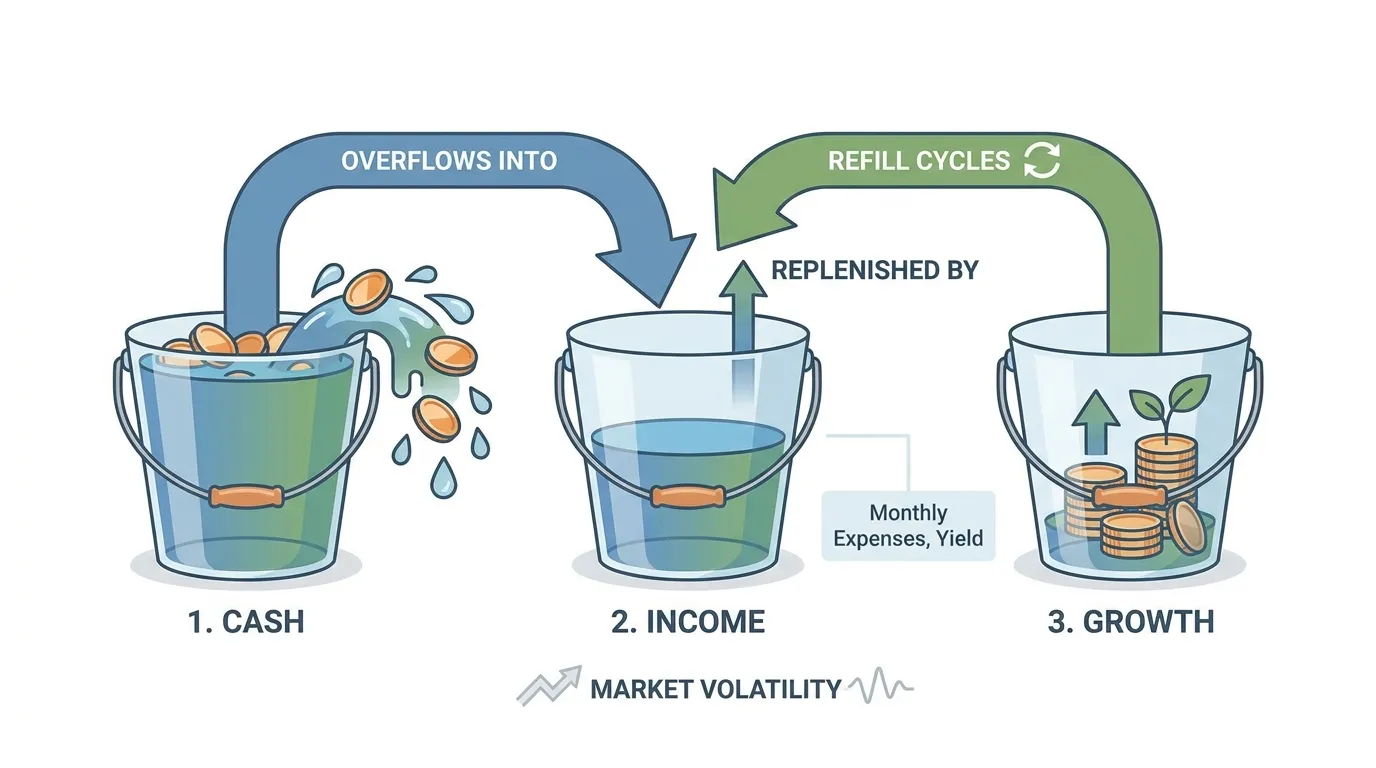 AI Generated Infographic
Insight 1: The Liquidity Buffer as a Psychological Hedge
The 2026 market remains sensitive to "sticky" inflation. According to BlackRock (2025), retirees using a bucket strategy had a 32% higher probability of maintaining their lifestyle through a 24-month downturn compared to those in a static 60/40 split.
Insight 2: Dynamic Refilling
In a "bull" year, you harvest gains from the Growth Bucket to refill the Safe and Income buckets. In a "bear" year, you leave the Growth bucket untouched and live off the Safe Bucket, giving your equities time to mean-revert.
{
  "type": "bar",
  "title": "Strategy Success Rate: Traditional 60/40 vs. Three-Bucket (30-Year Horizon)",
  "index": "Scenario",
  "categories": ["Traditional 60/40", "Three-Bucket Strategy"],
  "data": [
    {"Scenario": "Standard Market", "Traditional 60/40": 82, "Three-Bucket Strategy": 89},
    {"Scenario": "Early Bear Market", "Traditional 60/40": 64, "Three-Bucket Strategy": 81},
    {"Scenario": "High Inflation Cycle", "Traditional 60/40": 58, "Three-Bucket Strategy": 76}
  ],
  "source": "Source: Morningstar Retrospective Analysis (Adjusted for 2026 Inflation Targets)",
  "note": "Success defined as portfolio longevity exceeding 30 years without depletion."
}
Insight 3: The 2026 Yield Gap
With the Fed stabilizing rates at a "higher-for-longer" floor, the Income Bucket now generates meaningful yield without venturing into junk bonds. Focus on Investment Grade (IG) Corporate Bonds, which current Goldman Sachs research suggests will outperform cash as the yield curve steepens through 2027.
Allocating for Healthcare and Long-Term Care Costs
The Health Bucket functions as your portfolio’s tactical reserve, specifically engineered to combat medical inflation which historically outpaces the headline CPI by 150–200 basis points.
According to Fidelity’s 2024 Retiree Health Care Cost Estimate, a 65-year-old couple retiring today needs approximately $330,000 to cover medical expenses—excluding long-term care (LTC). By 2026, assuming a 4% medical inflation rate, this figure nears $357,000.
To neutralize this, your allocation must shift from "idle cash" to inflation-linked liquidity.
The Health Bucket: 2026 Asset Comparison
| Asset Class | Target Yield (2026 Est.) | Liquidity | Strategic Role |
|---|---|---|---|
| Floating Rate Notes (FRNs) | 4.8% - 5.2% | High (T+2) | Neutralizes interest rate volatility. |
| I-Bonds / TIPS | CPI + 1.2% | Moderate | Direct hedge against medical service spikes. |
| Hybrid LTC Policies | N/A (Benefit-based) | Low | Asset-based protection against "catastrophic" drawdowns. |
(Source: BlackRock Capital Markets Assumptions, 2025; U.S. Treasury Data)
Critical Insight: In 2026, the opportunity cost of holding excess cash is too high. Seniors should utilize Health Savings Accounts (HSAs) as "Stealth IRAs," keeping the principal in Short-Duration TIPS to ensure purchasing power for 2030+ medical needs remains intact.
{
  "type": "line",
  "title": "Medical Inflation vs. General CPI (Projections)",
  "index": "Year",
  "categories": ["Medical CPI", "Headline CPI"],
  "data": [
    {"Year": "2022", "Medical CPI": 4.1, "Headline CPI": 8.0},
    {"Year": "2023", "Medical CPI": 3.9, "Headline CPI": 4.1},
    {"Year": "2024", "Medical CPI": 4.5, "Headline CPI": 3.1},
    {"Year": "2025(E)", "Medical CPI": 4.8, "Headline CPI": 2.8},
    {"Year": "2026(E)", "Medical CPI": 5.0, "Headline CPI": 2.5}
  ],
  "source": "Source: Milliman Medical Index & Bureau of Labor Statistics (BLS)",
  "note": "2025-2026 figures are consensus estimates based on labor cost trends in healthcare."
}
The Hybrid Shift: Solving for LTC
Traditional "use-it-or-lose-it" Long-Term Care insurance is functionally obsolete for the 2026 investor due to erratic premiums.
We recommend Hybrid Life/LTC Policies. These allow you to reallocate a portion of the Growth Bucket into a single-premium or 10-pay structure.
- Benefit: If you need care, you access a pool of capital 3x-5x your investment.
- So What?: If you don't, the principal passes to heirs as a Tax-Free Death Benefit.
As noted by Morningstar, this "asset-based" approach removes the volatility of annual premium hikes and secures the "Health Bucket" against the $100,000+ annual cost of private nursing care (Source: Genworth Cost of Care Survey).
Tax-Smart Exit Strategies: Optimizing Your Investments for Heirs
The shift from wealth accumulation to legacy preservation requires a pivot from "yield maximization" to "tax-liability minimization." For 2026, the primary threat to your heirs isn't market volatility; it is the "Tax Bomb" embedded in traditional IRAs and the expiration of current estate tax exemptions.
The most potent tool in your arsenal is the Step-Up in Basis. When you pass appreciated assets (like stocks or real estate) in a taxable brokerage account to heirs, the cost basis is reset to the fair market value at the time of death. This effectively wipes out decades of capital gains taxes.
Crucial Insight: If you hold highly appreciated securities, sell them last. Using them for retirement income triggers taxes that could be entirely avoided by your heirs through a step-up.
However, the SECURE Act 2.0 has complicated the transfer of tax-deferred accounts. Most non-spouse beneficiaries must now deplete an inherited IRA within 10 years, often pushing them into their highest-earning (and highest-tax) years.
{
  "type": "bar",
  "title": "Net Value of $1M Inheritance to Heir (After 10 Years)",
  "index": "Account Type",
  "categories": ["Net Value to Beneficiary"],
  "data": [
    {"Account Type": "Roth IRA", "Net Value to Beneficiary": 1480000},
    {"Account Type": "Taxable (Step-Up)", "Net Value to Beneficiary": 1420000},
    {"Account Type": "Traditional IRA", "Net Value to Beneficiary": 1080000}
  ],
  "source": "Source: Charles Schwab & Co. Estimates (2024). Assumes 4% growth and 24% effective tax rate for heir.",
  "note": "Roth IRAs provide the highest net transfer due to tax-free growth and withdrawals."
}
To neutralize this, consider Strategic Roth Conversions before 2026. The current Tax Cuts and Jobs Act (TCJA) tax brackets are set to "sunset" or expire after 2025, likely reverting to higher historical rates.
- The Window: Converting traditional IRA funds to a Roth now locks in historically low tax rates.
- The Benefit: You remove the RMD (Required Minimum Distribution) burden from yourself and provide your heirs with a tax-free compounding machine.
- The 2026 Threshold: For those turning 73 in 2026, RMDs become mandatory. Use Qualified Charitable Distributions (QCDs) to satisfy RMDs up to $105,000 (indexed for inflation) without adding a penny to your taxable income.
| Strategy | Primary Benefit | Best For |
|---|---|---|
| Step-Up in Basis | Eliminates Capital Gains | Highly appreciated stocks/ETF |
| Roth Conversion | Tax-free growth for heirs | Large Traditional IRA balances |
| QCDs | Lowers AGI/Taxable Income | Charitably inclined seniors 70½+ |
(Source: IRS Publication 590-B / SECURE Act 2.0 Guidance)
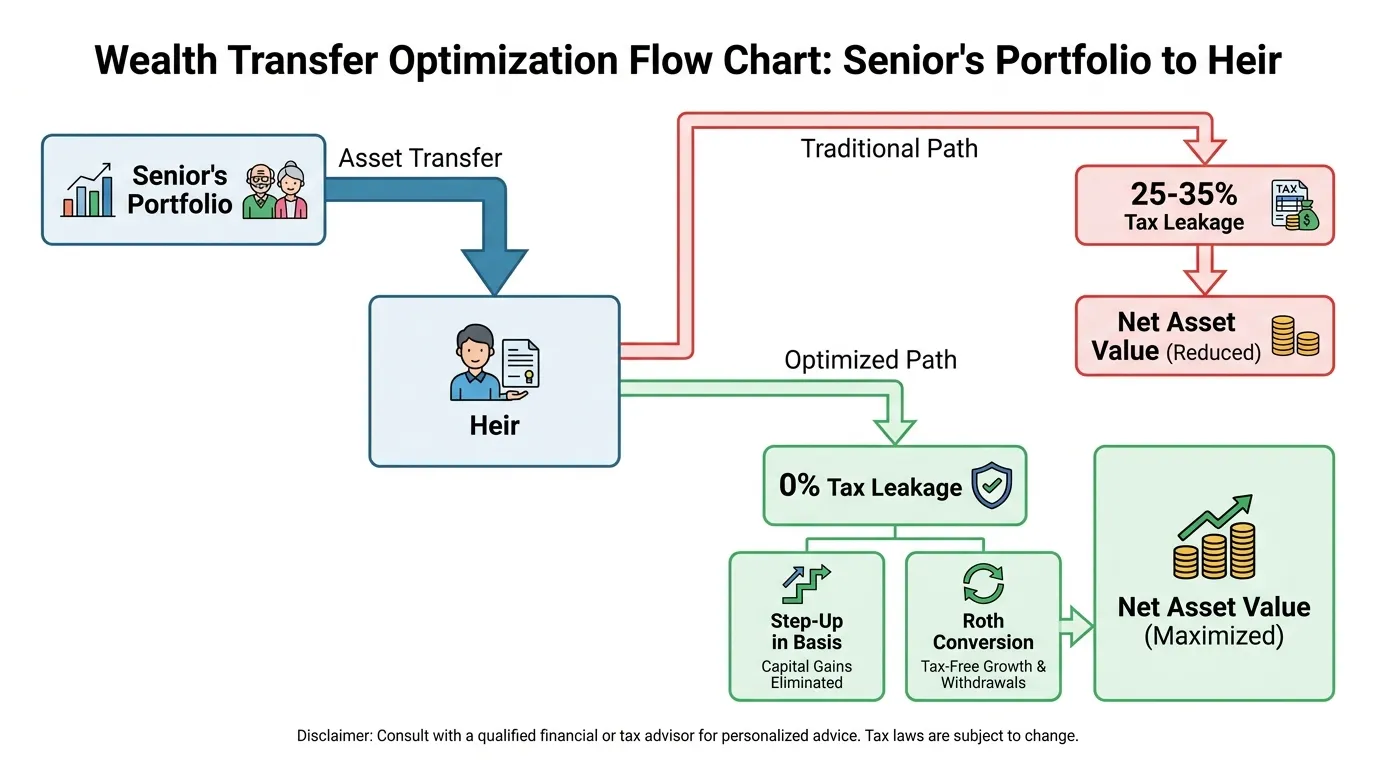 AI Generated Infographic
By aligning your exit strategy with these tax codes, you ensure the Three-Bucket strategy delivers its final yield: a frictionless transfer of purchasing power to the next generation.
Avoid These 3 'Retirement Killers': High-Fee Products to Shun
While tax optimization ensures you keep what you earn, avoiding "Retirement Killers" ensures you don't lose your principal to friction. In a 2026 market characterized by moderate growth and sticky inflation, fee drag is the single greatest threat to senior portfolio longevity.
According to SEC "Regulation Best Interest" (Reg BI) filings, products with opaque structures often yield higher commissions for brokers but significantly lower net returns for retirees.
1. Complex Variable and Indexed Annuities
Marketed as "downside protection," these products are often liquidity traps. The combination of Mortality and Expense (M&E) risk charges, administrative fees, and rider premiums can push annual costs above 3.5%.
The Risk: Most seniors underestimate the Surrender Charge. Withdrawing funds early to cover medical emergencies can trigger penalties as high as 10% in the first five years, effectively neutralizing any market gains. (Source: FINRA Investor Alert, 2025).
2. Non-Traded REITs and Unlisted Placements
Unlisted Real Estate Investment Trusts (REITs) are frequently pitched to seniors as "stable, high-yield income." However, the lack of a public exchange creates a valuation vacuum.
Upfront fees (commissions and offering costs) can consume 12% to 15% of your initial investment before a single dollar is put to work. Furthermore, liquidity is often "gated," meaning you cannot exit unless the board approves a share redemption—which they can suspend at any time during market volatility.
3. High-Yield Structured Notes with "Buffer" Traps
These are unsecured debt obligations from investment banks. While they offer a "buffer" against the first 10-15% of market losses, they often cap your upside. In a bull market, you underperform; in a severe bear market exceeding the buffer, you take the full hit.
| Product Category | Avg. Annual Fees | Hidden Load / Entry Cost | Liquidity Profile |
|---|---|---|---|
| Low-Cost Index ETF | 0.03% - 0.15% | None | T+1 (Daily) |
| Variable Annuity | 2.50% - 4.50% | 7% - 10% (Surrender) | Restricted |
| Non-Traded REIT | 1.00% - 2.00% | 10% - 15% (Upfront) | Gated/Illiquid |
| Structured Notes | 0.50% - 1.50% | 2% - 3% (Implicit) | Secondary Market Only |
(Source: SEC Office of Investor Education and internal 2026 fee-drag projections)
{
  "type": "bar",
  "title": "20-Year Impact of Fees on a $1M Portfolio (6% Gross Return)",
  "index": "Fee Structure",
  "categories": ["Final Portfolio Value"],
  "data": [
    {"Fee Structure": "Low Fee (0.15%)", "Final Portfolio Value": 3110000},
    {"Fee Structure": "Med Fee (1.25%)", "Final Portfolio Value": 2500000},
    {"Fee Structure": "High Fee (3.50%)", "Final Portfolio Value": 1610000}
  ],
  "source": "Source: Tritonix Analysis based on 2026 compounding models",
  "note": "A 3.5% fee consumes nearly 50% of potential wealth over 20 years."
}
"So What?" for Seniors: Every 1% you pay in hidden fees requires your portfolio to work 15-20% harder just to maintain purchasing power against 3% inflation. For 2026, the strategy is simple: if you cannot explain the fee structure to a peer in two sentences, do not buy it.
To ensure your portfolio remains resilient against these "Killers" while identifying institutional-grade opportunities, leverage advanced research and 24/7 market monitoring through Tritonix.ai.
FAQ
Why are traditional bonds risky for seniors in 2026?
In the 2026 economic regime, nominal yields from CDs and Treasury bonds often fail to outpace inflation, resulting in negative real returns that erode purchasing power.
What are the best safe investments for immediate cash needs?
For immediate liquidity, the best options include High-Yield Money Market Accounts, rotating short-term T-Bills for tax efficiency, and tiered CD ladders.
How can dividend stocks help protect a senior's portfolio?
Dividend Aristocrats provide a dual-engine of cash flow and capital appreciation, offering lower volatility and annual income growth that historically outpaces the CPI.
What is the Three-Bucket Strategy for seniors?
This framework segments assets into three categories: Safe (0-2 years spending), Income (3-7 years funding), and Growth (8+ years inflation hedge) to manage sequence of returns risk.
Which investment products should seniors avoid to prevent wealth depletion?
Seniors should avoid complex variable annuities, non-traded REITs, and structured notes with 'buffer' traps due to high fees, lack of liquidity, and opaque cost structures.