1979 Silver Dollar Value Guide: Is Your Coin a $10,000 Rarity? (2026 Update)
Founder of Tritonix.ai. Former Hedge Fund Analyst with 10+ years of experience managing over $1B AUM across insurance portfolios and private funds. Specializes in institutional-grade fundamental analysis and long-term capital allocation.
Is Your 1979 Dollar Actually Silver? US vs. Canada Identification
The term "1979 Silver Dollar" is a frequent misnomer in the numismatic world. To determine if your coin holds intrinsic bullion value or merely face value, you must first resolve the geographic confusion: The U.S. Susan B. Anthony (SBA) dollar contains zero silver, whereas its Canadian counterpart, the "Griffon," often does.
The Metal Reality Check
Most U.S. collectors are disappointed to learn that the 1979 SBA dollar is a cupro-nickel clad coin. Despite its "silver" appearance, it was designed as a circulation-friendly replacement for the Eisenhower dollar. In contrast, the Royal Canadian Mint issued a commemorative 50% silver dollar in 1979 to celebrate the 300th anniversary of the Le Griffon shipwreck.
Investor Insight: If your 1979 dollar is U.S.-issued, its value is almost certainly $1.00 unless it features a rare "Wide Rim" (Near Date) variety or a high-grade "S" Proof strike. If it is the Canadian Griffon, it has a guaranteed melt value based on its 0.375 troy oz silver content.
Unified Identification Matrix: 1979 Dollars
Use the physical specifications below to identify your coin. A simple digital scale is the most effective tool for distinguishing a base-metal "imposter" from a silver rarity.
| Feature | US Susan B. Anthony | Canada "Griffon" (Silver) | Canada "Griffon" (Nickel) |
|---|---|---|---|
| Metal Composition | 75% Copper, 25% Nickel | 50% Silver, 50% Copper | 100% Nickel |
| Weight | 8.1 grams | 23.33 grams | 15.62 grams |
| Diameter | 26.5 mm | 36.07 mm | 32.13 mm |
| Edge | Reeded (Copper core visible) | Reeded | Reeded |
| Intrinsic Value | $0.00 (Base Metal) | Silver Spot x 0.375 | $0.00 (Base Metal) |
(Source: PCGS, Royal Canadian Mint, August 2026).
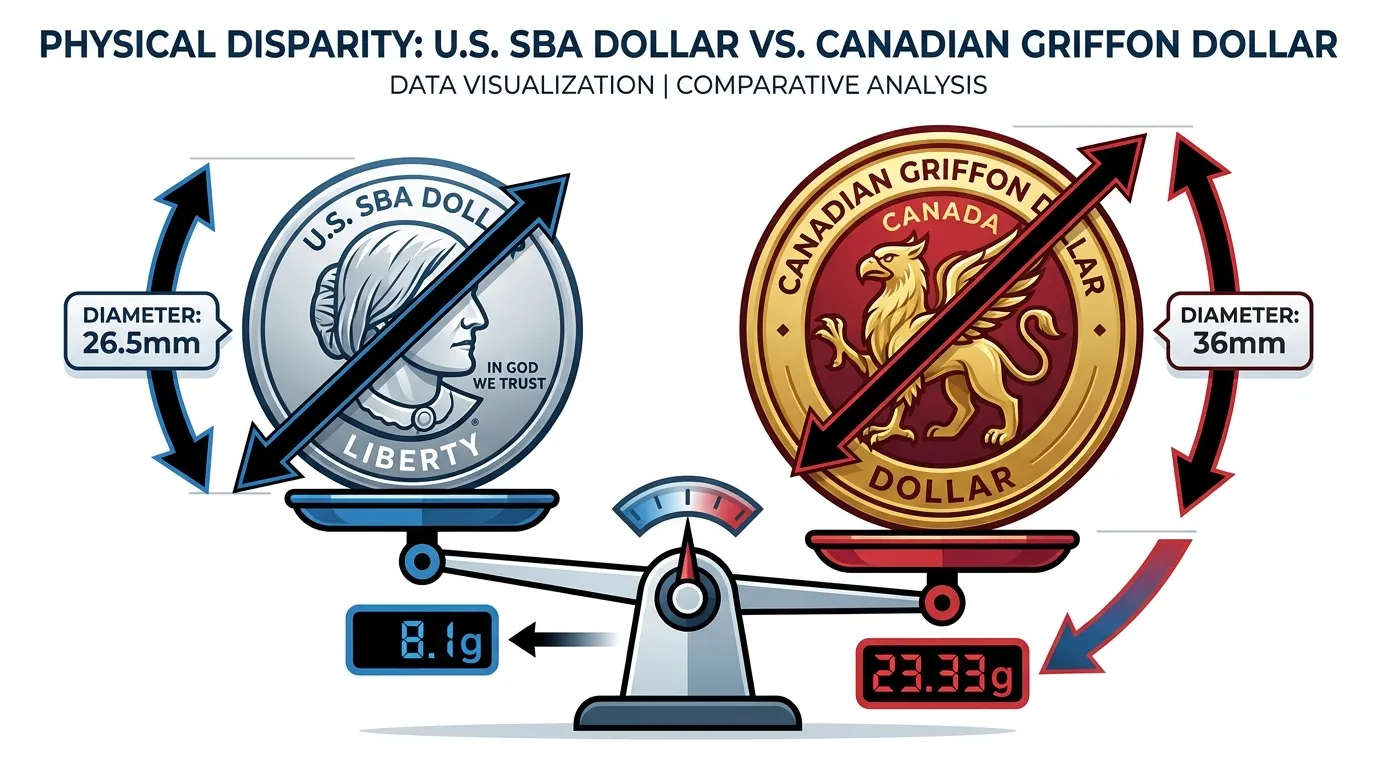 AI Generated Infographic
So What? (The Value Implication)
For the reader, identification dictates your next move:
- If it's a U.S. SBA: Stop looking for silver melt value. Focus instead on the "S" Mint Mark or the "Wide Rim" variety. These are the only 1979 U.S. dollars that command premiums (ranging from $20 to $1,500+ in top grades).
- If it's a Canadian Griffon: You own a piece of bullion. At a silver spot price of $30/oz, the melt value alone is approximately $11.25. Professional "Specimen" or "Proof" finishes can push the collector value to $25–$40. (Source: NGC Price Guide, 2026).
1979 Susan B. Anthony (SBA) Value: 2026 Price Guide
The most critical fact for any 1979 Susan B. Anthony (SBA) holder: it is not silver. Composed of a copper-nickel "sandwich" alloy, these coins were minted by the hundreds of millions (over 750 million in 1979 alone). Consequently, 99% of 1979 SBA dollars are worth exactly $1.
To find a "rarity," you must pivot away from metal content and toward condition rarity and die varieties. In the 2026 market, the "Value Cliff" begins at Grade MS67. Anything below this is considered common bulk.
2026 SBA Price Matrix: P, D, & S Mints
The following data reflects current market premiums for certified (PCGS/NGC) specimens. Raw, ungraded coins typically trade at face value regardless of the mint mark.
| Variety / Grade | MS63 | MS65 | MS66 | MS67+ |
|---|---|---|---|---|
| 1979-P (Narrow Rim) | $4 | $12 | $45 | $1,450+ |
| 1979-P (Wide Rim) | $35 | $65 | $185 | $1,200+ |
| 1979-D | $4 | $15 | $135 | $1,950+ |
| 1979-S (Business) | $4 | $18 | $110 | $4,400+ |
| 1979-S (Proof T2) | $10 | $15 | $35 | $150 (PR70) |
(Source: NGC Price Guide & PCGS CoinFacts, July 2026)
Key Value Drivers for 2026
- The "Wide Rim" (Near Date) Premium: The 1979-P Wide Rim is the only "circulation strike" worth more than $1 in average uncirculated condition. Look at the date: if the "1" is nearly touching the rim, you have a $30–$60 coin.
- The MS67 Exponential Spike: High-grade survivors are rare due to "bag marks" from mass transport. While an MS64 is worth pocket change, an MS67 specimen can command upwards of $1,900 at auction (Source: Heritage Auctions, 2026).
- Proof Type 2 (Clear S): For San Francisco proofs, the "Clear S" mint mark (Type 2) carries a 5x premium over the "Filled S" (Type 1).
{
  "type": "area",
  "title": "The Exponential Value Curve: 1979-D SBA Dollar",
  "index": "grade",
  "categories": ["Market Value (USD)"],
  "data": [
    {"grade": "MS63", "Market Value (USD)": 4},
    {"grade": "MS64", "Market Value (USD)": 8},
    {"grade": "MS65", "Market Value (USD)": 15},
    {"grade": "MS66", "Market Value (USD)": 135},
    {"grade": "MS67", "Market Value (USD)": 1950}
  ],
  "source": "Source: NGC & PCGS Market Reports (Aug 2026)",
  "note": "Values assume professional grading. Circulated coins remain at $1."
}
Expert Insight: Unless your coin is flawlessly preserved with original mint luster and zero visible scratches under 10x magnification, it is almost certainly a $1 spender. Do not pay for professional grading unless you are certain the coin will hit MS66 or higher.
The 1979-P Wide Rim (Near Date) Jackpot
The "Wide Rim"—commonly referred to by numismatists as the "Near Date"—is the only 1979-P Susan B. Anthony dollar that commands a significant liquidity premium. While the Philadelphia Mint struck over 360 million SBA dollars in 1979, the Wide Rim was a late-year design adjustment intended to improve die longevity. Its scarcity relative to the "Narrow Rim" (Far Date) variety creates a massive valuation gap in high grades.
The identification is purely structural. On the common Narrow Rim, the border is thin, leaving a wide gap between the date and the rim. On the Wide Rim rarity, the border is thickened to approximately 2.0mm, forcing the "1979" date to sit almost flush against the edge.
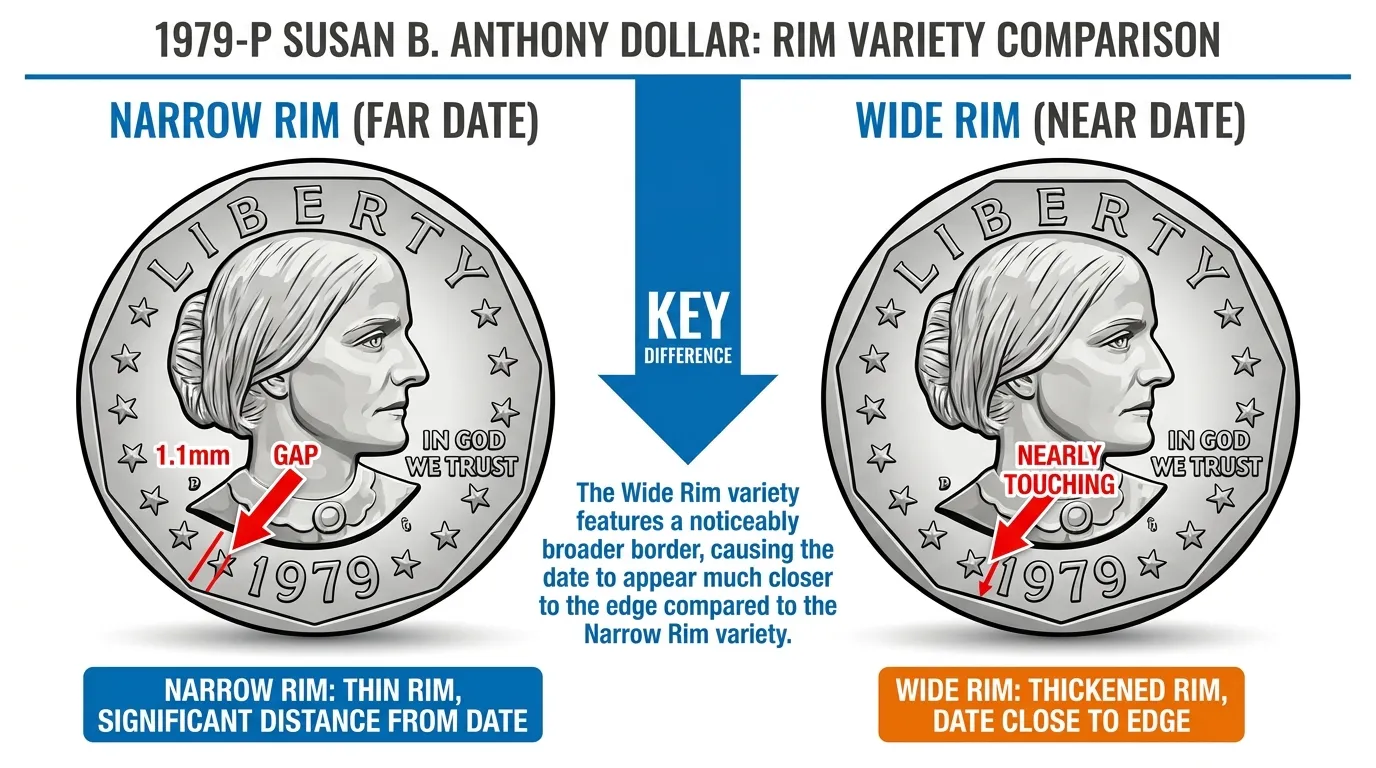 AI Generated Infographic
The Value Disparity: Narrow vs. Wide Rim
For the investor, the "So What?" is found in the asymmetric returns of the Wide Rim. While a standard 1979-P is worth exactly $1 in circulated condition, a Wide Rim variant in MS67 can realize prices exceeding $2,500 at major auction houses like Heritage or Stack's Bowers.
| Variety | Rim Width | Grade | Est. Market Value (2026) |
|---|---|---|---|
| Narrow Rim (Far Date) | ~1.5 mm | MS63-MS66 | $1 — $35 |
| Wide Rim (Near Date) | ~2.0 mm | MS63 | $65 — $110 |
| Wide Rim (Near Date) | ~2.0 mm | MS66 | $750 — $950 |
| Wide Rim (Near Date) | ~2.0 mm | MS67 | $2,650+ |
(Source: PCGS Price Guide & NGC Census Data, July 2026)
{
  "type": "bar",
  "title": "1979-P SBA Dollar Value Gap: MS67 Grade",
  "index": "Variety",
  "categories": ["Market Value (USD)"],
  "data": [
    {"Variety": "Narrow Rim", "Market Value (USD)": 35},
    {"Variety": "Wide Rim", "Market Value (USD)": 2650}
  ],
  "source": "Source: PCGS Auction Results (2025-2026)",
  "note": "The Wide Rim variety carries a 7,400% premium over the standard issue at the MS67 tier."
}
Strategic Note: The Wide Rim is a design-phase rarity. Unlike mint errors (which are random), this is a recognized variety listed in the Red Book. Its value is anchored by set-completion demand: no Susan B. Anthony collection is considered complete without both 1979-P iterations. Expect the premium for MS66 and higher to remain resilient even in volatile precious metal markets.
San Francisco Proofs: 1979-S Type 1 vs. Type 2 Value
The transition at the San Francisco Mint in 1979 created one of the most profitable "treasure hunts" in modern numismatics. While all 3.6 million proof sets produced that year are theoretically identical, a mid-year replacement of the mint mark punch created two distinct tiers of value.
The Technical Divide: Blob vs. Clarity
The "Filled S" (Type 1) utilizes a punch design carried over from 1974. By 1979, the equipment was so degraded that the "S" appears as a rectangular, unidentifiable blob. In contrast, the "Clear S" (Type 2) features a sharp, serpentine silhouette with distinct bulbous serifs and visible "holes" within the loops of the letter.
 Photo by Arturo Añez. on Pexels
| Feature | Type 1 (Filled S) | Type 2 (Clear S) |
|---|---|---|
| Visual Profile | Blurred, "blob-like" rectangle | Sharp, clear "S" with serifs |
| Scarcity | High (Common) | Low (Scarce) |
| Market Status | Base Proof Issue | Numismatic Key Variety |
| (Source: PCGS CoinFacts, 2025) |
The Premium: Data-Driven Performance
The market assigns a significant "clarity premium" to the Type 2. While a standard Type 1 in PR69 Deep Cameo (DCAM) is a liquid, low-cost asset, the Type 2 variant commands a 200% to 300% markup in identical grades.
{
  "type": "bar",
  "title": "1979-S SBA Proof Value Comparison (USD)",
  "index": "Grade",
  "categories": ["Type 1 (Filled)", "Type 2 (Clear)"],
  "data": [
    {"Grade": "Raw/Retail", "Type 1 (Filled)": 10, "Type 2 (Clear)": 45},
    {"Grade": "PR69 DCAM", "Type 1 (Filled)": 18, "Type 2 (Clear)": 55},
    {"Grade": "PR70 DCAM", "Type 1 (Filled)": 45, "Type 2 (Clear)": 165}
  ],
  "source": "Source: SD Bullion & PCGS Price Guide (July 2026)",
  "note": "Prices reflect realized auction averages for Deep Cameo (DCAM) designations."
}
So What? The Investor Verdict
For the reader, this distinction is the difference between a $1 face-value coin and a $160+ collectible. Because both types were issued in the same purple-lidded 1979 Proof Sets, thousands of high-value Type 2s remain "hidden" in unsearched legacy collections.
Strategic Insight: When sourcing 1979-S proofs, only PR70 DCAM specimens offer true "evergreen" growth potential. Lower grades are too common to outpace inflation. Always verify the "Clear S" under 10x magnification before paying a premium, as die polishing can occasionally make a Type 1 look deceptively "clean." (Source: NGC Variety Guide, Jan 2026).
Canada's 1979 'Griffon' Silver Dollar: Melt vs. Collector Value
While the US 1979 Susan B. Anthony dollar is notoriously a base-metal "slug," Canada’s 1979 "Griffon" Dollar is a legitimate silver asset. This coin commemorates the 300th anniversary of Le Griffon, the first commercial ship to navigate the Great Lakes. For investors, its value is anchored by a 50% silver composition, providing an intrinsic "floor" that the US equivalent lacks.
As of August 2026, silver trades near $58.00 per ounce, a significant rise fueled by industrial demand in the EV and solar sectors (Source: J.P. Morgan Global Research, 2026). This makes the 1979 Griffon a "junk silver" staple with a predictable liquidation value.
The Melt Value Calculation
The 1979 Griffon contains 0.375 troy ounces of Actual Silver Weight (ASW). Unlike the high-mintage nickel dollars of the era, these were struck primarily as Specimen (SP) coins for collectors.
| Metric | Specification (1979 Canada Griffon) | 2026 Market Value (Est.) |
|---|---|---|
| Total Weight | 23.33 Grams | — |
| Silver Fineness | 50.0% (.500 Fine) | — |
| Actual Silver Weight (ASW) | 0.375 Troy Oz | — |
| Intrinsic Melt Value | Based on $58/oz Spot | $21.75 |
| Specimen (SP67) Value | Numismatic Premium Included | $35.00 - $45.00 |
| High-Grade (SP69/70) | Top-Pop Rarity | $85.00 - $150.00+ |
(Source: NGC World Coin Price Guide & SilverPrice.org, Aug 2026)
So What? (The Investor’s Take)
If you hold a raw 1979 Griffon, you own $21.75 in bullion regardless of its condition. However, the market bifurcates sharply at the SP69 grade. Most 1979 sets were handled poorly; finding a "flawless" specimen allows you to capture a 300% premium over the melt value.
Market Alert: Avoid paying more than a 10% premium for "raw" uncertified coins. In the current high-silver environment, most 1979 Griffons trade as bullion proxies. True numismatic alpha is only found in certified SP70 specimens or the rare "Double Dollar" proof sets.
{
  "type": "bar",
  "title": "1979 Canada Griffon Value: Intrinsic vs. Numismatic (Aug 2026)",
  "index": "Grade/Type",
  "categories": ["Market Value (USD)"],
  "data": [
    {"Grade/Type": "Raw Melt Value", "Market Value (USD)": 21.75},
    {"Grade/Type": "Specimen (SP66)", "Market Value (USD)": 32.00},
    {"Grade/Type": "Premium (SP69)", "Market Value (USD)": 87.00},
    {"Grade/Type": "Perfect (SP70)", "Market Value (USD)": 145.00}
  ],
  "source": "Source: NGC Price Guide & Spot Market Data (Aug 2026)",
  "note": "Calculations assume a $58/oz silver spot price."
}
 Photo by Wolfgang Weiser on Pexels
How to Sell Your 1979 Dollar for Maximum Profit
Maximizing your exit price for a 1979 dollar requires a cold-blooded assessment of the "Grading Spread"—the difference between the coin’s raw value and its certified potential. In the 2026 market, grading fees (averaging $35-$60 per coin including shipping and insurance) act as a high hurdle rate.
The Professional Grading Threshold
Do not grade for "protection"; grade for liquidity and premium. For the 1979 Susan B. Anthony (SBA), unless the coin is a "Near Date" (Wide Rim) variety in MS66 or higher, the grading cost will likely exceed the market value. For the Canadian Griffon, grading is only justifiable for Specimen-70 (SP70) candidates or rare "Muled" varieties.
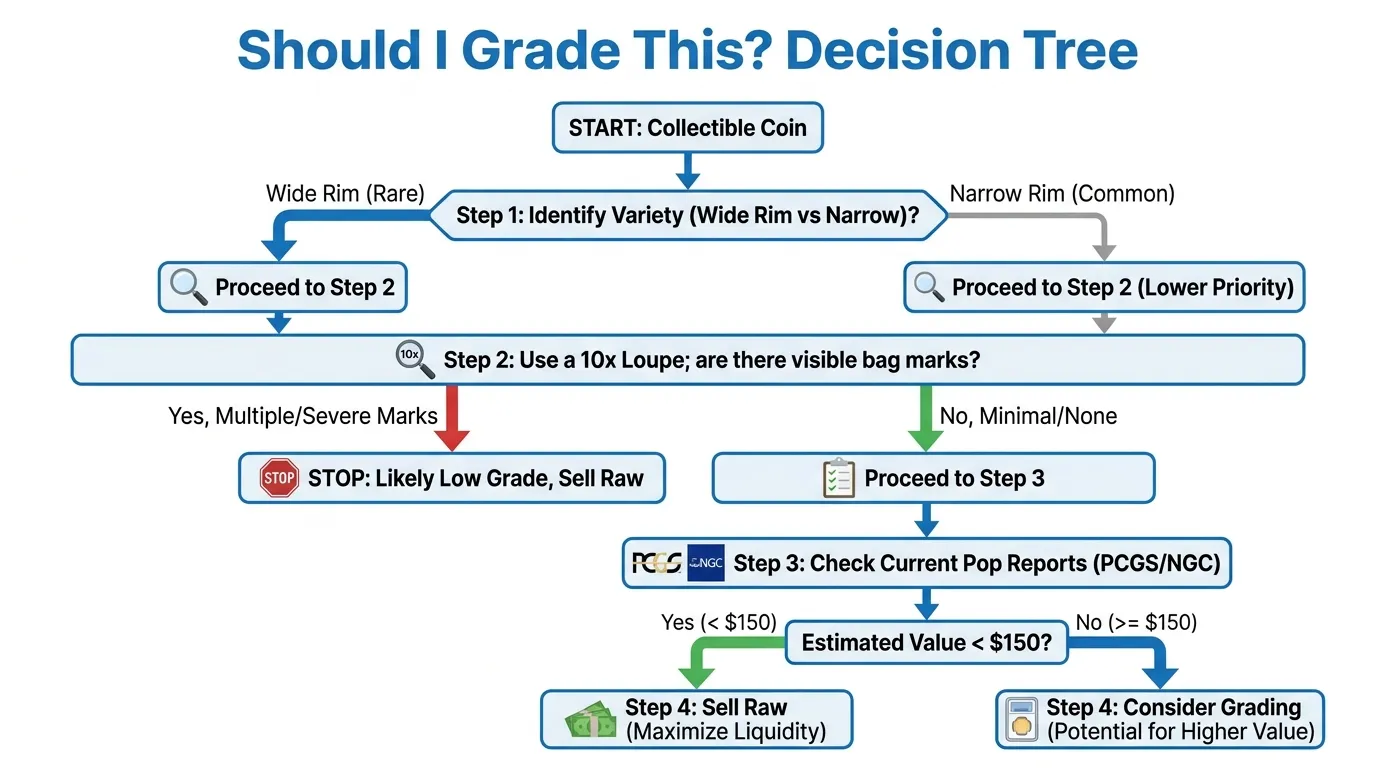 AI Generated Infographic
{
  "type": "bar",
  "title": "2026 Selling Strategy: Net Profit after Fees",
  "index": "Sales Channel",
  "categories": ["Low-Tier ($20-100)", "High-Tier ($500+)"],
  "data": [
    {"Sales Channel": "eBay (13.5% fee)", "Low-Tier ($20-100)": 72, "High-Tier ($500+)": 420},
    {"Sales Channel": "Heritage (20% BP)", "Low-Tier ($20-100)": 15, "High-Tier ($500+)": 485},
    {"Sales Channel": "Local Coin Shop", "Low-Tier ($20-100)": 60, "High-Tier ($500+)": 350}
  ],
  "source": "Source: Industry Average Fee Schedules (Aug 2026)",
  "note": "Net profit accounts for shipping, insurance, and commission."
}
Strategic Marketplace Selection
Where you sell is as critical as what you sell. The 2026 market is bifurcated between high-velocity retail (eBay) and specialized numismatic auctions (Heritage/Stack’s Bowers).
| Rarity Level | Best Venue | Execution Strategy |
|---|---|---|
| Common/Raw | Local Coin Shop | Instant liquidity for 50% silver Griffons at spot price. |
| Mid-Tier Varieties | eBay (Fixed Price) | Use "Best Offer" to capture the SBA Near Date enthusiast market. |
| Top-Pop / Rarities | Heritage Auctions | Essential for coins valued at $1,000+ to access global "Whale" registries. |
(Source: PCGS Auction Prices Realized, 2026)
For investors managing a broader numismatic or precious metal portfolio, staying ahead of institutional flows is vital. To optimize your timing based on broader market sentiment, consider utilizing a Smart Money Tracker for Institutional Portfolios.
FAQ
Is a 1979 U.S. Susan B. Anthony dollar made of silver?
No, the 1979 U.S. SBA dollar is made of a copper-nickel clad alloy and contains zero silver.
How much is a 1979 silver dollar from Canada worth?
The 1979 Canadian Griffon dollar contains 50% silver and has a melt value of approximately $21.75 (at $58/oz spot), with collector grades reaching $150 or more.
What makes a 1979-P Susan B. Anthony dollar valuable?
The 'Wide Rim' (Near Date) variety is the most valuable circulation strike, worth between $65 and $2,650 depending on its condition and grade.
How do I tell the difference between a Type 1 and Type 2 1979-S proof?
Type 1 has a 'Filled S' that looks like a blob, while Type 2 has a 'Clear S' with sharp serifs and visible loops, commanding a much higher premium.
When should I get my 1979 dollar professionally graded?
Grading is recommended only if the coin is a rare variety like the 'Wide Rim' or 'Clear S' in MS66/PR70 condition, where the market value justifies the fees.