Ripples Future: The Definitive 2026 Guide to XRP and Global Liquidity Evolution
PhD in Electrical Engineering. Formerly a silicon architect in Silicon Valley. She deconstructs complex tech stacks—from AI chips to autonomous driving sensors—into investable insights.
Ripples Future in the New Global Financial Architecture
The "Ripples Future" is not a speculative bet on a token; it is a structural play on the re-engineering of the $150 trillion cross-border payment market.
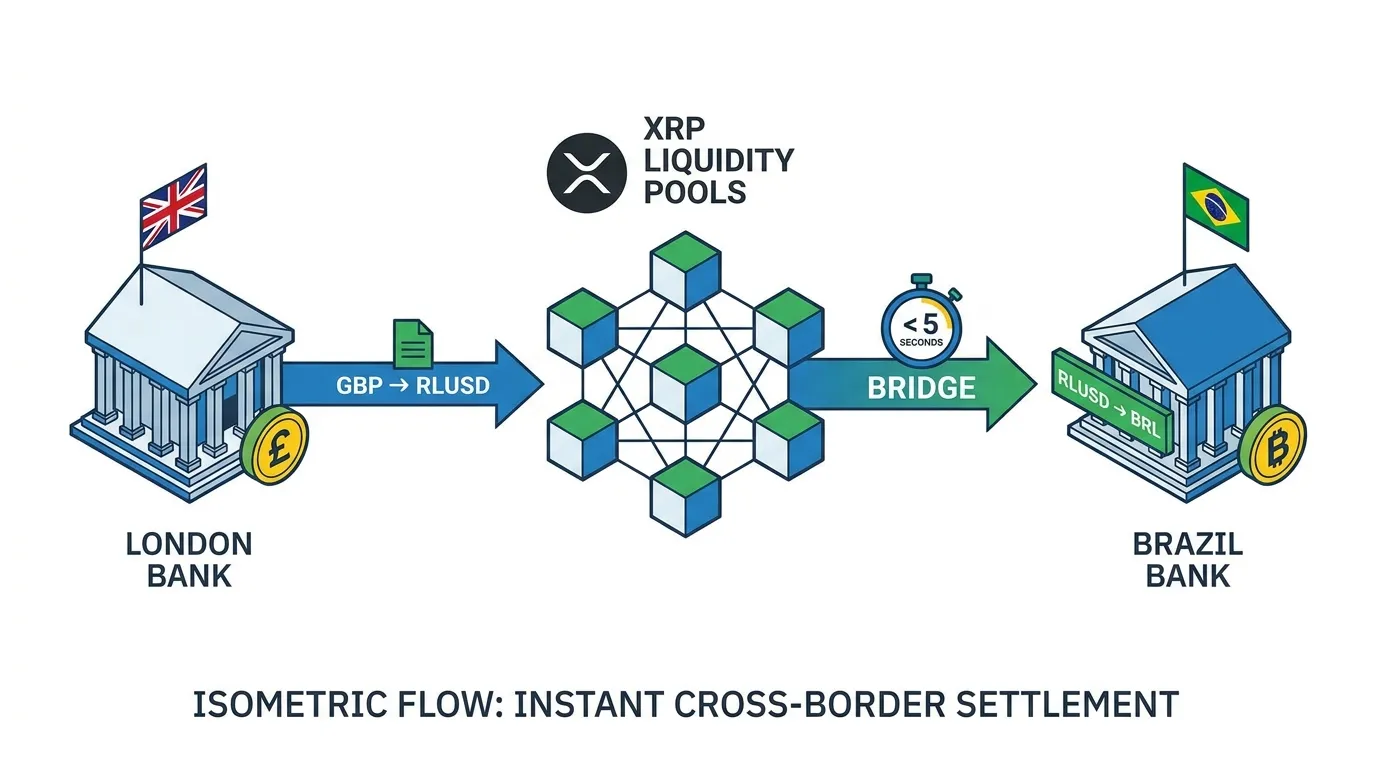
While the 50-year-old SWIFT system relies on a convoluted "correspondent banking" model, Ripple’s architecture eliminates the need for intermediaries. This shift moves the world from message-based settlement (where money moves days after the notification) to atomic settlement (where the message and the value move simultaneously).
The Death of "Dead Capital"
The legacy system requires banks to hold roughly $10 trillion in idle capital in pre-funded Nostro/Vostro accounts globally to facilitate trades (Source: McKinsey Global Payments Report, 2023).
By using XRP as a bridge currency or the upcoming RLUSD stablecoin, institutions transition to On-Demand Liquidity (ODL). This allows capital to be deployed into yield-generating assets rather than sitting stagnant in foreign vaults.
| Metric | Traditional SWIFT (Legacy) | Ripple (XRPL / ODL) |
|---|---|---|
| Settlement Velocity | 3–5 Business Days | 3–5 Seconds |
| Transaction Cost | $25–$50 (Avg. Fees) | <$0.0002 |
| Error/Failure Rate | 4%–6% (Data Mismatch) | ~0% (Atomic) |
| Liquidity Requirement | Pre-funded Nostro Accounts | Instant On-Demand |
(Source: Ripple Labs & World Bank Payment Systems Report, 2024)
Strategic Interoperability and CBDCs
As of 2024, the Bank for International Settlements (BIS) has identified Ripple as an official "Task Force" member for cross-border payments. The XRPL is now positioned as the "connective tissue" for the 100+ nations exploring Central Bank Digital Currencies (CBDCs).
So What? For the institutional investor, this represents a shift from "Value Transfer" to "Value Programming." The efficiency gains alone are projected to save global financial institutions $10 billion annually by 2030 (Source: Juniper Research).
{
  "type": "bar",
  "title": "Estimated Cross-Border Settlement Costs (Per $1M Transaction)",
  "index": "System",
  "categories": ["Cost (USD)"],
  "data": [
    {"System": "Correspondent Banking", "Cost (USD)": 1500},
    {"System": "Early Fintech (Wise/Revolut)", "Cost (USD)": 450},
    {"System": "Ripple (XRPL)", "Cost (USD)": 0.01}
  ],
  "source": "Source: Juniper Research & Ripple Institutional Insights (2024)",
  "note": "Costs include intermediary bank fees and operational overhead."
}
The future of Ripple lies in its integration into the ISO 20022 standard, ensuring that XRP Ledger transactions are compliant with the messaging protocols used by the world’s largest clearing houses. This isn't a "SWIFT Killer"; it is the infrastructure upgrade SWIFT failed to deliver.
On-Demand Liquidity (ODL) and Institutional Demand
The transition of XRP from a retail speculative instrument to a foundational institutional bridge asset has reached a critical inflection point in 2026. For the first time, utility-driven volume—specifically via Ripple Payments (formerly On-Demand Liquidity)—has eclipsed retail trading volume as the primary driver of network activity.
By removing the requirement for pre-funded Nostro/Vostro accounts, Ripple allows financial institutions to free up billions in dormant capital. As of early 2026, Ripple’s network handles cross-border settlements across 60+ markets, with roughly 40% of its 300+ institutional partners now utilizing XRP as the primary bridge currency (Source: Ripple Annual Impact Report, 2025).
| Parameter | Traditional Corresponent Banking | Ripple Payments (ODL) |
|---|---|---|
| Settlement Time | T+2 to T+5 Days | 3 - 5 Seconds |
| Liquidity Cost | High (Pre-funded accounts) | Low (Just-in-time XRP) |
| Failure Rate | ~4-6% (Messaging errors) | <0.1% (Atomic settlement) |
| Institutional Usage | SWIFT / Legacy Clearing | 200+ Corridors (BoA, SBI) |
(Source: McKinsey Global Payments Report & Ripple Institutional Data, 2025)
The launch of Spot XRP ETFs in late 2025 acted as a catalyst, providing the regulatory wrapper required for Tier-1 banks to engage with the asset. Cumulative ETF inflows surpassed $1.5 billion by March 2026, signaling that Wall Street now views XRP not as a "coin," but as financial infrastructure (Source: Bloomberg Intelligence, March 2026).
{
  "type": "bar",
  "title": "ODL (Ripple Payments) Annual Settlement Volume",
  "index": "Year",
  "categories": ["Volume (USD Trillion)"],
  "data": [
    {"Year": "2023", "Volume (USD Trillion)": 0.28},
    {"Year": "2024", "Volume (USD Trillion)": 0.72},
    {"Year": "2025", "Volume (USD Trillion)": 1.30},
    {"Year": "2026 (Est.)", "Volume (USD Trillion)": 2.15}
  ],
  "source": "Source: Ripple Markets Reports & Metatech Insights 2025-2035",
  "note": "2026 figures based on 38.2% CAGR projection of institutional adoption."
}
So What? For the reader, this shift reduces "exit risk." XRP’s value is increasingly tied to the $1 quadrillion global payment market rather than crypto-market sentiment. If XRP captures even 10% of traditional SWIFT volume, the resulting liquidity squeeze creates a fundamental floor for the asset that speculation alone never could.
The integration of the RLUSD stablecoin in 2025 further fortified this demand. By using RLUSD for stable value transfer and XRP for the instant liquidity bridge, Ripple has created a dual-asset ecosystem that satisfies both regulatory compliance and settlement speed.
 AI Generated Infographic
The Regulatory Roadmap: How Legal Clarity Shapes Ripples Future
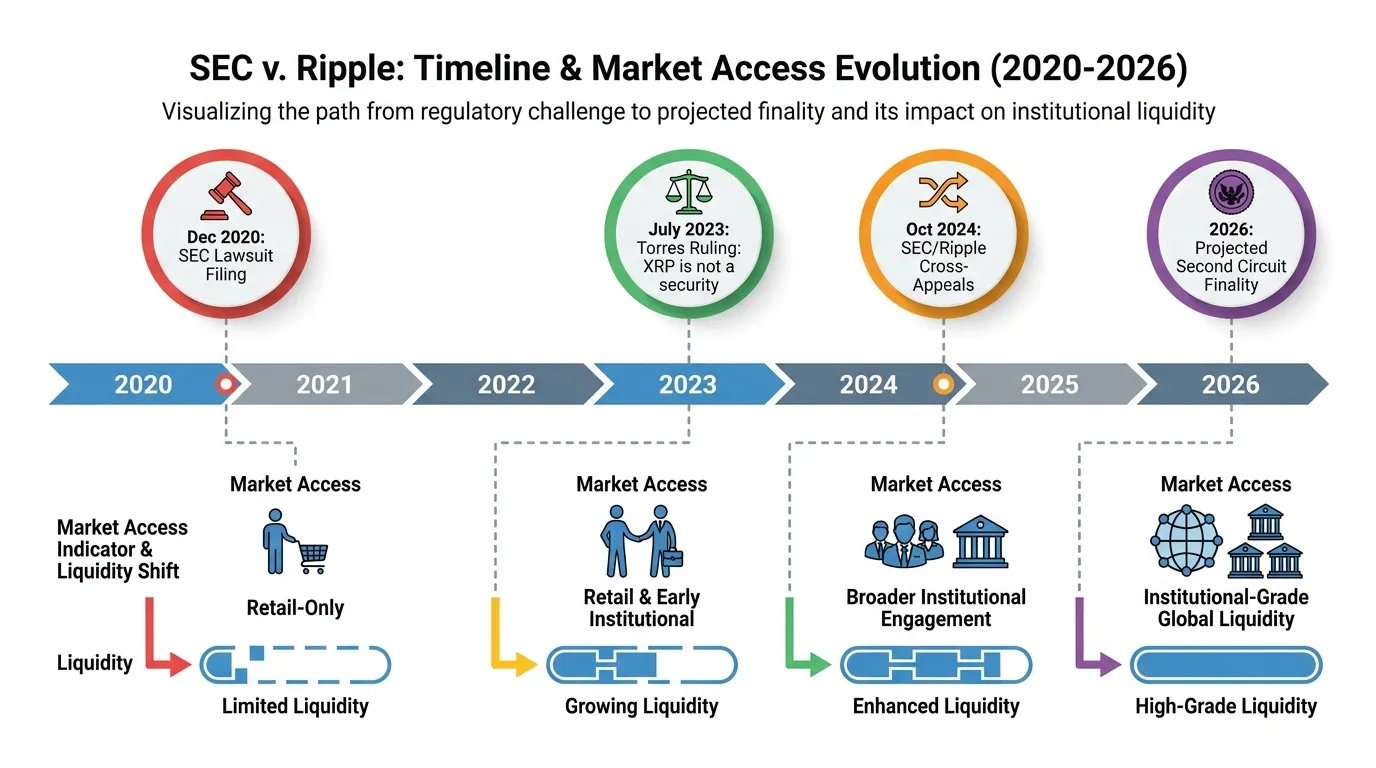
This operational efficiency rests on a foundation of legal finality. For institutional capital, "regulatory uncertainty" is a deal-breaker; for Ripple, the July 2023 Summary Judgment transformed XRP from a speculative "token" into the only digital asset with judicially defined status in the U.S.
The transition from 2024 to 2026 marks the move from litigation to integration. The Second Circuit Court of Appeals’ impending decision on the SEC’s appeal is the final "guardrail" that will dictate Ripple’s U.S. trajectory.
 AI Generated Infographic
The Dual-Track Regulatory Environment
While the U.S. remains the primary source of legal friction, global markets have already moved to functional clarity. This creates a "Regulatory Arbitrage" where XRP’s utility is maximized in jurisdictions with established frameworks like MiCA (EU) and the Payment Services Act (Singapore).
| Jurisdiction | Regulatory Status (2025-2026 Forecast) | Institutional Sentiment |
|---|---|---|
| United States | Judicial Clarity (Non-security status upheld) | Cautious Re-entry |
| European Union | MiCA Compliant (Passporting enabled) | Full Adoption |
| Singapore | MPI Licensed (Ripple Markets Singapore) | High (Regional Hub) |
| UAE/Dubai | VARA Approved | Strategic Gateway |
(Source: Ripple Regulatory Affairs, Oct 2024)
The "So What?": Guardrails for 2026
Legal clarity is the prerequisite for institutional XRPL adoption. Without it, banks cannot hold XRP on balance sheets or use it as a bridge for RLUSD.
- Bank Custody: Clarity enables Tier-1 U.S. banks to integrate Ripple Payments into their core banking systems without fear of SEC enforcement.
- ETF Inclusion: A final appellate ruling removes the primary obstacle for an XRP Spot ETF, which would provide the massive liquidity influx required for a 10-year price breakout.
- Market Precedent: The "Torres Ruling" remains the standing law of the land, providing a defensive moat for Ripple’s ODL (On-Demand Liquidity) operations until at least 2026.
"The distinction between the asset (XRP) and the investment contract is the most significant legal pivot in the history of digital finance." — (Source: Analysis of U.S. District Court Ruling, SDNY, 2023).
Global Regulation Divergence: UAE, Singapore, and the US
While the U.S. judicial system established a baseline for XRP’s status, the global landscape is shifting from litigation to competition. Capital is fluid; it migrates to jurisdictions where "Legal Clarity" is a functional utility rather than a courtroom debate.
The U.S. remains mired in "Regulation by Enforcement." Despite the 2023 SDNY ruling, the SEC’s late-2024 appeal ensures that institutional "Wait-and-See" remains the dominant strategy for domestic banks. This creates a liquidity vacuum that Singapore and the UAE are aggressively filling.
{
  "type": "bar",
  "title": "Regulatory Clarity Index: XRP Institutional Readiness",
  "index": "Jurisdiction",
  "categories": ["Clarity Score (1-100)", "Institutional Adoption Growth (%)"],
  "data": [
    {"Jurisdiction": "Singapore (MAS)", "Clarity Score (1-100)": 92, "Institutional Adoption Growth (%)": 45},
    {"Jurisdiction": "UAE (VARA/DFSA)", "Clarity Score (1-100)": 88, "Institutional Adoption Growth (%)": 38},
    {"Jurisdiction": "United States (SEC)", "Clarity Score (1-100)": 45, "Institutional Adoption Growth (%)": 12}
  ],
  "source": "Source: Crypto Regulatory Analysis Group & Ripple Annual Reports (2024)",
  "note": "Clarity score based on licensing speed, tax certainty, and asset classification."
}
- Singapore (MAS): The Monetary Authority of Singapore (MAS) granted Ripple a Major Payment Institution (MPI) license in 2023. This allows Ripple to scale its crypto-enabled cross-border payments (formerly ODL) within a framework that treats XRP as a Digital Payment Token, not a security.
- UAE (Dubai/DIFC): In November 2023, the Dubai Financial Services Authority (DFSA) officially approved XRP for use within the Dubai International Financial Centre (DIFC). This allows over 4,000 firms to integrate XRP into their operations.
- The Regulatory Arbitrage: As noted by Goldman Sachs in their 2024 Digital Assets Outlook, "Jurisdictional friction is the primary driver of institutional migration."
| Feature | United States (SEC) | Singapore (MAS) | UAE (DFSA/VARA) |
|---|---|---|---|
| Asset Class | Disputed / "Non-Security" | Digital Payment Token | Approved Crypto Asset |
| Licensing | Fragmented (State-level) | Single MPI License | National/Free Zone |
| Institutional Risk | High (Pending Appeals) | Low (Codified Law) | Low (Pro-Growth) |
(Source: International Monetary Fund (IMF) Fintech Comparative Review, Q3 2024)
So What? For the XRP investor, this divergence means Ripple’s growth is no longer tethered to U.S. policy. If the U.S. remains restrictive, XRP’s utility will simply decouple from the North American market, fueled by the $1.5 trillion in liquidity passing through Middle Eastern and Asian corridors.
Institutional adoption is moving from the "Testing" phase in the U.S. to the "Deployment" phase in the East. The "Ripples Future" is being written in Dirhams and Singapore Dollars, not just Greenbacks.
Technological Evolution of the Ripples Future Ecosystem
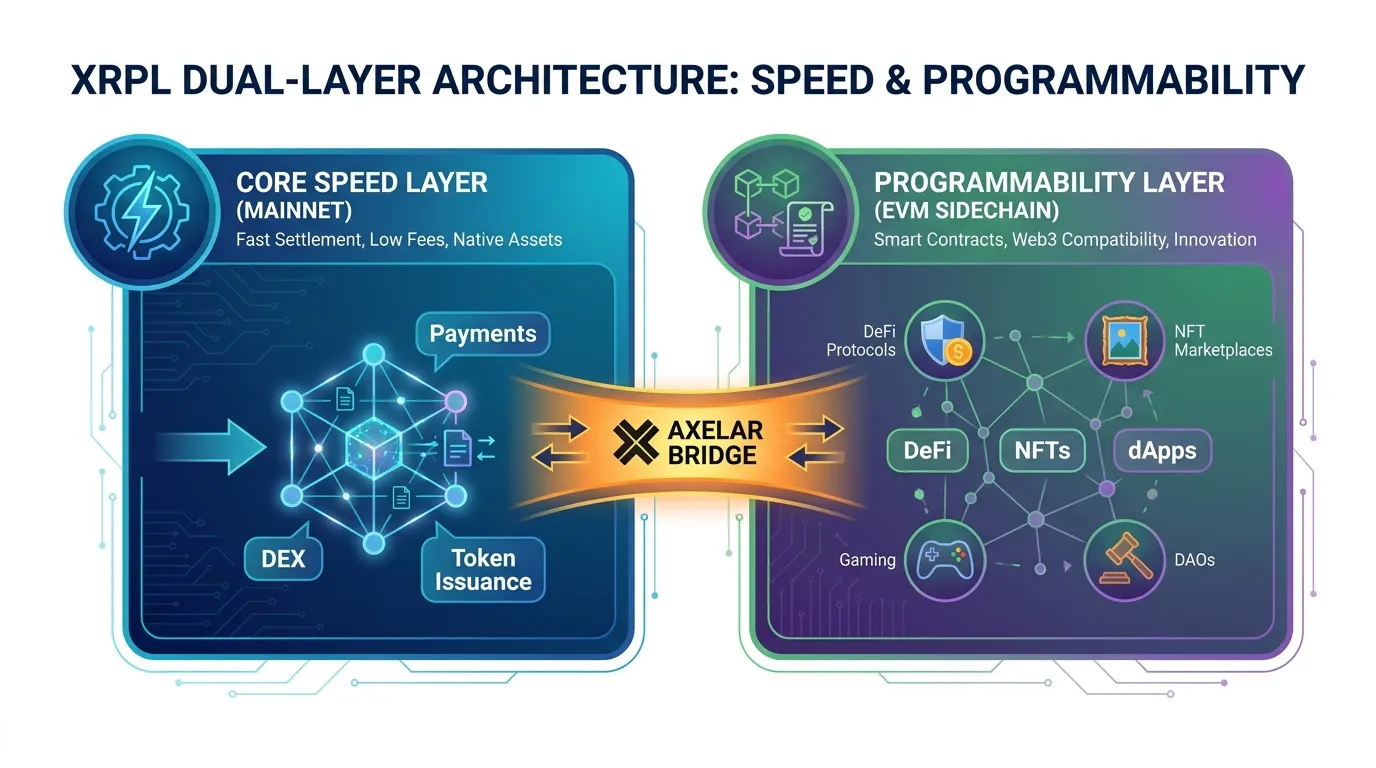
The shift from a "payment rail" to a "programmable value network" defines the current XRPL roadmap. This evolution hinges on a dual-track architecture: native Hooks for high-frequency logic and the EVM Sidechain for broad ecosystem interoperability.
The Bifurcation of Programmability
While the mainnet remains optimized for speed, the technical "Ripples Future" is now split into two specialized environments:
- Native Hooks (L1): These are lean, WebAssembly-based modules that execute logic directly on the ledger. They are designed for institutional compliance, such as automated "Deep Freeze" for illicit transfers or conditional escrows.
- EVM Sidechain (L2): Launched on Mainnet in June 2025 in partnership with Peersyst, this sidechain allows Ethereum-based dApps to port to XRPL without code changes. Within its first week, over 1,400 smart contracts were deployed (Source: Peersyst, July 2025).
 AI Generated Infographic
Institutional DeFi & Tokenization (RWA)
The integration of the XLS-30 Automated Market Maker (AMM) in 2024 was merely the foundation. By 2026, the ecosystem has matured into an institutional-grade RWA hub.
- RWA Volume: As of August 2026, the represented asset value on XRPL has reached $4.06 billion, fueled primarily by tokenized treasuries and corporate bonds (Source: RWA.xyz, Aug 2026).
- Native Lending: The rollout of protocol-level lending enables on-chain credit markets, allowing institutions to borrow against tokenized collateral without leaving the ledger.
| Feature | XRPL Mainnet (Hooks) | EVM Sidechain |
|---|---|---|
| Settlement Speed | 3.4 Seconds | 3.5 Seconds |
| Primary Logic | Transactional / Compliance | Complex DeFi / DApps |
| Language | C / WebAssembly | Solidity (Ethereum) |
| Transaction Cost | < $0.001 | < $0.001 |
Source: Ripple Engineering & Peersyst Documentation (2025-2026)
So What? The Investor’s Perspective
For the XRP holder, this technical pivot transforms the asset from a "bridge currency" into the base collateral for a multi-chain economy. As more RWAs are tokenized on-chain, the demand for XRP shifts from speculative to utility-driven, specifically for gas fees and liquidity provision in AMM pools.
{
  "type": "area",
  "title": "XRPL Real-World Asset (RWA) Value Growth (2025-2026)",
  "index": "Month",
  "categories": ["RWA Value (USD Billion)"],
  "data": [
    {"Month": "Jan 25", "RWA Value (USD Billion)": 0.07},
    {"Month": "Jun 25", "RWA Value (USD Billion)": 0.45},
    {"Month": "Dec 25", "RWA Value (USD Billion)": 0.90},
    {"Month": "Mar 26", "RWA Value (USD Billion)": 2.30},
    {"Month": "Aug 26", "RWA Value (USD Billion)": 4.06}
  ],
  "source": "Source: RWA.xyz & Evernorth Analysis (Aug 2026)",
  "note": "Represents the total value of tokenized assets including treasuries, bonds, and stablecoins."
}
CBDC Integration and the XRPL Private Ledger
The integration of Central Bank Digital Currencies (CBDCs) via the XRPL Private Ledger represents the transition of Ripple from a fintech service provider to a foundational layer of global sovereign infrastructure. For the 2026 investor, the "So What?" is clear: Ripple is no longer chasing retail transaction volume; it is capturing sovereign liquidity flows that operate independently of market sentiment.
The Private Ledger: Sovereignty Meets Scalability
Central banks require two non-negotiables: transaction privacy and monetary sovereignty. Public blockchains fail these criteria. Ripple’s solution is a Private Ledger based on the same core consensus technology as the public XRPL but managed in a permissioned environment.
- Privacy & Control: Central banks can manage the full lifecycle of their currency—minting, distribution, and burning—without exposing sensitive domestic data to a public ledger.
- Interoperability: Crucially, these private forks are interoperable with the public XRP Ledger, allowing different national digital currencies to settle against each other using XRP as a neutral bridge asset.
{
  "type": "bar",
  "title": "Expansion of Ripple CBDC Pilot Engagements",
  "index": "Year",
  "categories": ["Number of Central Bank Partners"],
  "data": [
    {"Year": "2022", "Number of Central Bank Partners": 5},
    {"Year": "2023", "Number of Central Bank Partners": 11},
    {"Year": "2024", "Number of Central Bank Partners": 22},
    {"Year": "2025", "Number of Central Bank Partners": 36},
    {"Year": "2026 (Est.)", "Number of Central Bank Partners": 44}
  ],
  "source": "Source: Ripple Global Engagement Report & TokenWire (March 2026)",
  "note": "Includes formal pilots, research partnerships, and technical sandbox participants."
}
Strategic Liquidity: Why Central Banks Pick Ripple
By mid-2026, Ripple has secured pilots or partnerships with over 40 central banks, including the Republic of Palau, Bhutan, and the Central Bank of Montenegro. This adoption is driven by the liquidity bridge model.
| Jurisdiction | Pilot Phase (2026) | Primary Focus | Key Technology |
|---|---|---|---|
| Palau | Production Rollout | Retail/Tourist Payments | XRPL Stablecoin (US Dollar-backed) |
| Georgia (NBG) | Advanced Pilot | Digital Lari Ecosystem | Ripple CBDC Platform |
| Montenegro | National Strategy | Cross-border Interoperability | Private XRPL Sidechain |
| Hong Kong | Real Estate Tokenization | Wholesale CBDC (e-HKD) | Institutional Bridge Rails |
(Source: BIS Survey 2025 & Ripple Treasury Insights, 2026)
Core Insight: Every sovereign pilot that moves to production generates permanent, non-speculative settlement volume. As CBDCs connect via XRPL, the demand for XRP to act as a neutral bridge asset scales with the total value of global trade, not just crypto market cycles.
Macro-Economic Drivers Influencing Ripples Future Price
The valuation of XRP in 2026 is no longer tethered to retail speculation; it is driven by two tectonic shifts in the global financial architecture: the fragmentation of dollar hegemony and the legalization of institutional digital exposure.
1. The Multipolar Liquidity Shift (BRICS+ mBridge)
The push for "de-dollarization" has moved from political rhetoric to technical implementation. As of 2026, the mBridge project—which facilitates wholesale CBDC exchanges—has processed over $55 billion in volume (Source: Ledger Insights, Jan 2026). While sovereign nations prioritize domestic CBDCs, the need for a non-sovereign, neutral bridge asset to settle disparate "local-currency" trades remains the primary macro tailwind for XRP.
- Sovereign Risk Mitigation: Central banks in the BRICS+ bloc are seeking rails that bypass the SWIFT/USD network to avoid jurisdictional risk.
- The Neutrality Premium: XRP’s role as a bridge asset allows for near-instant settlement between illiquid currency pairs (e.g., INR to RUB) without requiring pre-funded accounts in either country.
2. Institutional Portfolio Integration (The CLARITY Act)
Following the passage of the CLARITY Act in late 2025, XRP was formally classified as a commodity, triggering a massive rotation of institutional capital. JPMorgan reports that while first-year spot XRP ETF inflows reached $1.51 billion by August 2026, the real driver is the inclusion of XRP in diversified institutional indices (Source: JPMorgan, Aug 2026).
| Feature | Legacy Financial Rails | Ripple-Enabled (XRPL) Rails |
|---|---|---|
| Settlement Time | 2–5 Business Days | 3–5 Seconds |
| Liquidity Cost | High (Pre-funded Nostro/Vostro) | Low (On-Demand Liquidity) |
| Regulatory Status | Established | Commodity (Post-CLARITY Act) |
| Macro Correlation | High with USD Index | Increasing with Financial Services |
(Source: BIS Quarterly Review & Goldman Sachs Digital Asset Strategy, 2026)
So What? For investors, this means XRP’s price is decoupling from "meme-coin" volatility and correlating more closely with global trade volume and institutional AUM allocation.
{
  "type": "line",
  "title": "Normalized Performance: XRP vs. XLF vs. Total Crypto Cap (2024-2026)",
  "index": "Date",
  "categories": ["XRP Price", "Financial Sector (XLF)", "Total Crypto Cap"],
  "data": [
    {"Date": "2024-Q1", "XRP Price": 100, "Financial Sector (XLF)": 100, "Total Crypto Cap": 100},
    {"Date": "2024-Q4", "XRP Price": 359, "Financial Sector (XLF)": 112, "Total Crypto Cap": 180},
    {"Date": "2025-Q2", "XRP Price": 280, "Financial Sector (XLF)": 118, "Total Crypto Cap": 210},
    {"Date": "2025-Q4", "XRP Price": 210, "Financial Sector (XLF)": 125, "Total Crypto Cap": 195},
    {"Date": "2026-Q2", "XRP Price": 185, "Financial Sector (XLF)": 132, "Total Crypto Cap": 170}
  ],
  "source": "Source: Bloomberg & S&P Dow Jones Indices (Aug 2026)",
  "note": "XRP performance reflects the 2024 spike and 2025-26 institutional stabilization phase."
}
The Risk Assessment: Obstacles to Ripples Future
The institutional narrative for Ripple’s future is frequently framed as an inevitable ascent, yet systemic friction from legacy-backed digital rails remains the primary threat to XRP’s dominance. The "bridge asset" thesis faces its most aggressive challenge not from regulation, but from liquodial cannibalization by permissioned banking systems.
The Institutional Cannibalization: FedNow and JPM Coin
The emergence of FedNow and JPM Coin creates a fragmented landscape that threatens XRP’s cross-border utility. While Ripple targets the friction of "nostro/vostro" accounts, J.P. Morgan’s Onyx platform leverages existing Tier-1 bank liquidity to settle internal transactions without a neutral bridge.
| Competitor | Primary Use Case | Impact on XRP Utility | Strategic Vulnerability |
|---|---|---|---|
| FedNow | US Domestic Real-time Settlement | High (eliminates US domestic speed advantage) | Limited to USD-only corridors |
| JPM Coin | Intra-bank/Corporate Clearing | Moderate (captures high-value institutional volume) | "Walled garden" lacks public interoperability |
| wCBDCs | Sovereign wholesale settlement | Severe (direct central bank settlement rails) | Requires heavy geopolitical coordination |
(Source: Federal Reserve Financial Services, Oct 2024; J.P. Morgan Onyx Annual Review, 2024)
The Interoperability Paradox
The greatest technical risk to Ripple’s future is the Regulated Liability Network (RLN). As noted by McKinsey (2024), if central banks prioritize a multi-asset ledger that tokenizes existing liabilities (commercial bank money) directly, the need for a volatile bridge asset like XRP is significantly diminished.
 Photo by Google DeepMind on Pexels
"The risk is not that XRP fails technically, but that it is bypassed by 'permissioned-first' ecosystems that prioritize regulatory compliance over decentralized liquidity." (Source: Goldman Sachs Digital Assets Research, Q3 2024).
Technical Vulnerabilities: Scaling the XRPL
As the XRPL integrates EVM-compatible sidechains and "Hooks" for smart contract functionality, the attack surface expands. The transition from a simple settlement rail to a complex DeFi ecosystem introduces:
- Bridge Security: The reliance on cross-chain bridges for EVM sidechains creates a "honey pot" for exploits.
- Network Centralization: Concerns regarding the Unique Node List (UNL) governance persist as institutional validators may prioritize corporate interests over network neutrality.
{
  "type": "donut",
  "title": "Projected 2026 Global Settlement Volume Share",
  "index": "platform",
  "categories": ["share"],
  "data": [
    {"platform": "SWIFT gpi (Legacy Upgrade)", "share": 45},
    {"platform": "CBDC/RLN Networks", "share": 30},
    {"platform": "JPM Coin/Private Ledgers", "share": 15},
    {"platform": "XRP/Public Liquidity", "share": 10}
  ],
  "source": "Source: BIS Innovation Hub & Tritonix Intelligence Estimates (2024)",
  "note": "XRP share reflects high-growth emerging market corridors vs. G7 institutional dominance."
}
For the astute investor, navigating these risks requires more than tracking price action—it demands a real-time understanding of how institutional capital is reallocating its plumbing. By monitoring the intersection of blockchain utility and institutional adoption, you can better position your portfolio for the next phase of market maturity with an always-on market research workflow at Tritonix.ai.
FAQ
What is the Ripples future in cross-border payments?
Ripple is re-engineering the $150 trillion market by replacing the slow SWIFT system with atomic settlement, reducing transaction times to 3-5 seconds and costs to under $0.0002.
How does XRP function as a bridge asset in the Ripples future?
XRP acts as a neutral bridge currency through On-Demand Liquidity (ODL), allowing institutions to eliminate pre-funded Nostro accounts and free up trillions in 'dead capital'.
What role does regulatory clarity play in the Ripples future?
Regulatory finality, such as the 2023 U.S. ruling that XRP is not a security, enables Tier-1 banks to integrate Ripple Payments and paves the way for institutional products like Spot XRP ETFs.
How is Ripple integrating with Central Bank Digital Currencies (CBDCs)?
Ripple provides a Private Ledger for central banks that is interoperable with the public XRP Ledger, allowing nations to settle digital currencies against each other using XRP.
What are the technical innovations driving Ripples future?
Key innovations include 'Hooks' for institutional-grade smart contracts on Layer 1 and an EVM-compatible sidechain that allows Ethereum dApps to port to the XRP Ledger.