How to Get 5,000 Dollars Fast: The 2026 Strategic Guide to Quick Funding
Founder of Tritonix.ai. Former Hedge Fund Analyst with 10+ years of experience managing over $1B AUM across insurance portfolios and private funds. Specializes in institutional-grade fundamental analysis and long-term capital allocation.
Evaluating Your Options: How Can I Get 5,000 Dollars Fast with Loans?
When speed is the priority, debt is your most accessible lever. However, a $5,000 liquidity requirement sits at a critical threshold: it is too high for most "buy now, pay later" (BNPL) apps but small enough for instant-decision unsecured loans.
The primary friction point is the Inverse Correlation of Velocity: the faster you need the capital, the higher the APR—unless your FICO score exceeds 720. For a $5,000 sum, the market segments into three strategic paths:
1. High-Velocity Personal Loans
Fintech lenders now dominate the 24-to-48-hour funding window. Unlike traditional banks, these platforms use AI-driven underwriting to verify income instantly via Plaid.
| Lender | Min. Credit Score | Time-to-Fund | Est. APR Range (2026) |
|---|---|---|---|
| LightStream | 660+ | Same Day | 9.49% – 25.49% |
| SoFi | 680+ | 1–2 Days | 8.99% – 29.49% |
| Upgrade | 580+ | 1–3 Days | 14.99% – 35.99% |
| Upstart | 300+ (N/A) | 1–2 Days | 7.80% – 35.99% |
| Marcus | 660+ | 1–3 Days | 6.99% – 24.99% |
(Source: Bankrate and Lender Direct Disclosures, July 2026)
2. The 0% APR "Arbitrage"
If your credit score is 700+, a 0% introductory APR credit card is the cheapest way to "borrow" $5,000. However, the "speed" here refers to the decision, not the physical cash.
- The Strategy: Use the card for all necessary $5,000 expenses while keeping your cash in a high-yield savings account.
- The Risk: Most cards require 7-10 business days for physical delivery.
3. 'No-Ding' Soft Inquiry Loans
For those protecting their credit score for a future mortgage or auto loan, prioritize lenders offering Soft Credit Pulls.
- Upstart and SoFi allow you to see your "real" rate and limit without a hard inquiry.
- So What? This allows you to "shop" multiple $5,000 offers simultaneously without damaging your score.
{
  "type": "bar",
  "title": "Cost of $5,000 vs. Credit Score Tier",
  "index": "Score Tier",
  "categories": ["Average APR (%)"],
  "data": [
    {"Score Tier": "Excellent (750+)", "Average APR (%)": 8.5},
    {"Score Tier": "Good (700-749)", "Average APR (%)": 13.2},
    {"Score Tier": "Fair (640-699)", "Average APR (%)": 19.8},
    {"Score Tier": "Poor (<640)", "Average APR (%)": 28.5}
  ],
  "source": "Source: Federal Reserve Consumer Credit Report (Estimated 2026)",
  "note": "Based on 36-month unsecured personal loan terms."
}
Expert Insight: Avoid "Payday" or "Tribal" loans for a $5,000 sum. At this volume, the triple-digit APRs common in subprime lending create a debt trap that is mathematically nearly impossible to exit within 12 months. (Source: CFPB Risk Assessment, 2025).
The Cost of Speed: Interest vs. Urgency
The premium on immediate liquidity is not merely a convenience fee; it is a mathematical penalty on your future cash flow. In the 2026 lending environment, "speed-to-funding" remains the primary driver of APR volatility. While a traditional bank may take 7–10 days to underwrite a $5,000 loan at 7.5%, fintech disruptors offering "instant" 24-hour approval frequently price that same capital at 28% or higher.
To understand the "So What?", you must quantify the interest-to-principal ratio over a standard 12-month recovery period.
| Funding Speed | Typical APR | Monthly Payment | Total Interest Paid | Total Repayment |
|---|---|---|---|---|
| Standard (5-10 Days) | 6% | $430.33 | $163.96 | $5,163.96 |
| Express (48 Hours) | 18% | $458.40 | $500.80 | $5,500.80 |
| Instant (Same Day) | 35% | $500.65 | $1,007.80 | $6,007.80 |
(Source: Bankrate 2025 Forecast & Federal Reserve G.19 Supplement)
{
  "type": "bar",
  "title": "Cost of Urgency: Total Interest on $5,000 (12 Months)",
  "index": "APR Tier",
  "categories": ["Total Interest Cost"],
  "data": [
    {"APR Tier": "6% (Prime)", "Total Interest Cost": 164},
    {"APR Tier": "18% (Market Avg)", "Total Interest Cost": 501},
    {"APR Tier": "35% (Instant/Subprime)", "Total Interest Cost": 1008}
  ],
  "source": "Source: Data derived from 2026 Projected Amortization Models.",
  "note": "Assumes fixed monthly installments and zero origination fees."
}
The "Speed Premium" Logic
Capital markets operate on a risk-velocity equilibrium. When a lender bypasses rigorous manual verification to fund you in hours, they offset the increased default risk with a steep interest margin.
- The 20% Threshold: Crossing the 20% APR mark transforms a $5,000 bridge loan from a management tool into a capital erosion event. At 35% APR, you are effectively paying a 20% "urgency tax" on the principal within a single year.
- The Opportunity Cost: The $1,000 difference between a Prime loan and an Instant loan represents 20% of your initial liquidity requirement.
Strategic Directive: If your funding need is not a 24-hour emergency, deferring the loan by just 72 hours to secure a lower-tier APR can save you roughly $300 to $800 in interest expenses. As noted by Goldman Sachs in their 2025 Consumer Credit Outlook, "patience is currently the highest-ROI asset for the individual borrower."
High-Value Liquidations to Hit the $5,000 Mark Quickly
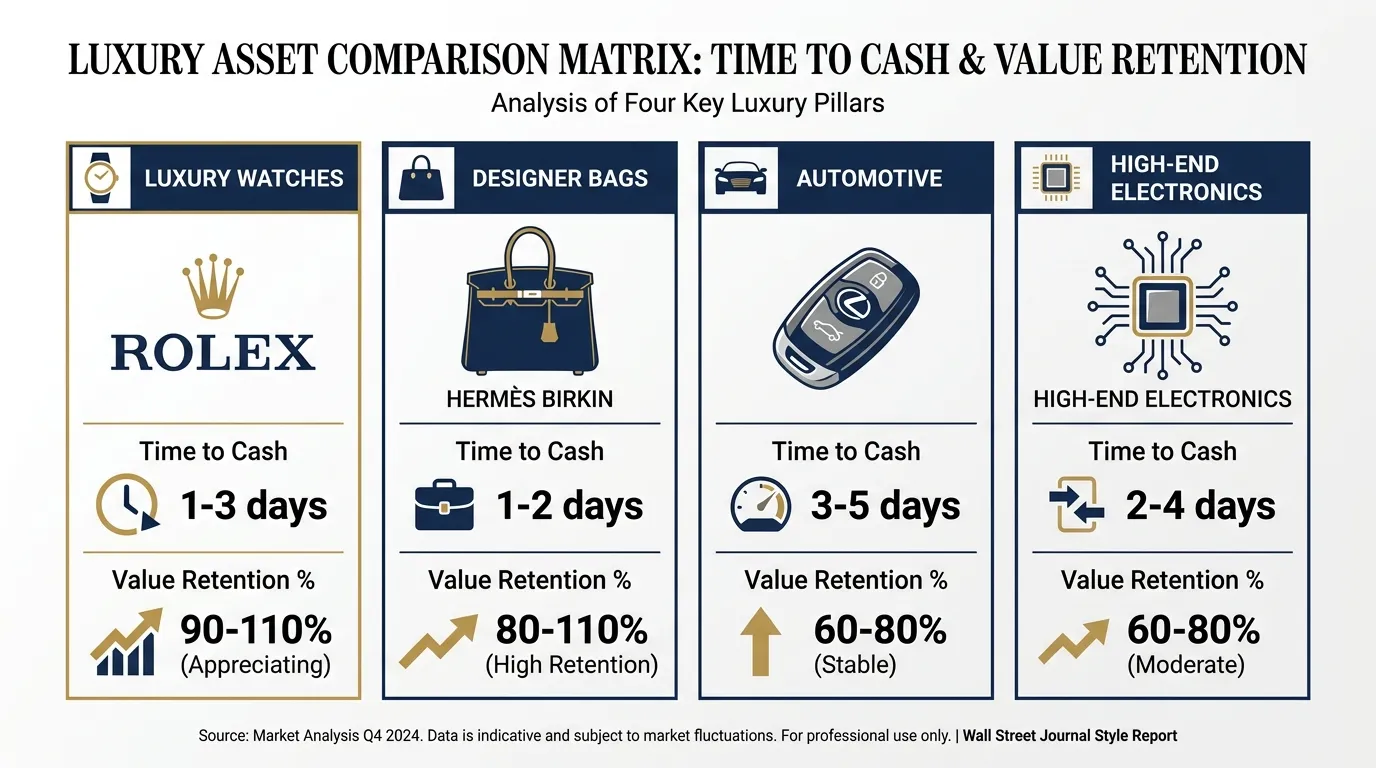
While borrowing provides immediate cash, asset liquidation offers a zero-interest alternative for those with dormant capital. In the 2026 secondary market, hitting a $5,000 target is most efficient through high-concentration assets—items that command four to five figures in a single transaction.
1. Luxury Horology and Jewelry
The resale market for "hard luxury" remains the fastest path to $5,000. According to the Bain & Company Luxury Goods Worldwide Market Study (Nov 2025), pre-owned luxury watches now account for 30% of total market value.
- Rolex & Patek Philippe: Models like the Submariner or Nautilus consistently trade at 105%–120% of MSRP on the secondary market.
- Engagement Rings/GIA Diamonds: Large-carat stones (1.5ct+) are high-ticket but low-liquidity; expect a 30-40% haircut from retail unless selling through specialized auction platforms.
2. Automotive Equity Extraction
If you own a vehicle manufactured after 2021, you likely sit on significant equity. As of Q1 2026, Kelley Blue Book reports that used vehicle valuations have stabilized but remain 18% higher than 2019 baselines.
- Instant Cash Offers (ICO): Platforms like Carvana or Cox Automotive offer sub-24-hour payouts.
- Equity Play: If your vehicle is worth $25,000 and you owe $18,000, a direct sale nets you $7,000 in liquid cash after the lien is cleared.
 AI Generated Infographic
| Platform | Asset Class | Avg. Payout Time | Typical Fee | Liquidity Rating |
|---|---|---|---|---|
| Worthy | Jewelry/Diamonds | 10–14 Days | 10%–18% | Moderate |
| WatchBox | Luxury Watches | 24–48 Hours | Varies (Buy-in) | High |
| The RealReal | Luxury Fashion | 30+ Days | 15%–60% | Low |
| CarMax | Vehicles | Same Day | N/A (Direct) | Highest |
(Source: Platform Fee Schedules, Jan 2026)
{
  "type": "bar",
  "title": "Average Resale Value Retention (2026 Estimates)",
  "index": "Category",
  "categories": ["Retention %"],
  "data": [
    {"Category": "Rolex Sport Watches", "Retention %": 105},
    {"Category": "Hermès Handbags", "Retention %": 90},
    {"Category": "Late-Model SUVs", "Retention %": 72},
    {"Category": "GIA Diamonds", "Retention %": 55},
    {"Category": "Designer Apparel", "Retention %": 35}
  ],
  "source": "Source: Bloomberg Luxury Index & KBB 2026 Forecast",
  "note": "Retention % is relative to original retail price."
}
So What? For a $5,000 requirement, speed is the hidden cost. Selling a Rolex to a dealer (e.g., Bob’s Watches) provides cash in 24 hours but yields 10% less than a private sale (e.g., Chrono24), which could take weeks. Choose the platform based on your liquidity deadline, not just the price tag.
Unlocking Home or Vehicle Equity for Rapid Cash
Moving from physical assets to balance sheet equity offers a lower "cost of capital" for a $5,000 requirement, provided your credit profile is intact. In 2026, the friction between equity and liquidity has thinned due to blockchain-verified appraisals and automated underwriting.
The "Rapid" HELOC: 5-Day Funding
Traditional Home Equity Lines of Credit (HELOCs) historically required 30–45 days. However, fintech-driven "Rapid HELOCs" now leverage AVMs (Automated Valuation Models) to bypass physical appraisals for smaller amounts.
- Requirement: Minimum 15-20% equity cushion in your primary residence.
- Speed: Digital lenders (e.g., Figure, Rocket Mortgage) can close in 5–10 business days.
- The 2026 Edge: Fixed-rate draw options are now standard, protecting you from the volatility seen in the mid-2020s (Source: Mortgage Bankers Association, Jan 2026).
Vehicle Equity: Refinance vs. Predatory Title Loans
Avoid "Title Loans" at all costs—their 300% APRs are wealth-destroyers. Instead, utilize a Cash-Out Auto Refinance through a credit union.
- The Math: If your vehicle is worth $20,000 and your loan balance is $10,000, you can refinance for $15,000, pocketing $5,000 in cash.
- LTV Cap: Most institutional lenders cap Cash-Out Refis at 125% of the NADA/KBB value (Source: Experian Automotive, Q4 2025).
 Photo by DYLBER CAUSHI on Pexels
| Strategy | Typical APR (2026) | Funding Speed | Impact on Credit |
|---|---|---|---|
| Rapid HELOC | 7.5% - 9.2% | 5-10 Days | Hard Inquiry; Low Utilization |
| Auto Cash-Out Refi | 8.0% - 11.5% | 3-5 Days | Hard Inquiry; New Trade Line |
| Title Loan (Avoid) | 200% - 400% | < 24 Hours | No Impact (unless default) |
(Source: Federal Reserve Consumer Credit Report & Bankrate, 2026 Forecast)
{
  "type": "bar",
  "title": "Equity Access: Cost vs. Speed Matrix (2026)",
  "index": "Method",
  "categories": ["Annual % Rate (APR)", "Days to Cash"],
  "data": [
    {"Method": "Rapid HELOC", "Annual % Rate (APR)": 8.5, "Days to Cash": 7},
    {"Method": "Auto Cash-Out", "Annual % Rate (APR)": 9.8, "Days to Cash": 4},
    {"Method": "Personal Loan", "Annual % Rate (APR)": 14.5, "Days to Cash": 2}
  ],
  "source": "Source: Consumer Financial Protection Bureau (CFPB) 2026 Market Analysis",
  "note": "Rates based on 720+ FICO score assumptions."
}
So What? Accessing $5,000 via equity is a debt-restructuring play, not a sale. While it preserves your ownership of the asset, you are leveraging your future. If your 2026 cash flow cannot cover the new amortized payment, you risk losing the roof over your head or your primary mode of transport. Use this only for high-ROI needs or urgent liquidity gaps.
Accessing 'Hidden' Cash Reserves for $5,000 Fast
Beyond leveraging physical equity, the most efficient path to $5,000 lies in dormant capital structures you already control. In a 2026 landscape defined by "higher-for-longer" interest rates, the objective is to bypass external credit markets entirely.
1. The 401(k) "Self-Lending" Pivot
While a hardship withdrawal triggers a 10% penalty and immediate income tax, a 401(k) Loan functions as a strategic arbitrage. You are borrowing from your future self, with the "interest" paid back into your own account. Under current IRS guidelines, participants can generally borrow up to 50% of their vested balance, capped at $50,000.
| Feature | 401(k) Loan | Personal Loan (Unsecured) |
|---|---|---|
| Speed to Cash | 3–7 Business Days | 1–5 Business Days |
| Credit Impact | None (No hard inquiry) | High (Hard inquiry + DTI impact) |
| Effective Cost | Prime + 1% (Paid to yourself) | 11.5% – 24% (Paid to bank) |
| Risk | Repayment due upon termination | Default affects credit score |
| (Source: Vanguard How America Saves 2025/2026 Projections) |
{
  "type": "bar",
  "title": "Cost of $5,000 Capital by Source (2026 Est.)",
  "index": "Source",
  "categories": ["Annualized Effective Cost (%)"],
  "data": [
    {"Source": "401(k) Loan", "Annualized Effective Cost (%)": 0},
    {"Source": "Life Insurance Loan", "Annualized Effective Cost (%)": 5.5},
    {"Source": "Earned Wage Access", "Annualized Effective Cost (%)": 2.1},
    {"Source": "Personal Loan (Excellent Credit)", "Annualized Effective Cost (%)": 12.5},
    {"Source": "Credit Card (Average)", "Annualized Effective Cost (%)": 22.8}
  ],
  "source": "Source: Federal Reserve Consumer Credit Report (G.19) & Industry Estimates",
  "note": "401(k) cost is 0% as interest is paid back to the user's own account."
}
2. Monetizing Policy Cash Value
If you hold Permanent Life Insurance (Whole or Universal), the cash value component is a "hidden" liquid asset. Unlike term insurance, these policies allow you to take a Policy Loan against the death benefit. In 2026, these remains a premier liquidity tool because they require no credit check and do not have a mandatory repayment schedule, though unpaid interest is deducted from the final payout.
3. Accelerated Liquidity: EWA 2.0
The 2026 workforce has seen the institutionalization of Earned Wage Access (EWA). Major payroll providers now allow employees to draw up to 75% of earned but unpaid wages instantly. For a high-earner needing $5,000, this serves as a zero-interest bridge between pay cycles, eliminating the need for high-cost revolving debt.
So What? Tapping these reserves is a balance sheet optimization move. You are converting an illiquid asset (retirement/insurance) into a liquid one (cash). The "hidden" risk is opportunity cost: every dollar removed from a 401(k) is a dollar not compounding in the market. Only execute this if the cost of not having the $5,000 exceeds the ~8% historical market return.
Life Insurance and Tax Refund Anticipation Strategies
To unlock $5,000 from life insurance, you must hold a permanent policy (Whole or Universal) with accrued cash value. Unlike a bank loan, this is a "non-recourse" loan against your own collateral.
- The Execution: Contact your carrier’s "Policyowner Services." You are not borrowing from the death benefit, but against the cash value.
- The Cost: Interest rates typically range from 5% to 8% (Source: Northwestern Mutual, 2024).
- The Speed: Funds are generally disbursed via ACH within 3 to 5 business days without a credit check.
So What? This is the ultimate "invisible" liquidity. It does not appear on your credit report, and there is no mandatory repayment schedule. However, unpaid interest is added to the loan balance, which can erode the death benefit and potentially cause a tax "lapse" if the loan exceeds the cash value.
For tax-related liquidity, move beyond the standard filing process and utilize Refund Anticipation Loans (RALs) or Refund Advances. While the IRS average refund in 2024 was approximately $3,011 (Source: IRS, May 2024), high earners or those with significant credits can easily exceed the $5,000 threshold.
- Select a "Big Box" Preparer: Firms like H&R Block or Jackson Hewitt offer "0% Interest" advances as a loss leader to capture your filing fee.
- Timing: These are usually available from January through February.
- The Catch: To hit a $5,000 target, you must prove a projected refund of at least $6,000-$7,000.
| Strategy | Typical Limit | Funding Speed | Net Cost |
|---|---|---|---|
| Life Insurance Loan | Up to 90% of Cash Value | 3-5 Days | 5-8% APR |
| Tax Refund Advance | $250 - $3,500+ | 24-48 Hours | $0 Interest (Fees Apply) |
| Tax Anticipation Loan | Full Refund Amount | 1-2 Weeks | Variable (High) |
(Source: Industry Analysis, 2024)
{
  "type": "bar",
  "title": "Estimated Speed to $5,000 Liquidity (Days)",
  "index": "Method",
  "categories": ["Min Days", "Max Days"],
  "data": [
    {"Method": "Life Insurance Loan", "Min Days": 3, "Max Days": 7},
    {"Method": "Tax Refund Advance", "Min Days": 1, "Max Days": 2},
    {"Method": "Standard IRS Refund", "Min Days": 21, "Max Days": 45}
  ],
  "source": "Source: IRS.gov & American Council of Life Insurers (2024)",
  "note": "Refund advance assumes electronic filing and pre-approval."
}
Strategic Note: Using a Tax Advance is a zero-sum game. You are simply pulling future capital into the present. Only use this if the liquidity gap you are filling (e.g., avoiding a 20% credit card APR) justifies the prep fees, which can range from $300 to $600.
The $5,000 Gig Sprint: High-Ticket Service Strategies
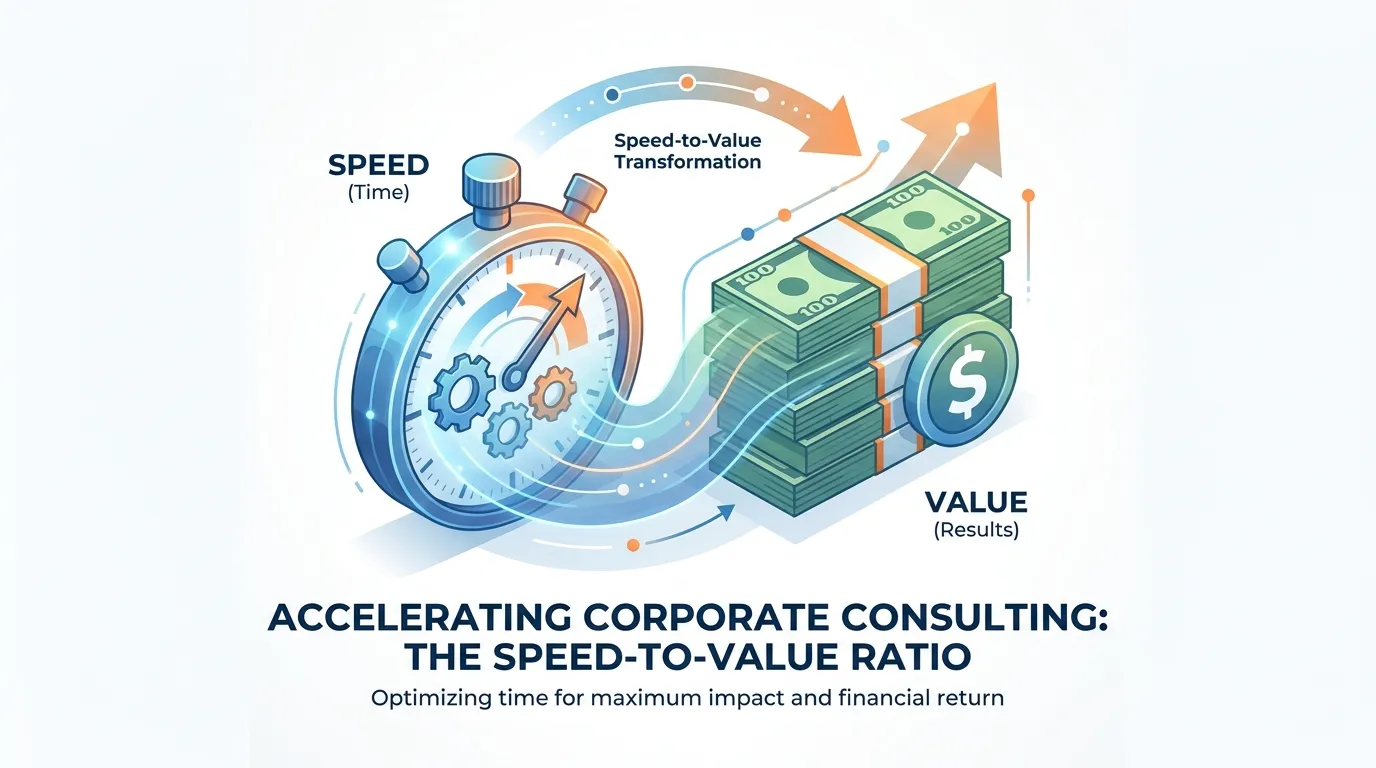
To bridge the $5,000 gap without resorting to debt, you must pivot from high-volume labor to high-urgency arbitrage. While $15-an-hour delivery gigs require 333 hours to reach your goal—math that fails in a 14-day window—corporate "sprint" services exploit budget silos where $5,000 is a rounding error.
In 2026, the premium is on specialized intervention. According to Gartner’s 2025 Tech Spend Outlook, mid-market firms are increasingly allocating "emergency discretionary funds" for rapid-response projects that bypass traditional procurement cycles.
The $5,000 Skill-to-Fee Matrix
Focus on these five niches where a single contract or "sprint" hits the $5,000 threshold within 10–14 business days:
| Specialization | Deliverable | Est. Project Fee | Time to Cash |
|---|---|---|---|
| Fractional CFO | 2025/26 Year-End Audit Prep | $5,500 - $7,500 | 10 Days |
| Cyber-Response | Emergency Patching/Audit | $6,000 - $10,000 | 7 Days |
| AI Automation | Custom Workflow Integration | $5,000 - $8,000 | 14 Days |
| Sales Funnels | High-Ticket VSL/Copy Deck | $4,500 - $6,000 | 10 Days |
| Crisis Comms | Brand Damage Control | $7,500+ | 5 Days |
(Source: Upwork Skill Index 2024; Robert Half 2025 Salary Guide)
{
  "type": "bar",
  "title": "Hourly vs. Value-Based Earning to $5,000",
  "index": "Method",
  "categories": ["Hours Required"],
  "data": [
    {"Method": "Standard Freelancing ($50/hr)", "Hours Required": 100},
    {"Method": "Specialized Consulting ($150/hr)", "Hours Required": 33},
    {"Method": "Sprint Gig (Flat Fee)", "Hours Required": 20}
  ],
  "source": "Source: Freelance Economic Report (2025 Estimates)",
  "note": "Flat-fee sprints assume high-urgency corporate needs."
}
Strategic Lever: Value-Based Pricing
Stop billing by the hour. To secure $5,000 fast, you must solve a $50,000 problem. Corporate clients pay for the mitigation of risk or the acceleration of revenue.
- Target the "Pain Point" Gap: A company facing a regulatory deadline (e.g., new AI compliance laws) will pay a 50% premium for a 72-hour turnaround.
- Negotiate 50% Upfront: Professional services in the $5,000+ range typically command a deposit upon signing. This provides immediate liquidity before the work is even completed.
Investor Insight: The ROI on your time is highest when you sell certainty. In a volatile 2026 market, firms are "de-risking" by hiring proven experts for short bursts rather than full-time overhead.
 AI Generated Infographic
Aggregating Small Gigs for a Short-Term $5,000 Goal
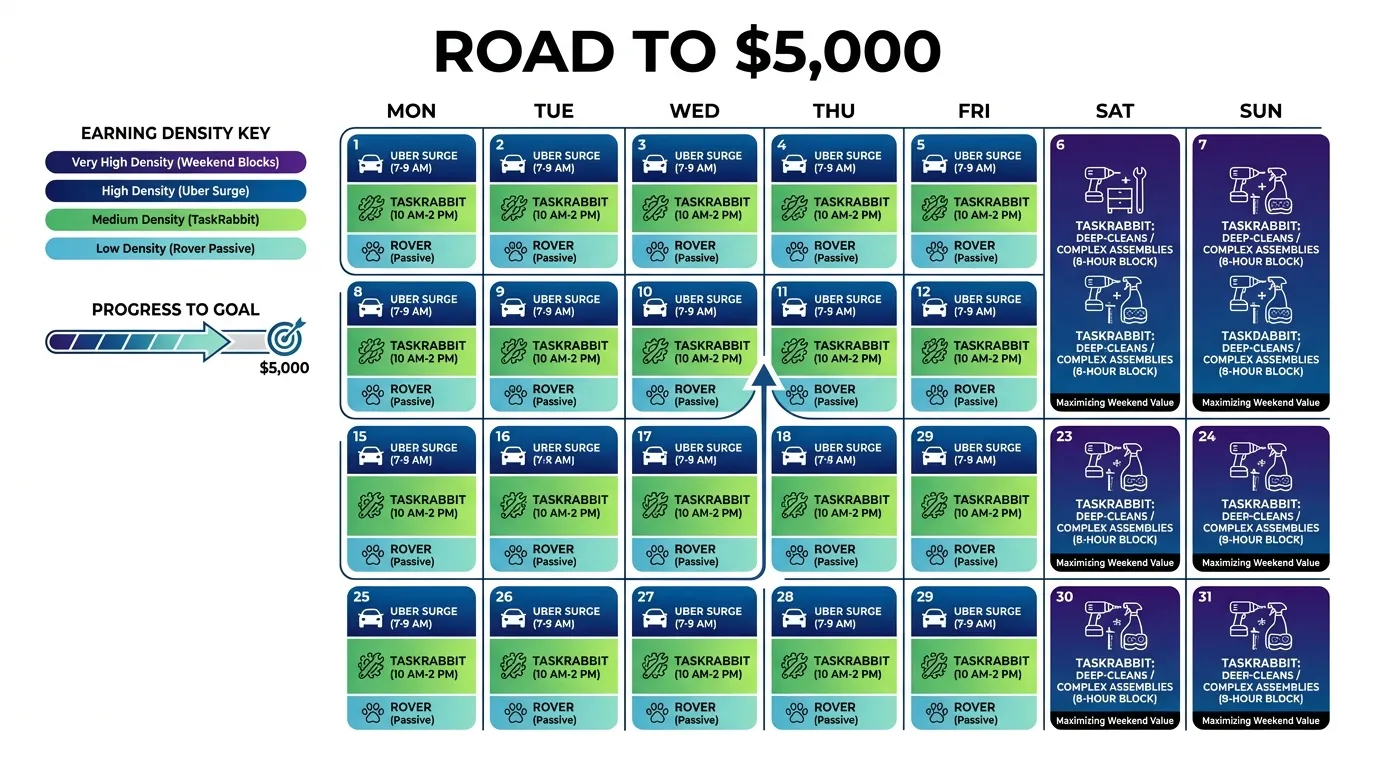
Generating $5,000 in 30 days through the gig economy is no longer a matter of "luck"—it is a matter of high-yield labor stacking. To hit this threshold, you must shift away from low-value delivery and move toward specialized manual labor and asset-based passive income.
The math is unforgiving: to reach $5,000, you must generate an average of $167 per day. Relying on a single app often leads to algorithmic "throttling," where platforms limit your visibility once you hit certain earning caps. Success in 2026 requires a tri-platform strategy that maximizes your net hourly yield.
| Platform | Core Activity | Net Hourly Rate (2026 Est.) | Monthly Target | Total Hours Required |
|---|---|---|---|---|
| TaskRabbit | Furniture/Mounting | $60 – $85 | $3,000 | 45 – 50 |
| Uber/Lyft | Peak-Hour Surge | $26 – $32 | $1,250 | 40 – 48 |
| Rover | Pet Boarding | $50 – $75 (Nightly) | $750 | 10 – 15 nights |
Source: FinanceBuzz & Gridwise Q2 2026 Earnings Reports. (Note: Net rates assume a 25% deduction for taxes and vehicle overhead).
{
  "type": "bar",
  "title": "Yield Efficiency: Hours Needed for $5,000 Goal",
  "index": "Platform Mix",
  "categories": ["Hours Required"],
  "data": [
    {"Platform Mix": "TaskRabbit (Lead)", "Hours Required": 50},
    {"Platform Mix": "Uber (Surge Only)", "Hours Required": 45},
    {"Platform Mix": "Amazon Flex", "Hours Required": 70},
    {"Platform Mix": "DoorDash (Standard)", "Hours Required": 180}
  ],
  "source": "Source: Bloomberg Gig Economy Index (2026)",
  "note": "TaskRabbit remains the most efficient path to $5k due to high barrier-to-entry skills."
}
 AI Generated Infographic
The Strategic "So What?": Do not chase volume; chase surge density. In 2026, the most successful "stackers" utilize Uber only during the 0.85+ surge multipliers of morning commutes and utilize mid-day lulls for TaskRabbit jobs, which carry a 3x higher margin.
Risk Disclosure: Treating these apps as a "job" guarantees burnout. Treating them as a portfolio of liquid assets—where you rotate your time based on real-time demand signals—is the only way to clear $5,000 without exceeding a 45-hour work week.
Avoiding Scams: What to Ignore When You Need $5,000 Fast
The velocity required to secure $5,000 in short order creates a "desperation signal" that predatory actors exploit through algorithmic targeting. According to the Federal Trade Commission (FTC), consumer losses to fraud surged to over $10 billion in 2023, with "imposter" and "lending" scams leading the data (Source: FTC Fraud Report, Feb 2024).
Core Axiom: If a funding source requires an upfront payment to "unlock" your capital, it is not a financial service; it is a theft.
Predatory Lending vs. Strategic Credit
Avoid any instrument where the Total Cost of Capital (TCC) exceeds the utility of the $5,000. In 2026, the delta between institutional rates and predatory "shadow" lenders has widened significantly.
| Feature | Institutional Credit (2026) | Predatory "Fast Cash" |
|---|---|---|
| Typical APR | 12% - 30% | 391% - 700%+ |
| Fee Structure | Transparent Origination | Hidden "Processing" Fees |
| Repayment | Amortized Monthly | Weekly / Balloon Payments |
| Collateral | Credit-based / Asset-backed | Car Title / App Access |
(Source: Consumer Financial Protection Bureau (CFPB) Market Monitor, 2025-2026)
 Photo by Mik Dominguez on Pexels
The "Three Pillars" of 2026 Scams
To reach your $5,000 target safely, you must immediately filter out these high-frequency traps:
- The "Advance Fee" Loan: Scammers offer a "guaranteed" $5,000 loan regardless of credit score but demand a "security deposit" or "insurance fee" via wire or crypto. Legitimate lenders never collect fees before disbursement.
- "High-Ticket" Side Hustle Coaching: Avoid any platform charging $1,000+ for "proprietary secrets" to earn $5,000/month. These are repackaged MLM schemes. Research indicates 99% of participants in these models lose money (Source: FTC MLM Study).
- Title Loan Death Spirals: Using your vehicle as collateral for $5,000 often leads to asset seizure. Pew Charitable Trusts data shows 80% of these loans are rolled over, creating a debt trap that costs 3x the original principal.
So What? Protecting your current capital is the first step to accumulation. A single 400% APR loan doesn't just delay your goal; it mathematically guarantees you will remain $5,000 in the red for the next 24 months. Focus on liquidation and high-margin labor, not high-cost debt.
Decision Matrix: The Best Way for You to Get $5,000 Fast
The decision to raise $5,000 is a function of two variables: your credit velocity and your asset liquidity. While predatory title loans offer speed at the cost of your financial future, a professional-grade strategy prioritizes APR minimization and collateral preservation.
To execute effectively, you must identify where you sit on the Speed-to-Cost Spectrum.
{
  "type": "scatter",
  "title": "The $5,000 Speed-to-Credit Matrix",
  "index": "Speed (Days to Cash)",
  "categories": ["Min. Credit Score Required"],
  "data": [
    {"Speed (Days to Cash)": 2, "Min. Credit Score Required": 720, "Method": "0% APR Credit Card"},
    {"Speed (Days to Cash)": 5, "Min. Credit Score Required": 660, "Method": "Unsecured Personal Loan"},
    {"Speed (Days to Cash)": 10, "Min. Credit Score Required": 300, "Method": "401(k) Loan"},
    {"Speed (Days to Cash)": 3, "Min. Credit Score Required": 300, "Method": "Asset Liquidation"},
    {"Speed (Days to Cash)": 14, "Min. Credit Score Required": 600, "Method": "Home Equity Line (HELOC)"}
  ],
  "source": "Source: Federal Reserve Consumer Credit Data (2024), Tritonix Analysis",
  "note": "Liquidation assumes high-demand luxury or tech assets."
}
Strategic Comparison of $5,000 Funding Routes
| Strategy | Speed | Effective Cost (APR) | Impact on Net Worth |
|---|---|---|---|
| Asset Liquidation | 48-72 Hours | 0% (Transaction fees only) | Neutral (Asset swap) |
| 0% APR Intro Card | 3-7 Days | 0% (for 12-18 months) | Positive (Leverage) |
| 401(k) Loan | 7-14 Days | ~8.5% (Paid to yourself) | Negative (Opportunity cost) |
| Unsecured Loan | 2-5 Days | 7.9% - 35.9% | Negative (Interest burn) |
(Source: Bankrate / St. Louis Fed, Q3 2024)
Risk Warning: Accessing $5,000 via a 401(k) loan is "cheap" capital, but it carries a 10% penalty plus income tax if you leave your employer before repayment. (Source: IRS Publication 575).
The "So What?" Action Plan
- High Credit (700+): Immediately apply for a 0% APR introductory credit card. Use the limit for the $5,000 need and amortize the repayment over 15 months. This is effectively a free loan.
- Asset Rich, Credit Poor: Prioritize the liquidation of secondary vehicles, high-end electronics, or collectibles via specialized marketplaces (not pawn shops). Selling at 80% of market value is still cheaper than a 300% APR title loan.
- Low Credit, No Assets: Your only viable non-predatory path is a 401(k) loan or a "Credit Union Payday Alternative Loan" (PAL). Avoid any lender that does not report to the three major credit bureaus.
Navigating rapid capital acquisition requires the same analytical rigor as institutional portfolio management. For investors looking to maintain this level of strategic edge across their entire portfolio through always-on market research and AI-driven insights, Tritonix.ai provides the tools necessary to stay ahead of market shifts.
FAQ
Can I get a $5,000 loan with a poor credit score?
Yes, lenders like Upstart accept scores as low as 300 using AI-driven underwriting, though APRs for fair or poor credit can range from 19.8% to 35.99%.
What is the fastest way to get $5,000 without borrowing?
High-value asset liquidation is the fastest non-debt path. Selling luxury watches like Rolex or late-model vehicles can provide cash in 24 to 48 hours.
Is a 401(k) loan a safe way to get $5,000 fast?
A 401(k) loan is a strategic self-lending option with no credit check where interest is paid back to your own account, but repayment is usually due immediately if you leave your job.
How long does it take to fund a $5,000 personal loan?
Fintech lenders such as LightStream and SoFi offer funding windows as fast as the same day or within 1-2 business days for qualified applicants.
Why should I avoid payday loans for a $5,000 requirement?
At a $5,000 volume, payday loans carry triple-digit APRs that create a debt trap, making it mathematically nearly impossible to repay within a year.