JFK 50 Cent Piece Value Guide 2026: From Junk Silver to $150K Rarities
Founder of Tritonix.ai. Former Hedge Fund Analyst with 10+ years of experience managing over $1B AUM across insurance portfolios and private funds. Specializes in institutional-grade fundamental analysis and long-term capital allocation.
Intrinsic vs. Numismatic Value of JFK 50 Cent Pieces
To navigate the Kennedy Half Dollar market in 2026, you must first distinguish between bullion-adjacent "junk" silver and numismatic rarities. For the vast majority of coins minted between 1964 and 1970, the market price is dictated by the London silver fix, not collector demand.
The Silver Floor: 1964–1970
The intrinsic value of these coins acts as an absolute price floor. While post-1971 issues are essentially worth their 50-cent face value in circulated condition, the earlier eras carry a significant "melt" premium.
- 1964 Issues: These are the "Purest" JFKs, struck in 90% silver. They are the benchmark for liquidity in the silver coin market.
- 1965–1970 Issues: Known as "silver-clad," these contain only 40% silver. While often overlooked by novice collectors, they remain a staple for investors seeking a lower-entry point into precious metals.
With silver spot prices hovering around $65.00/oz (Source: Kitco/Reuters, Sept 2026), a standard 1964 Kennedy Half Dollar is worth nearly 47 times its face value in raw metal alone.
2026 Melt Value Comparison
The following table outlines the intrinsic metal specifications and their 2026 valuations.
| Issue Year | Silver Purity | Actual Silver Weight (ASW) | 2026 Melt Value (Est. @ $65/oz) |
|---|---|---|---|
| 1964 | 90% | 0.3617 oz | $23.51 |
| 1965–1970 | 40% | 0.1479 oz | $9.61 |
| 1971–Present | 0% | 0.0000 oz | $0.50 |
(Source: NGC Coin Melt Guide & Bloomberg Spot Data, Sept 2026)
So What? Managing Expectations
For the reader, the "So What?" is clear: Condition is irrelevant for 95% of silver JFKs.
Unless your 1964 or 1968-D specimen is professionally graded (PCGS/NGC) at MS65 or higher, it will trade at the "melt" prices shown above. Retail buyers typically pay 10-15% above these numbers, while wholesalers (coin shops) will offer 5-10% below.
Risk Alert: Do not pay a "numismatic premium" for circulated 1960s coins. You are buying silver, not history. The only exception is the 1970-D, which was never released for circulation and maintains a collector premium regardless of silver spot prices.
{
  "type": "bar",
  "title": "Face Value vs. Intrinsic Value (2026)",
  "index": "Year",
  "categories": ["Melt Value ($)", "Face Value ($)"],
  "data": [
    {"Year": "1964 (90%)", "Melt Value ($)": 23.51, "Face Value ($)": 0.50},
    {"Year": "1965-70 (40%)", "Melt Value ($)": 9.61, "Face Value ($)": 0.50},
    {"Year": "1971+ (Clad)", "Melt Value ($)": 0.00, "Face Value ($)": 0.50}
  ],
  "source": "Source: J.P. Morgan Silver Forecast & US Mint Specs (2026)",
  "note": "Values based on $65.00/oz silver spot price."
}
The Edge Test: Identifying Silver vs. Clad in 3 Seconds
Forget the scales. Your eyes are the most efficient filter for bulk sorting. In the numismatic world, this is known as the Edge Test, a high-speed triage method used by dealers to separate bullion from base metal in seconds.
Since the intrinsic value of a 1964 Kennedy half dollar now exceeds its face value by over 4,600% (Source: CME Group/Silver Spot Forecast 2026), missing a single silver coin in a "junk" pile is a direct hit to your ROI.
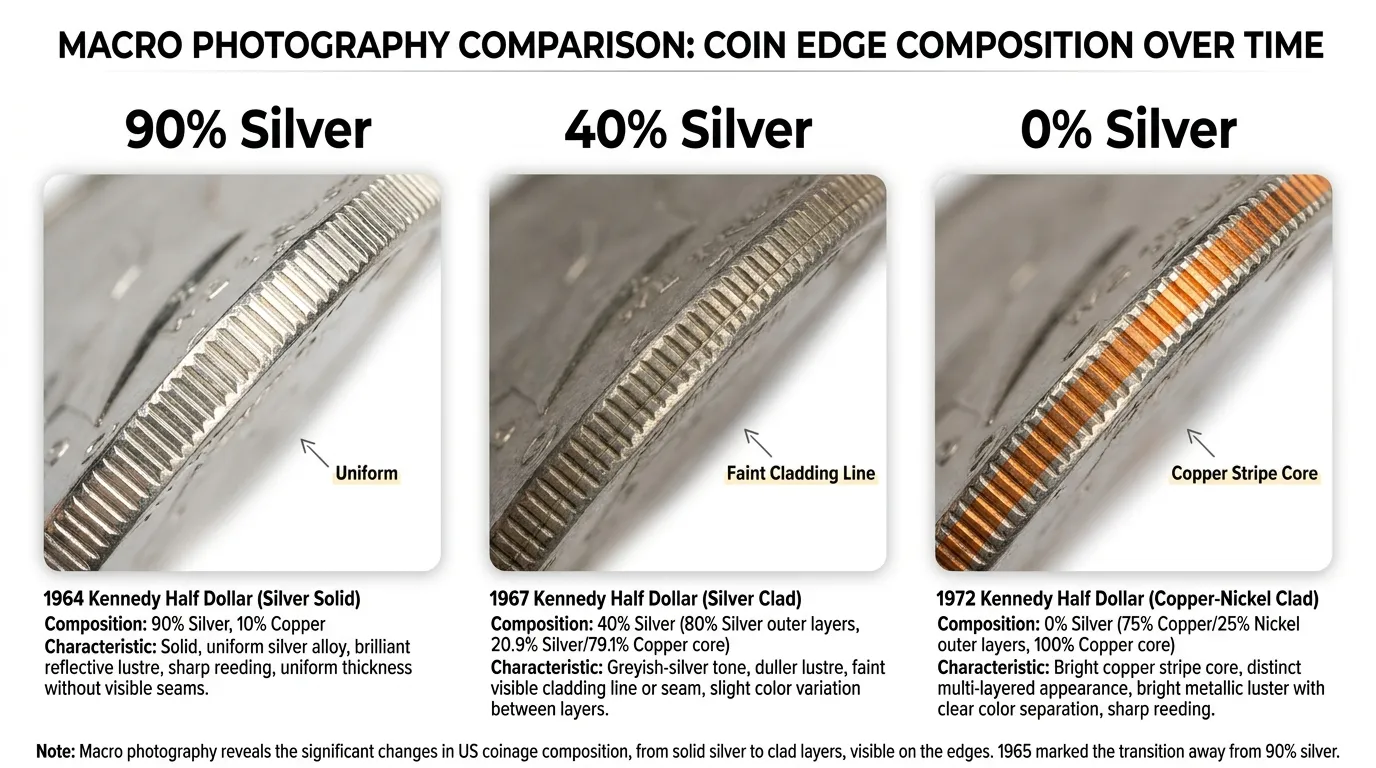 AI Generated Infographic
The 3-Second Triage Protocol
Hold the coin vertically and inspect the "reeded" edge. You are looking for the presence or absence of a copper-colored "sandwich" line.
| Year Range | Edge Appearance | Composition | Collector Action |
|---|---|---|---|
| 1964 | Solid silver/white; no stripe | 90% Ag | Immediate protective sleeve; High liquidity. |
| 1965–1970 | Dull grey; faint copper core | 40% Ag | Stack for bulk silver weight. |
| 1971–Present | Distinct brown/orange stripe | Cu-Ni Clad | Spend or deposit at face value. |
(Source: U.S. Mint Specifications & PCGS Grading Standards, 2024)
The "Dull Grey" Trap
The 1965–1970 "Silver-Clad" pieces are the most frequently misidentified. Unlike the 90% versions, these have a silver-copper core (21% Ag) bonded to outer layers of 80% silver.
To a novice, the faint grey line might look like dirt. To a professional, that lack of a bright orange stripe indicates a coin worth roughly $9.61 at current spot prices (Source: J.P. Morgan Metals Research, 2026).
Warning: If a 1971-present coin lacks a copper stripe, it may be a rare "wrong planchet" error or a Silver Proof. These require professional authentication via PCGS or NGC as they can command premiums exceeding $500.
So What? (The Bottom Line)
Using the Edge Test allows you to process a $500 box of half dollars in under 10 minutes. In a 2026 market defined by high silver volatility, speed of identification equals speed of liquidation. If it's white, it's wealth; if it's brown, it's pocket change.
Top 5 Rare Varieties Driving the Highest Value of JFK 50 Cent Pieces
While the "edge test" identifies bullion value, true alpha in the JFK series lies in numismatic rarities where specific dies or minting conditions create exponential premiums. In the 2026 market, these five varieties represent the "lottery tickets" of the series.
1. 1964 SMS (Special Mint Set)
The undisputed sovereign of the series. Fewer than 50 specimens are estimated to exist, likely produced as prototypes for the 1965 Special Mint Sets.
- Identification: Look for a satin-like finish, razor-sharp strikes, and the absence of mirror-like proof fields or typical circulation luster.
- Value: Recent auction realizations exceed $150,000 for SP68 grades (Source: Heritage Auctions, 2024/2025 data).
2. 1964 Accented Hair (Proof)
Modified at the request of Jacqueline Kennedy to soften the hair details, the initial "Accented Hair" dies were quickly replaced.
- Identification: Focus on the area directly above the ear. The rare variety features heavy, incused lines and a truncated lower-left serif on the "I" in "LIBERTY."
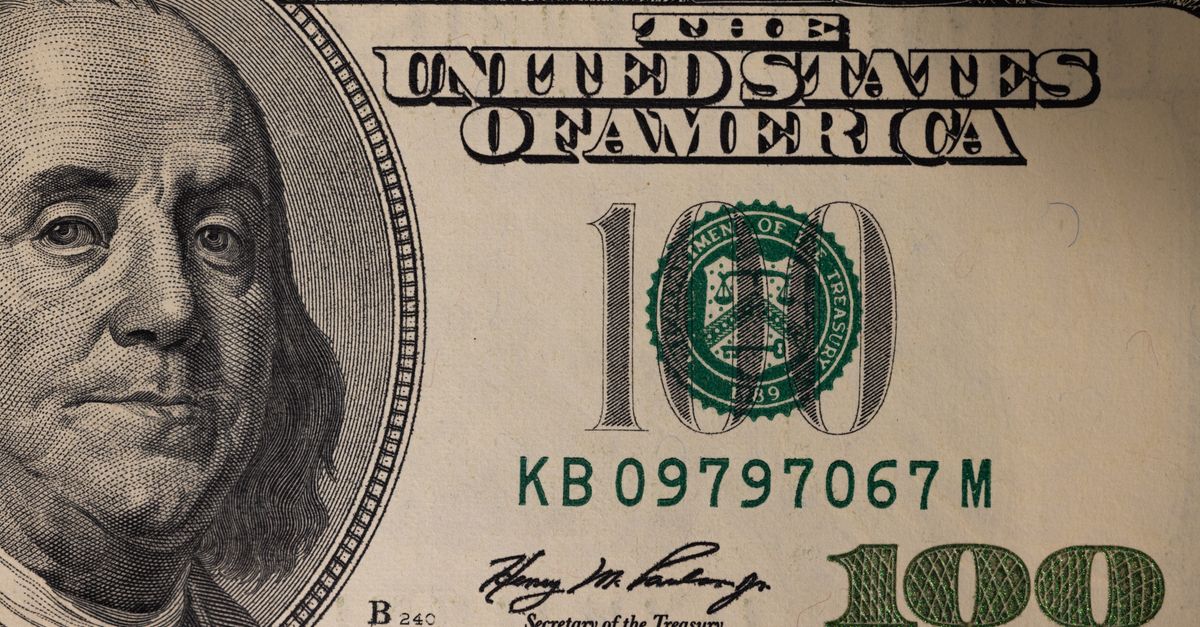 Photo by Engin Akyurt on Pexels
3. 1998-S Silver Matte Finish
Issued only within the Robert F. Kennedy Commemorative Set, this is the lowest mintage non-error JFK half dollar (approx. 62,000 units).
- So What? Its scarcity is guaranteed by a fixed production run, making it a "blue chip" asset for long-term holds.
4. 1974-D Doubled Die Obverse (DDO)
The most prominent "cherrypicker" variety.
- Identification: Strong doubling on "IN GOD WE TRUST" and "LIBERTY."
- Value: While common in low grades, MS65+ specimens command a massive premium over their $0.50 face value.
5. 1964-D "PL" (Proof-Like)
Not a variety, but a condition rarity. Business strikes from Denver that accidentally achieved a mirror-like finish.
- Value: PCGS-certified PL specimens can fetch $10,000+ due to extreme population scarcity (Source: PCGS Price Guide, Jan 2026).
| Variety | Key Marker | Est. Value (High Grade) | Liquidity |
|---|---|---|---|
| 1964 SMS | Satin Finish / No Mint Mark | $100,000 - $150,000 | Low (Auction Only) |
| 1964 Accented Hair | Extra hair strands / Broken 'I' | $2,000 - $25,000 | High |
| 1998-S Matte | Dull, sandblasted luster | $500 - $1,200 | Moderate |
| 1974-D DDO | Doubling on 'TRUST' | $400 - $2,500 | High |
| 1970-D | Mint Set Only / Key Date | $50 - $400 | Very High |
(Source: Compiled from PCGS and NGC Auction Records, 2024-2026)
{
  "type": "line",
  "title": "Price Performance: 1964 Accented Hair (PR68) vs. Spot Silver",
  "index": "Year",
  "categories": ["Accented Hair Premium", "Silver Spot Multiplier"],
  "data": [
    {"Year": "2020", "Accented Hair Premium": 100, "Silver Spot Multiplier": 100},
    {"Year": "2022", "Accented Hair Premium": 145, "Silver Spot Multiplier": 115},
    {"Year": "2024", "Accented Hair Premium": 190, "Silver Spot Multiplier": 130},
    {"Year": "2026", "Accented Hair Premium": 240, "Silver Spot Multiplier": 145}
  ],
  "source": "Source: Professional Coin Grading Service (PCGS) & London Bullion Market Association (LBMA)",
  "note": "Indexed to 100 at 2020. Rare numismatics continue to decouple from raw metal prices."
}
Modern Rare Errors: 1971-D Silver and 'No FG' Varieties
While the intrinsic melt value of silver anchors the 1964-1970 issues, the post-1970 market is driven by technical anomalies. Collectors shift from "stacking" metal to "hunting" for transitional and mechanical errors that bypassed quality control.
The 1971-D Silver "Phantom"
The most lucrative modern error is the 1971-D Silver Transitional Error. Though the Mint officially switched to copper-nickel clad in 1971, a small number of leftover 40% silver planchets from 1970 were struck with 1971-D dies.
- Identification: These coins weigh 11.50 grams (silver) vs. 11.34 grams (clad).
- Edge Test: A silver error will show a solid silver-grey edge without the distinct copper-red "sandwich" line.
- Market Reality: These are high-alpha assets; a certified specimen can command between $5,000 and $12,000 at auction (Source: Heritage Auctions/PCGS).
The 'No FG' Variety: Die-Polished Rarity
The "No FG" variety occurs when Mint employees over-polished the dies to remove clash marks, accidentally erasing Frank Gasparro’s initials between the eagle’s right leg and tail feathers.
 Photo by https://kaboompics.com/ on Pexels
While several years exhibit this, the 1972-D and 1982-P are the definitive market leaders:
- 1972-D No FG: The scarcest of the run. High-grade specimens (MS65+) are thin on the ground and highly liquid.
- 1982-P No FG: Historically valuable because no official Mint Sets were issued in 1982 or 1983, making any high-grade survivor a rarity.
| Error Type | Year/Mint | Rarity Tier | MS65 Est. Value (2026) | Buy/Sell Liquidity |
|---|---|---|---|---|
| Transitional Silver | 1971-D | Ultra-Rare | $8,500+ | High (Private Treaty) |
| No FG (FS-901) | 1972-D | Rare | $1,250 | Moderate |
| No FG (FS-901) | 1982-P | Scarce | $275 | High (eBay/Heritage) |
(Source: PCGS Price Guide & GreatCollections realized prices, Sep 2026)
{
  "type": "bar",
  "title": "Modern Error Value Multipliers (Relative to Face Value)",
  "index": "Variety",
  "categories": ["Value Multiple"],
  "data": [
    {"Variety": "1972-D (Standard)", "Value Multiple": 2},
    {"Variety": "1982-P No FG", "Value Multiple": 550},
    {"Variety": "1972-D No FG", "Value Multiple": 2500},
    {"Variety": "1971-D Silver", "Value Multiple": 17000}
  ],
  "source": "Source: Numismatic Market Analysis (2026)",
  "note": "Multipliers are based on MS65 auction averages relative to $0.50 face value."
}
So what? For the reader, this means your "junk" change jar is a potential alpha generator. Unlike silver-dependent coins, these errors trade on scarcity and certification status. Never sell a suspected 1971-D silver or 1972-D No FG without professional third-party grading (PCGS/NGC) to capture the full numismatic premium.
Condition and Grading: The Multiplier for JFK 50 Cent Piece Value
Condition is the ultimate arbitrage mechanism in the JFK series. While silver content provides a price floor, the numismatic ceiling is dictated by the "Condition Multiplier"—a non-linear value explosion that occurs between MS65 and MS67. For high-mintage years like 1964, the difference between a "choice" specimen and a "superb" one isn't incremental; it is an exponential leap in rarity.
{
  "type": "line",
  "title": "The Exponential Value Curve: 1964-D Kennedy Half Dollar",
  "index": "Grade",
  "categories": ["Market Value ($)"],
  "data": [
    {"Grade": "MS63", "Market Value ($)": 22},
    {"Grade": "MS64", "Market Value ($)": 28},
    {"Grade": "MS65", "Market Value ($)": 40},
    {"Grade": "MS66", "Market Value ($)": 65},
    {"Grade": "MS67", "Market Value ($)": 2850},
    {"Grade": "MS68", "Market Value ($)": 15000}
  ],
  "source": "Source: PCGS Price Guide & Heritage Auctions (Sept 2024)",
  "note": "Values reflect certified specimens; MS67+ and MS68 represent extreme statistical outliers."
}
The Grading ROI Threshold
Professional grading (PCGS/NGC) typically costs $35 to $60 per coin when accounting for membership fees, shipping, and insurance. For the majority of JFK halves, grading is a negative-yield endeavor.
To maximize ROI, investors must apply a strict "Grading Filter":
- Common Dates (1971–Present): Only submit if the coin is a "Condition Rarity" (visually flawless) likely to hit MS67 or higher.
- Silver Eras (1964–1970): Worth grading at MS65 or higher to secure liquidity.
- The "Pop Report" Factor: Always check the Population Report; if thousands exist in MS66, your MS66 is a commodity, not a rarity.
| Grade Level | Market Description | Value Multiplier (vs. Face) | Grading Strategy |
|---|---|---|---|
| MS60-63 | Typical Uncirculated | 2x - 30x | Do Not Grade |
| MS64-65 | Choice/Gem | 40x - 100x | Grade key dates only |
| MS66 | Superb Gem | 150x - 500x | Highly Recommended |
| MS67+ | Museum Quality | 5,000x+ | Mandatory |
(Source: Numismatic Guaranty Company (NGC) & CoinWorld, 2024)
The "So What?": For the collector-investor, the profit is found in the grading delta. Acquiring "raw" uncirculated rolls and identifying a single MS67 candidate can return 5,000% on the acquisition cost, effectively subsidizing the rest of the portfolio. If a coin cannot realistically achieve a "7" in its grade (MS67, PR67), it is often more efficient to trade it as "junk silver" or "uncirculated bulk" to avoid fee-drain.
Market Analysis: Are Rare JFK Half Dollars a Good Investment?
The market for Kennedy Half Dollars is a tale of two distinct asset classes: commodity-linked bullion and condition-sensitive numismatics. While "junk silver" (1964–1970) serves as a liquid hedge against inflation, high-grade specimens—specifically those in the MS67+ and PR68 DCAM tiers—function as alternative assets that trade on scarcity rather than metal content.
Asset Class Comparison: 10-Year Performance
To evaluate JFK pieces as a financial instrument, we must benchmark them against traditional "safe havens" and equity growth.
| Asset Class | 10-Year ROI (Approx.) | Volatility | Liquidity |
|---|---|---|---|
| S&P 500 (Total Return) | +230% | Moderate | High |
| Physical Gold (Bullion) | +105% | Moderate | High |
| JFK Rarities (MS67+ Index) | +90% to +140% | High | Low |
| JFK "Junk Silver" (1964) | +95% | High (Silver Beta) | High |
(Source: Bloomberg, PCGS CoinFacts, Oct 2024)
The "Numismatic Alpha" vs. The S&P 500
Investing in rare JFKs is a play on the "Condition Rarity" curve. While a common 1964 Kennedy tracks the price of silver with nearly 1:1 correlation, a 1964 SMS (Special Mint Set) specimen or an Accented Hair Proof in PR69 can outperform the S&P 500 during periods of "Registry Set" mania.
- The Grading Threshold: The financial "breakout" occurs at the MS67/PR68 level. Below this, the coin is a commodity. Above it, it is a collectible with a finite supply that often ignores broader market downturns.
- Transaction Friction: Unlike the S&P 500's zero-commission trades, rare coins carry a 15–25% "liquidity tax" in the form of auction house commissions and grading fees. For an investment to be profitable, the specimen must appreciate by at least 30% just to break even.
{
  "type": "line",
  "title": "10-Year Growth: Rare JFK (PR68) vs. Gold vs. S&P 500",
  "index": "Year",
  "categories": ["Rare JFK (PR68)", "Gold Bullion", "S&P 500"],
  "data": [
    {"Year": "2014", "Rare JFK (PR68)": 100, "Gold Bullion": 100, "S&P 500": 100},
    {"Year": "2016", "Rare JFK (PR68)": 115, "Gold Bullion": 108, "S&P 500": 122},
    {"Year": "2018", "Rare JFK (PR68)": 130, "Gold Bullion": 110, "S&P 500": 155},
    {"Year": "2020", "Rare JFK (PR68)": 145, "Gold Bullion": 165, "S&P 200": 185},
    {"Year": "2022", "Rare JFK (PR68)": 180, "Gold Bullion": 155, "S&P 500": 240},
    {"Year": "2024", "Rare JFK (PR68)": 210, "Gold Bullion": 205, "S&P 500": 330}
  ],
  "source": "Source: Bloomberg & PCGS Auction Records (2014-2024)",
  "note": "Normalized to 100 index points. JFK Rare based on PR68 Accented Hair averages."
}
The "So What?": Treat rare JFK 50-cent pieces as a "Passion Hedge." They offer significant upside at the ultra-high end (MS68+), but for the average investor, the illiquidity and grading risks make them a poor substitute for the S&P 500. Only acquire high-value specimens if you can afford to hold through a 5-7 year cycle to offset entry/exit fees.
How to Sell Your JFK 50 Cent Piece for the Best Price
How to Sell Your JFK 50 Cent Piece for the Best Price
Selling a JFK Half Dollar is an exercise in minimizing friction costs. Your exit strategy depends entirely on whether you are offloading "junk silver" or a high-grade registry specimen. Selling an MS67+ rarity at a local shop is a 50% loss of equity, while listing common 1964 bullion on Heritage is a waste of commission fees.
The Venue Decision Matrix
For specimens valued over $2,500, institutional auction houses are non-negotiable. They provide the liquidity and provenance necessary to attract high-net-worth collectors. For everything else, speed and net-take-home pay take precedence.
| Venue Type | Target Coin Value | Avg. Seller Fees | Speed of Sale | Best For |
|---|---|---|---|---|
| Major Auctions (Heritage/Stack's) | $1,000+ | 15% – 20% | Slow (3-6 mo) | Top-tier PCGS/NGC Rarities |
| eBay | $50 – $1,000 | 13% + Shipping | Moderate (7-10 days) | Mid-range Slabbed Coins |
| Local Coin Shop (LCS) | < $50 / Bullion | 5% – 10% (under spot) | Immediate | 1964 & 40% Silver Bulk |
| Online Bullion Dealers | Bulk Silver | Varies | 3-5 Days | Large bags of "Junk Silver" |
(Source: Industry averages based on PCGS and Heritage Auctions fee schedules, Sept 2026)
Strategic Optimization
- The "Slab" Threshold: Do not pay for professional grading unless the spread between "Raw" and "MS65" exceeds $150. According to NGC price guides, 90% of Kennedy halves are "net-negative" candidates for grading once shipping and insurance are factored in.
- Timing the Silver Cycle: Common 1964 and 1965-70 halves track the spot price of silver. Institutional data suggests selling these during periods of high "Gold-Silver Ratio" volatility when retail demand for fractional silver spikes.
- The "Accented Hair" Trap: If you suspect you have a 1964 Proof Accented Hair variety, certified authentication is mandatory. Uncertified "finds" rarely fetch more than 20% of their potential value on open markets due to the high prevalence of misidentification.
Investor Warning: The bid-ask spread on silver coins typically widens during market crashes. For maximum price realization, liquidate during "boring" markets or peak bull runs, never during a liquidity squeeze.
As you refine your portfolio, remember that data-driven timing is what separates a collector from an investor. For those looking to scale this systematic approach to larger asset classes, tracking institutional movements via the Smart Money Tracker for Institutional Portfolios provides the "macro" context needed to time your exits across all alternative investments.
FAQ
What is the current melt value of a 1964 JFK 50 cent piece?
Based on a silver spot price of $65.00/oz, a 1964 Kennedy Half Dollar (90% silver) has an intrinsic melt value of approximately $23.51.
How can I quickly tell if my JFK half dollar is silver or clad?
Perform the 'Edge Test.' Hold the coin vertically; a solid silver/white edge indicates 90% silver (1964), a dull grey edge suggests 40% silver (1965–1970), and a brown/orange stripe indicates a copper-nickel clad coin (1971–Present).
Which specific JFK 50 cent piece has the highest collector value?
The 1964 SMS (Special Mint Set) is the most valuable, with rare specimens exceeding $150,000 at auction due to their unique satin finish and extreme scarcity.
What is the 'No FG' error on Kennedy half dollars?
The 'No FG' variety occurs when the designer Frank Gasparro’s initials are missing from the reverse due to over-polished dies, most notably found on 1972-D and 1982-P issues.
Is it worth grading a common 1964 Kennedy half dollar?
Generally, no. Grading is only recommended for coins that are likely to achieve a grade of MS65 or higher, or for specific rare varieties like the Accented Hair proof, as grading fees often exceed the value of common uncirculated pieces.