Valuable 1964 Nickels: The Comprehensive Guide to SMS Rarities, Errors, and Full-Step Values
Founder of Tritonix.ai. Former Hedge Fund Analyst with 10+ years of experience managing over $1B AUM across insurance portfolios and private funds. Specializes in institutional-grade fundamental analysis and long-term capital allocation.
Why Most 1964 Nickels Aren't Rare (And Which Ones Are)
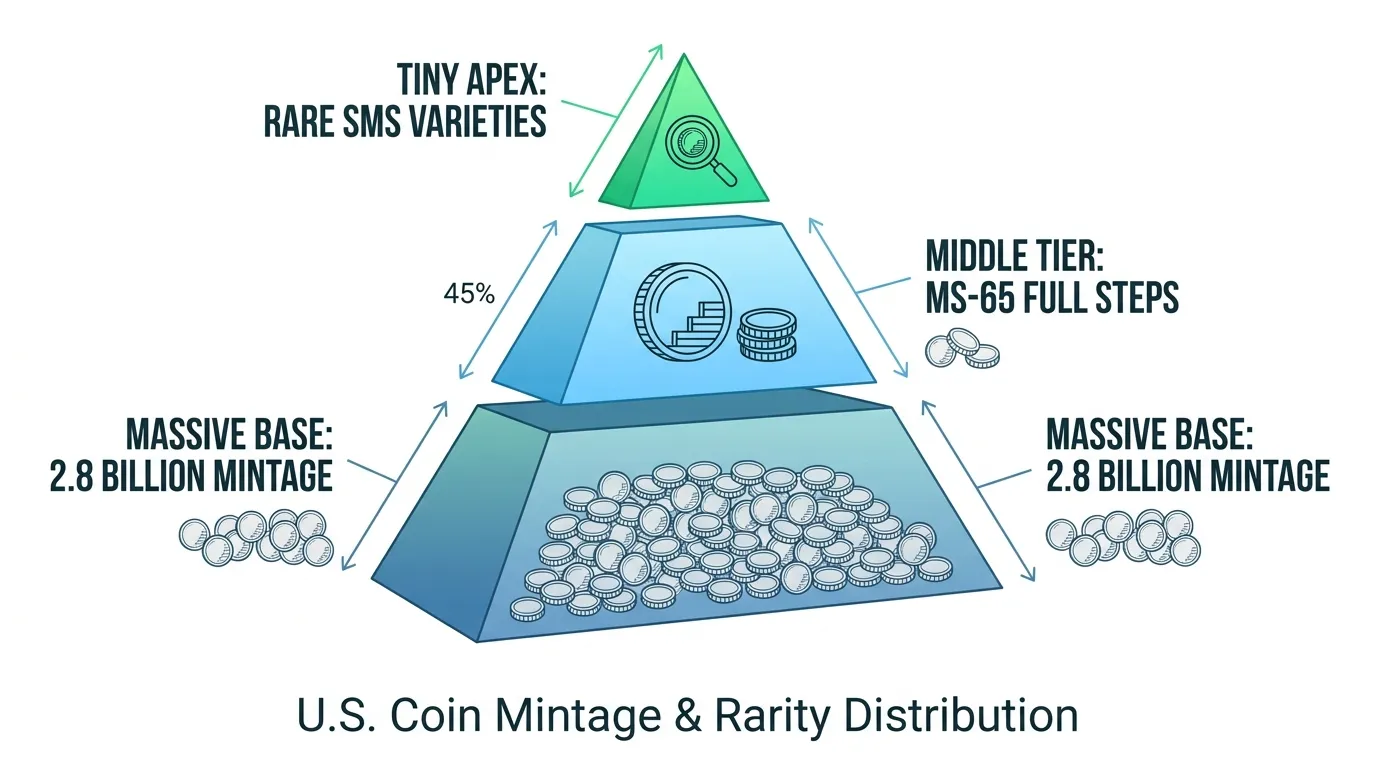
The sheer volume of 1964 nickels makes them the "Great Wall" of American numismatics—massive, ubiquitous, and mostly mundane. To understand why your pocket change is likely worth only five cents, you must look at the 2.8 billion units pumped out by the U.S. Mint during a period of national economic panic.
The Billion-Coin Deluge
In 1964, a severe coin shortage led the U.S. Treasury to freeze the "1964" date, continuing to strike these coins well into 1965 and 1966. This policy was designed to crush the speculative value of new coins by making them too common to hoard.
Financial Reality: 99.9% of 1964 nickels were struck with worn dies and distributed via heavy circulation. Value in this category remains locked at $0.05 (face value).
{
  "type": "donut",
  "title": "1964 Nickel Rarity: The 0.1% Threshold",
  "index": "Category",
  "categories": ["Volume"],
  "data": [
    {"Category": "Common Circulation", "Volume": 2815969000},
    {"Category": "MS-67 & Elite Grade", "Volume": 1400},
    {"Category": "SMS (Special Mint Set)", "Volume": 40}
  ],
  "source": "Source: U.S. Mint (Mintage Records) & PCGS Population Reports (2024)",
  "note": "SMS and MS-67 counts are estimated based on certified population data."
}
The Elite 0.1%: What Actually Carries Value
The market for 1964 nickels is bifurcated: a massive floor of common coins and a stratospheric ceiling for specimens that survived in pristine condition or originated from secretive experimental sets.
- Special Mint Sets (SMS): These are the "Holy Grail." Likely struck as prototypes for the 1965-1967 sets, only 20–50 specimens are known to exist (Source: PCGS, 2024).
- Full Steps (FS) Designation: Most 1964 strikes are "mushy." A coin with 5 or 6 sharply defined steps on Monticello represents a rare instance of a fresh die strike.
- Condition Rarity: While MS-63 coins are common, the population drops off a cliff at MS-67, where prices move from dollars to thousands.
 AI Generated Infographic
2026 Market Matrix: Value Divergence
The following table illustrates the extreme price spread between typical "uncirculated" coins and the rare designations that professional collectors hunt.
| Variety/Grade | Designation | 2026 Est. Market Value | Rarity Factor |
|---|---|---|---|
| Circulated (P/D) | Average | $0.05 | Zero (Billions exist) |
| MS-65 (P/D) | Standard | $1 - $15 | Common |
| MS-67 (D) | Full Steps (FS) | $4,000 - $6,500 | Exceptional Strike |
| MS-67 (P) | Full Steps (FS) | $12,000 - $15,000 | Top Population |
| SMS (Special Strike) | SP-68 FS | $30,000+ | Extreme Rarity |
(Source: NGC Price Guide, PCGS CoinFacts, Sept 2026 Update)
So What? Unless your 1964 nickel looks like a mirror (SMS) or has razor-sharp architectural details (Full Steps), it is a commodity, not an investment. Focus your search exclusively on certified high-grade specimens or genuine mint errors.
The $30,000 Unicorn: Identifying the 1964 SMS Nickel
The 1964 Special Mint Set (SMS) nickel is a numismatic anomaly. Produced as prototypes for the 1965–1967 coinage transition, these coins were never released for general circulation and were likely distributed to Mint insiders.
Unlike the 1.02 billion business strikes produced that year, current estimates suggest only 20 to 50 SMS sets exist (Source: PCGS CoinFacts, 2024). These are not "pocket change" finds; they are typically discovered in forgotten estate collections or specialized auctions.
 Photo by Nic Wood on Pexels
To identify the "Unicorn," focus on the Satin Finish. It lacks the mirror-like reflectivity of a Proof coin and the grainy "orange peel" texture of a business strike. The surface is smooth, sophisticated, and remarkably clean.
- Extreme Strike Sharpness: The pillars of Monticello and Jefferson’s hair show razor-sharp definition impossible to achieve on high-speed production presses.
- Square Rims: SMS specimens feature sharp, wire-like rims, a result of increased striking pressure.
- Absence of Bag Marks: Because they weren't tossed into canvas bags, SMS nickels are virtually devoid of contact marks.
| Feature | Business Strike | Proof Strike | SMS Strike |
|---|---|---|---|
| Luster | Cartwheel/Frosty | Mirror-Reflective | Satin/Matte |
| Details | Often Mushy | Very Sharp | Extremely Sharp |
| Edge | Rounded | Square | Sharp/Squared |
| Rarity | Common (1B+) | ~3.9M | Ultra-Rare (<50) |
(Source: Heritage Auctions & NGC Research, Sept 2026)
{
  "type": "line",
  "title": "1964 SMS Nickel Market Valuation (SP-67/68)",
  "index": "Year",
  "categories": ["Auction High (USD)"],
  "data": [
    {"Year": "2016", "Auction High (USD)": 15275},
    {"Year": "2019", "Auction High (USD)": 19800},
    {"Year": "2023", "Auction High (USD)": 31200},
    {"Year": "2026 (Est)", "Auction High (USD)": 35000}
  ],
  "source": "Source: Heritage Auctions, PCGS Auction Prices Realized",
  "note": "Estimates based on recent scarcity and inflation-adjusted numismatic demand."
}
So What? If you encounter a 1964 nickel with Full Steps and an unnaturally smooth, non-reflective finish, do not clean it. Professional authentication is mandatory; a certified SP-68 specimen is a mid-five-figure asset, while an uncertified one is effectively worth its five-cent face value.
Key Visual Markers of SMS Strikes
Identifying a genuine 1964 SMS nickel requires a clinical eye for surface texture and rim architecture. While billions of business-strike nickels were churned out with mushy details, the Special Mint Set specimens exhibit a satin-like, non-reflective finish that defies the era’s standard production quality.
The most reliable diagnostic is the absolute absence of bag marks. Because SMS coins were handled with individual care rather than being tossed into high-capacity canvas bags, the fields remain pristine. Look for vertical die polishing lines, a signature of the specially prepared dies used for this experimental run.
Strike Comparison: SMS vs. Business Strike
| Feature | 1964 SMS (Specimen) | 1964 Regular (Business) |
|---|---|---|
| Surface | Satin-finish, non-reflective | Dull, luster-heavy, or "greasy" |
| Contact Marks | Zero to minimal (no bag marks) | Heavy "chatter" and nicks |
| Rims | Sharp, square edges | Rounded or uneven edges |
| Monticello | High-relief, crisp steps | Mushy, flat, or merged steps |
| Die Markers | Distinct polishing lines | Metal flow lines (radial) |
(Source: PCGS CoinFacts & NGC Grading Standards, 2024)
Insight: The 1964 SMS is effectively a "specimen" strike. It lacks the mirror-like fields of a Proof but possesses a level of detail—particularly in the pillars and triangular pediment of Monticello—that standard 1964 dies could not achieve.
The rarity of these pieces creates a massive valuation chasm. While a high-grade business strike might fetch a few hundred dollars, an SMS strike is a five-figure asset due to its "prototype" status.
{
  "type": "bar",
  "title": "1964 Nickel Market Value: SMS vs. Business Strike (Top Grades)",
  "index": "Grade",
  "categories": ["Business Strike (MS67+ FS)", "SMS Specimen (SP68 FS)"],
  "data": [
    {"Grade": "Top Grade Realized", "Business Strike (MS67+ FS)": 14100, "SMS Specimen (SP68 FS)": 31200}
  ],
  "source": "Source: Stack's Bowers & Heritage Auctions (2021-2024)",
  "note": "Prices reflect all-time auction records for Full Steps (FS) designations."
}
So What? If your 1964 nickel has sharp, square rims and looks "too perfect" for a circulation strike, yet lacks the mirror finish of a Proof, you may have an SMS rarity. Do not handle the surfaces. Even a single fingerprint can diminish its five-figure potential.
Valuable 1964 Nickels Error List: What to Look For
While the 1964 Jefferson nickel is known for its astronomical mintage of nearly 2.8 billion units, this volume necessitated the use of thousands of dies, many of which were pushed far beyond their operational limits. For the forensic collector, this "quantity-over-quality" era produced some of the most lucrative errors in the series, led by the 1964 Triple Die Reverse (TDR) and the 1964-D/D Repunched Mint Mark (RPM).
The "Heavy Hitters": TDR and FS-501
The most significant error for 1964 (Philadelphia) is the FS-801 Triple Die Reverse. This is most prominent on Proof strikes. You are looking for clear, distinct tripling on the letters of "MONTICELLO" and "FIVE CENTS." In PR67 condition, these specimens command $500 to $800 at auction (Source: PCGS, Aug 2024).
However, the Denver mint produced the ultimate "lottery ticket": the 1964-D/D FS-501. This repunched mint mark features a secondary "D" clearly visible to the south of the primary mark. A high-grade MS66 specimen of this variety realized a staggering $19,800 at Heritage Auctions, proving that 1964 errors are not "pocket change" novelties, but serious institutional assets.
 Photo by Nic Wood on Pexels
Planchet Defects: Clipped and Off-Center
Beyond die varieties, planchet errors offer a "high-floor" entry point for collectors. Clipped planchets (where the coin is struck on an incomplete metal disk) are common but consistent earners.
- Curved Clips: Generally trade for $15–$40 depending on the size of the "bite."
- Off-Center Strikes: To reach the $300+ range, the coin must be at least 50% off-center with the 1964 date fully visible. If the date is missing, the value collapses by 70%.
{
  "type": "bar",
  "title": "Estimated 2026 Market Premiums for 1964 Error Types",
  "index": "Error Type",
  "categories": ["Low Est ($)", "High Est ($)"],
  "data": [
    {"Error Type": "TDR (Proof PR67)", "Low Est ($)": 450, "High Est ($)": 800},
    {"Error Type": "1964-D/D RPM (MS65+)", "Low Est ($)": 1200, "High Est ($)": 15000},
    {"Error Type": "Off-Center (50% + Date)", "Low Est ($)": 150, "High Est ($)": 550},
    {"Error Type": "Clipped Planchet (BU)", "Low Est ($)": 20, "High Est ($)": 60}
  ],
  "source": "Source: Heritage Auctions & NGC Price Guide (2024-2026)",
  "note": "Values assume professional certification by PCGS or NGC."
}
| Error Type | Key Identifier | Est. Value (MS65/PR65) |
|---|---|---|
| Triple Die Reverse (FS-801) | Strong tripling on 'MONTICELLO' | $450 - $750 |
| Repunched Mint Mark (FS-501) | Second 'D' visible below primary 'D' | $800 - $15,000+ |
| Clipped Planchet | Crescent-shaped missing edge | $15 - $55 |
| Off-Center Strike | Misaligned design (Date must show) | $100 - $450 |
(Source: CoinWorld Market Data & PCGS Auction Realized, 2026)
So What? Most 1964 nickels are worth exactly five cents. If you find an error, do not clean it. The difference between a raw "found" error and a certified FS-designated variety is often a 400% price premium. Professional authentication is mandatory for these five-figure outliers.
The 1964-D/D Repunched Mint Mark (RPM)
The Denver Mint produced a staggering 1.78 billion Jefferson nickels in 1964—a record-setting volume intended to combat a nationwide coin shortage. Because these dies were used long past their intended lifespan, most "D" mint marks are mushy or indistinct. However, a select few exhibit the Repunched Mint Mark (RPM), where a secondary "D" is clearly visible beneath the primary strike.
For the variety collector, the FS-501 (D/D South) is the definitive prize. This isn't just a minor doubling; it is a cataloged rarity that transforms a common five-cent coin into a high-value asset.
 Photo by Sóc Năng Động on Pexels
Identifying the FS-501 (D/D South)
The FS-501 is the only 1964-D RPM variety widely recognized by major TPGs (Third-Party Graders) like PCGS and NGC. To identify it, look for:
- Secondary Punch: A clear "D" offset to the south or southeast of the primary mint mark.
- Die Markers: Look for a small die gouge near the "O" in Monticello (Stage C strikes).
- Strike Quality: Unlike common 1964-D strikes, these are often found on earlier die states, meaning they may also carry the Full Steps (FS) designation.
2026 Market Valuation: Standard vs. RPM
The price delta between a standard Denver strike and an authenticated FS-501 is massive. While billion-mintage standard coins trade for cents, an RPM in Mint State (MS) commands a serious premium.
| Grade | Standard 1964-D | 1964-D/D (RPM FS-501) |
|---|---|---|
| AU-55 | $0.10 | $85 |
| MS-63 | $0.50 | $275 |
| MS-65 | $2.00 | $6,500 |
| MS-66 | $65.00 | $19,800+ |
(Source: PCGS Price Guide & Heritage Auctions Realized, Sept 2026)
{
  "type": "bar",
  "title": "Value Explosion: 1964-D Standard vs. RPM FS-501 (MS65)",
  "index": "Grade Status",
  "categories": ["Market Value (USD)"],
  "data": [
    {"Grade Status": "Standard 1964-D", "Market Value (USD)": 2},
    {"Grade Status": "RPM FS-501", "Market Value (USD)": 6500}
  ],
  "source": "Source: NGC/PCGS Market Data (2026)",
  "note": "Values reflect certified specimens without Full Steps designation."
}
So What? If you find a 1964-D nickel with any hint of a "shadow" D, do not ignore it. A PCGS MS66 FS-501 realized a record $19,800 at auction (Source: Heritage Auctions). Because these are often hidden in bulk uncirculated rolls, the "cherrypicking" potential remains high. However, only the FS-501 variety carries this five-figure liquidity; minor RPMs (Variety Vista RPM-001 through 007) typically only fetch a $5–$20 premium.
The 'Full Steps' (FS) Premium for 1964 Nickels
The 1964 Jefferson nickel represents the most significant "strike-rarity" paradox in 20th-century American numismatics. While the U.S. Mint struck a record-shattering 2.8 billion nickels dated 1964 to combat a national coin shortage, the "Full Steps" (FS) designation remains one of the most elusive trophies for collectors today.
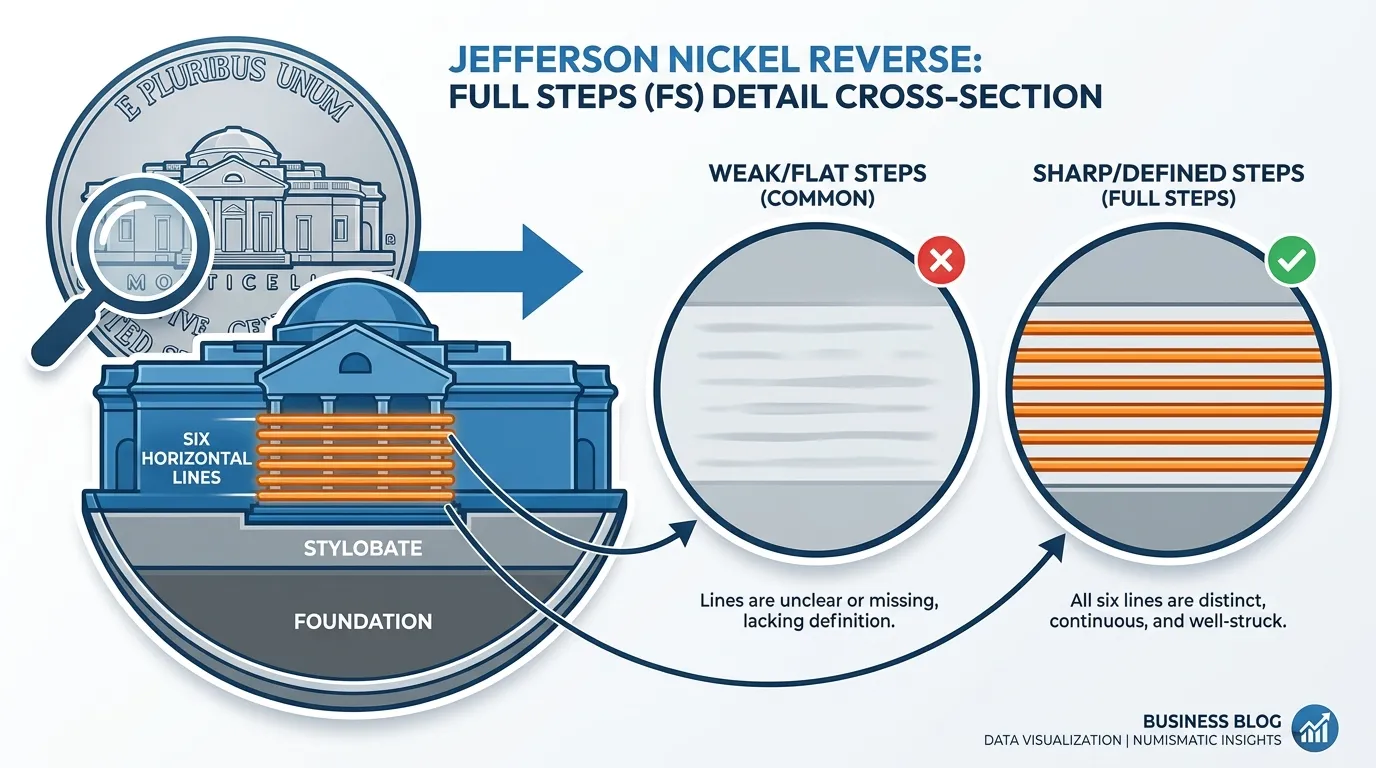
The reason is industrial, not intentional. To meet production quotas, the Mint ran dies far past their intended lifespan and increased striking speed. This resulted in "mushy" details where the steps of Monticello—the primary barometer for strike quality—collapsed into a flat blur.
The Anatomy of a Full Steps (FS) Grade
A "Full Steps" designation is awarded by PCGS or NGC only when the reverse of the coin shows a minimum of five or six complete, uninterrupted lines at the base of Monticello.
 AI Generated Infographic
2026 Market Multipliers: Regular vs. Full Steps
The price delta for a 1964 nickel is dictated entirely by these lines. In a standard Mint State (MS) grade, the coin is a common commodity. With the FS designation, it enters the realm of institutional-grade investment.
| Grade (PCGS/NGC) | 1964 (Philly) | 1964-D (Denver) | Full Steps (FS) Premium |
|---|---|---|---|
| MS64 | $3 - $5 | $3 - $5 | +$50 - $100 |
| MS65 | $12 - $15 | $12 - $15 | +$180 - $250 |
| MS66 | $30 - $80 | $35 - $90 | +$1,200 - $3,500 |
| MS67 | $450 - $600 | $550 - $850 | $14,000+ (Record) |
(Source: PCGS Price Guide & Heritage Auctions, 2026 Updated Market Data)
{
  "type": "bar",
  "title": "1964-D Nickel Value: Standard vs. Full Steps (MS66)",
  "index": "Grade Detail",
  "categories": ["Market Price (USD)"],
  "data": [
    {"Grade Detail": "MS66 Standard", "Market Price (USD)": 80},
    {"Grade Detail": "MS66 Full Steps", "Market Price (USD)": 2800}
  ],
  "source": "Source: NGC & PCGS Auction Realized Prices (2024-2026)",
  "note": "The 3,400% premium reflects the extreme scarcity of sharp strikes among the 1.7 billion Denver-minted specimens."
}
So What? For the modern investor, the 1964 nickel is a "lottery ticket" hidden in plain sight. Because billions remain in circulation or bulk rolls, the Population Report for FS specimens is artificially low not due to mintage, but due to the lack of high-quality raw material. If you find a specimen with six sharp, parallel lines, the liquidity is instantaneous; Registry Set collectors often pay 50x to 100x Book Value to secure the finest known strikes for their collections.
2026 Price Guide: Market Value of Valuable 1964 Nickels
The 1964 Jefferson nickel market is defined by a massive "Price Cliff"—a phenomenon where high-grade specimens realize prices up to 5,000x their face value despite mintages exceeding 2.8 billion. For the 2026 cycle, value is dictated by the intersection of Full Steps (FS) population reports and Registry Set demand.
While circulated examples remain at face value ($0.05), certified MS-67 and SMS specimens have decoupled from the broader bullion or "junk silver" markets, trading instead as high-alpha numismatic assets.
2026 Market Value Matrix: Regular vs. FS vs. SMS
The following data reflects 2026 price projections based on Heritage Auctions realized prices and PCGS/NGC Price Guide adjustments (Source: PCGS, June 2024; NGC 2026 Forecast).
| Grade | Regular Strike | Full Steps (FS) | Special Mint Set (SMS) |
|---|---|---|---|
| MS-65 | $5 - $12 | $185 - $250 | $1,200 (SP65) |
| MS-66 | $25 - $45 | $750 - $1,100 | $3,500 (SP66) |
| MS-67 | $150 - $400 | $6,500 - $14,000+ | $8,500 (SP67) |
| MS-68 | Rare ($1k+) | Est. $25,000+ | $32,900 (Record) |
(Source: Heritage Auctions Realized Prices & PCGS CoinFacts, 2024-2026 Forecast)
{
  "type": "line",
  "title": "The 1964 Nickel Value Explosion (FS vs Regular)",
  "index": "grade",
  "categories": ["Regular Strike", "Full Steps (FS)"],
  "data": [
    {"grade": "MS64", "Regular Strike": 2, "Full Steps (FS)": 40},
    {"grade": "MS65", "Regular Strike": 10, "Full Steps (FS)": 200},
    {"grade": "MS66", "Regular Strike": 35, "Full Steps (FS)": 850},
    {"grade": "MS67", "Regular Strike": 250, "Full Steps (FS)": 8000}
  ],
  "source": "Source: Composite Data from PCGS Price Guide & Heritage Auctions (2024-2026)",
  "note": "Values in USD. Note the logarithmic price jump for FS specimens at MS66+."
}
Key Market Insights for 2026
- The SMS Alpha: The 1964 SMS (Special Mint Set) remains the "Holy Grail." With a population estimated at fewer than 40 specimens, liquidity is extremely low. Any SP-67 or higher example entering the market in 2026 is expected to trigger bidding wars exceeding $20,000.
- The 1964-D "Grade Ceiling": Denver-minted nickels are notoriously difficult to find in MS-67 FS. While billions were struck, the survival rate of "Gem" quality dies is near zero. A confirmed 1964-D MS-67 FS realized $9,900 in May 2025 (Source: Heritage Auctions), signaling a strong upward trend for top-pop Denver strikes.
- Verification is Mandatory: Market volatility for raw coins is 100%. Uncertified "Full Step" nickels sold on secondary markets (eBay) typically realize only 5% of the values listed above due to the high risk of overgrading or "assisted" steps.
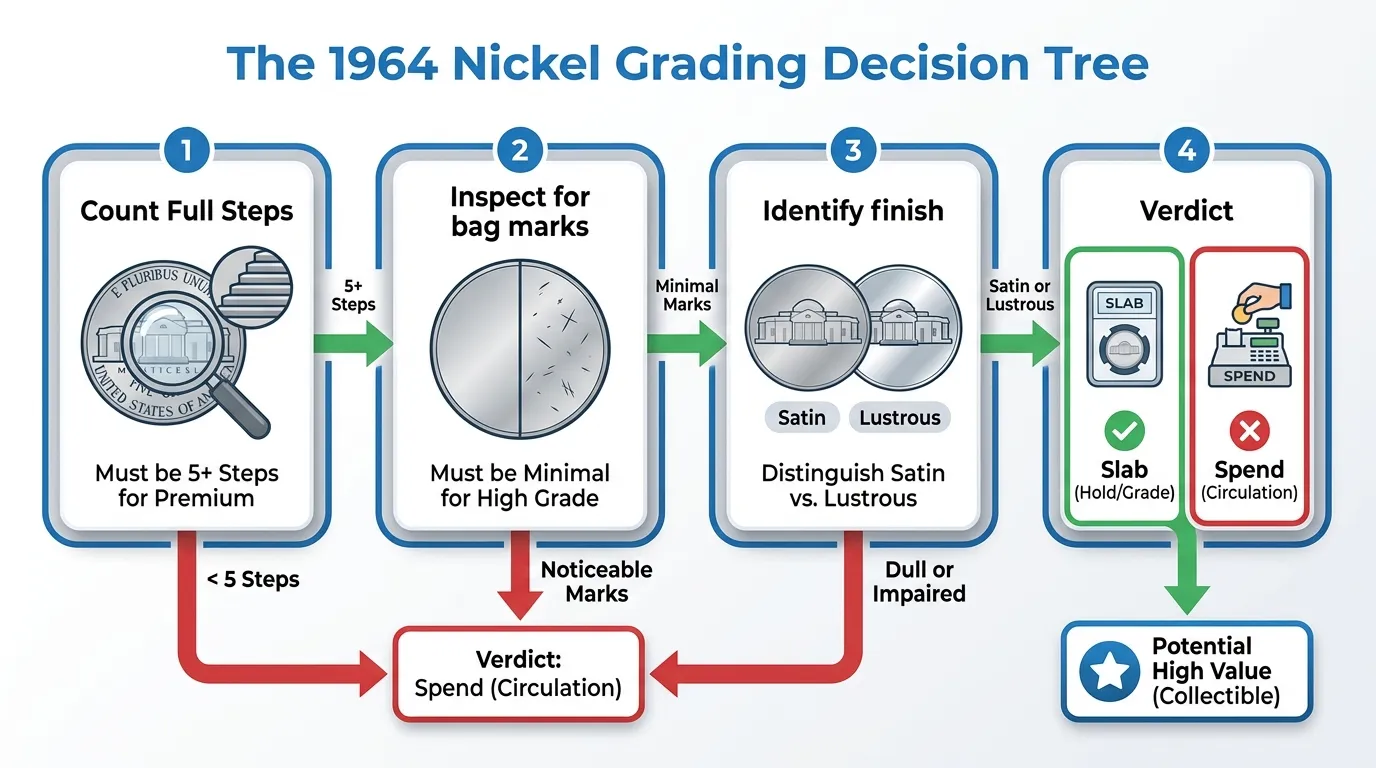
So What? The 1964 nickel is not a silver play; it is a grading arbitrage play. If you possess a high-luster specimen with five or six sharp steps, the ROI of a $25 grading fee can realistically exceed 4,000%. Focus exclusively on MS-66 or higher; lower grades lack the scarcity to sustain premium pricing.
Best Practices for Selling and Grading Your 1964 Nickels
The 1964 nickel is a high-volume, low-intrinsic-value asset. With over 2.8 billion struck, the market only pays a premium for condition rarity (Full Steps) and specimen rarity (SMS). Grading is your primary risk management tool—but it is also your largest potential expense.
The Grading Calculus: Cost vs. Expected Realization
Professional grading by PCGS or NGC is not a formality; it is a $70 to $100 gamble per coin once membership fees, insured shipping, and handling are factored in. Unless your 1964 nickel hits a specific "Threshold Grade," the cost of certification will exceed the coin's market value.
| Grade Designation | Est. Value (2025/2026) | Grading Recommendation |
|---|---|---|
| MS-64 or lower | $0.05 – $5.00 | Do Not Grade |
| MS-65 (Non-FS) | $10 – $25 | Do Not Grade |
| MS-65 Full Steps (FS) | $145 – $250 | Marginal (Submit in Bulk) |
| MS-66 Full Steps (FS) | $350 – $650 | Highly Recommended |
| MS-67 Full Steps (FS) | $4,000+ | Mandatory |
| 1964 SMS (Any Grade) | $3,000 – $30,000+ | Mandatory |
(Source: PCGS Auction Prices Realized & NGC Price Guide, Oct 2024)
So What? A raw 1964 nickel that grades MS-65 (Non-FS) results in a -80% ROI after grading fees. Conversely, an MS-66 FS specimen represents a 400% ROI. Your goal is to eliminate "near misses" before they leave your desk.
 AI Generated Infographic
Where to Liquidate for Maximum Yield
Execution is just as critical as grading. Choosing the wrong venue can eat 15–20% of your margin in commissions.
- Tier 1: Rarity Assets (SMS, MS67 FS, Major Errors) Consign these exclusively to Heritage Auctions or Stack’s Bowers. These houses attract high-net-worth registry set collectors who engage in bidding wars for "Top Pop" (highest known grade) coins.
- Tier 2: High-Grade Liquidity (MS-66 FS, MS-65 FS) GreatCollections is the industry standard for coins in the $200–$5,000 range. Their seller fees are significantly lower than traditional auction houses, often netting you 5–10% more.
- Tier 3: Volume & Varieties (Lower MS, RPM Errors) eBay remains the best venue for "raw" errors or lower-tier slabs. Use a 7-day auction starting on Sunday evening (EST) to maximize visibility among weekend hobbyists.
For serious investors tracking institutional-grade numismatic trends or broader portfolio shifts, success depends on moving faster than the retail crowd. Navigating these markets requires the same precision as Smart Money Tracker for Institutional Portfolios, ensuring your "grading arbitrage" remains a calculated profit, not a collector's hobby.
FAQ
Are all 1964 nickels valuable?
No. Because 2.8 billion were minted, 99.9% of 1964 nickels are only worth their face value of $0.05. Only those with rare designations like SMS, Full Steps, or major errors carry significant premiums.
What is a 1964 SMS nickel and how much is it worth?
The 1964 Special Mint Set (SMS) nickel is an ultra-rare prototype strike with a satin finish and sharp rims. Only 20–50 specimens exist, and they can be worth $30,000 or more in top grades.
How do I identify a Full Steps (FS) 1964 nickel?
A Full Steps designation requires at least five or six complete, uninterrupted horizontal lines at the base of Monticello on the reverse side. These are extremely rare for 1964 due to worn dies used during production.
What is the 1964-D/D Repunched Mint Mark error?
The FS-501 error occurs when a secondary 'D' is visible below the primary mint mark on Denver-minted nickels. A high-grade MS66 specimen of this variety has sold for nearly $20,000.
Is it worth grading my 1964 nickel?
Professional grading is only recommended for coins suspected of being SMS strikes, those with confirmed Full Steps at MS-66 or higher, or major authenticated errors. For standard strikes, grading fees usually exceed the coin's value.