UPS Stock in November 2026: Dividend, Valuation, and Outlook
Founder of Tritonix.ai. Former Hedge Fund Analyst with 10+ years of experience managing over $1B AUM across insurance portfolios and private funds. Specializes in institutional-grade fundamental analysis and long-term capital allocation.
What UPS stock is pricing after the November 11 close
UPS stock is the Class B common stock of United Parcel Service, Inc., trading on the New York Stock Exchange under the ticker UPS. The shares closed at $112.45 on Wednesday, November 11, 2026. Yahoo Finance and StockAnalysis both show the session up $1.40, or 1.26%, with a range of $111.13 to $112.64. U.S. equity markets were open that day, so this is the latest official close available as of Thursday, November 12.
At that price, StockAnalysis, citing S&P Global Market Intelligence data last updated November 11, put the company's market capitalization at $95.75 billion on 851.47 million shares outstanding. Trailing twelve-month revenue was $91.37 billion, net income was $4.42 billion, and GAAP earnings per share were $5.19. The trailing price-to-earnings ratio stood at 21.67.
The shares have already climbed out of this year's trough, but they are not priced as if the reset is finished. The 52-week range is $90.84 to $122.41. The November 11 close sits about 8% below that high and about 24% above the low. Yahoo Finance's trailing total return, including dividends, was 18.75% year to date and 26.10% over one year as of November 11. The price-only year-to-date gain on the same quote page was 13.37%.
UPS stock at $112.45 is discounting a stabilized 2026, a high cash yield, and only modest upside in the Street's average target.
A lot of the post-earnings bounce is already in the price. StockAnalysis reports a 29-analyst average target of $115.46, just 2.68% above the last close, with a consensus rating of "Buy." The 50-day moving average is $100.28 and the 200-day is $104.71, so the shares are trading above both after the late-October rally. Investors who want a rules-based read on that trend, rather than a single close, can check the setup in Tritonix’s AI technical analysis tools.
Ownership is institutionally heavy, though not extreme. Institutions hold 63.43% of the shares, insiders own 0.06%, and short interest is 26.21 million shares, or 3.08% of shares outstanding and 3.49% of the float, equal to 5.17 days to cover. That is not a crowded short. Readers who want to see how large funds are actually positioned, instead of inferring sponsorship from the ownership percentage alone, can cross-check 13F-style holdings through Tritonix’s institutional smart money dashboard.
{
  "type": "line",
  "title": "UPS Stock Closing Price Around the Q3 2026 Report",
  "index": "Date",
  "categories": ["Close"],
  "data": [
    {"Date": "2026-09-30", "Close": 93.44},
    {"Date": "2026-10-08", "Close": 94.13},
    {"Date": "2026-10-15", "Close": 97.83},
    {"Date": "2026-10-22", "Close": 101.52},
    {"Date": "2026-10-26", "Close": 100.32},
    {"Date": "2026-10-27", "Close": 106.09},
    {"Date": "2026-10-30", "Close": 108.25},
    {"Date": "2026-11-04", "Close": 114.31},
    {"Date": "2026-11-06", "Close": 108.30},
    {"Date": "2026-11-11", "Close": 112.45}
  ],
  "source": "StockAnalysis / S&P Global Market Intelligence, unadjusted session closes through November 11, 2026",
  "note": "October 27 is the third-quarter earnings date. UPS reported results before the open."
}
Third-quarter earnings and the raised 2026 outlook
The fundamental reset started before this week's tape. On October 27, 2026, before the open, UPS released third-quarter results and raised full-year guidance again. The company's earnings release showed consolidated revenue of $22.9 billion, up 6.7%, with growth in all three segments. GAAP operating margin was 7.6%, and non-GAAP adjusted operating margin was 9.0%. Diluted EPS was $1.37; adjusted EPS was $1.69.
GAAP results included a net charge of $279 million, or $0.32 per diluted share, made up of $130 million in after-tax transformation strategy costs and a $182 million goodwill impairment in Supply Chain Solutions, partly offset by a $33 million gain on the sale of MD-11 assets. Chief executive Carol Tomé said the quarter showed "the continued strengthening of our business fundamentals, driven by premium growth and greater network efficiency."
The segment mix is what matters for the stock. U.S. Domestic still supplies most of the revenue, International still supplies most of the margin, and Supply Chain Solutions is growing fastest while absorbing the impairment.
| Segment | Q3 2026 revenue | YoY | GAAP operating profit | GAAP margin | Adj. operating profit | Adj. margin |
|---|---|---|---|---|---|---|
| U.S. Domestic | $14.865B | 4.5% | $906M | 6.1% | $1,034M | 7.0% |
| International | $5.007B | 7.1% | $746M | 14.9% | $746M | 14.9% |
| Supply Chain Solutions | $2.981B | 18.2% | $92M | 3.1% | $274M | 9.2% |
Source: UPS third-quarter 2026 earnings release, October 27, 2026.
U.S. Domestic revenue rose even as average daily volume fell 3.3% to 15.621 million pieces, because revenue per piece increased 6.1%. About half of that yield gain came from base rates and customer mix, with the rest from fuel, according to the October 27 earnings call and Digital Commerce 360's October 28 report. International revenue rose 7.1% on a 15.0% increase in revenue per piece, and the 14.9% operating margin was the same on a GAAP and adjusted basis. Digital Commerce 360, citing Tomé, said International returned to year-over-year operating profit growth for the first time since U.S. trade-policy changes took effect in 2025.
Supply Chain Solutions was the growth engine on the top line and the weak spot on GAAP profit. Revenue increased 18.2% on forwarding and logistics, including healthcare, but GAAP operating profit dropped to $92 million after the impairment. Adjusted operating profit was $274 million, for a 9.2% adjusted margin, still well below the year-earlier adjusted $536 million.
Management raised the 2026 outlook. The company now expects consolidated revenue of about $92.6 billion, non-GAAP adjusted operating profit of about $8.75 billion, and adjusted diluted EPS of about $7.28. It also raised its adjusted free cash flow target to about $6.1 billion. For the fourth quarter, the call pointed to revenue of about $25.7 billion, up about 5%, and adjusted operating profit of about $3.3 billion. Capital expenditures are still expected at about $3.0 billion, with dividend payments of around $5.4 billion, subject to board approval.
The raised 2026 guide is a quality-of-revenue story: fewer packages, higher yield, and a still-elevated payout.
On guided adjusted EPS of $7.28, the November 11 close implies about 15.4 times earnings, cheaper than the 21.67 trailing multiple that is still carrying transformation charges and the impairment. That gap is why headline valuation screens can mislead on UPS stock right now.
The Amazon volume pivot toward healthcare and SMBs
The volume decline is intentional. In a July 28, 2026 company recap of the second-quarter call, UPS said it had completed its Amazon "glide down" and related network reconfiguration, "eliminating approximately 2 million pieces per day of lower-quality Amazon volume." The official third-quarter release confirmed that planned volume reductions from the company's largest customer were completed in the second quarter of 2026, while the broader Efficiency Reimagined initiative is not expected to finish until the fourth quarter of 2027.
The mix is already shifting. SMB average daily volume grew 3.7% in the third quarter, and SMBs, including platforms, represented a record 35.1% of total U.S. volume, up about 240 basis points from a year earlier. Average daily volume from SMB and enterprise customers together increased 1.8%, or more than 200,000 pieces per day. Healthcare revenue exceeded $3 billion for the third consecutive quarter, with year-over-year growth in every segment. Global Digital Access Program revenue reached $1.4 billion, and air services and ground commercial made up nearly 30% of DAP volume for the first time.
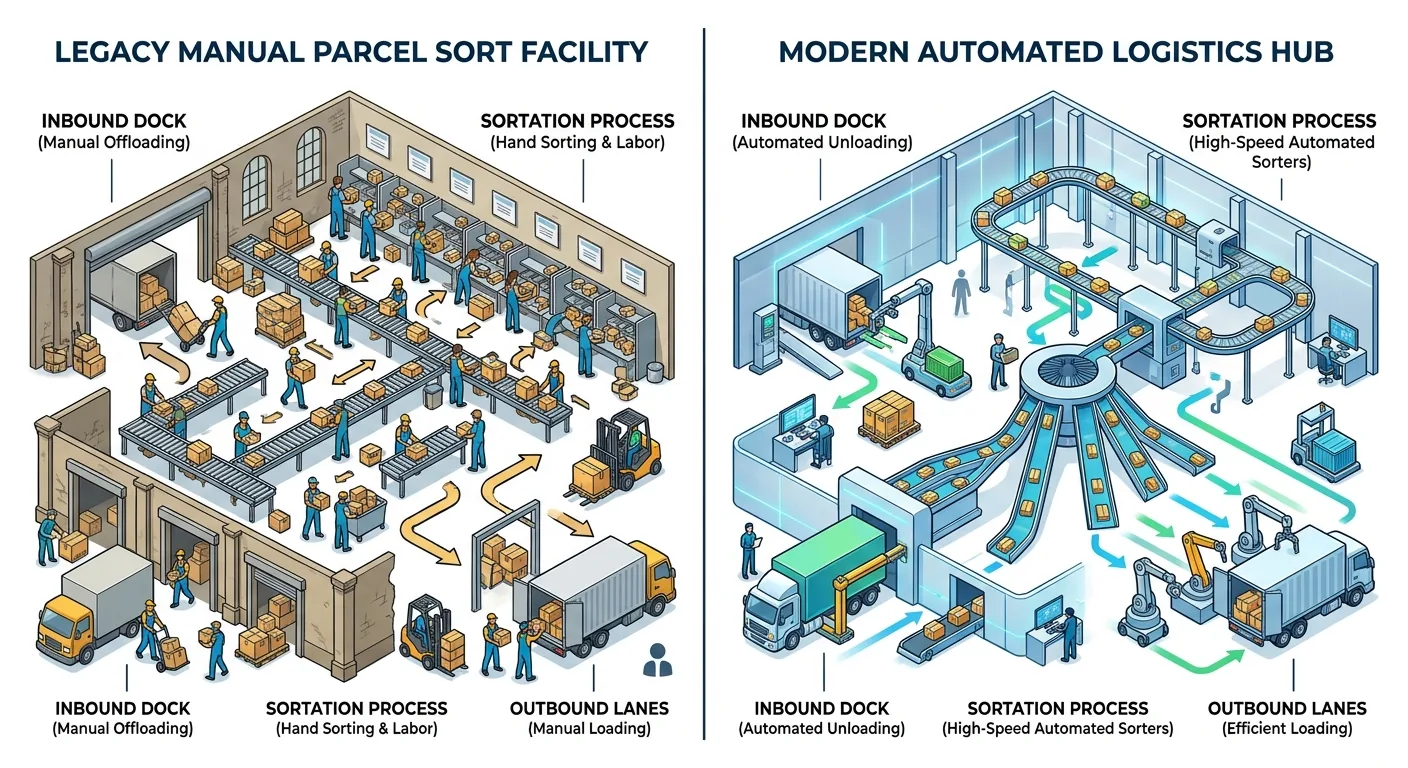
A conceptual look at the network shift UPS has been funding: fewer manual touch points and more automated sortation as lower-quality volume leaves the system.
That is the investment case in one picture: take out lower-quality Amazon density, automate more of what remains, and refill the network with healthcare, SMB, and other premium B2B volume. Tomé said nearly 70% of packages are expected to flow through automated processes during peak season, which should reduce the need for rented vehicles and extra aircraft. The company still expects average daily volume to rise about 25% from the third quarter to the fourth, in line with last year's seasonal surge, but Digital Commerce 360, citing CFO Brian Dykes, said fourth-quarter U.S. average daily volume is expected to decline 1.3% year over year because of the Amazon reduction.
On the October 27 call, Dykes said UPS had already captured $1.8 billion of a $3 billion 2026 cost-savings target through September, with the remaining $1.2 billion expected in the fourth quarter as Amazon-related hours leave the network. Transformation strategy costs are still heavy: the company expects $1.4 billion to $1.6 billion in such costs for the full year, and it had already incurred $1.4 billion of them in 2026 as of September 30. The final phase of the Driver Choice Program was completed at the end of the third quarter, with about 1,500 participants leaving the company.
The Amazon exit is largely done; the 2026 debate is whether healthcare, SMB, and automation can replace the density without breaking peak-season service.
Is the UPS dividend still covered by free cash flow?
Income is the main reason many investors still look at UPS stock. On November 4, 2026, the company declared its regular quarterly dividend of $1.64 on all outstanding Class A and Class B shares, payable December 3, 2026, to shareowners of record on November 16, 2026. That is a $6.56 annualized rate. At the November 11 close of $112.45, the forward yield is 5.83%. UPS said it has either maintained or increased its dividend each year since going public in 1999.
The coverage math is tighter on earnings than on cash. The $1.64 quarterly dividend exceeded third-quarter GAAP EPS of $1.37 and was only just covered by adjusted EPS of $1.69. StockAnalysis valuation data put the trailing earnings payout ratio at 126.40% on $5.19 of GAAP EPS, and the free-cash-flow payout ratio at 87.95%. Trailing free cash flow was $6.35 billion, or $7.46 a share, against an enterprise that still carries $30.52 billion of debt and $6.84 billion of cash.
The company's own cash-flow statement is more encouraging than the GAAP payout ratio. In the third-quarter release, non-GAAP free cash flow for the nine months ended September 30, 2026, was $4.22 billion, up from $2.74 billion a year earlier. Management then raised the full-year adjusted free cash flow target to about $6.1 billion. Against planned dividend payments of about $5.4 billion, that implies a payout of about 89% of guided free cash flow — covered, but with limited room if peak season disappoints or if transformation cash costs linger.
The dividend looks payable from 2026 free cash flow, not from GAAP earnings; that is a coverage cushion, not a blank check.
Capex of about $3.0 billion is modest relative to the dividend. That is consistent with a company that has already spent heavily to reconfigure the U.S. network and is now trying to harvest efficiency. It also means the payout, not growth spending, is the first claim on cash. Investors who need the 5.83% yield should watch fourth-quarter cash conversion, not just the adjusted EPS guide of $7.28, because a dividend this large has very little slack if free cash flow falls short of $6.1 billion.
How UPS stock valuation stacks up against FedEx
The natural comparison for UPS stock is FedEx. On November 11, FedEx shares closed at $322.63, with a market cap of $75.56 billion. UPS is the larger company and the richer yielder. It is more expensive on trailing earnings and cheaper on forward earnings.
| Metric (as of Nov. 11, 2026) | UPS | FedEx |
|---|---|---|
| Close | $112.45 | $322.63 |
| Market cap | $95.75B | $75.56B |
| Trailing P/E | 21.67 | 17.39 |
| Forward P/E | 14.10 | 16.11 |
| Annual dividend | $6.56 | $4.88 |
| Dividend yield | 5.83% | 1.51% |
| FCF payout ratio | 87.95% | 24.45% |
| Price-to-book | 6.38 | 2.45 |
| Debt / equity | 2.03 | 1.36 |
| Average target (29 analysts) | $115.46 | $356.62 |
| Implied upside | 2.68% | 10.54% |
Source: StockAnalysis / S&P Global Market Intelligence, last updated November 11, 2026. UPS yield is $6.56 divided by the $112.45 close.
The table is a reminder that "cheap" depends on the lens. UPS stock looks inexpensive if the $7.28 adjusted earnings guide, or the 14.10 forward multiple, is the right denominator. It looks fully valued, and more levered, if investors stay focused on trailing GAAP earnings, a 6.38 price-to-book ratio, and a 2.03 debt-to-equity ratio. FedEx, by contrast, offers a much lower 1.51% yield but a far more conservative 24.45% FCF payout and more implied upside in the average target.
Consensus is not a catalyst by itself. A 2.68% gap to the average UPS target means the stock has to earn its return primarily from the dividend and from any multiple expansion if the mix shift keeps working. That is a different bet from chasing a deep discount.
Versus FedEx, UPS stock is an income vehicle with a tighter payout and less stated upside, not a clearly cheaper compounder.
The risks still sitting under the yield
The first risk is volume, even after the Amazon glide down is complete. U.S. average daily volume is still running below last year, and management already expects a 1.3% year-over-year decline in the fourth-quarter U.S. figure. If SMB and healthcare growth slows, or if Amazon-related density losses prove harder to replace in a peak week than in a third-quarter run-rate, both margins and free cash flow could undershoot the raised guide.
The second risk is trade policy. Digital Commerce 360 reported that international average daily volume fell 8.7% in the third quarter. Dykes attributed the drop primarily to geopolitical tensions, and Tomé said the elimination of a European de minimis exemption for low-value imports in July caused a sharp decline in shipping volume. Conditions improved later in the quarter: U.S. inbound shipments returned to year-over-year growth in September, and China-to-U.S. and intra-Asia volume continued to increase. That recovery can reverse if tariffs or customs rules tighten again into 2027.
The third risk is labor and transformation cost. The official release still traces part of the network redesign to "volume diversions attributed to our 2023 labor negotiations." 2026 cash and earnings remain burdened by transformation charges of $1.4 billion to $1.6 billion, including the Driver Choice exits. A leaner, more automated network should help, but wage and benefit inflation does not disappear because Amazon volume has left. Any service miss in peak season would test both the cost-savings target and the dividend's cash coverage.
Peak itself is the near-term exam. Tomé cited industry forecasts for an average increase of about 9% in U.S. holiday online retail sales and said a little over 100 U.S. customers account for about 80% of the peak surge. That concentration is useful for planning and dangerous if a handful of large shippers pull back. Investors will get the next official update with fourth-quarter results, which Yahoo Finance currently lists around January 26, 2027, as an estimated date.
The 5.83% yield is compensation for volume, trade, labor, and peak-season execution risk, not a risk-free annuity.
UPS stock, at $112.45, is a high-yield logistics franchise mid-reset: the Amazon volume is largely gone, healthcare and SMB mix is improving, and 2026 free cash flow is guided to cover the dividend with a slim margin. The shares already trade close to the average target, so the next move depends less on a rerating and more on whether fourth-quarter cash flow confirms that the payout is earned, not merely declared.
FAQ
What is the latest price of UPS stock?
UPS stock closed at $112.45 on Wednesday, November 11, 2026, up $1.40, or 1.26%, according to Yahoo Finance and StockAnalysis. The 52-week range is $90.84 to $122.41.
What is the UPS dividend yield in November 2026?
On November 4, 2026, UPS declared a regular quarterly dividend of $1.64 a share, or $6.56 annualized, payable December 3 to holders of record on November 16. At the November 11 close of $112.45, that is a 5.83% forward yield.
Is the UPS dividend sustainable?
The $1.64 quarterly payout exceeded third-quarter GAAP EPS of $1.37 and was only just covered by adjusted EPS of $1.69. Coverage looks better on cash: the trailing free-cash-flow payout ratio was about 88%, and UPS guided 2026 adjusted free cash flow of about $6.1 billion against dividend payments of about $5.4 billion, subject to board approval.
Why is UPS reducing Amazon volume?
UPS completed its Amazon glide down in the second quarter of 2026, eliminating about 2 million lower-quality Amazon packages per day and reconfiguring the U.S. network toward higher-return work. In the third quarter, SMBs reached a record 35.1% of U.S. volume, and healthcare revenue exceeded $3 billion for the third straight quarter.
How does UPS stock compare with FedEx?
As of the November 11, 2026 close, UPS yielded 5.83% versus 1.51% for FedEx, according to StockAnalysis. UPS traded at 21.67 times trailing earnings and 14.10 times forward earnings, compared with 17.39 and 16.11 for FedEx. The average UPS target implied only 2.68% upside, versus 10.54% for FedEx.