Stock of BABA in 2026: Price, Valuation, and the AI-Cloud Bet
Founder of Tritonix.ai. Former Hedge Fund Analyst with 10+ years of experience managing over $1B AUM across insurance portfolios and private funds. Specializes in institutional-grade fundamental analysis and long-term capital allocation.
What the stock of BABA is pricing in now
The stock of BABA is the New York-listed American depositary share of Alibaba Group Holding Limited, the Hangzhou-based company that still makes most of its money in China e-commerce and is now spending like a hyperscaler to build an AI and cloud franchise. Each ADS represents eight ordinary shares. The same equity also trades in Hong Kong as 9988 (Hong Kong dollar counter) and 89988 (renminbi counter).
BABA closed at $102.72 on November 10, 2026, down $2.66, or 2.52%, on the session, according to Yahoo Finance and StockAnalysis. That close left the company with a market value of about $255.32 billion.
The more important context is the path from January. ChartExchange data show a 52-week high of $181.10 on January 22, 2026, and a 52-week low of $91.99 on June 26, 2026. The November 10 close sits 43% below that January peak and only about 12% above the June trough.
StockAnalysis, citing S&P Global Market Intelligence figures as of the same close, puts the 52-week price change at -38.25%. The stock also sits below both its 50-day moving average of $107.80 and its 200-day moving average of $123.96.
BABA is no longer priced as a 2026 rerating story. It is priced as a show-me stock: investors will pay for AI-cloud compounding only after they see cash flow stabilize and China commerce stop shrinking on a reported basis.
The next scheduled catalyst is already on the calendar: Alibaba reports results on Thursday, November 19, 2026, before the U.S. open, StockAnalysis confirms.
{
  "type": "bar",
  "title": "BABA Price Levels Versus the November 10, 2026 Close",
  "index": "Level",
  "categories": ["Price (USD)"],
  "data": [
    {"Level": "52-week high (Jan. 22, 2026)", "Price (USD)": 181.10},
    {"Level": "Analyst average target", "Price (USD)": 184.05},
    {"Level": "200-day moving average", "Price (USD)": 123.96},
    {"Level": "50-day moving average", "Price (USD)": 107.80},
    {"Level": "Nov. 10, 2026 close", "Price (USD)": 102.72},
    {"Level": "52-week low (June 26, 2026)", "Price (USD)": 91.99}
  ],
  "source": "ChartExchange 52-week high and low; Yahoo Finance / StockAnalysis closing price and moving averages as of November 10, 2026; StockAnalysis analyst-target average from 41 analysts",
  "note": "The January 22 high and the November 10 close imply a 43% drawdown from the 52-week peak. The average target is a Street compilation, not a company forecast."
}
Fiscal 2026 already showed the trade-off
Alibaba's fiscal year 2026, which ended March 31, 2026, is the base rate for the current debate. In its May 13, 2026 results, the company reported revenue of RMB1,023.67 billion ($148.40 billion), up 3% year over year. Excluding the disposed Sun Art and Intime businesses, like-for-like revenue would have grown 11%.
Profitability told a different story. Net income fell 19% to RMB102.13 billion ($14.81 billion). Non-GAAP net income dropped 62% to RMB60.66 billion ($8.79 billion) from RMB158.12 billion a year earlier, as Alibaba leaned into quick commerce, user experience, and technology investment. GAAP diluted earnings were $6.38 per ADS, down 18%. Non-GAAP diluted earnings were $3.89 per ADS, down 59%. Operating margin compressed from 14% to 5%, and adjusted EBITA margin fell from 17% to 7%.
The bright spot was already visible in the cloud line. Cloud Intelligence Group revenue rose 34% to RMB158.13 billion ($22.92 billion) in fiscal 2026. In the March quarter, Alibaba said external cloud revenue growth accelerated to 40%, helped by public-cloud demand and AI-related products.
| Metric | FY2025 | FY2026 | YoY |
|---|---|---|---|
| Revenue (RMB billion) | 996.35 | 1,023.67 | 3% |
| Like-for-like revenue growth | — | 11% | — |
| Operating margin | 14% | 5% | -9 ppt |
| Adjusted EBITA margin | 17% | 7% | -10 ppt |
| Net income (RMB billion) | 125.98 | 102.13 | -19% |
| Non-GAAP net income (RMB billion) | 158.12 | 60.66 | -62% |
| Diluted EPS / ADS (US$) | — | 6.38 | -18% |
| Non-GAAP diluted EPS / ADS (US$) | — | 3.89 | -59% |
| Cloud Intelligence Group revenue (RMB billion) | 118.03 | 158.13 | 34% |
Source: Alibaba Group, March quarter and fiscal year 2026 results, May 13, 2026. U.S. dollar figures are the company's convenience translations. Like-for-like growth excludes disposed Sun Art and Intime revenue. Percentage changes are calculated on renminbi amounts.
That mix is why the stock of BABA can look inexpensive on forward earnings and still trade as if something is wrong: reported growth was modest, margins were cut in half, and non-GAAP profits fell much faster than GAAP profits because management chose investment over near-term earnings quality.
The June quarter: cloud compounded, cash flow did not
The latest official snapshot is the quarter ended June 30, 2026, released on August 20, 2026, the first period of fiscal 2027. Revenue was RMB268.95 billion ($39.64 billion), up 9%—a healthier top line than the full-year 3% rate. The cost of the strategy still shows up below that line. Income from operations fell 57% to RMB15.16 billion ($2.23 billion), and the operating margin slipped to 6% from 14%. Adjusted EBITA declined 30% to RMB27.33 billion ($4.03 billion). GAAP diluted earnings were $0.55 per ADS, down 79%. Non-GAAP diluted earnings were $1.26 per ADS, down 42%.
Cash generation is the sharper constraint. Operating cash flow rose 11% to RMB22.95 billion ($3.38 billion), but free cash flow was an outflow of RMB44.67 billion ($6.58 billion), wider than the RMB18.82 billion outflow a year earlier. Capital expenditure jumped 75% to RMB67.68 billion ($9.98 billion) as Alibaba added AI infrastructure, including more CPU capacity for AI-agent workloads and higher component prices. Cash and other liquid investments were still RMB474.51 billion ($69.93 billion) as of June 30, 2026, down from RMB520.82 billion at March 31, mainly because of the free-cash-flow outflow and dollar-renminbi translation, partly offset by RMB11.01 billion ($1.62 billion) of net bank borrowings.
The bull case is that Alibaba is converting a cash-rich commerce platform into a full-stack AI company. The bear case is that $6.6 billion of negative free cash flow in a single quarter is what that conversion costs until cloud profits grow fast enough to fund it.
The segment mix makes that tension clear. In the June quarter Alibaba reorganized reporting into four groups: Alibaba E-commerce Group, AI Cloud and Compute Services, AI Labs and Applications, and All Others. E-commerce still supplied $30.34 billion of revenue, up 4%, while AI Cloud and Compute Services contributed $7.14 billion, up 45%.
| Segment | June-qtr 2026 revenue (US$ million) | YoY |
|---|---|---|
| China e-commerce | 16,345 | -8% |
| China quick commerce | 7,855 | 45% |
| International e-commerce | 4,091 | -1% |
| Global wholesale | 2,049 | 7% |
| Alibaba E-commerce Group total | 30,340 | 4% |
| AI Cloud and Compute Services | 7,139 | 45% |
| AI Labs and Applications | 492 | 16% |
| All others | 4,245 | 1% |
| Consolidated revenue | 39,639 | 9% |
Source: Alibaba Group, June quarter 2026 results, August 20, 2026. Consolidated revenue is after unallocated items and inter-segment eliminations. U.S. dollar figures are company translations at RMB6.7851 per dollar on June 30, 2026.
China customer-management revenue, the old advertising and commission engine, fell 7%. Excluding a contra-revenue effect from a new business-development program, CMR would have grown only 1%. Management pointed to weaker transaction activity, with some offset from higher Taobao monthly active consumers pulled in by quick commerce.
Quick commerce is the other growth engine inside the group. Revenue from Taobao Instant Commerce, Freshippo, and related on-demand delivery rose 45% to $7.86 billion. Alibaba said unit economics improved quarter over quarter through higher average order value and better fulfillment, while market share was maintained. Membership in 88VIP, the highest-spending cohort, rose at a double-digit pace to about 64 million as of June 30, 2026. AliExpress, in international retail, reached operating profit in the quarter.
E-commerce adjusted EBITA was almost unchanged at RMB39.75 billion ($5.86 billion), down just 1%. Cloud is starting to throw off more earnings as it scales: AI Cloud and Compute Services adjusted EBITA jumped 133% to RMB5.63 billion ($830 million), lifting the segment margin to about 12%.
The losses sit in the application layer. AI Labs and Applications posted an adjusted EBITA loss of RMB13.86 billion ($2.04 billion), versus a RMB3.22 billion loss a year earlier, reflecting heavier model investment and higher inference costs for the Qwen app. All Others swung to a $493 million adjusted EBITA loss, and the company recorded a RMB4.46 billion ($657 million) goodwill impairment in that group. General and administrative expense also included a provision for a €550 million European Commission fine under the Digital Services Act.
Share repurchases were modest relative to the drawdown. In the June quarter Alibaba bought 13.4 million ordinary shares, or about 1.7 million ADSs, for $162 million. The board's repurchase program, last upsized in February 2024, is a $65 billion authorization running through March 2027. At the June-quarter pace, buybacks are a rounding error next to capex.
{
  "type": "bar",
  "title": "Alibaba June-Quarter 2026 Revenue by Reported Segment",
  "index": "Segment",
  "categories": ["Revenue (US$ billion)"],
  "data": [
    {"Segment": "China e-commerce", "Revenue (US$ billion)": 16.35},
    {"Segment": "China quick commerce", "Revenue (US$ billion)": 7.86},
    {"Segment": "AI Cloud and Compute", "Revenue (US$ billion)": 7.14},
    {"Segment": "All others", "Revenue (US$ billion)": 4.25},
    {"Segment": "International e-commerce", "Revenue (US$ billion)": 4.09},
    {"Segment": "Global wholesale", "Revenue (US$ billion)": 2.05},
    {"Segment": "AI Labs and Applications", "Revenue (US$ billion)": 0.49}
  ],
  "source": "Alibaba Group, June quarter 2026 results, August 20, 2026",
  "note": "Figures are company U.S. dollar translations. Consolidated revenue of $39.64 billion also reflects unallocated items and inter-segment eliminations not shown as standalone bars."
}
Cloud, Qwen, and the T-Head listing
The strategic argument for the stock of BABA is no longer that Taobao and Tmall will re-rate on their own. It is that Alibaba can stack proprietary chips, cloud infrastructure, foundation models, and consumer and enterprise applications into one system, then monetize that system in a market where some U.S. consumer models are less freely available.
In the June quarter, AI-related product revenue reached RMB12.38 billion ($1.82 billion) and delivered a twelfth consecutive quarter of triple-digit year-over-year growth. Alibaba Cloud's total revenue and external-customer revenue both accelerated to 45%. Omdia's "AI Cloud Market: China — 2025" report, cited in the August 20 release, ranked Alibaba Cloud first in China's AI cloud market with a 38.1% share.
The chip layer is T-Head, also known as Pingtouge. Alibaba said its Zhenwu processors, including the Zhenwu M890, had been adopted through Alibaba Cloud by more than 650 external customers across more than 20 industries, covering training, fine-tuning, and inference. CNBC, reporting on November 10–11, 2026, noted that Alibaba in late September introduced the Zhenwu V900, which the company said delivers three times the performance of the M890 released in May.
The model and application layer is moving just as quickly, and just as expensively. In August, Alibaba launched Qwen3.8-Max and opened the model's weights at 2.4 trillion parameters. QwenWork is the company's flagship enterprise workforce agent, distributed through Alibaba Cloud and DingTalk. On the consumer side, Alibaba said 250 million users have had a first AI-driven shopping experience through Qwen app features since the product's launch.
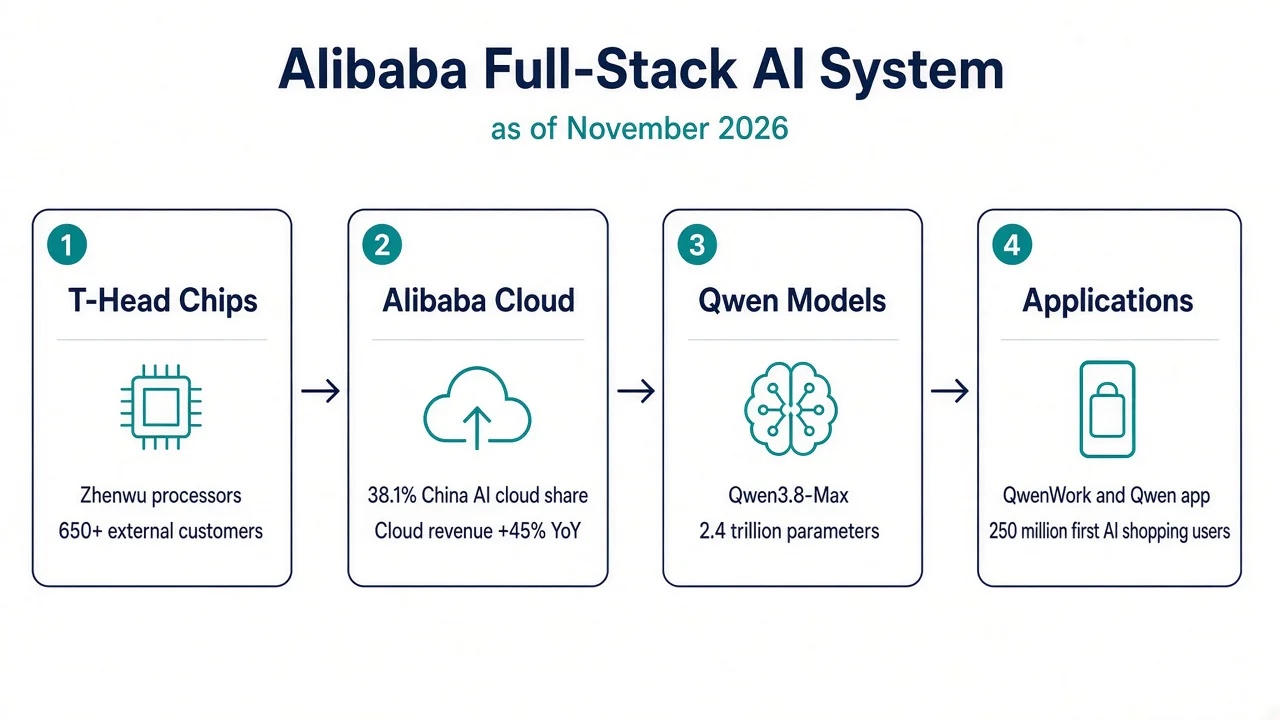 AI generated infographic of Alibaba's full-stack AI system as of November 2026, with figures from the company's June-quarter 2026 results
The newest corporate action sits on top of that stack. On November 10, 2026, Alibaba announced that the Hong Kong Stock Exchange had confirmed it may proceed with a proposed spin-off and main-board listing of T-Head (Pingtouge (Shanghai) Technology Co., Ltd.). T-Head had filed a confidential listing application on September 11, 2026. The company said T-Head is expected to remain a subsidiary after the listing. The size and structure of the offering have not been finalized, and completion still depends on listing-committee approval, a China Securities Regulatory Commission filing, and a final go-ahead from both boards.
A T-Head listing would not, by itself, fix negative free cash flow. It would give investors a cleaner price for the chip business and a potential valuation marker for the rest of the AI stack.
Morgan Stanley, in commentary reported on November 11, 2026, called the proposed spin-off a possible catalyst for unlocking Alibaba's valuation and kept the company as a top pick, citing the combination of chips, cloud, models, and applications. The same research, as reported, said T-Head aims to supply 40% to 50% of the compute for a 20-gigawatt global data-center capacity goal by 2032. That is an analyst framing, not company guidance in the listing announcement.
CNBC noted that Hong Kong-listed Alibaba shares traded about 1% lower on the morning of November 11 and were down roughly 29% year to date. The U.S. ADS, as of the November 10 close, remains much closer to its June low than to its January high. The listing news is a catalyst, not yet a rerating.
Valuation, the Street's $184 target, and what can close the gap
On conventional multiples, the stock of BABA does not look expensive. As of the November 10 close, StockAnalysis put the trailing price-to-earnings ratio at 23.45, the forward P/E at 12.96, and the PEG ratio at 0.47. The stock also traded at 1.66 times trailing sales and 1.55 times book value, with book value of about $66.17 a share.
The balance sheet still provides a floor that many software-only AI names do not have. StockAnalysis estimates enterprise value at $237.78 billion and net cash at $17.54 billion, or about $7.06 a share, after netting $39.24 billion of debt against $56.78 billion of cash and equivalents. That net-cash figure is narrower than Alibaba's own $69.93 billion of cash and other liquid investments as of June 30, because the company's definition includes treasury investments beyond cash equivalents. Either way, this is not a levered growth story.
It is also not a dividend story. BABA pays an annual dividend of $1.05 a share, a 1.02% yield, with an ex-dividend date of June 11, 2026. StockAnalysis shows that dividend down 47.5% year over year. Trailing free cash flow of about -$11.48 billion, or -$4.62 a share, is a reminder that cash returns are competing with the AI build-out.
The bullish valuation case lives in the Street's targets. StockAnalysis, compiling 41 analysts, shows a consensus rating of Strong Buy and an average price target of $184.05, implying about 79% upside from $102.72. The same forecast set, as of November 10, clustered around a median of $187.87, with a low of $95.74 and a high of $221.89. Recent published targets, shown below, have stayed well above the tape even as J.P. Morgan trimmed its figure from $210 to $200.
| Firm | Analyst | Action date | Rating | Target (US$) |
|---|---|---|---|---|
| Goldman Sachs | Ronald Keung | Nov. 9, 2026 | Buy | 177 |
| Mizuho | Wei Fang | Nov. 3, 2026 | Buy | 200 |
| Citi | Alicia Yap | Nov. 2, 2026 | Buy | 193 |
| J.P. Morgan | Alex Yao | Oct. 13, 2026 | Buy | 200 |
| Bank of America | Joyce Ju | Oct. 9, 2026 | Buy | 178 |
| Street average (41 analysts) | — | As of Nov. 10, 2026 | Strong Buy | 184.05 |
Source: StockAnalysis / S&P Global Market Intelligence, price targets as compiled around the November 10, 2026 close. J.P. Morgan's October 13 target was reduced from $210. Bank of America's October 9 target was raised from $175. These are analyst opinions, not guarantees of future performance.
The $80-plus gap between the market price and the average target is not a math error. It is the market assigning a high discount rate to three execution questions: whether China CMR can return to solid growth, whether cloud's 45% growth and 12% EBITA margin can fund a $10 billion quarterly capex run-rate, and whether AI Labs losses shrink as Qwen monetizes.
Investors who want to test that debate with primary filings and segment trends can use an AI investment agent to compare Alibaba's cloud trajectory with the slower commerce base before the November 19 print. For a view of how large holders have been positioning around China tech and the T-Head news, institutional smart-money data is a cleaner supplement to a simple price-to-earnings screen.
Short interest is not the main source of pressure. StockAnalysis put short interest at 37.76 million shares, or 1.54% of shares outstanding, with a 4.33-day short ratio. A 0.40 five-year beta also suggests the 2026 drawdown was more about Alibaba-specific earnings and China-tech sentiment than about market-wide volatility.
The risks that still sit under the bull case
The first risk is domestic demand. A 7% decline in reported CMR, even with a 1% like-for-like figure, is not the profile of a business that can carry a $255 billion market cap on commerce alone. If November 19 shows another quarter of weak China transaction activity, the multiple the Street wants to pay for the cloud story will stay compressed.
The second risk is the cash cycle. Capex rose 75%, free cash flow was deeply negative, and liquid investments declined by more than RMB46 billion in one quarter. Management has been explicit that spending is tied to customer demand, procurement timing, and component pricing. That is rational. It is also the variable that can keep BABA trapped between $90 and $110 even if revenue holds up.
The third risk is competitive and geopolitical. Alibaba is spending to hold share in quick commerce and in China's AI cloud market. Export-control limits on advanced chips, shifting U.S.-China policy, and the legal structure of an ADR add a discount that no earnings beat fully erases. The €550 million Digital Services Act provision is a reminder that international regulation can also show up as a one-line hit.
The fourth risk is that the application layer stays unprofitable for longer than the cloud layer stays scarce. A $2.04 billion quarterly adjusted EBITA loss in AI Labs and Applications can be strategic if Qwen shopping and QwenWork convert into high-margin software. It is value-destructive if inference costs stay ahead of monetization.
The T-Head listing carries its own uncertainty. The offering size is undisclosed, completion is not guaranteed, and a listing would not automatically transfer a semiconductor multiple to the parent. Alibaba has also said the spin-off is not expected to be a notifiable transaction under Hong Kong listing rules, which implies it may be modest relative to the group's assets.
November 19 will not settle every issue. It can answer the questions that matter most over the next two quarters: did cloud growth stay near the mid-40% range, did CMR stabilize, did free cash flow narrow, and did management add any specificity on T-Head's timetable or on AI capex for the rest of fiscal 2027?
The stock of BABA at $102.72 is a claim that those answers are still too uncertain to pay anything close to the January high—or to the Street's $184 average target. If the September quarter shows cloud still compounding, commerce no longer shrinking, and cash burn peaking, that discount can close. If it shows the opposite, the June low at $91.99 remains the more relevant reference than any bullish price target.
FAQ
What is the stock of BABA?
The stock of BABA is the New York-listed American depositary share of Alibaba Group Holding Limited. Each ADS represents eight ordinary shares, and the same equity also trades in Hong Kong as 9988 and 89988. Alibaba is a Hangzhou-based company whose largest business is still China e-commerce, while growth and capital spending are increasingly concentrated in AI cloud, chips, and applications.
What is BABA's stock price as of November 2026?
BABA closed at $102.72 on November 10, 2026, down 2.52% on the session, leaving a market value of about $255.32 billion. That close was 43% below the 52-week high of $181.10 on January 22, 2026, and about 12% above the 52-week low of $91.99 on June 26, 2026.
When does Alibaba report earnings next?
Alibaba's next confirmed earnings date is Thursday, November 19, 2026, before the U.S. market open, according to StockAnalysis. That report will cover the September quarter, the second period of fiscal 2027, and investors will focus on cloud growth, China customer-management revenue, free cash flow, and any update on the proposed T-Head listing.
Is BABA stock undervalued after the 2026 drawdown?
It depends on whether Alibaba can fund its AI build-out without permanently thinning cash flow. As of the November 10, 2026 close, StockAnalysis put BABA at 23.45 times trailing earnings and 12.96 times forward earnings, with 41 analysts assigning a Strong Buy rating and an average target of $184.05. The market price embeds much more skepticism than those targets, mainly because free cash flow was an outflow of $6.58 billion in the June quarter and reported China commerce growth remains weak.
What is the T-Head or Pingtouge listing?
T-Head, also known as Pingtouge, is Alibaba's semiconductor unit. On November 10, 2026, Alibaba said the Hong Kong Stock Exchange had confirmed it may proceed with a proposed spin-off and main-board listing. T-Head filed a confidential application on September 11, 2026, and is expected to remain an Alibaba subsidiary if the listing is completed. The offering size and structure have not been finalized, and the transaction still requires further approvals.