SPCX Stock Price Analysis 2026: SpaceX After Q3 Earnings
Founder of Tritonix.ai. Former Hedge Fund Analyst with 10+ years of experience managing over $1B AUM across insurance portfolios and private funds. Specializes in institutional-grade fundamental analysis and long-term capital allocation.
What "SPCX Stock Price" Searches Actually Mean
People typing SPCX stock price are almost always looking for Space Exploration Technologies Corp. (Nasdaq: SPCX), the Class A stock that began trading on Nasdaq and Nasdaq Texas on June 12, 2026, after SpaceX priced 555,555,555 shares at $135.00 the day before.
The ticker itself is new enough to create confusion. Until April 7, 2026, SPCX was the symbol for Tuttle Capital's SPAC and New Issue ETF, which changed its ticker to SPCK so SpaceX could take the more intuitive letters. That ETF closed at $21.79 on November 6, 2026, according to Yahoo Finance. It is not SpaceX, and its price says nothing about rockets, Starlink, or Super Intelligence.
SpaceX closed at $134.27 on November 6, 2026, up $10.65, or 8.62%, according to Yahoo Finance. The session ranged from $128.57 to $135.32 on volume of about 115.5 million shares, versus a three-month average near 98.0 million.
That close sat just below the $135.00 IPO price and about 10.5% below the $150 opening print reported by Nasdaq and CNBC on listing day. It was also far beneath the 52-week high of $225.64 and well above the 52-week low of $104.83, which CNBC dated to August 3, just before the first lockup expired. Yahoo Finance put the market value at about $1.824 trillion.
SPCX stock price is no longer a private-market rumor. It is a public debate about whether a newly listed launch-and-connectivity franchise can justify a near-$1.8 trillion valuation after Super Intelligence became the largest segment overnight.
A Historic IPO, Then a Volatile First Five Months
SpaceX priced 555,555,555 Class A shares at $135.00 on June 11, 2026, and granted underwriters an option for another 83,333,333 shares. Trading began on June 12. On June 15, the company said the offering closed with the overallotment fully exercised, for 638,888,888 shares and about $85.7 billion of gross proceeds. The cash-flow statement later recorded $85.675 billion net of commissions and offering costs.
Nasdaq's newsroom said the stock opened at $150, an 11% premium to the issue price, implying about $1.77 trillion of value on the $75 billion base deal. Yahoo Finance later showed the market cap sliding from about $2.25 trillion at June 30 and $2.05 trillion at September 30 to $1.82 trillion on November 6.
The path was violent. CNBC noted that SPCX had slipped to about $147.50 on the morning of October 20, after hitting $104.83 on August 3 and rallying when the August 6 lockup released more than 911 million shares. The stock then traded as high as $171.92 on October 6 before sliding through earnings week and the U.S. midterms, closing $123.62 on November 5 and bouncing to $134.27 the next session.
Yahoo Finance's 50-day moving average stood at $149.18 as of November 6, so the rebound still left SPCX below its short-term trend line. The 200-day average was $145.17. The September 30 balance sheet showed 8.240 billion Class A shares and 5.339 billion Class B shares; Yahoo Finance reports 13.58 billion implied shares, the figure StockAnalysis uses for the $1.82 trillion market cap. Insiders were listed at 12.49% and institutions at 47.83%.
The first five months taught a simple lesson: a record IPO does not permanently re-rate a stock if the public float, AI capex, and merger headlines keep rewriting the story.
Q3 2026 Scorecard: Super Intelligence Takes the Lead
SpaceX reported third-quarter results on October 20, 2026, for the period ended September 30, 2026. Revenue was $14.575 billion, up 161% from $5.576 billion a year earlier. Income from operations was $2.791 billion, versus an operating loss of $273 million. Net income was $4.404 billion, an improvement of about $5.5 billion from a $1.054 billion net loss. Adjusted EBITDA, a non-GAAP measure, rose 306% to $8.809 billion.
CNBC, citing LSEG, said revenue of about $14.58 billion beat a $12.72 billion consensus and that adjusted earnings of 45 cents a share beat the 13 cents Wall Street had modeled. GAAP diluted EPS was $0.35.
The mix is the real story. Super Intelligence — the segment formerly labeled Artificial Intelligence — contributed $7.560 billion, up 195% from the second quarter and 830% from $813 million a year earlier. Connectivity added $5.248 billion, up 22% sequentially and 69% year over year. The Space segment, the business most people still picture when they search SPCX stock price, contributed $1.767 billion, up 84% from the second quarter but only 6% from last year.
| Metric (Q3 2026) | Result | Year-over-year |
|---|---|---|
| Revenue | $14.575B | +161% |
| Income from operations | $2.791B | vs. −$273M |
| Net income | $4.404B | vs. −$1.054B |
| Adjusted EBITDA | $8.809B | +306% |
| Diluted EPS (GAAP) | $0.35 | vs. −$0.36 |
| Super Intelligence revenue | $7.560B | +830% |
| Connectivity revenue | $5.248B | +69% |
| Space revenue | $1.767B | +6% |
| Total capex | $19.593B | vs. $6.880B |
Source: SpaceX third-quarter 2026 earnings release, filed with the SEC on October 20, 2026.
{
  "type": "bar",
  "title": "SpaceX Q3 2025 vs Q3 2026 Revenue by Segment",
  "index": "Segment",
  "categories": ["Space", "Connectivity", "Super Intelligence"],
  "data": [
    {"name": "Q3 2025 ($B)", "values": [1.666, 3.097, 0.813]},
    {"name": "Q3 2026 ($B)", "values": [1.767, 5.248, 7.560]}
  ],
  "source": "SpaceX Q3 2026 earnings release, filed with the SEC on October 20, 2026.",
  "note": "Total revenue was $5.576 billion in Q3 2025 and $14.575 billion in Q3 2026. Super Intelligence was previously reported as the Artificial Intelligence segment."
}
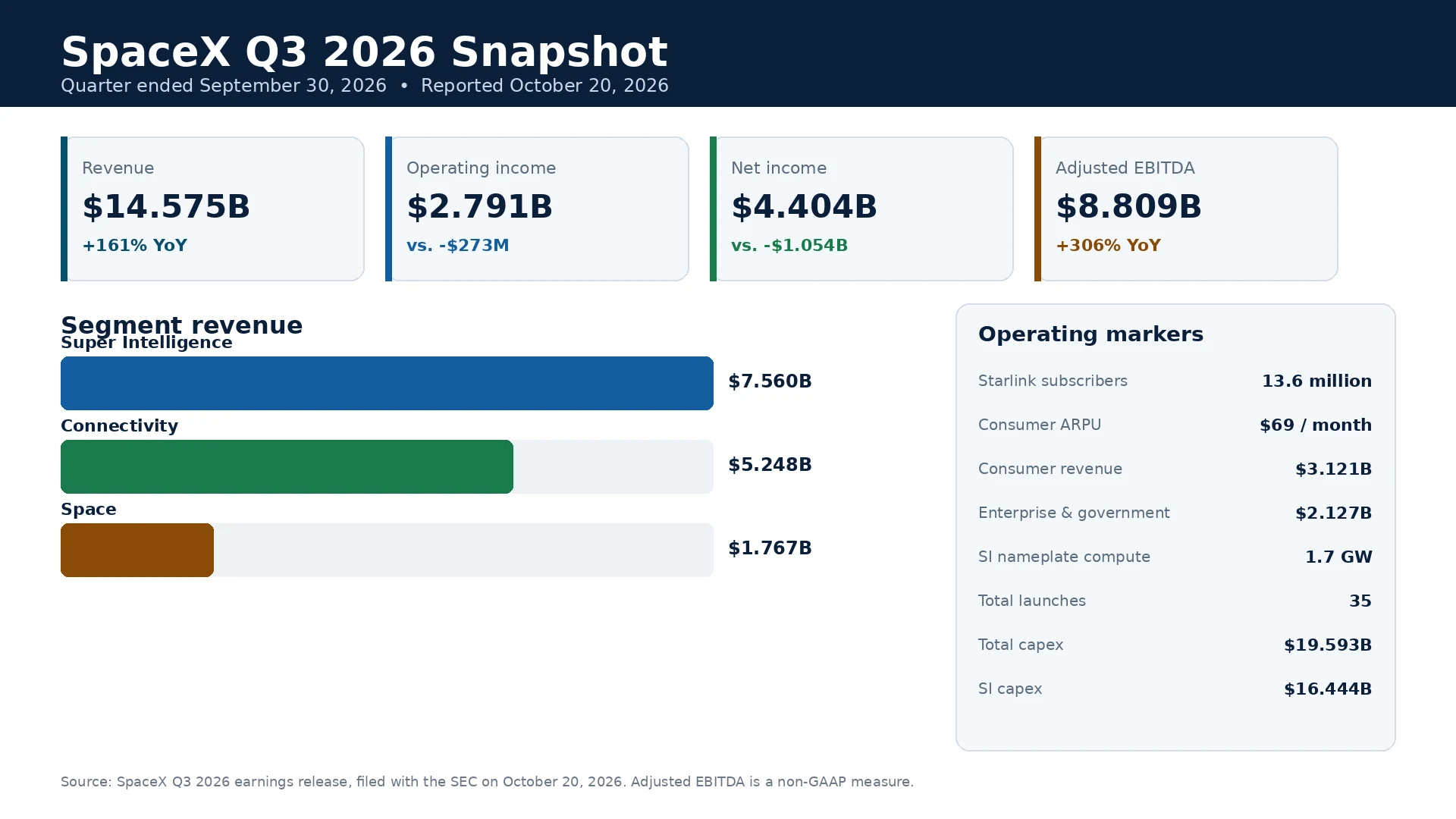 Q3 2026 snapshot: revenue, segment mix, profitability, Starlink scale, and capital spending. Source: SpaceX earnings release, October 20, 2026.
Profitability is no longer a single-company number. Connectivity produced $2.367 billion of operating income, up 99% year over year. Super Intelligence swung to $431 million of operating income from a $1.722 billion year-ago loss, even after $1.217 billion of share-based compensation tied to the Cursor acquisition. The Space segment nearly broke even, losing just $7 million after a $542 million operating loss in the second quarter.
Cash outgoing is as important as cash incoming. Capex was $19.593 billion in the quarter, including $16.444 billion for Super Intelligence, and $48.069 billion over nine months. Nine-month operating cash flow was $13.097 billion. At September 30 the company held $51.294 billion of cash plus $38.561 billion of marketable securities, about $89.86 billion against $38.844 billion of debt and finance leases. Nine-month revenue was $27.083 billion, but net loss attributable to shareholders was still $1.084 billion. Yahoo Finance shows trailing net income to common of −$3.43 billion and a −8.61% profit margin, even while screening a trailing P/E near 585x on $0.23 of TTM EPS. Q3 was highly profitable; the year-to-date ledger is not.
Investors who want a structured way to compare SpaceX's segment mix, capex, and filing language against other aerospace and AI-infrastructure names can use an AI investment agent to pull the earnings release, cash-flow statement, and call commentary into one research workflow.
How the Three Segments Contributed
Super Intelligence is now the swing factor. The company said the $6.7 billion year-over-year increase in SI solutions and infrastructure revenue came from new cloud-services agreements, the Cursor acquisition, and growing model demand, including Grok Bot. Advertising contributed $538 million; SI solutions and infrastructure contributed $7.022 billion. Nameplate compute reached 1.7 gigawatts as of September 30, up from 1.4 GW in June and 0.6 GW a year earlier.
Cursor closed on August 14, 2026, at an implied equity value of $60 billion and a GAAP purchase price of $42.5 billion. From closing through September 30, it contributed $608 million of revenue — meaningful, but not the whole SI print.
Connectivity remains the cash engine underneath the AI headline. Starlink consumer subscribers reached 13.6 million as of September 30, up from 12.0 million in the second quarter and 7.2 million a year earlier. Consumer ARPU improved 5% sequentially to $69, though that is still below the year-ago $83. Consumer revenue was $3.121 billion; enterprise and government revenue was $2.127 billion, up 91% year over year. More than 3,800 aircraft carried Starlink at quarter-end.
The Space segment is no longer the profit center, but it is still the strategic option. SpaceX completed 35 launches, including 12 customer missions and 23 internal flights, and lofted 476 metric tons to orbit. Launch-services revenue was $1.130 billion and launch-and-development revenue was $637 million. Wins included NASA's Roman Space Telescope launch, more Crew missions, and 18 National Security Space Launch awards.
Q3 turned SPCX from a launch story with a broadband annuity into a compute story that still needs Starlink's cash and Starship's next proof points.
Starlink, Spectrum, and a Launch Business Still Finding Its Next S-Curve
Starship is the variable that can change the Space segment's slope. In the third quarter SpaceX completed Flight 14, which the earnings release called both the first orbital Starship flight and the first revenue-generating Starship mission. The flight delivered 26 Starlink V3 satellites and, according to the company, added about 10 times the downlink capacity of a Falcon 9 Starlink launch. That matters because internal Starlink missions still dominate the manifest: 23 of 35 third-quarter launches were internal.
The next physical footprint is already on the calendar. SpaceX announced Starbase, Louisiana, a spaceport designed to support thousands of Starship flights a year, with the first launch targeted for 2029. CNBC reported that Gwynne Shotwell repeated that date on the call, while Elon Musk said a late-2028 start might be possible and that the next test would attempt to catch both the booster and the ship.
Starlink's next product cycle is terrestrial as well as orbital. On October 8, 2026, after the quarter closed, SpaceX agreed to acquire a nationwide portfolio of up to 14 megahertz of paired spectrum in the 800 MHz band to advance Starlink Mobile. The company expects the transaction to close in the first half of 2027, subject to regulatory and other customary conditions.
The launch business still has to earn a new margin structure. Space operating costs rose by $367 million year over year as Starship research accelerated. Nine-month Space revenue was only $3.348 billion, versus $3.277 billion a year earlier, and the segment lost $1.211 billion from operations. The market is paying a connectivity-and-compute multiple while still financing a rocket program that is not yet a second profit engine.
CFO Bret Johnsen said SpaceX is trying to scale "with discipline" and keep an investment-grade balance sheet. The September 30 snapshot showed about $89.86 billion of cash and marketable securities and $176.8 billion of equity. That cash pile will be tested by the next phase of spending.
Starlink is already a scaled, profitable network. Starship and Starlink Mobile are still conversion stories — technically impressive, but not yet the cash flows baked into a $1.8 trillion price.
Valuation, Targets, and the Tesla-Merger Overhang
At $134.27, SPCX screens as expensive on sales, ambiguous on earnings, and cheap only against the most optimistic targets. Yahoo Finance listed a price-to-sales ratio of 54.84, a price-to-book ratio of 10.44, enterprise value of about $1.77 trillion, and a forward P/E of 46.46. StockAnalysis showed a similar 44.44 forward multiple and no meaningful trailing P/E, a better match for the year-to-date loss than Yahoo's 585x trailing print.
The sales multiple is easier to interrogate. Trailing-twelve-month revenue of $32.04 billion against a $1.82 trillion equity value is a software-like premium for a company that just spent $19.6 billion of capex in one quarter. Bulls will annualize the $14.575 billion print; bears will point to nine-month revenue of $27.1 billion and a capex bill that still outran operating cash flow.
Wall Street is paying for the ramp. Yahoo Finance and StockAnalysis both show an average 12-month target of $255.06, about 90% above the November 6 close, with StockAnalysis counting 40 analysts and a Buy consensus. Ahead of the print, CNBC cited Mizuho's $200 outperform target and Cantor Fitzgerald's $246 overweight mark.
On October 28, 2026, Morningstar analyst Nicolas Owens raised SpaceX's fair-value estimate only to $70 from $62, kept a narrow moat rating and a Very High uncertainty rating, and assigned the stock one star. Morningstar valued the space and connectivity businesses together at $35 a share, added $7 a share of cash, and attributed $28 a share to AI in its base case. At $134.27, the stock still trades at roughly 1.9 times that estimate.
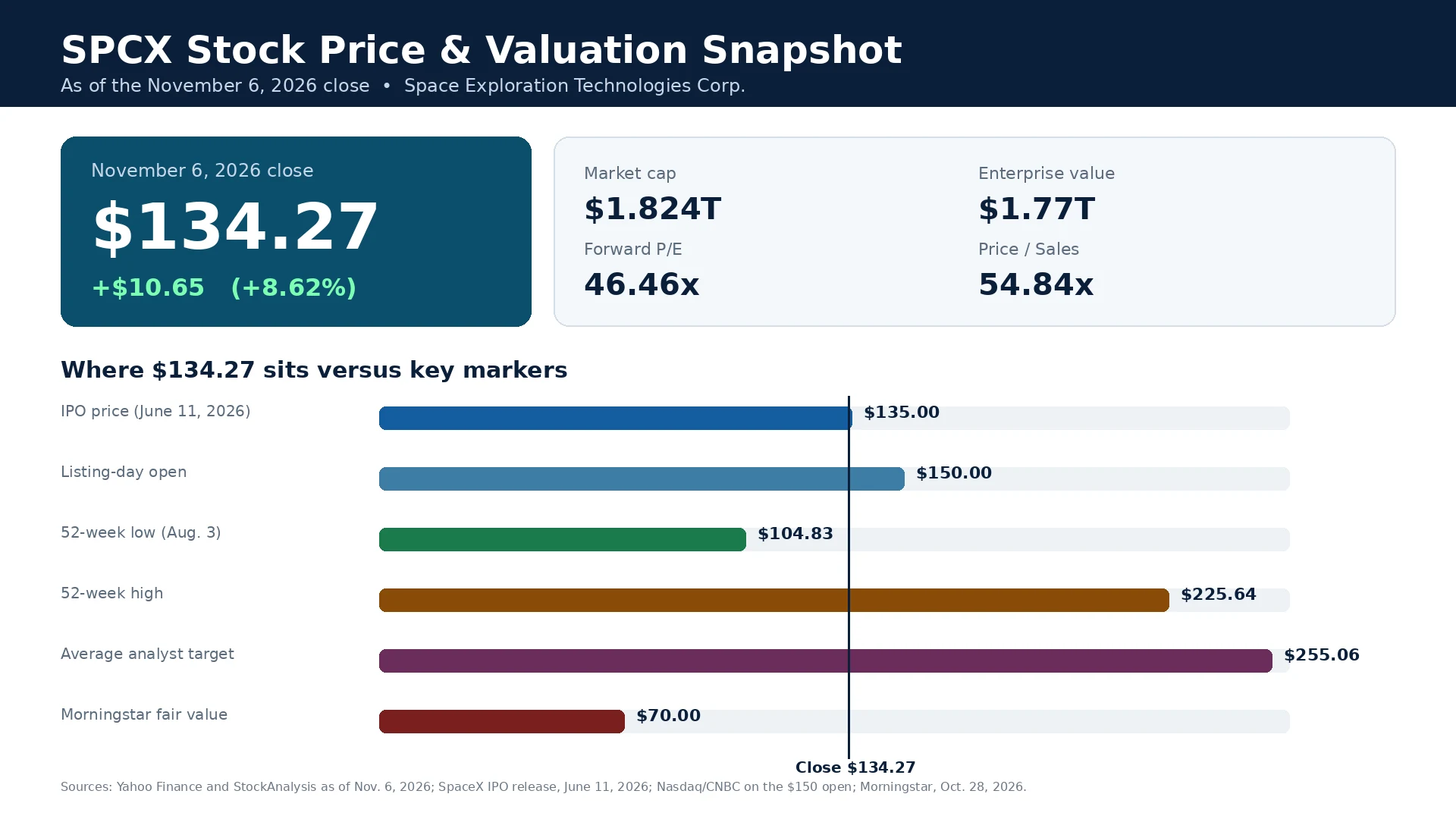 Price, valuation, balance-sheet, and target snapshot as of the November 6, 2026 close. Sources: Yahoo Finance, StockAnalysis, SpaceX Q3 release, and Morningstar.
The other overhang is corporate structure. On the October 20 call, CNBC reported that Musk said the Tesla and SpaceX boards had formed special committees to discuss a possible merger "at the request of shareholders." He called a combination a "good idea" but said he is conflicted and that Tesla would need support from 50% of all shares outstanding, not merely of shares that vote. Until terms exist, that is an overhang, not a catalyst.
Traders watching whether SPCX can reclaim the $149 50-day average, or merely bounce inside the $105–$226 range, can pair that debate with structured markup on Tritonix AI technical analysis rather than reacting only to each headline.
A $255 average target and a $70 independent fair-value estimate cannot both be right. SPCX investors are choosing which model of the AI buildout they believe.
The Risks That Still Justify a Margin of Safety
The cleanest risk is capital intensity. SpaceX spent $16.444 billion on Super Intelligence capex in the third quarter and $39.995 billion over nine months. On October 26, 2026, it reached a binding commitment for an approximately $40 billion master finance lease for GPUs and related equipment with an Apollo-managed entity. Goldman Sachs was sole structuring agent, with anchor commitments from funds managed by BlackRock, Goldman Sachs Asset Management, and KKR. The lease is expected to close before year-end 2026, with NVIDIA Vera Rubin deliveries in the first half of 2027.
Johnsen said the facility diversifies funding and that SpaceX was seeing "less than one year payback periods" on SI infrastructure. It also adds a large claim on future cash flows after year-to-date investing outflows of $84.6 billion. Any pause in cloud-contract activations would make that lease look less like cheap growth capital.
Guidance risk sits beside capex risk. CNBC reported that Johnsen told analysts first-quarter 2027 revenue would be $33 billion to $37 billion, versus a $22.2 billion LSEG estimate, citing stronger visibility into the compute pipeline. Musk said annual recurring revenue by the end of next year could reach $500 billion to $1 trillion, far above the roughly $110 billion of 2027 sales analysts were modeling, according to LSEG via CNBC. Those comments are not audited segment tables. If the next two quarters do not support that slope, the multiple can compress quickly.
Governance is a structural discount. Morningstar noted that Musk retains majority voting control through a dual-class structure and that SpaceX's charter renounces any expectation he would prioritize the company over his other ventures. After an IPO of just under 5% of the shares, the rest becoming available for sale could "test marginal demand." The August lockup already showed how sensitive the tape is to incremental supply.
Execution and political risk remain live. Starship still has to prove reliable reuse, and the spectrum deal still has to close. CNBC reported on earnings day that a federal judge allowed an NAACP Clean Air Act suit over Memphis-area data-center turbines to proceed, and that the Wall Street Journal said Musk had ordered Starshield speed restrictions in Ukraine. None of that appears in the income statement, but all of it can move a stock Morningstar already rates as Very High uncertainty.
What Investors Should Watch Next
The next checkpoints are operational. Watch whether Super Intelligence can hold a $7.6 billion quarterly run-rate without another mega-acquisition, whether Connectivity can grow from 13.6 million subscribers with ARPU near $69, whether Starship Flight 14 becomes repeatable, and whether the $40 billion GPU lease closes on the October 26 terms.
SPCX stock price works if the Super Intelligence ramp compounds without a funding shock, Starlink keeps throwing off operating profit, and Starship eventually lowers the cost of both satellites and future orbital compute. It fails if capex stays ahead of durable cash returns, lockup supply meets a weaker AI multiple, or a Tesla combination forces holders to accept terms they did not underwrite at $135. After the November 6 bounce, the stock is no longer pricing disaster — but it is also no longer priced as if the IPO pop never faded.
FAQ
What does SPCX stock price refer to?
Searches for SPCX stock price almost always mean Space Exploration Technologies Corp. (Nasdaq: SPCX), which began trading on June 12, 2026 after pricing 555,555,555 Class A shares at $135.00. Until April 7, 2026, SPCX was the ticker for Tuttle Capital's SPAC and New Issue ETF, now listed as SPCK; that ETF closed at $21.79 on November 6, 2026 and is not SpaceX.
Why is SPCX trading near its IPO price after a strong third quarter?
SpaceX closed at $134.27 on November 6, 2026, just below the $135.00 IPO price and about 10.5% below the $150 listing-day open, even after reporting $14.575 billion of third-quarter revenue and $4.404 billion of net income. The stock has already seen a $225.64 high, a $104.83 low around the August lockup, heavy Super Intelligence capex, and debate over a possible Tesla combination, so the market is discounting execution and funding risk rather than ignoring the beat.
How did SpaceX perform in the third quarter of 2026?
For the quarter ended September 30, 2026, SpaceX reported $14.575 billion of revenue, up 161% from $5.576 billion a year earlier, $2.791 billion of operating income, $4.404 billion of net income, and $8.809 billion of adjusted EBITDA. Super Intelligence contributed $7.560 billion, Connectivity $5.248 billion, and Space $1.767 billion. Starlink consumer subscribers reached 13.6 million, and CNBC said the print beat LSEG estimates of $12.72 billion in revenue and 13 cents of adjusted EPS.
Is SPCX stock expensive after the Q3 2026 report?
At the November 6, 2026 close of $134.27, Yahoo Finance listed a $1.824 trillion market cap, a 54.84 price-to-sales ratio, and a 46.46 forward P/E. The average 12-month analyst target was $255.06, about 90% upside, according to Yahoo Finance and StockAnalysis (40 analysts, Buy). Morningstar was far more cautious, raising fair value only to $70 from $62 on October 28, 2026, and rating the shares one star.
What should SPCX investors watch next?
The key checkpoints are whether Super Intelligence can sustain a $7.6 billion quarterly run-rate without another mega-acquisition, whether Starlink can grow from 13.6 million subscribers with ARPU near $69, whether Starship Flight 14 becomes a repeatable product, and whether the roughly $40 billion Apollo-managed GPU finance lease announced on October 26, 2026 closes before year-end. Investors should also watch any formal Tesla-SpaceX merger terms and additional lockup-related supply.