Shiba Inu Investor Guide 2026: Supply, Liquidity, and Meme-Coin Risk
PhD in Electrical Engineering. Formerly a silicon architect in Silicon Valley. She deconstructs complex tech stacks—from AI chips to autonomous driving sensors—into investable insights.
Why search interest in Shiba Inu still outruns the cash-flow case
When U.S. investors type Shiba Inu into a search bar, they are rarely asking about a Japanese dog breed. They want a read on SHIB, the Ethereum-based meme token that still sits near the top of crypto market-cap tables even after a long slide from its 2021 peak.
As of November 9, 2026, CoinGecko put SHIB near $0.00000432, with a market capitalization of about $2.55 billion and a rank around #38. Circulating supply was 589.238 trillion tokens, almost identical to total supply of 589.496 trillion. Twenty-four-hour trading volume was about $54.5 million, and perpetual-futures open interest sat near $57.5 million—a derivatives book roughly 2.3% of market cap.
Those are large figures for a token that began as an anonymous joke in August 2020. They are also small next to the story many holders still tell themselves: that a sub-cent price must be “cheap,” and that burns or a layer-2 network will eventually force scarcity.
Shiba Inu’s 2026 market price is a sentiment multiple on attention, not a discounted claim on protocol cash flow.
The gap between search volume and fundamentals is the reason this guide exists. The keyword attracts huge informational traffic in the United States, but the investable questions are narrower: how the float was created, whether Shibarium usage supports the valuation, how deep the order books really are, and how a retail holder can research a meme narrative without treating social heat as due diligence.
SHIB also trades about 95% below its all-time high of $0.00008616, recorded in October 2021 on CoinGecko. Over the 30 days through early November 2026 the token was down about 21%, and over one year about 56%. A token can remain famous and still be a poor risk-adjusted holding.
How Shiba Inu tokenomics actually work
Shiba Inu launched with a total supply of one quadrillion tokens—1,000 trillion. The anonymous founder, known as Ryoshi, sent half of that supply to Ethereum co-founder Vitalik Buterin, a publicity move that later became the most important supply event in the token’s history.
On May 16, 2021, Buterin burned 410.24 trillion SHIB, about 41% of then-circulating supply and 90% of what remained in his wallet after an earlier gift. CoinDesk reported the burn was worth about $6.7 billion at the time. Days earlier he had donated 50 trillion SHIB, then worth around $1.2 billion, to an India COVID-19 relief fund organized with Polygon founder Sandeep Nailwal. In a note attached to the transactions, Buterin said he did not want to be “a locus of power” and asked projects not to send him tokens without consent.
That single 2021 episode still dominates today’s burn folklore. Community trackers often say more than 410 trillion SHIB have been destroyed in total, and most of that stock traces back to Buterin’s transfer to a null address, not to routine network activity.
Almost all of Shiba Inu’s historical supply reduction happened in one 2021 charity-and-burn episode, not through a steady protocol sink.
The remaining float is still enormous. At 589.24 trillion circulating tokens, a $1 SHIB price would imply a market cap near $589 trillion—many times global equity-market value and larger than world GDP. That arithmetic does not make a lower price “safe,” but it does make “SHIB to $1” a slogan rather than a scenario. Price per token is a formatting choice. Market cap is the economic claim.
Burns, BONE, and the three-token stack
The broader Shiba Inu ecosystem uses three well-known tokens: SHIB as the meme currency, LEASH as a scarce companion token, and BONE as the governance and Shibarium gas token. On Shibarium, users pay fees in BONE; a portion of accumulated fees is designed to be swapped into SHIB and burned.
The mechanism is real. The scale is not. DefiLlama’s Shibarium dashboard showed only $0.26 in chain fees and revenue over the 24 hours to November 9, 2026. A fee pool that small cannot retire a meaningful slice of a 589 trillion token float. Weekly burn headlines that celebrate “hundreds of percent” jumps usually start from a tiny base—tens of millions of tokens against a denominator measured in hundreds of trillions.
Investors should treat burn-rate spikes as social metrics unless they can show a lasting change in circulating supply measured in basis points, not headlines. A useful check is simple: divide tokens burned over 30 days by 589.24 trillion. If the result is a rounding error, the burn is branding.
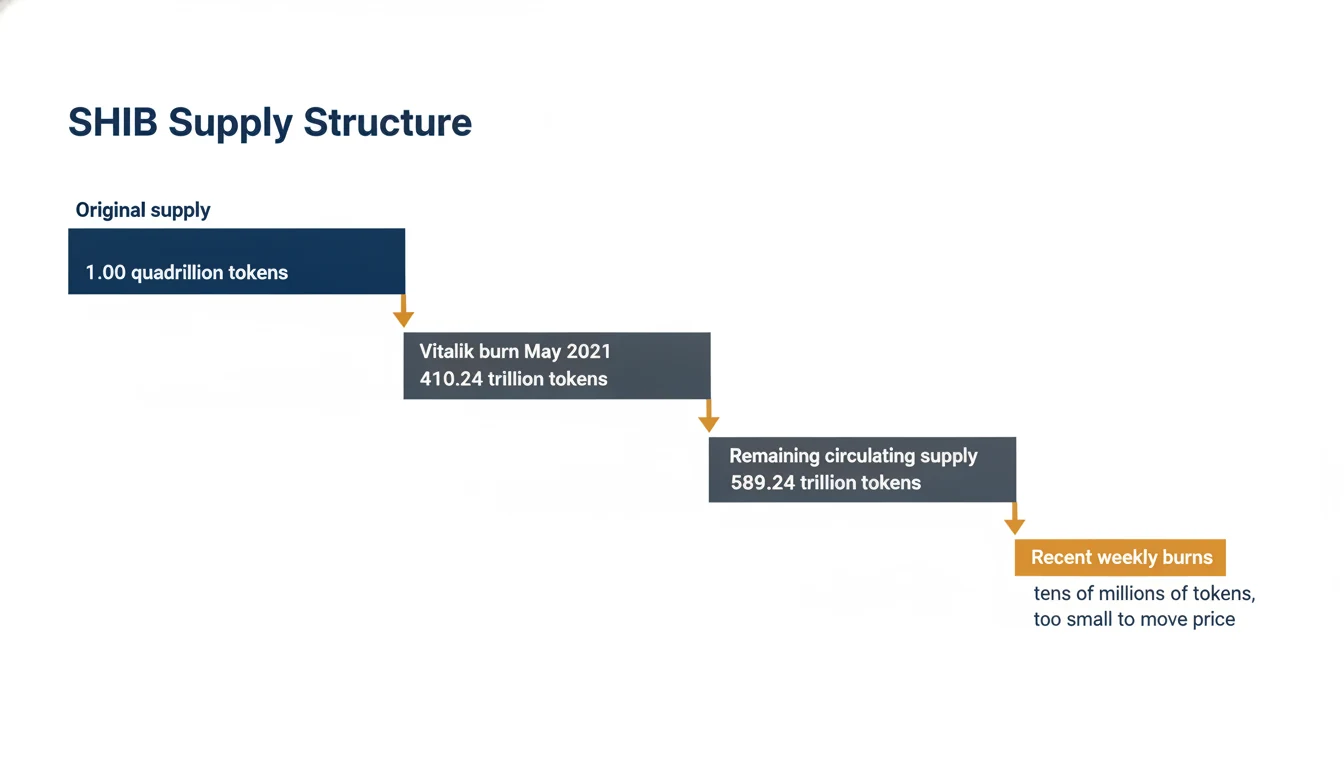 Shiba Inu supply is still dominated by the original mint and the May 2021 burn; routine weekly burns remain too small to tighten the float.
Shibarium usage versus a multi-billion-dollar market cap
Shibarium, the project’s Ethereum layer-2 network, went live on August 16, 2023, according to the project’s GlobeNewswire announcement and contemporaneous coverage. The pitch was straightforward: cheaper transactions, an on-chain home for ShibaSwap and related apps, and a fee-driven burn that would slowly tighten SHIB supply.
More than three years later, the usage numbers do not match a $2.55 billion token. DefiLlama showed Shibarium total value locked at $44,841 on November 9, 2026, down 0.65% on the day. Tracked decentralized-exchange volume on the chain was $0 over 24 hours and only $46.34 over seven days. BONE itself had a market cap near $11.8 million and a price around $0.047.
The largest protocol on the chain, ShibaSwap, held about $20,785 in TVL and recorded $0 in 24-hour fees. Several other Shibarium DEXs sat in the low four figures or below. For context, SHIB’s market cap was roughly 57,000 times Shibarium’s locked deposits.
{
  "type": "line",
  "title": "SHIB closing price, Oct. 21–Nov. 8, 2026 (USD × 1,000,000)",
  "index": "Date",
  "categories": ["Price"],
  "data": [
    {"Date": "Oct 21", "Price": 5.16},
    {"Date": "Oct 22", "Price": 4.94},
    {"Date": "Oct 23", "Price": 4.97},
    {"Date": "Oct 24", "Price": 4.92},
    {"Date": "Oct 25", "Price": 4.85},
    {"Date": "Oct 26", "Price": 4.89},
    {"Date": "Oct 27", "Price": 4.90},
    {"Date": "Oct 28", "Price": 4.96},
    {"Date": "Oct 29", "Price": 4.64},
    {"Date": "Oct 30", "Price": 4.80},
    {"Date": "Oct 31", "Price": 4.67},
    {"Date": "Nov 1", "Price": 4.70},
    {"Date": "Nov 2", "Price": 4.57},
    {"Date": "Nov 3", "Price": 4.62},
    {"Date": "Nov 4", "Price": 4.74},
    {"Date": "Nov 5", "Price": 4.51},
    {"Date": "Nov 6", "Price": 4.54},
    {"Date": "Nov 7", "Price": 4.49},
    {"Date": "Nov 8", "Price": 4.36}
  ],
  "source": "CoinGecko SHIB historical data, retrieved November 9, 2026",
  "note": "Values are daily closes multiplied by 1,000,000 so 4.36 equals $0.00000436. November 9 did not yet have a published close."
}
Security history adds another layer. On September 12, 2025, attackers combined a flash loan of about 4.6 million BONE with compromised validator keys to push a malicious withdrawal through the Shibarium bridge. The Block first reported about $2.4 million drained; a September 17, 2025 community update later pegged losses near $4.1 million across ETH, SHIB, and 15 other tokens. In an October 3, 2025 follow-up, The Block said developers had rotated validator keys, migrated more than 100 contracts, recovered the borrowed BONE, and were preparing user reimbursements.
A layer-2 with tens of thousands of dollars in deposits cannot, by itself, justify a multi-billion-dollar meme-token valuation.
The exploit matters less as a one-day price event than as evidence of validator concentration and operational-key risk. Meme-coin investors often underwrite “community” as if it were decentralization. Bridge design, key custody, and the number of independent validators are the variables that actually determine whether deposits can leave the chain safely.
What institutional desks see that retail screens hide
Retail screens emphasize logo, rank, and 24-hour percent change. Institutional crypto desks, when they look at a name like Shiba Inu at all, start with float, custody rails, borrow availability, and whether the asset has a regulated wrapper. SHIB is widely listed, which helps liquidity versus newer meme coins, but it has no cash-flow statement, no claim on Shibarium fees, and no spot ETF that would force systematic creations and redemptions.
That distinction is why SHIB can print tens of millions of dollars in daily volume and still behave like a high-beta sentiment claim. Volume measures how actively the token changes hands. It does not measure whether anyone is underwriting future protocol revenue.
Liquidity, leverage, and what selling Shiba Inu really costs
Headline volume can flatter a meme coin. Depth cannot. Lyra Terminal, sampling 15 centralized exchanges from early October through November 8, 2026, put aggregate SHIB resting orders within 2% of mid near $1.7 million. Median spread was about 6.5 basis points. Depth within that 2% band had fallen about 37% from $2.5 million on October 1 to $1.6 million by November 8.
Lyra’s modeled market-sale costs are the more practical number for anyone sizing a position:
| Sale size | Split cost | Exchanges used | Best single-exchange cost |
|---|---|---|---|
| $50,000 | 0.15% | 5 | 0.22% on MEXC |
| $250,000 | 0.28% | 13 | 0.73% on MEXC |
| $1,000,000 | 0.64% | 15 | 4.28% on LBank |
Source: Lyra Terminal SHIB liquidity tracker, medians updated November 8, 2026. Costs include estimated price impact and base-tier taker fees.
A $1 million market sale split across 15 books costs about 0.64%. The same size on the cheapest single venue in Lyra’s sample, LBank, would cost about 4.28%. No serious allocator should confuse “listed everywhere” with “I can exit size without moving the tape.” Nearby depth of roughly $1.7 million is adequate for small retail tickets and thin for anything that looks like a fund-sized exit.
CoinGecko’s November 9 snapshot also showed perpetual-futures volume running about 2.0 times spot volume, with open interest near $57.5 million. That is not an extreme leverage overlay versus some smaller meme coins, but it is enough for liquidations to accelerate a spot move when funding and social posts line up.
Shiba Inu’s true liquidity constraint is order-book depth, not the number of exchange logos on a listing page.
Investors who want to compare SHIB volume, depth, and related market tape against other digital assets can do that work inside Tritonix market data rather than relying on a single social screenshot. The question is not whether SHIB trades; it is whether the book can absorb your intended exit during a risk-off hour.
Retail holders also face venue risk that institutions try to negotiate away: withdrawal pauses, chain-specific transfer delays, and the difference between keeping SHIB as an ERC-20 on Ethereum versus a bridged representation. Those operational details rarely appear in “next 100x” threads, but they determine whether a paper gain is actually withdrawable.
How to research a Shiba Inu narrative without chasing social heat
Meme coins are narrative assets. The research process should therefore treat social posts as inputs to be scored, not as conclusions. A durable checklist is more useful than another price target.
First, separate token, chain, and community. SHIB is an ERC-20 with a known Ethereum contract (0x95ad61b0a150d79219dcf64e1e6cc01f0b64c4ce on CoinGecko). Shibarium is a separate execution environment whose security depends on its validator set and bridge. The ShibArmy is a distribution and attention engine. Conflating the three is how a burn tweet becomes an investment thesis.
Second, demand a unit that can be audited. Useful units include circulating supply, 30-day burned tokens as a share of float, Shibarium TVL, chain fees, DEX volume, exchange netflows, and order-book depth inside 1–2% of mid. Useless units include “burn rate up 1,000%,” follower counts, and any price target that ignores the 589 trillion denominator.
Third, map who can sell. You do not need a perfect whale list to respect the implication: a handful of large holders can overwhelm retail bid depth of roughly $1–2 million within 2% of mid. Check a current holder dashboard before assuming the float is widely distributed just because the logo is familiar.
| Snapshot | Reading |
|---|---|
| SHIB price (Nov. 9, 2026) | ~$0.00000432 |
| Market capitalization | ~$2.55 billion |
| Circulating supply | 589.238 trillion |
| 24-hour volume | ~$54.5 million |
| Distance from October 2021 ATH | about -95% |
| 30-day price change | about -21% |
| One-year price change | about -56% |
| Shibarium TVL (Nov. 9, 2026) | $44,841 |
| Shibarium 24-hour fees | $0.26 |
| Aggregate ±2% book depth (Nov. 8, 2026) | ~$1.7 million |
Source: CoinGecko SHIB page and historical table (November 9, 2026); DefiLlama Shibarium dashboard (November 9, 2026); Lyra Terminal (November 8, 2026).
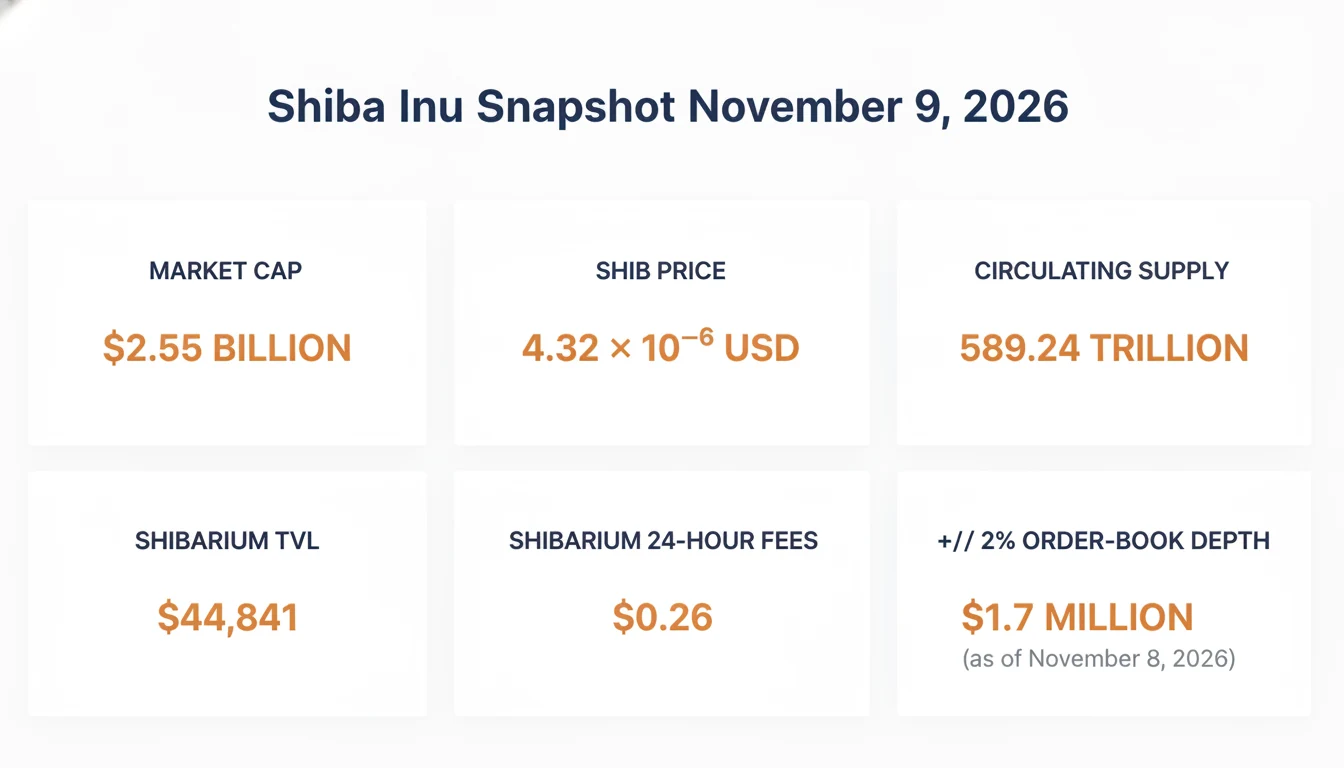 Key Shiba Inu readings as of November 9, 2026; nearby order-book depth is as of November 8. A price of 4.32 × 10⁻⁶ USD equals about $0.00000432.
A practical research workflow
A cleaner workflow looks like this:
- Read the supply identity first: original mint, 2021 burn, current circulating float, and whether any unlock schedule still exists. SHIB’s remaining supply is already almost fully circulating, so inflation is not the main risk; overhang and attention decay are.
- Check whether the “utility” layer is producing fees. For Shiba Inu, that means Shibarium TVL, BONE fee generation, and ShibaSwap volumes—not roadmap adjectives.
- Measure exit capacity before entry size. If your position is large relative to $1.7 million of nearby depth, you are the liquidity event.
- Discount any thesis that requires SHIB to reach a round-number dollar price. The market-cap math fails before the storytelling starts.
- Re-run the same dashboard after every viral post. If TVL, fees, and depth have not changed, the post did not change the asset.
Tools that compress filings, flows, and multi-source market context can shorten that loop. An AI investment agent is most useful here when it is asked to compare SHIB’s usage and liquidity metrics against other high-attention crypto names, not when it is asked to invent a price target. The edge is process consistency, especially when a meme cycle compresses decision time into a few noisy hours.
If a Shiba Inu thesis cannot survive a one-page dashboard of supply, fees, TVL, and book depth, it is a social trade, not an investment case.
What a disciplined investor should monitor next
None of this says SHIB cannot rally. Meme coins can reprice violently when Bitcoin volatility falls, when a large exchange runs a campaign, or when a new consumer app briefly recaptures attention. The correct framing is position sizing and invalidation, not moral judgment about “community tokens.”
Watch five gauges rather than a single influencer thread:
- Spot versus perpetual volume. If perps keep running well ahead of spot while open interest rises, squeezes and liquidations will dominate the next move.
- Shibarium fees and TVL. A sustained climb from today’s $44,841 deposits and $0.26 daily fees would be the first evidence that the utility story is no longer theoretical.
- Net exchange flows and book depth. A drop in ±2% depth toward or below $1 million raises the cost of both entry and exit.
- Validator and bridge disclosures. After the September 2025 exploit, any claim of ecosystem recovery should include independent security review, not only a marketing restart.
- Relative performance versus other meme names. CoinGecko noted SHIB falling about 6.9% over seven days into November 9, versus about 9.1% for its meme-coin peer set and 6.1% for the broader crypto market. Relative strength can flip quickly; it should be measured, not assumed.
{
  "type": "bar",
  "title": "SHIB drawdowns as of November 9, 2026",
  "index": "Window",
  "categories": ["Change (%)"],
  "data": [
    {"Window": "7 day", "Change (%)": -6.9},
    {"Window": "14 day", "Change (%)": -10.5},
    {"Window": "30 day", "Change (%)": -21.1},
    {"Window": "1 year", "Change (%)": -55.7},
    {"Window": "Since Oct 2021 ATH", "Change (%)": -95.0}
  ],
  "source": "CoinGecko SHIB statistics, November 9, 2026",
  "note": "The all-time-high comparison uses CoinGecko’s recorded peak of $0.00008616 from October 2021."
}
For most portfolios, Shiba Inu belongs—if it belongs at all—in a tightly capped satellite sleeve, funded with capital the investor can lose in full. It is liquid enough to trade, famous enough to keep attracting search traffic, and still fundamentally a high-beta claim on attention. That combination can be useful for a tactical allocation. It is a poor substitute for assets with identifiable cash flows, transparent governance, and usage that scales with market cap.
The investor’s job is not to decide whether Shiba Inu is culturally important. It clearly is. The job is to decide whether $2.55 billion of market value is compensation for thin on-chain usage, concentrated supply, bridge-risk history, and an order book that starts to slip once sale size approaches seven figures.
FAQ
What is Shiba Inu in an investment context?
Shiba Inu, or SHIB, is an Ethereum-based meme token launched in August 2020. As of November 9, 2026, CoinGecko showed a price near $0.00000432, a market cap of about $2.55 billion, and a circulating supply of 589.238 trillion tokens. It is best treated as a high-beta attention asset, not a claim on protocol cash flow.
Why does SHIB have so many zeros after the decimal?
The token launched with a one-quadrillion supply. After Vitalik Buterin burned 410.24 trillion SHIB in May 2021, about 589.24 trillion tokens still circulate. A $1 price would imply a market cap near $589 trillion, so the many decimal places are a function of that huge float, not evidence that the token is cheap.
Do SHIB burns meaningfully reduce supply in 2026?
Not at a scale that changes valuation by itself. Most historical supply reduction came from the May 2021 burn. DefiLlama showed Shibarium chain fees of only $0.26 over 24 hours on November 9, 2026, which cannot retire a meaningful share of a 589-trillion-token float. Treat burn-rate headlines as social metrics unless 30-day burns move circulating supply by basis points.
How much liquidity does Shiba Inu currently have?
CoinGecko reported about $54.5 million in 24-hour volume on November 9, 2026. Lyra Terminal, sampling 15 centralized exchanges through November 8, 2026, found only about $1.7 million of resting orders within 2% of mid. A $1 million market sale split across those books was modeled to cost about 0.64%, or about 4.28% if sent to a single cheaper venue.
What happened to the Shibarium bridge in 2025?
On September 12, 2025, attackers used a flash loan of about 4.6 million BONE plus compromised validator keys to drain the Shibarium bridge. The Block first reported about $2.4 million stolen; a September 17 community update later pegged losses near $4.1 million. An October 3, 2025 report said developers had rotated keys, migrated more than 100 contracts, and were preparing user reimbursements.