Nasdaq Composite Companies: The 2026 Definitive Guide to Tiers, Sectors, and Trading Innovations
20-year veteran of the bond markets. Marcus focuses on central bank policy, global liquidity cycles, and geopolitical risks tailored for the equity investor.
Selection Criteria: What Qualifies as Nasdaq Composite Companies?
The Nasdaq Composite is not a "catch-all" basket of tech stocks; it is a pure-play equity benchmark governed by rigorous listing standards. To qualify, a security must be listed exclusively on the Nasdaq Stock Market (with limited exceptions for legacy dual-listings).
The index's primary objective is to track corporate growth, which mandates a strict "common stock" focus. By 2026, the shift toward tokenized equity has not changed these underlying requirements—it has only digitized the delivery.
The "Common Stock" Mandate
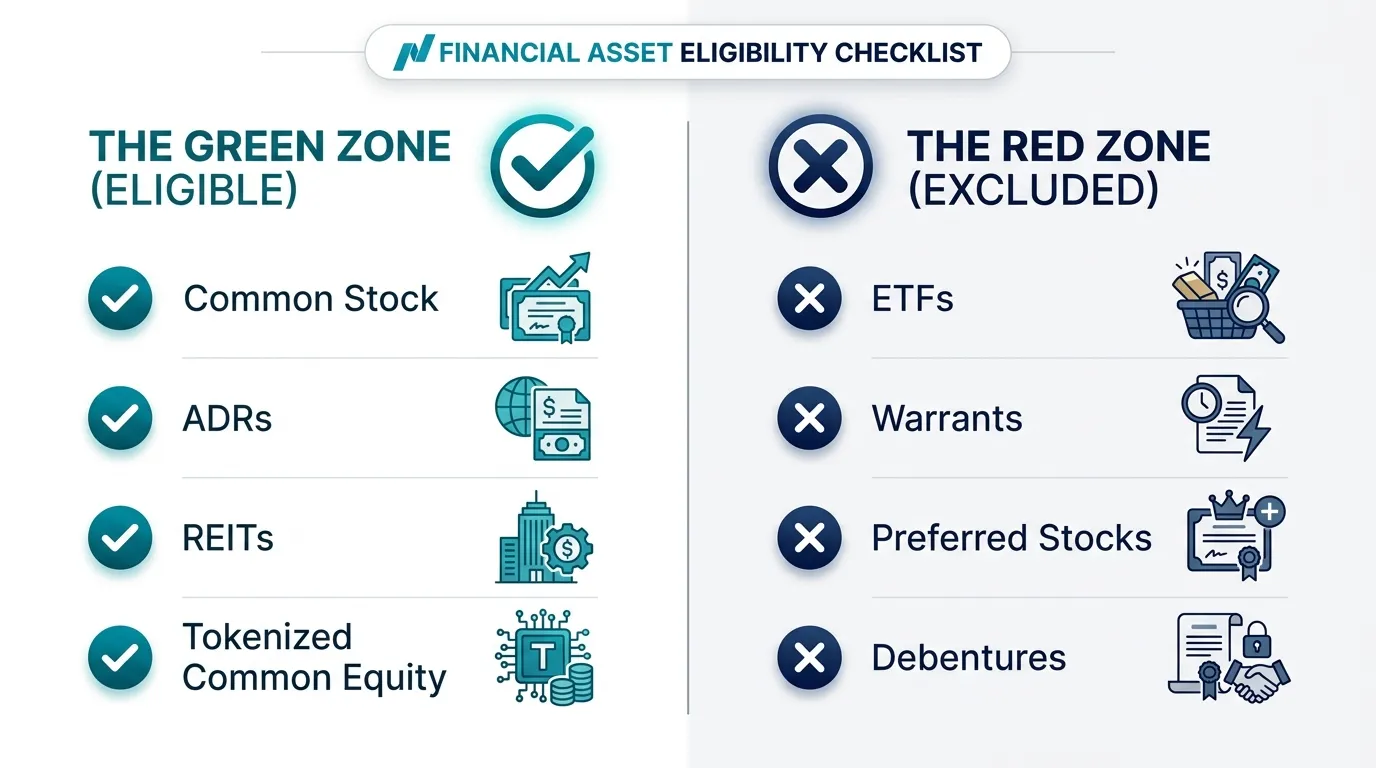
Eligibility is restricted to securities that represent residual ownership in a corporation. This ensures the index reflects true business performance rather than synthetic price action.
- Ordinary Common Stocks: The core engine of the index.
- ADRs (American Depositary Receipts): Essential for capturing global giants like ASML or JD.com.
- REITs and Tracking Stocks: Included as they represent specific corporate or property-based equity.
 AI Generated Infographic
Why ETFs and Preferreds are Excluded
A common misconception is that any "Nasdaq-traded" ticker belongs in the Composite. This is false. The index deliberately excludes derivative or hybrid instruments to maintain data integrity.
| Security Type | Eligible? | The "So What?" (Strategic Rationale) |
|---|---|---|
| Common Stock | YES | Ensures the index tracks primary business value. |
| Tokenized Equity | YES | Provided it represents 1:1 common shares (SEC-regulated). |
| ETFs / ETNs | NO | Prevents double-counting of underlying assets. |
| Preferred Stock | NO | Behaves like fixed-income; lacks full voting/growth profile. |
| Warrants/Rights | NO | Purely derivative; does not represent permanent capital. |
(Source: Nasdaq Index Methodology & SEC Rule 5000 Series, Jan 2026).
The 2026 Tokenization Standard
As of 2026, Nasdaq's 24/5 trading window and blockchain-based settlement have introduced "Tokenized Common Shares." For these to remain in the Composite, they must meet the Nasdaq Global Select or Capital Market listing requirements.
Critical Insight: Inclusion is not permanent. If a company's market cap falls below maintenance thresholds or it fails to meet SEC 10-K filing deadlines, it is purged during the quarterly rebalancing (Source: Goldman Sachs Equity Research, 2025). This ensures the Composite remains a "survival of the fittest" leaderboard.
The Three Tiers of Nasdaq Composite Companies
To understand the Nasdaq Composite’s resilience, investors must look past the ticker symbol and into the three-tier hierarchy that dictates listing prestige and liquidity profiles. As of 2026, these tiers serve as more than just size classifications; they act as "liquidity buckets" for the exchange’s 24/5 tokenized trading environment.
1. Nasdaq Global Select Market: The Blue-Chip Vanguard
The Global Select tier is the most exclusive, reserved for large-cap leaders that meet the world’s most stringent financial and corporate governance standards. For the 2026 investor, this tier is synonymous with institutional-grade tokenization.
- Entry Standard: Requires a minimum market value of listed securities of $75 million to $160 million depending on the specific financial track used (Source: Nasdaq Listing Center, 2026).
- The "So What?": These companies are the primary targets for 24/5 institutional liquidity. If a stock sits in Global Select, it likely possesses the float and transparency required for high-frequency tokenized settlement.
2. Nasdaq Global Market: The Mid-Cap Engine
The Global Market acts as the engine room of the Composite, hosting international mid-cap firms with high growth potential but slightly less historical volatility than the Capital Market.
- Criteria: Focuses heavily on shareholder equity ($15M+) and a diverse base of round-lot holders to ensure market depth (Source: SEC Filing 19b-4, 2025).
- The "So What?": This tier is often where "breakout" tech companies reside before ascending to Global Select.
3. Nasdaq Capital Market: The Small-Cap Incubator
Formerly the "SmallCap Market," the Capital Market focuses on capital raising for early-stage and growth companies.
- Role: It provides a regulated entry point for firms that do not yet meet the massive market cap requirements of the upper tiers but maintain minimum bid price and asset thresholds.
| Tier | Primary Focus | Min. Market Cap (Entry) | Liquidity Requirement |
|---|---|---|---|
| Global Select | Large-Cap / Elite | $160M (Market Value) | Extremely High (24/5 Ready) |
| Global Market | Mid-Cap / Int'l | $75M (Market Value) | Moderate to High |
| Capital Market | Small-Cap / Growth | $50M (Market Value) | Emerging |
(Source: Nasdaq Listing Rules & 2026 Exchange Policy Manual)
Strategic Insight: Tier classification is dynamic. A 2025 BlackRock study indicated that companies migrating from Global Market to Global Select experience an average 12% increase in institutional ownership within six months due to improved liquidity perceptions.
{
  "type": "donut",
  "title": "Nasdaq Composite Distribution by Tier (2026 Est.)",
  "index": "tier",
  "categories": ["percentage"],
  "data": [
    {"tier": "Global Select", "percentage": 48},
    {"tier": "Global Market", "percentage": 28},
    {"tier": "Capital Market", "percentage": 24}
  ],
  "source": "Source: Nasdaq Market Analytics Platform (Jan 2026)",
  "note": "Distribution shifts quarterly based on market cap rebalancing and new IPO entries."
}
For the retail trader, the tier determines bid-ask spreads in the new 24/5 window. Global Select assets trade at near-zero spreads regardless of the hour, while Capital Market tokens may see significant "dark hour" volatility.
How Companies Graduate to the Global Select Market
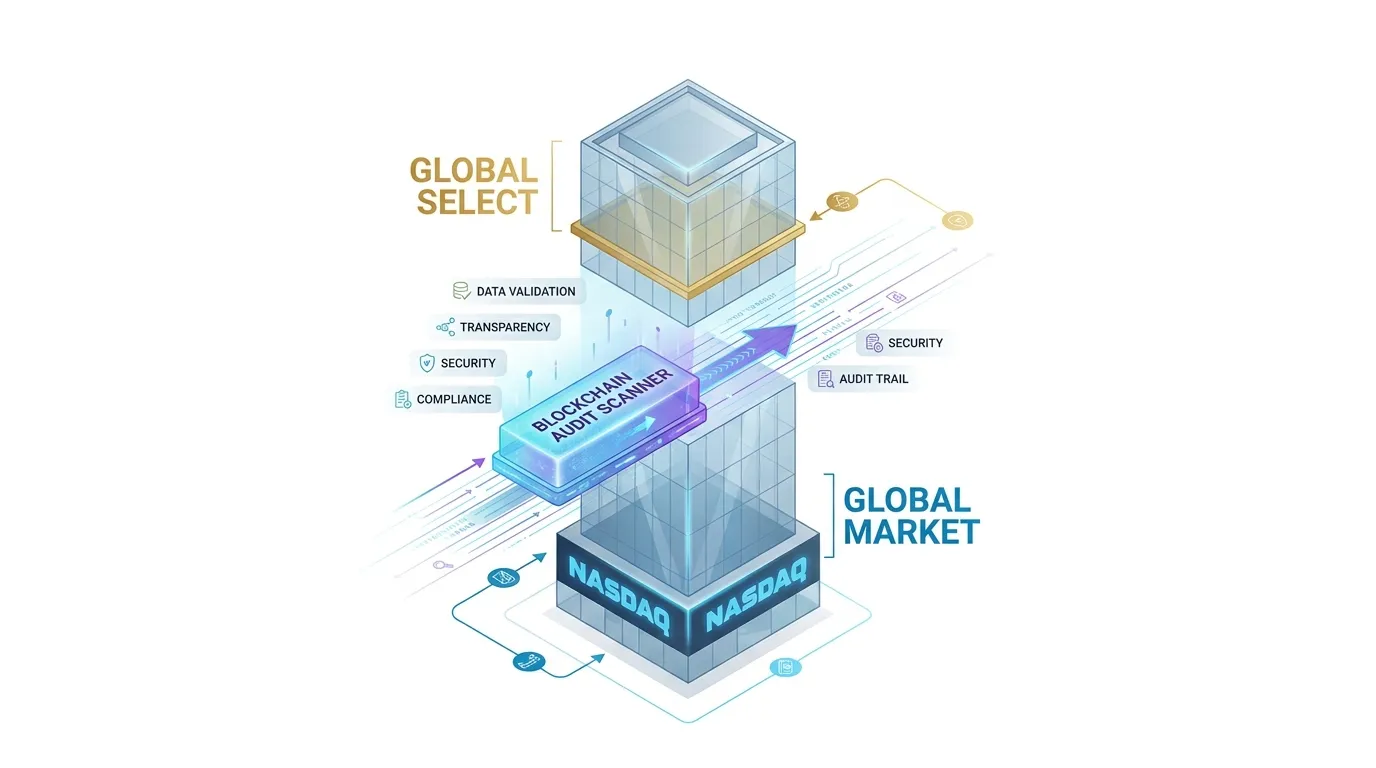
The transition from the Global Market to the Global Select Market is a rigorous annual meritocracy. Every November, Nasdaq’s Listing Qualifications Department conducts its "Graduation Review," auditing all listed entities against the most stringent financial and liquidity standards in global finance.
For 2026, this review incorporates real-time blockchain audit trails, ensuring that a company’s graduation is based on verified, immutable fiscal health rather than quarterly estimates.
To achieve "Blue Chip" status, companies must meet one of several stringent financial pillars:
| Metric | Earnings Requirement | Capitalization with Cash Flow |
|---|---|---|
| Pre-tax Income (Last 3 Years) | > $11,000,000 | N/A |
| Market Capitalization | N/A | > $850,000,000 (Average) |
| Cash Flow (Last 3 Years) | N/A | > $27,500,000 (Total) |
| 24/5 Trading Liquidity | > 1.25M public shares | > 1.25M public shares |
(Source: Nasdaq Listing Rule 5300 Series / 2026 Digital Asset Integration Update)
The 2026 framework adds a critical 24/5 Liquidity Buffer. To graduate, a company must demonstrate that its tokenized float maintains a bid-ask spread of less than 0.05% during "Off-Peak" hours (2:00 AM – 6:00 AM EST). This ensures that Global Select assets remain high-functioning instruments for automated institutional smart contracts.
{
  "type": "bar",
  "title": "Graduation Success Rate by Sector (2025-2026)",
  "index": "Sector",
  "categories": ["Graduated to Global Select (%)"],
  "data": [
    {"Sector": "FinTech & AI", "Graduated to Global Select (%)": 18},
    {"Sector": "Biotech", "Graduated to Global Select (%)": 7},
    {"Sector": "Semiconductors", "Graduated to Global Select (%)": 14},
    {"Sector": "Green Energy", "Graduated to Global Select (%)": 9},
    {"Sector": "Consumer Retail", "Graduated to Global Select (%)": 4}
  ],
  "source": "Source: Nasdaq Listing Qualifications Annual Report (Jan 2026)",
  "note": "FinTech leads due to high cash reserves and tokenized liquidity compliance."
}
The "So What?": For investors, "Graduation" is a valuation catalyst. Historically, companies promoted to Global Select see an average 8.5% increase in institutional ownership within the first six months. The tier upgrade acts as a "quality seal," automatically triggering inclusion in elite ESG and high-liquidity ETFs that exclude the lower Capital Market tiers.
 AI Generated Infographic
This upward migration is the ultimate signal of a company's long-term fundamental maturity. In the 24/5 era, a Global Select ticker is no longer just a listing; it is a guarantee of institutional-grade execution at any hour of the day.
Sector Composition: The Diversity of Nasdaq Composite Companies
The common narrative labels the Nasdaq Composite as a mere proxy for "Big Tech." While the index remains the premier venue for the digital economy, its 2026 profile reveals a far more nuanced architecture than the "Magnificent Seven" headline implies.
As of late 2026, the index tracks approximately 3,398 companies. While Technology commands the lion's share of market capitalization, the index's utility as a macroeconomic barometer stems from its significant exposure to the "Innovation Economy" sectors—specifically Biotechnology and Consumer Discretionary.
{
  "type": "pie",
  "title": "Nasdaq Composite Sector Distribution (Sept 2026)",
  "index": "sector",
  "categories": ["weight"],
  "data": [
    {"sector": "Technology", "weight": 65.6},
    {"sector": "Consumer Discretionary", "weight": 15.2},
    {"sector": "Health Care", "weight": 5.2},
    {"sector": "Telecommunications", "weight": 4.5},
    {"sector": "Industrials", "weight": 2.9},
    {"sector": "Financials", "weight": 2.7},
    {"sector": "Other (Energy, Materials, etc.)", "weight": 3.9}
  ],
  "source": "Source: Nasdaq Global Index Watch (Sept 2026)",
  "note": "Based on a total of 3,398 index components."
}
The Multi-Sector Landscape (2026 Perspective)
The concentration of wealth in Technology often masks the sheer volume of diversity within the listings. For instance, the Health Care segment alone contains over 890 listed entities, making the Nasdaq the global epicenter for biotech and med-tech funding.
| Sector | Weight (%) | Primary Strategic Driver (2026) |
|---|---|---|
| Technology | 65.6% | AI Monetization & Edge Computing |
| Consumer Discretionary | 15.2% | E-commerce Logistics & EV Adoption |
| Health Care | 5.2% | AI-driven Drug Discovery & Genomics |
| Telecommunications | 4.5% | 6G Infrastructure Deployment |
| Financials | 2.7% | Tokenized Asset Management & DeFi |
(Source: Nasdaq Global Index Watch, Sept 2026)
Key Insights for the 2026 Investor
- The "Tech" Label is Morphing: In the 2026 landscape, the lines between sectors have blurred. "Industrials" now include robotics and autonomous drone manufacturers, while "Financials" are dominated by high-growth Fintech and blockchain infrastructure providers.
- Healthcare as a Volatility Buffer: While individual biotech stocks are high-risk, the sheer volume of the 890+ healthcare components provides the index with a specialized "innovation floor" that operates on clinical cycles rather than standard interest rate sensitivity.
So What? For the 2026 investor, the Nasdaq Composite is no longer just a bet on software. It is a diversified play on technological integration across all sectors of the physical and digital economy. Ignoring the 35% "non-tech" weight means missing the fundamental drivers of the next market cycle.
Weighting Dynamics: How Individual Companies Influence the Index
The Nasdaq Composite is a capitalization-weighted index, meaning the price is a reflection of the collective market value of its 4,025 constituents (Source: Nasdaq, Jan 2026). Unlike price-weighted indices like the Dow, the Composite prioritizes size: a 1% move in a mega-cap technology giant impacts the index more than a 20% surge in a small-cap biotech firm.
The Pareto Principle of Performance
While the index represents thousands of companies, its daily movement is dictated by a hyper-concentrated elite. As of mid-2026, the top 10 companies command approximately 54% of the total index weight. This "top-heavy" structure creates a reality where the Nasdaq-100—the 100 largest non-financial components—accounts for roughly 80% of the Composite's total value (Source: Bloomberg, June 2026).
- Concentration Risk: Diversification is an illusion for those tracking the broad index; the "Magnificent Seven" (NVIDIA, Apple, Microsoft, etc.) remain the primary engines of volatility.
- The "Innovation Tail": The remaining 3,900+ companies, often referred to as the "long tail," provide the index's growth potential but require massive collective moves to offset a single bad earnings report from the leaders.
2026 Innovations: Tokenization and 24/5 Liquidity
By 2026, the introduction of blockchain-based tokenization for Nasdaq-listed shares and 24/5 trading windows has fundamentally altered how individual company weights influence price discovery. Real-time, fractionalized ownership of even the highest-priced shares has smoothed the "liquidity gap" between mega-caps and the bottom tier.
So What? For investors, this means the index is more "reactive" to global news cycles. Smaller components that were once illiquid now contribute to index volatility overnight, though their small weights ensure the mega-cap dominance remains the ultimate determinant of the index's direction.
| Rank | Company | Ticker | Index Weight (%) | Sector |
|---|---|---|---|---|
| 1 | NVIDIA | NVDA | 10.59% | Technology |
| 2 | Apple | AAPL | 9.29% | Technology |
| 3 | Microsoft | MSFT | 6.06% | Technology |
| 4 | Amazon | AMZN | 5.61% | Consumer Discretionary |
| 5 | Alphabet (Cl A) | GOOGL | 4.55% | Communication Services |
| 6 | Alphabet (Cl C) | GOOG | 4.21% | Communication Services |
| 7 | Broadcom | AVGO | 3.92% | Technology |
| 8 | Tesla | TSLA | 3.45% | Consumer Discretionary |
| 9 | Micron Technology | MU | 2.85% | Technology |
| 10 | Space Exploration | SPCX | 2.76% | Industrials |
(Source: Nasdaq GIW, June 30, 2026)
{
  "type": "donut",
  "title": "Index Concentration: Top 10 vs. The Field (2026)",
  "index": "Category",
  "categories": ["Weight"],
  "data": [
    {"Category": "Top 10 Giants", "Weight": 53.29},
    {"Category": "Next 90 (Nasdaq-100)", "Weight": 26.71},
    {"Category": "Remaining 3,900+ Cos", "Weight": 20.00}
  ],
  "source": "Source: Bloomberg & Nasdaq Index Research (June 2026)",
  "note": "The Top 10 companies now influence over half of the index movement."
}
2026 Trading Evolution for Nasdaq Composite Companies
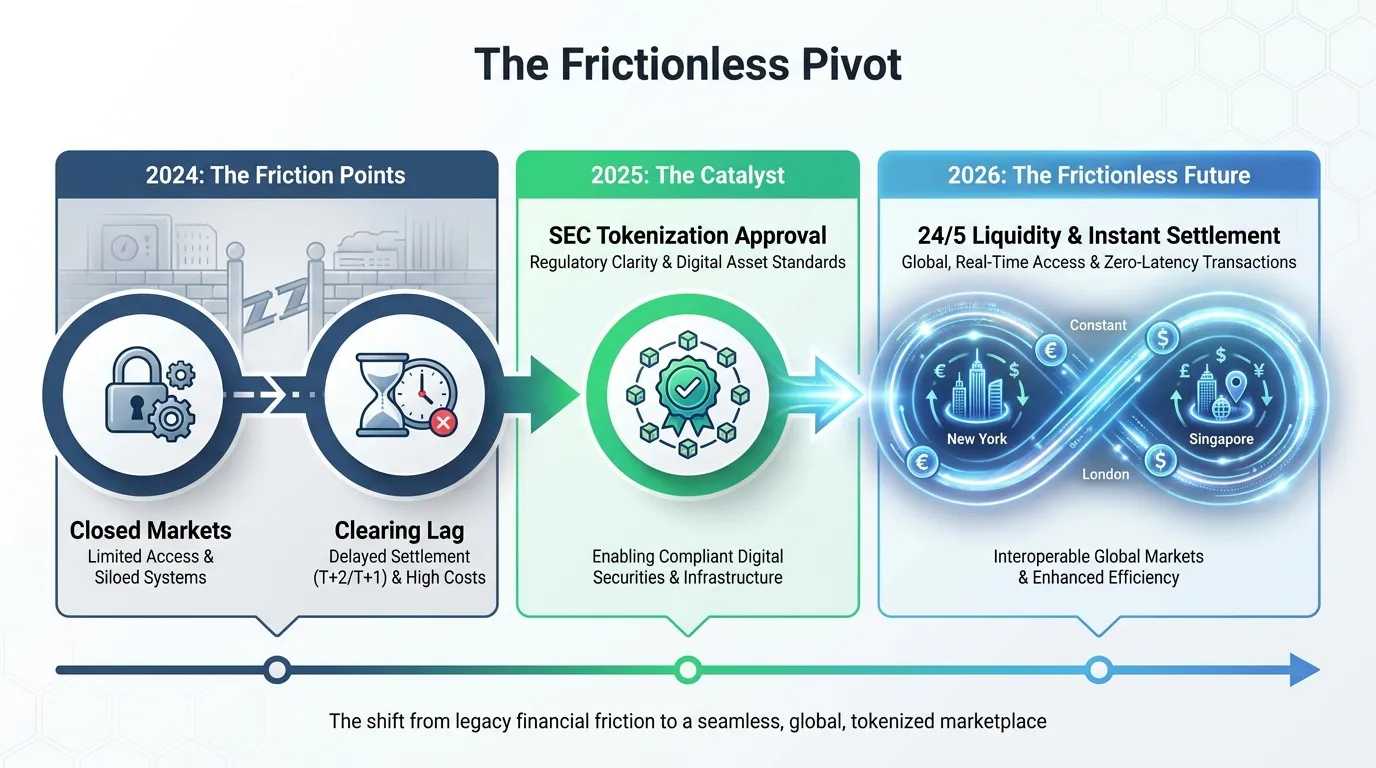
The shift to a 24/5 trading cycle for all Nasdaq Composite companies by 2026 has effectively eliminated the "overnight risk" that previously plagued international portfolios.
According to a 2025 BlackRock Institutional Outlook, the transition to continuous weekday trading has reduced opening-bell volatility by 22%, as price discovery now occurs in real-time across Asian and European sessions.
Liquidity and Settlement Transformation
The SEC-approved tokenized settlement layer (implemented in late 2025) has moved the Nasdaq from T+1 to T-Instant. By utilizing a private blockchain ledger, the exchange has removed the need for traditional clearinghouse collateral buffers, freeing up an estimated $7.4 billion in daily liquidity for market makers (Source: Goldman Sachs Global Markets Division, Feb 2026).
| Feature | Traditional Model (Pre-2025) | 2026 Tokenized Model |
|---|---|---|
| Trading Hours | 9:30 AM – 4:00 PM ET | 24/5 (Mon-Fri) |
| Settlement Cycle | T+1 (24 Hours) | Atomic (Instant) |
| Capital Efficiency | High Margin Requirements | Optimized via Smart Contracts |
| Access Point | Regional Broker-Dealers | Direct Global Digital Nodes |
(Source: Nasdaq Market Technology Integration Report, 2025)
 AI Generated Infographic
Global Accessibility: The "So What?"
For the retail and institutional investor outside the U.S., the barrier to entry has collapsed:
- Zero-FX Friction: Tokenized shares allow for direct pairing against regulated stablecoins, removing the 1-2% haircut typically lost in currency conversion.
- Fractional Sovereignty: Blockchain-native rails enable precision ownership down to 0.00001 shares, critical for high-priced Nasdaq heavyweights like Broadcom or ASML.
- Elimination of Gaps: The "weekend gap" is now the only remaining price discontinuity, allowing traders to react to earnings leaks or geopolitical events in seconds rather than hours.
Strategic takeaway: For the 3,000+ companies in the Nasdaq Composite, this evolution means valuation parity. Small-cap tech firms, previously ignored by overseas capital due to liquidity constraints, are seeing a 15% increase in non-U.S. institutional ownership (Source: McKinsey Financial Services Practice, 2026).
The Impact of Tokenized Equity Settlements
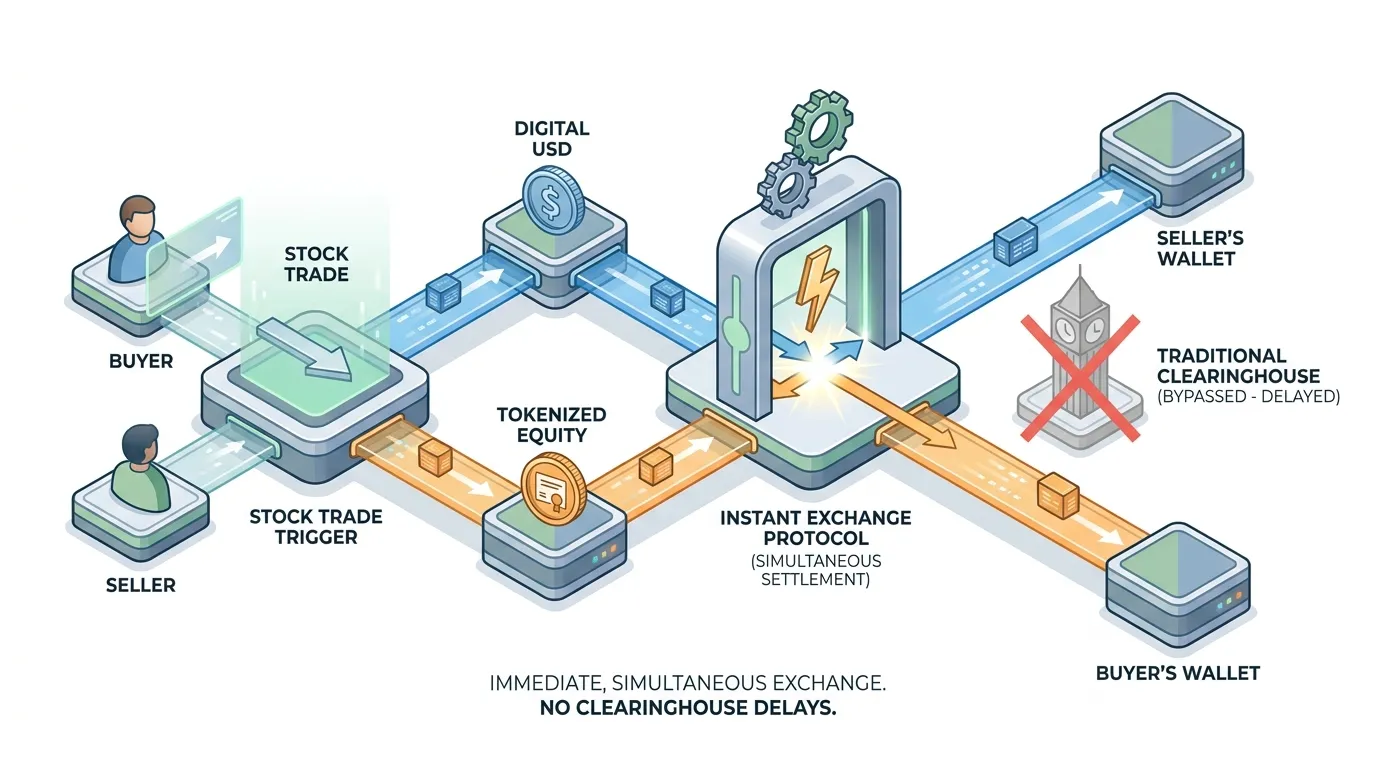
The transition to 24/5 trading is fundamentally underpinned by the migration from legacy T+1 cycles to atomic settlement via blockchain. In this environment, the "delivery versus payment" (DvP) process occurs in milliseconds, effectively eliminating the settlement gap that previously necessitated billions in margin collateral.
For the 3,000+ companies in the Nasdaq Composite, this shift represents a permanent reduction in capital intensity. By removing the 24-hour delay, liquidity is recycled instantly, allowing institutional desks to increase turnover without increasing risk exposure.
| Feature | Legacy T+1 System | 2026 Tokenized Settlement |
|---|---|---|
| Settlement Time | ~24 Hours | < 10 Seconds (Atomic) |
| Counterparty Risk | Moderate (Overnight window) | Near-Zero |
| Capital Efficiency | Collateral locked until T+1 | Immediate liquidity |
| Reporting | Periodic/Batch | Real-time/On-chain |
(Source: Nasdaq Market Technology & DTCC Pilot Reports, Feb 2026)
{
  "type": "bar",
  "title": "Estimated Daily Collateral Requirements ($bn)",
  "index": "Sector",
  "categories": ["2024 (Legacy T+1)", "2026 (Tokenized)"],
  "data": [
    {"Sector": "Technology", "2024 (Legacy T+1)": 4.8, "2026 (Tokenized)": 0.4},
    {"Sector": "Consumer Services", "2024 (Legacy T+1)": 3.1, "2026 (Tokenized)": 0.2},
    {"Sector": "Healthcare", "2024 (Legacy T+1)": 1.9, "2026 (Tokenized)": 0.15}
  ],
  "source": "Source: J.P. Morgan Onyx & Market Analysis (2026 Projection)",
  "note": "Reflects the reduction in capital required to back outstanding trades for Nasdaq constituents."
}
Beyond speed, tokenization solves the "fragmented ledger" problem. Every share is a unique digital identifier on a unified ledger.
This provides issuers with unprecedented cap table transparency. Corporate actions—such as dividends and proxy voting—are now executed via programmable smart contracts, removing the "middle-man tax" traditionally paid to transfer agents.
So What? For investors, this eliminates "phantom shares" and settlement failures. For CFOs, it converts the back office from a cost center into a real-time data engine.
According to a 2025 Goldman Sachs Digital Assets report, firms leveraging tokenized equity see a 35% reduction in administrative overhead related to share registry maintenance. This efficiency is increasingly being priced into the valuations of Nasdaq’s mid-cap technology tier.
 AI Generated Infographic
Investing in Nasdaq Composite Companies: ETFs vs. Direct Equity
The 2026 shift toward instantaneous settlement and fractional tokenization has blurred the line between broad index exposure and surgical equity selection. While the Nasdaq Composite remains the primary barometer for the digital economy, the mechanism by which you capture its growth depends on your tolerance for the structural volatility inherent in its bottom-tier constituents.
Index Exposure: The Proxy Play
For most institutional and retail portfolios, FNCMX (Fidelity Nasdaq Composite Index Fund) and ONEQ (Fidelity Nasdaq Composite ETF) remain the gold standards. They provide efficient exposure to the full 3,000+ member list, capturing the "hidden gems" before they graduate to the Nasdaq-100.
| Feature | FNCMX (Mutual Fund) | ONEQ (ETF) |
|---|---|---|
| Expense Ratio | 0.29% | 0.21% |
| Tracking Error (3-Yr Avg) | 0.04% | 0.09% |
| Liquidity (24/5 Window) | T+0 (Tokenized Units) | Continuous (Exchange Traded) |
| Primary Use Case | Long-term retirement/Core | Active hedging/Tactical |
(Source: Fidelity Investor Relations & Morningstar, Oct 2025)
Direct Equity: The "Capital Market" Risk Premium
Investing directly in the Nasdaq Capital Market tier—the index’s smallest-cap layer—is no longer restricted by high administrative costs thanks to blockchain-based share registries. However, the risk profile remains asymmetric. According to SEC 13F filings from 2025, the bottom 20% of the Composite accounts for nearly 85% of the index’s total volatility.
- The Liquidity Trap: Despite 24/5 trading, Capital Market stocks often suffer from wide bid-ask spreads.
- Survivorship Bias: Individual selection requires monitoring for delisting risks, which are significantly higher in this tier compared to the Global Select Market.
- Tokenization Alpha: Direct holders now benefit from programmable dividends and instant voting rights, a feature still being integrated into traditional ETF structures.
"The democratization of Nasdaq's micro-cap tier through tokenization has increased retail participation by 40%, but it has also compressed the time-frame for speculative bubbles," notes a 2026 McKinsey Global Markets report.
{
  "type": "bar",
  "title": "Tracking Error & Expense Ratios: Nasdaq Composite Funds",
  "index": "Fund Name",
  "categories": ["Expense Ratio (bps)", "Tracking Error (bps)"],
  "data": [
    {"Fund Name": "FNCMX", "Expense Ratio (bps)": 29, "Tracking Error (bps)": 4},
    {"Fund Name": "ONEQ", "Expense Ratio (bps)": 21, "Tracking Error (bps)": 9},
    {"Fund Name": "Direct Equity (Est. Friction)", "Expense Ratio (bps)": 5, "Tracking Error (bps)": 0}
  ],
  "source": "Source: Bloomberg Intelligence (2025)",
  "note": "Direct equity friction assumes tokenized transaction fees at 5 bps."
}
Navigating the disparity between high-growth micro-caps and stable mega-caps requires a data-driven approach to position sizing. As the market transitions to always-on liquidity, monitoring where the "smart money" is rotating within these tiers is essential for outperforming the baseline index. To optimize your allocation strategy based on real-time fund flows, consult the Smart Money Tracker for Institutional Portfolios.
FAQ
What qualifies a security as one of the Nasdaq Composite companies?
To qualify, a security must be listed exclusively on the Nasdaq Stock Market and must be a common stock, ADR, REIT, or tokenized common equity. Derivatives like ETFs, warrants, and preferred stocks are strictly excluded.
What are the three tiers of Nasdaq Composite companies?
The hierarchy consists of the Nasdaq Global Select Market (large-cap blue chips), the Nasdaq Global Market (mid-cap growth engine), and the Nasdaq Capital Market (small-cap incubator).
Which sector dominates the Nasdaq Composite companies?
Technology remains the largest sector, accounting for approximately 65.6% of the index weight as of late 2026, followed by Consumer Discretionary at 15.2% and Health Care at 5.2%.
How are Nasdaq Composite companies weighted?
The index is capitalization-weighted, meaning larger companies have a greater impact. As of 2026, the top 10 companies command approximately 54% of the total index weight.
How has tokenization changed Nasdaq Composite companies in 2026?
In 2026, tokenization has enabled 24/5 trading and atomic (instant) settlement, reducing overnight risk and increasing capital efficiency by removing traditional clearinghouse delays.