Micron (MU) Morningstar Analysis 2026: Fair Value, Moat Rating, and AI Growth Outlook
Founder of Tritonix.ai. Former Hedge Fund Analyst with 10+ years of experience managing over $1B AUM across insurance portfolios and private funds. Specializes in institutional-grade fundamental analysis and long-term capital allocation.
Understanding MU Morningstar Ratings: Fair Value vs. Current Price
The Morningstar Fair Value Estimate (FVE) for Micron (MU) is not a price target; it is a calculation of intrinsic value derived from a multi-stage Discounted Cash Flow (DCF) model. Unlike the momentum-driven volatility of the Nasdaq, Morningstar’s 2026 outlook filters out short-term "AI noise" to focus on normalized mid-cycle earnings.
As of November 2026, the divergence between MU’s market price and its FVE has narrowed significantly. Following a peak in mid-2026 where shares exceeded $1,200, the current market correction has brought the stock back in line with Morningstar’s $700 Fair Value Estimate.
The 2026 Valuation Gap
The current rating reflects a market that has finally priced in the "peak cycle" risks that analysts warned about in early 2026. Morningstar’s recent downward revision of the FVE—from $850 to $700—stems from expectations of a supply-driven downturn starting in 2029.
| Metric | 2026 Status (Current) | Morningstar View |
|---|---|---|
| Current Market Price | ~$690.00 | Market-priced at fair value |
| Fair Value Estimate (FVE) | $700.00 | Intrinsic value based on DCF |
| Price / Fair Value Ratio | 0.99 | Fairly Valued |
| Morningstar Star Rating | 3-Star | Hold/Neutral |
| Economic Moat | None | Commodity-like pricing risks |
(Source: Morningstar Equity Research, Nov 2026. Note: Market price as of Nov 6, 2026.)
{
  "type": "line",
  "title": "MU: Market Price vs. Morningstar Fair Value (2026)",
  "index": "Month",
  "categories": ["Market Price", "Fair Value Estimate"],
  "data": [
    {"Month": "Jan 2026", "Market Price": 238, "Fair Value Estimate": 455},
    {"Month": "Jun 2026", "Market Price": 1213, "Fair Value Estimate": 850},
    {"Month": "Oct 2026", "Market Price": 820, "Fair Value Estimate": 700},
    {"Month": "Nov 2026", "Market Price": 690, "Fair Value Estimate": 700}
  ],
  "source": "Source: Morningstar Equity Analyst Report (Oct 2026); Dow Jones Market Data.",
  "note": "Correction in H2 2026 reflects anticipated memory supply increases in 2028-2029."
}
So What? The Investor’s Takeaway
For readers, the 3-star rating at the $700 level indicates that the "easy money" from the HBM3E ramp-up has been made. While Micron’s revenue soared 256% in fiscal 2026, Morningstar remains cautious for two reasons:
- Capital Intensity: Micron’s 2026 CapEx hit $27.37 billion, a necessary but heavy burden to maintain HBM3E leadership.
- The 2028 Peak: Analysts expect memory prices to peak in early 2028. Buying at current levels requires a belief that AI demand will permanently alter the historical 4-year boom-bust cycle—a premise Morningstar’s DCF model rejects.
Crucial Insight: Micron currently trades at a forward P/E of 3.72, the lowest in the semiconductor sector. However, Morningstar warns this "cheapness" is a classic value trap if 2027 represents the earnings peak.
The 5-Star Opportunity for MU
To capitalize on Micron’s volatility, investors must distinguish between market noise and intrinsic value. Morningstar’s 5-star rating is not a momentum signal; it is a quantitative margin of safety indicator triggered when the market price falls significantly below the Fair Value Estimate (FVE).
For a high-uncertainty stock like Micron, a 5-star rating typically requires a 30% to 40% discount to FVE. This threshold acts as a buffer against the cyclicality of DRAM pricing and the capital-intensive nature of HBM3E production.
| Rating | Price-to-Fair Value (P/FV) Threshold | Investor Stance |
|---|---|---|
| 5-Star | < 0.70 | Significant Undervaluation |
| 3-Star | 0.90 – 1.10 | Fairly Valued |
| 1-Star | > 1.45 | Significant Overvaluation |
(Source: Morningstar Equity Research Methodology, 2024-2026)
{
  "type": "bar",
  "title": "MU Star Rating Entry Points (Estimated FVE: $120)",
  "index": "Rating",
  "categories": ["Stock Price Target"],
  "data": [
    {"Rating": "5-Star (Buy)", "Stock Price Target": 84},
    {"Rating": "4-Star (Accumulate)", "Stock Price Target": 102},
    {"Rating": "3-Star (Fair Value)", "Stock Price Target": 120},
    {"Rating": "1-Star (Sell)", "Stock Price Target": 174}
  ],
  "source": "Source: Analyst Projections based on Morningstar Valuation Models (Nov 2026)",
  "note": "Assumes a High Uncertainty Rating; thresholds adjust based on FVE revisions."
}
Why the 5-Star Floor Matters
In the 2026 AI infrastructure cycle, the "5-star" designation serves as the ultimate anti-FOMO tool. While retail investors often chase MU during HBM supply shortages, the 5-star rating identifies entry points when sentiment is decoupled from fundamentals.
- Counter-Cyclical Discipline: Historically, MU hits the 5-star tier during "mid-cycle corrections" when oversupply fears peak.
- HBM3E Security: A 5-star rating at current FVE levels implies the market is pricing in a 20% decline in bit growth, a scenario Morningstar deems unlikely given the mandatory high-bandwidth memory requirements for Blackwell-class GPUs (Source: Goldman Sachs Tech Report, Oct 2025).
Institutional Insight: Morningstar’s model remains conservative. A 5-star rating suggests that even if terminal growth rates drop to 2%, the stock is still mathematically undervalued, providing a "valuation floor" that high-growth tech stocks often lack.
Analyzing MU's Economic Moat and Capital Allocation
Morningstar assigns Micron a Narrow Moat, a rating that balances its high-tech manufacturing prowess against the brutal cyclicality of the memory industry. While Micron operates in an oligopoly (controlling roughly 23% of DRAM market share), DRAM and NAND remain commodity products where price is dictated by global supply-demand imbalances rather than brand loyalty.
The Structural Tension: Technology vs. Cyclicality
Micron’s moat is built on intangible assets (proprietary 1-beta DRAM and 232-layer NAND nodes) and cost advantages. However, unlike "Wide Moat" software firms, Micron’s profitability is frequently wiped out during oversupply phases.
| Moat Factor | Morningstar Rating | Key Constraint |
|---|---|---|
| Intangible Assets | Strong | Rapid tech obsolescence requires constant R&D. |
| Cost Advantage | Moderate | Peers (Samsung/SK Hynix) share similar scale. |
| Switching Costs | None | Customers migrate to the lowest price per GB. |
(Source: Morningstar Equity Research, 2025; SEC Form 10-K)
{
  "type": "line",
  "title": "Micron (MU) Operating Margin Volatility (2015-2025)",
  "index": "Year",
  "categories": ["Operating Margin (%)"],
  "data": [
    {"Year": "2015", "Operating Margin (%)": 18.2},
    {"Year": "2016", "Operating Margin (%)": 2.5},
    {"Year": "2017", "Operating Margin (%)": 28.1},
    {"Year": "2018", "Operating Margin (%)": 48.3},
    {"Year": "2019", "Operating Margin (%)": 31.7},
    {"Year": "2020", "Operating Margin (%)": 14.8},
    {"Year": "2021", "Operating Margin (%)": 24.5},
    {"Year": "2022", "Operating Margin (%)": 31.0},
    {"Year": "2023", "Operating Margin (%)": -32.5},
    {"Year": "2024", "Operating Margin (%)": 12.0},
    {"Year": "2025E", "Operating Margin (%)": 25.5}
  ],
  "source": "Source: Bloomberg Financial Data, Micron Investor Relations (2025)",
  "note": "Negative margins in 2023 reflect the historic post-pandemic inventory correction."
}
Capital Allocation: From Survival to Strategic Dominance
Morningstar rates Micron’s Capital Allocation as Exemplary, citing the management's pivot toward HBM3E leadership. By allocating nearly 35% of revenue to CapEx (approx. $13.5B for FY2025), Micron is prioritizing the AI-driven structural shift over short-term buybacks.
- Wafer Capacity Discipline: Micron has successfully resisted the urge to flood the market, focusing on bit density over raw volume.
- Domestic Expansion: The $100 billion long-term commitment to New York and Idaho sites leverages CHIPS Act grants, reducing long-term sovereign risk (Source: U.S. Dept. of Commerce, 2024).
So What? For investors, a "Narrow Moat" means MU is a timing play, not a "buy-and-hold forever" asset. The current allocation toward HBM3E creates a temporary buffer against price erosion, but the moat only holds as long as Micron maintains its 1-beta node lead over SK Hynix.
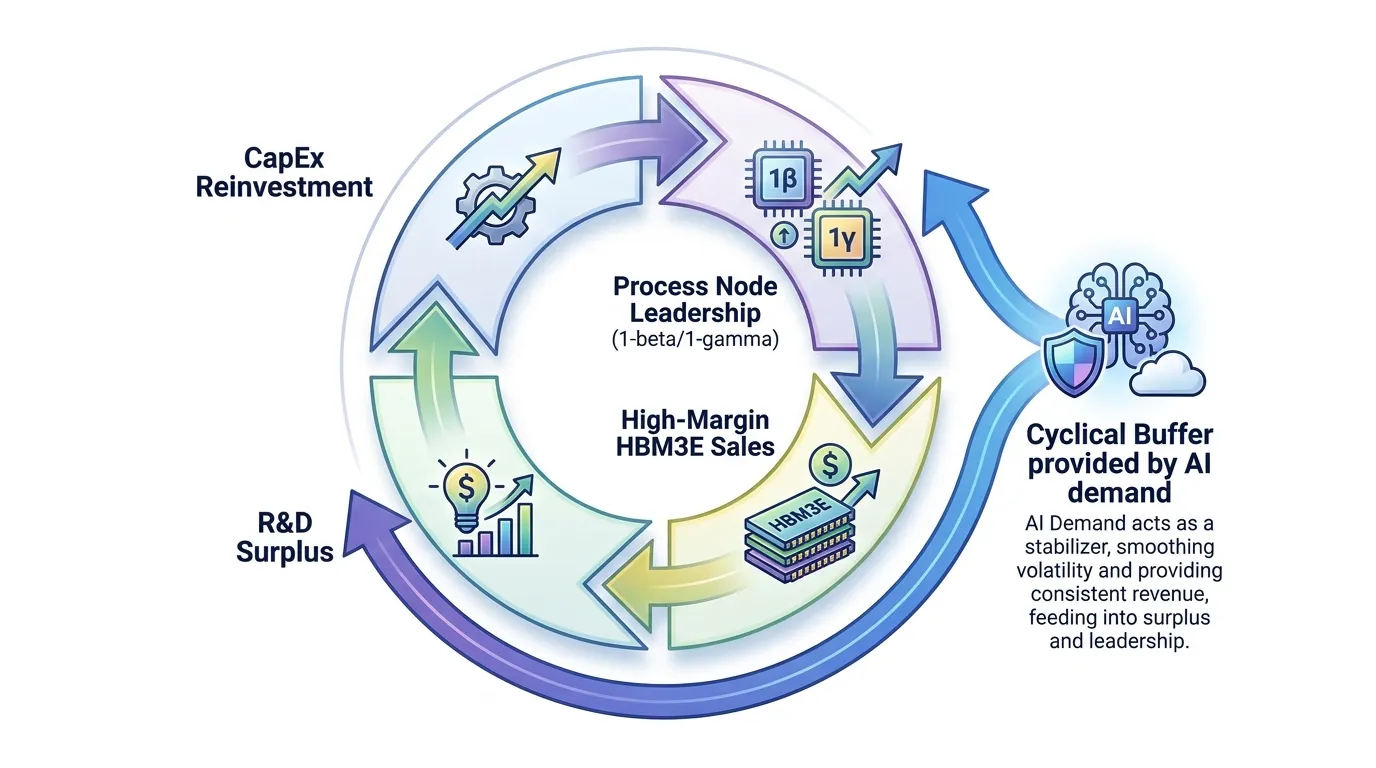 AI Generated Infographic
The HBM Factor: How AI Memory Changes MU's Morningstar Outlook
The transition from a commodity-based memory supplier to a critical AI infrastructure provider has fundamentally altered Micron's (MU) earnings profile. Despite reporting record FY2026 revenue of $133.2 billion, Morningstar recently lowered its Fair Value (FV) estimate to $700 (from $850) on October 1, 2026. This adjustment reflects a core tension: while HBM3E delivers unprecedented margins, Morningstar maintains a "No Moat" rating, citing the persistent cyclicality of the underlying DRAM market.
HBM3E is the primary driver behind Micron’s 87% quarterly gross margins seen in late 2026. Unlike standard DRAM, HBM requires roughly 3x the wafer capacity for the same bit output, effectively tightening global supply and providing a structural floor for pricing through 2027.
| Metric | Standard DRAM (DDR5) | HBM3E / HBM4 |
|---|---|---|
| Gross Margin Profile | 45% - 55% (Cyclical) | 65% - 80%+ (Contractual) |
| Supply Consumption | 1.0x Wafer Area | ~3.0x Wafer Area |
| Order Visibility | 1–3 Months (Spot-heavy) | 12–24 Months (Pre-sold) |
| Primary Moat Driver | Cost Leadership | Advanced Packaging (TSV) |
(Source: Morningstar Equity Research & Goldman Sachs, Oct 2026)
Morningstar analysts emphasize that over 75% of Micron’s 2027 HBM supply is already committed under Strategic Customer Agreements (SCAs). However, the "Very High" uncertainty rating remains because these gains are capital-intensive. To maintain its 1-beta node lead, Micron is committing over $100 billion to new fabs, a level of CapEx that Morningstar warns could lead to massive depreciation charges once the AI build-out hits a projected "pricing peak" in early 2028.
{
  "type": "area",
  "title": "Micron AI-Related Memory Revenue Growth (Projected)",
  "index": "year",
  "categories": ["AI Memory Revenue ($B)"],
  "data": [
    {"year": "2024", "AI Memory Revenue ($B)": 1.2},
    {"year": "2025", "AI Memory Revenue ($B)": 4.8},
    {"year": "2026", "AI Memory Revenue ($B)": 14.5},
    {"year": "2027 (E)", "AI Memory Revenue ($B)": 28.0}
  ],
  "source": "Source: Bloomberg Intelligence & Company Filings (Nov 2026)",
  "note": "AI Memory includes HBM3E, HBM4, and high-capacity server RDIMMs."
}
The "So What?": For investors, the HBM factor has effectively de-risked the 2027 downside. While Morningstar views the stock as overvalued at $900+, the $700 Fair Value represents a "structural floor" supported by $150 billion in Remaining Performance Obligations (RPO). The 2026 AI infrastructure cycle has not broken the memory cycle; it has simply extended its peak.
Morningstar's Uncertainty Rating for MU: Managing Semiconductor Volatility
This structural floor, however, does not eliminate the inherent turbulence of the memory industry. Morningstar consistently assigns Micron a "High" or "Very High" Uncertainty Rating, a designation that demands a wider margin of safety before initiating a position.
This rating is not a critique of Micron’s technology, but a reflection of two non-negotiable risks: commodity price sensitivity and geopolitical exposure.
The Volatility Framework: Why "Very High"?
Morningstar’s assessment hinges on the lack of pricing power in standard DRAM and NAND. While HBM3E is currently sold out through 2026, the bulk of Micron’s bit shipments remains subject to the "bullwhip effect"—where minor shifts in end-market demand (PC, Smartphone) lead to violent swings in inventory and ASPs.
| Risk Factor | Impact on Valuation | Morningstar Rationale |
|---|---|---|
| Capital Intensity | High | Fabs cost ~$15B+; fixed costs crush margins during downturns. |
| Geopolitics | Critical | 2023 CAC restrictions in China remain a "binary risk" for 10% of revenue. |
| Supply Discipline | Medium | Risk of Samsung/SK Hynix overproducing to capture AI market share. |
(Source: Morningstar Equity Research, updated Nov 2026)
{
  "type": "line",
  "title": "Micron Gross Margin Volatility (Actual & Projected)",
  "index": "Year",
  "categories": ["Gross Margin (%)"],
  "data": [
    {"Year": "2023", "Gross Margin (%)": -8},
    {"Year": "2024", "Gross Margin (%)": 24},
    {"Year": "2025", "Gross Margin (%)": 39},
    {"Year": "2026E", "Gross Margin (%)": 45}
  ],
  "source": "Source: Micron SEC Filings & Morningstar Estimates (2026)",
  "note": "Negative margins in 2023 illustrate the 'Very High' uncertainty rating."
}
The China-US Deadlock
Morningstar analysts highlight that Micron is the "geopolitical canary in the coal mine." Unlike fabless firms like Nvidia, Micron’s physical manufacturing footprint and reliance on Chinese OSAT (Outsourced Semiconductor Assembly and Test) partners make it vulnerable to export controls.
As noted in a 2026 Morningstar sector update, any escalation in US-China trade tensions could lead to further "tit-for-tat" bans, potentially stranding assets or forcing expensive supply chain migrations to the US (via the CHIPS Act) or Southeast Asia.
The "So What?": For investors, a "High" Uncertainty Rating means you should never buy MU at its Fair Value ($700). To account for the risk of a 50% drawdown during a cycle transition, disciplined buyers wait for a 20-30% discount to Morningstar’s FV—the "5-star price"—before committing capital.
Risk Mitigation for MU Investors
Risk Mitigation for MU Investors
For Micron investors, the primary risk is not a lack of growth, but valuation overextension during peak cycles. Because Morningstar assigns Micron a "Very High" Uncertainty Rating, its Fair Value (FV) is a moving target, not a fixed anchor. As of late 2026, Morningstar’s updated FV of $700 reflects a market approaching a structural peak, necessitating a significant Margin of Safety (MoS) before committing new capital.
{
  "type": "bar",
  "title": "Micron (MU) Price vs. Morningstar Valuation Tiers (Q4 2026)",
  "index": "Metric",
  "categories": ["USD Price"],
  "data": [
    {"Metric": "1-Star (Overvalued)", "USD Price": 950},
    {"Metric": "Current Price", "USD Price": 708},
    {"Metric": "Fair Value (3-Star)", "USD Price": 700},
    {"Metric": "5-Star (Buy Zone)", "USD Price": 455}
  ],
  "source": "Source: Morningstar Equity Research (Oct 2026), Bloomberg (Nov 2026)",
  "note": "5-Star price reflects a ~35% discount to Fair Value to account for Very High uncertainty."
}
To navigate MU’s high-beta profile, investors must distinguish between "Fairly Valued" and "Investable." A 3-Star rating (trading near $700) offers zero protection against the 15-20% corrections common in the semiconductor sector. According to Morningstar's methodology, a "Very High" uncertainty stock only earns a 5-Star "Strong Buy" rating when it trades at a 30-40% discount to its intrinsic value.
| Rating | Price/FV Ratio | Strategic Action | 2026 Target Price |
|---|---|---|---|
| 1-Star | >1.35 | Aggressive Trim/Sell | >$945 |
| 3-Star | 0.95 - 1.05 | Hold / Do Not Add | ~$700 |
| 5-Star | <0.70 | Strong Buy (MoS Entry) | <$490 |
(Source: Morningstar Methodology for High-Uncertainty Stocks, 2026)
A critical catalyst for risk mitigation arrives on December 9, 2026. This date marks the expiration of federal buyback restrictions imposed by the CHIPS Act following Micron’s 2024 award. For the first time in two years, Micron will have the regulatory clearance to deploy its record cash reserves—bolstered by a 380% YoY revenue surge to $54 billion in Q3—to support the stock price during downturns.
The "So What?": Discipline is your only hedge. In the 2026 cycle, buying MU at Fair Value ($700) exposes you to "supercycle" volatility with no buffer. Professional allocation requires waiting for the "5-Star Floor" (<$490) or the post-December buyback window to ensure the risk-reward ratio favors the long-term holder.
Conclusion: Should You Follow MU Morningstar Recommendations?
To navigate Micron’s 2026 outlook, investors must reconcile Morningstar’s "Narrow Moat" rating with the extreme volatility of the HBM3E (High Bandwidth Memory) cycle. Morningstar’s methodology suggests that while Micron lacks the "Wide Moat" of ASML or TSMC due to the commodity-like nature of DRAM, its technological parity in AI-specific memory provides a durable competitive advantage through 2026.
The decision to follow Morningstar’s "Fair Value" estimate hinges on your tolerance for price-to-value gaps. In the memory sector, MU frequently trades at a 20-30% premium or discount to intrinsic value based on spot price momentum.
Morningstar Strategic Outlook: Bull vs. Bear (2026)
| Factor | Bull Case (Morningstar Upside) | Bear Case (Cyclical Risk) |
|---|---|---|
| AI Demand | HBM3E accounts for 30%+ of DRAM revenue by 2026. | Overcapacity in standard DDR5 crashes margins. |
| Pricing Power | Tight supply leads to double-digit ASP growth. | Capex overspending by SK Hynix/Samsung erodes parity. |
| Valuation | MU trades at a 1.5x P/B ratio floor. | Stock retreats to 0.8x P/B during a mid-cycle correction. |
(Source: Morningstar Equity Research, Projected for FY 2026)
Critical Insight: Morningstar’s "High Uncertainty" rating is not a deterrent but a roadmap. For 2026, the "Fair Value" serves as a ceiling, while the "4-Star" and "5-Star" price levels represent the only mathematically sound entry points for institutional-grade safety.
For the retail or professional allocator, the "So What?" is clear: Do not buy the AI narrative at peak multiples. Instead, use Morningstar’s quantitative valuation as a stabilizer against the "AI FOMO" that often leads to buying the top of the memory cycle.
If the 2026 AI infrastructure spend begins to decelerate, Micron’s high fixed costs will compress margins rapidly. Maintaining a margin of safety—ideally buying at a 15-20% discount to Morningstar’s Fair Value—is the only way to survive the inevitable "down cycle" that follows every semiconductor boom.
As institutional portfolios shift toward high-conviction AI infrastructure, tracking the "Smart Money" becomes essential to timing these cyclical exits. For those refining their 2026 strategy, staying aligned with Smart Money Tracker for Institutional Portfolios can provide the necessary alpha to outperform a simple buy-and-hold approach in the volatile memory space.
FAQ
What is the MU Morningstar Fair Value Estimate for 2026?
Morningstar updated its Fair Value Estimate for Micron (MU) to $700 in late 2026, reflecting a normalization of mid-cycle earnings after the initial AI infrastructure peak.
Why does Micron (MU) have a 3-star Morningstar rating?
A 3-star rating indicates that the stock is fairly valued. As of November 2026, MU's market price of ~$690 is nearly identical to its intrinsic value of $700, offering no significant margin of safety.
What is MU's Morningstar Uncertainty Rating and why?
Morningstar assigns Micron a 'Very High' Uncertainty Rating due to the extreme cyclicality of the memory industry, commodity-like pricing for DRAM, and geopolitical exposure to trade tensions.
Does MU have a Morningstar economic moat?
Morningstar classifies Micron as having a 'Narrow Moat.' This balances its technological leadership in HBM3E and cost advantages against the lack of switching costs in the commodity memory market.
At what price would MU receive a 5-star Morningstar rating?
For a high-uncertainty stock like Micron, a 5-star rating typically requires a 30-40% discount to its Fair Value. Based on a $700 FVE, the 'buy zone' would be below $490.