Most Valuable 1964 Nickel Value Guide: Identifying the $30,000 SMS and Rare Errors
Founder of Tritonix.ai. Former Hedge Fund Analyst with 10+ years of experience managing over $1B AUM across insurance portfolios and private funds. Specializes in institutional-grade fundamental analysis and long-term capital allocation.
The 1964 SMS Nickel: Why This Prototype is the Most Valuable 1964 Nickel
The 1964 Special Mint Set (SMS) nickel is a numismatic anomaly—a prototype that officially should not exist. While the U.S. Mint began producing "Special Mint Sets" in 1965 to replace traditional proof sets during a national coin shortage, a handful of 1964-dated sets surfaced decades later, likely as experimental strikes under the direction of then-Mint Director Eva Adams.
With an estimated mintage of only 20 to 50 sets, these coins represent the "Holy Grail" of modern Jefferson nickels. Unlike the nearly 3 billion business strikes produced that year, which are worth exactly five cents, a top-tier 1964 SMS nickel can command $30,000 or more at elite auctions.
 Photo by Nic Wood on Pexels
Identification Matrix: Spotting the $30,000 Prototype
Distinguishing an SMS nickel from a standard strike requires a high-powered loupe and an eye for surface texture. The SMS version is neither a mirror-like proof nor a grainy circulation coin.
| Feature | 1964 SMS Strike | 1964 Proof Strike | 1964 Business Strike |
|---|---|---|---|
| Surface Finish | Satin / Smooth Matte | Mirror-like Reflectivity | Dull Luster / Grainy |
| Rim Detail | Razor-Sharp, Square | Wire-thin or Rounded | Often Slanted/Weak |
| Bag Marks | Virtually None | None (unless handled) | Heavy Scratches/Dings |
| Strike Depth | High Detail (Full Steps) | High Detail | Typically Weak/Mushy |
| (Source: PCGS CoinFacts & NGC Archive, 2024) |
Market Value & Auction Performance
The value of the 1964 SMS nickel is driven by condition rarity and its status as a "Specimen" (SP) strike. A 2016 sale at Heritage Auctions saw a PCGS SP68 example reach $32,900, cementing its position as the most valuable non-error nickel of the era.
{
  "type": "bar",
  "title": "Historical Auction Records: 1964 SMS Jefferson Nickel",
  "index": "Grade",
  "categories": ["Auction Price (USD)"],
  "data": [
    {"Grade": "SP64", "Auction Price (USD)": 4500},
    {"Grade": "SP65", "Auction Price (USD)": 8200},
    {"Grade": "SP67", "Auction Price (USD)": 18000},
    {"Grade": "SP68", "Auction Price (USD)": 32900}
  ],
  "source": "Source: Heritage Auctions & Stack's Bowers (2016-2024)",
  "note": "Prices reflect realized auction hammers including buyer's premium."
}
So what? If you discover a 1964 nickel with extraordinarily sharp rims and a soft, satiny glow—rather than a shiny or dull surface—do not spend it. Certification is mandatory for this issue; without a PCGS or NGC "SP" (Specimen) label, the market treats these as standard pocket change. (Source: PCGS, Oct 2024).
Spotting the Satin Finish and Sharp Strike
To identify the 1964 SMS Jefferson Nickel, you must look beyond mere luster. Unlike the mirror-like finish of a standard Proof or the grainy texture of a Business Strike, the SMS specimen exhibits a unique satin sheen. This finish is the result of sandblasted dies and increased striking pressure, intended as a prototype for the 1965 Special Mint Sets.
According to PCGS (Professional Coin Grading Service), the two non-negotiable technical markers are:
- Razor-Sharp Rims: The edges are perfectly squared and high, resembling the "wire rim" effect usually reserved for high-relief medals.
- Absence of "Bag Marks": Because these were likely handled individually at the Philadelphia Mint, they lack the microscopic nicks and scratches found on coins that tumbled into canvas bags (Source: PCGS CoinFacts, 2024).
Critical Insight: The "Full Steps" on the reverse of an SMS nickel are not just present; they are surgically defined. If the steps of Monticello show any blurring or weakness, it is almost certainly a well-preserved business strike, not an SMS.
| Feature | 1964 Business Strike | 1964 SMS Specimen | 1964 Proof Strike |
|---|---|---|---|
| Luster | Lustrous/Frosty | Satin/Matte | Mirrored/Reflective |
| Rim Shape | Rounded | Sharp/Square | Sharp/Square |
| Strike Detail | Variable (often weak) | Extreme/Full Steps | High Detail |
| Surface Marks | Heavy (Bag marks) | Virtually None | Minimal (Handling) |
(Source: Heritage Auctions & NGC Research, 2024)
The "So What?" for the collector is a matter of exponential valuation. A high-grade 1964 business strike may trade for $20–$50, but an SMS specimen is a five-figure asset. As noted by Stack’s Bowers, these prototypes represent the "missing link" in 1960s numismatics.
{
  "type": "bar",
  "title": "Value Gap: 1964 Nickel SMS vs. Business Strike (MS67)",
  "index": "Strike Type",
  "categories": ["Market Value (USD)"],
  "data": [
    {"Strike Type": "Business Strike", "Market Value (USD)": 150},
    {"Strike Type": "SMS Specimen", "Market Value (USD)": 22500}
  ],
  "source": "Source: PCGS Price Guide & Recent Auction Realized (Oct 2024)",
  "note": "SMS values based on SP67 grade; Business strikes based on MS67 Full Steps."
}
When examining your coin, use a 10x triplet loupe under incandescent light. Look for die polishing lines—distinctive, tiny parallel grooves on the coin's surface. On the 1964 SMS, these lines are often more prominent than on regular strikes, acting as a "fingerprint" of the experimental die prep. (Source: NGC, 2024).
1964 Nickel Value Factors: Grade vs. Full Steps (FS) Designation
While the SMS prototype represents the "holy grail," the secondary market is dominated by business-strike nickels. For these coins, the value floor is dictated by mintage volume—over 2.8 billion units were produced—but the value ceiling is governed by strike sharpness, specifically the Full Steps (FS) designation.
In 1964, the U.S. Mint prioritized quantity over quality. Dies were used well beyond their expiration, resulting in "mushy" details on Monticello’s reverse. A Full Steps (FS) nickel—showing five or six crisp, uninterrupted lines at the base of the building—is a statistical anomaly.
The "Full Steps" Premium: A Price Delta Analysis
For the 1964-P, an MS65 specimen is common and carries negligible value. However, the scarcity of FS details in Philadelphia strikes creates a massive pricing gap at the MS66 and MS67 levels.
| Grade | 1964-P (No FS) | 1964-P (Full Steps) | 1964-D (No FS) | 1964-D (Full Steps) |
|---|---|---|---|---|
| MS65 | $15 | $45 | $10 | $35 |
| MS66 | $30 | $3,250 | $25 | $225 |
| MS67 | $125 | $14,000+ | $275 | $4,500 |
(Source: PCGS Price Guide, Sept 2024; Heritage Auctions Realized Prices)
So What? For investors, the "Full Steps" designation is the only factor that transforms a high-mintage 1964 nickel from a pocket-change curiosity into a high-liquidity asset. Without FS, an MS66 coin is a $30 item; with it, it is a four-figure rarity.
Die Deterioration vs. True Detail
Collectors often mistake die deterioration lines (radiating from the center) for strike quality. A true Full Steps 1964 nickel must show no "bridging" or merging of the steps due to contact marks or worn dies.
- Philadelphia (1964-P) Rarity: FS strikes are significantly rarer for Philadelphia than Denver. An MS66 FS Philadelphia nickel is a "condition rarity" that often outperforms gold bullion in percentage growth over decade-long horizons.
- Denver (1964-D) Yields: While 1964-D is more common in FS, prices surge at MS67. Any Denver strike below MS66 FS is generally not worth the professional grading fees.
{
  "type": "bar",
  "title": "Value Explosion: FS vs. Non-FS (1964-P)",
  "index": "Grade",
  "categories": ["Standard Strike", "Full Steps (FS)"],
  "data": [
    {"Grade": "MS65", "Standard Strike": 15, "Full Steps (FS)": 45},
    {"Grade": "MS66", "Standard Strike": 30, "Full Steps (FS)": 3250},
    {"Grade": "MS67", "Standard Strike": 125, "Full Steps (FS)": 14000}
  ],
  "source": "Source: PCGS & NGC Auction Data (2024)",
  "note": "Values reflect the extreme scarcity of Philadelphia Full Steps strikes."
}
The 'Full Steps' Premium Explained
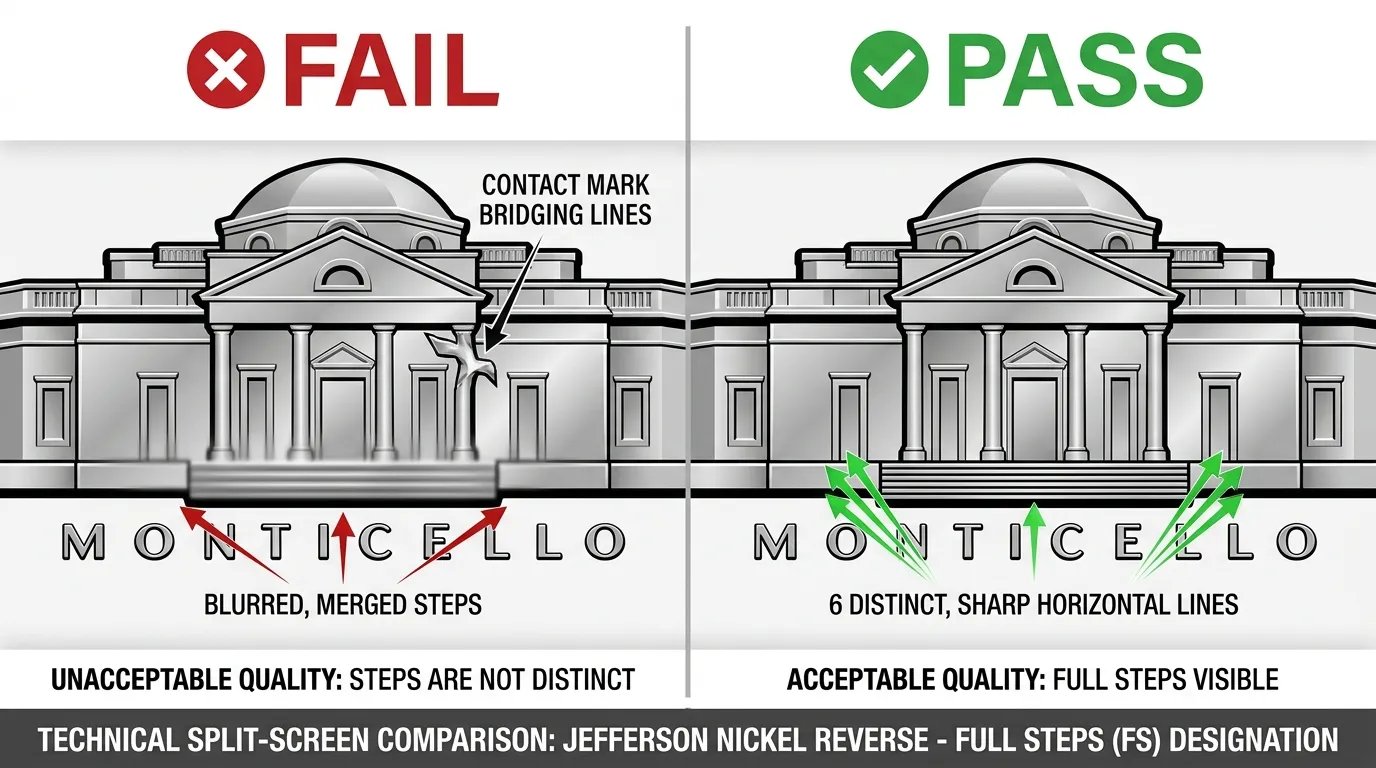
The "Full Steps" (FS) designation is the ultimate arbiter of value for the 1964 Jefferson Nickel. While a standard strike shows a blurred mass beneath Monticello, a Full Steps strike features 5 or 6 sharply defined parallel lines.
For a coin to qualify, these horizontal lines must be uninterrupted by nicks, scratches, or bridge marks. Even a microscopic contact mark across the steps will disqualify the coin, stripping it of its "FS" status and vaporizing up to 98% of its potential market value.
 AI Generated Infographic
The 1964 Strike Scarcity
The 1964 Philadelphia strike is notorious among numismatists for its "mushy" details. Due to massive production demands exceeding 1 billion coins, dies were used far beyond their intended lifespan. This makes a fully struck reverse a statistical anomaly rather than a standard output.
- Identify the Count: Focus on the five recessed lines that create the six steps of the Monticello portico.
- Verify Continuity: Use a 10x loupe. If any two steps merge due to a weak strike or a "hit," the premium vanishes.
- Threshold for Profit: FS designations are only economically viable for MS64 grades and higher.
| Grade | Standard Strike Value | Full Steps (FS) Value | Value Multiplier |
|---|---|---|---|
| MS64 | $1 - $5 | $25 - $40 | ~8x |
| MS65 | $15 | $550+ | 36x |
| MS66 | $35 | $3,250+ | 92x |
(Source: PCGS Price Guide & Heritage Auctions, Sept 2024)
The "Step" Trap
For the 1964 nickel, the jump from MS65 to MS65 FS represents the difference between common bullion and a blue-chip numismatic asset. In today’s market, liquidity is concentrated in strike quality over raw mintage volume.
Pro Insight: Do not confuse the vertical pillars of Monticello with the steps. Only the horizontal lines at the base of the building determine the FS premium. If the steps look like a smooth ramp, the coin is worth face value.
Top 1964 Nickel Error List: Discovering Hidden Value
Beyond conditional rarity, the true "black swans" of the 1964 nickel series are mint errors. Because the Philadelphia and Denver mints were operating at maximum capacity to combat a national coin shortage, quality control suffered, creating a window for lucrative mistakes.
The "Big Three" 1964 Error Varieties
While dozens of minor die chips exist, three specific errors represent the peak of market liquidity and value for 1964 nickels:
- 1964-D/D Repunched Mint Mark (RPM - FS-501): The most significant variety. Look for a clear secondary "D" to the south of the primary mint mark. A PCGS MS66 FS example set a record at $19,800 (Source: Heritage Auctions, July 2022).
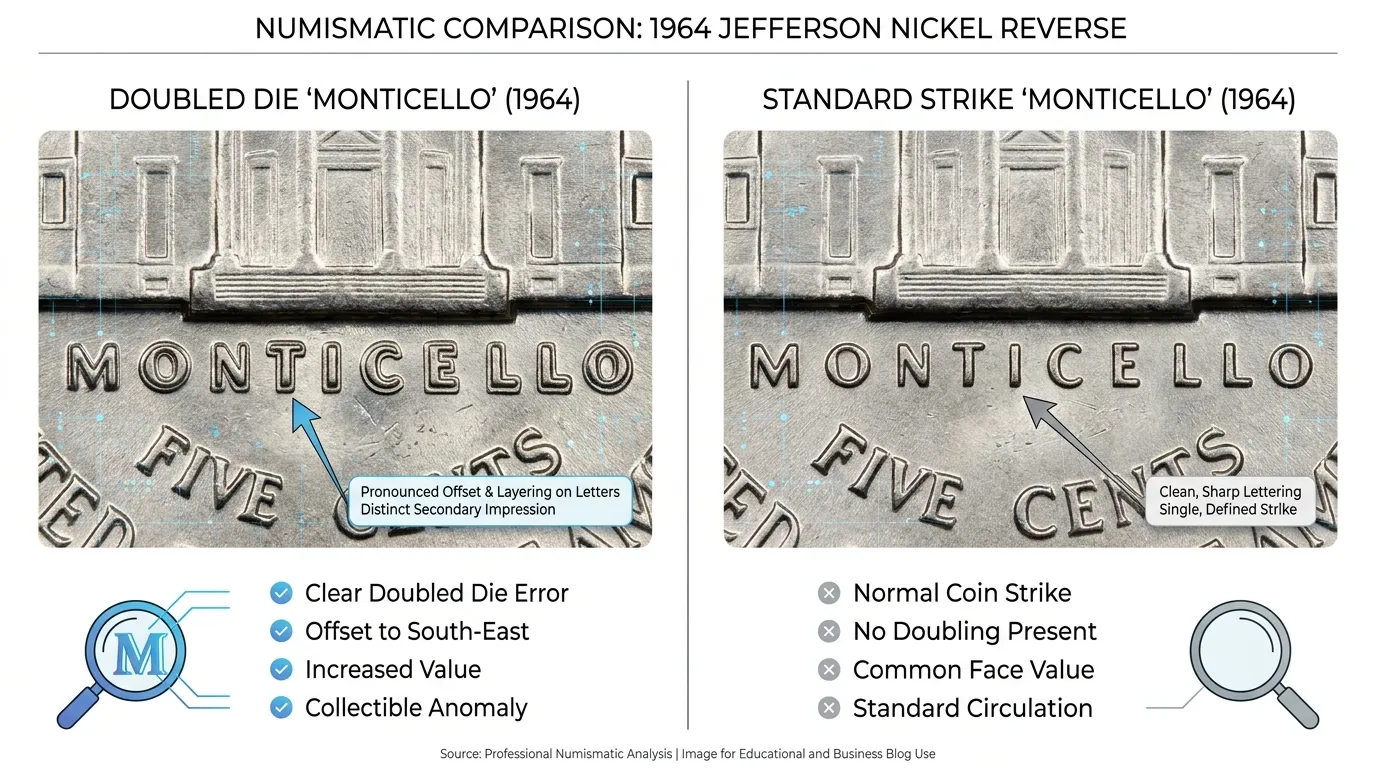
- Doubled Die Reverse (DDR): Noticeable doubling on the lettering of "MONTICELLO" and "FIVE CENTS." High-grade business strikes are exceptionally rare, often fetching $500 to $2,000 depending on the "Full Steps" (FS) status.
- Off-Center Strikes: To command a premium, the coin must be at least 10% to 50% off-center while still showing the full date and mint mark. A 50% off-center 1964 nickel typically trades between $100 and $250.
 AI Generated Infographic
1964 Nickel Error Valuation Matrix
The following table outlines the current market premiums for identified errors based on recent auction realized prices.
| Error Type | Key Identification Feature | Estimated Value (MS63+) | Record Sale |
|---|---|---|---|
| D/D Repunched | Second "D" visible at bottom | $250 – $1,200 | $19,800 |
| Doubled Die Reverse | Thickening/doubling on "FIVE CENTS" | $40 – $500+ | $2,400 |
| Broadstruck | Expanded diameter; no rim | $20 – $60 | $150 |
| Off-Center (25%+) | Crescent moon blank area | $50 – $150 | $450 |
| Wrong Planchet | Struck on 1¢ copper blank | $400 – $800 | $1,150 |
(Source: PCGS Price Guide & Heritage Auctions, Sept 2024)
So What? (Investor's Takeaway)
For the casual hunter, the Repunched Mint Mark (RPM) is the highest ROI target because it is often overlooked in "unsearched" bulk rolls. Unlike high-grade MS67 coins which require professional grading to verify value, a major off-center strike or a 1964 nickel struck on a copper penny planchet (which will appear red and weigh 3.11g) is a "visual win" that carries immediate, high-floor value in any market condition.
{
  "type": "bar",
  "title": "1964 Nickel Error High-Water Marks",
  "index": "Error Type",
  "categories": ["Top Auction Price ($)"],
  "data": [
    {"Error Type": "D/D Repunched (RPM)", "Top Auction Price ($)": 19800},
    {"Error Type": "Doubled Die Reverse", "Top Auction Price ($)": 2400},
    {"Error Type": "Wrong Planchet (1c)", "Top Auction Price ($)": 1150},
    {"Error Type": "50% Off-Center", "Top Auction Price ($)": 450}
  ],
  "source": "Source: Heritage Auctions & PCGS (2022-2024)",
  "note": "Prices reflect certified Mint State (MS) examples."
}
Identifying 1964 Doubled Die and Repunched Mint Marks
The 1964-D nickel is the most overproduced coin in the series, but within the billions of standard strikes lie two specific die varieties that command institutional-grade premiums: the FS-501 Repunched Mint Mark (RPM) and the Doubled Die Reverse (DDR).
The 1964-D FS-501: Identifying the $19,000 Variety
The FS-501 (D over D) is the apex of 1964 nickel varieties. Unlike common "machine doubling," which is flat and shelf-like, the genuine FS-501 exhibits a clear secondary 'D' punch offset to the south of the primary mark.
- Primary Identifier: Look for a distinct horizontal bar or "crescent" protruding from the bottom of the main Denver 'D' mint mark.
- Magnification Strategy: Use a 10x or 20x loupe. If the doubling looks rounded and has separation lines, it is a die variety; if it looks like a flat "shadow," it is worthless mechanical doubling.
- The So-What: A PCGS-certified MS66 FS-501 realized $19,800 at Heritage Auctions in July 2022, confirming that "conditional rarity" meets "variety rarity" to create five-figure value. (Source: PCGS & Heritage Auctions, 2024).
 Photo by Pixabay on Pexels
The 'E PLURIBUS UNUM' DDR
True Doubled Die Reverses for the 1964 business strike are significantly rarer than their proof counterparts. Collectors must scrutinize the motto above Monticello.
- Split Serifs: In the letters 'E' and 'P', look for notching at the corners.
- Increased Letter Thickness: Genuine doubling adds "girth" to the font. If the letters look thinner or "smeared," it is likely die deterioration.
- Secondary Points: Doubling often extends to the columns of Monticello and the words "FIVE CENTS."
| Grade | 1964-D RPM (FS-501) | 1964 DDR (E Pluribus) |
|---|---|---|
| MS63 | ~$230 | ~$100 |
| MS65 | $4,140 | ~$450 |
| MS66 | $19,800 (Record) | $1,200+ |
(Source: PCGS Price Guide & CoinValueChecker, Sep 2024).
The 'Pluridus' Trap
Note the "E PLURIDUS UNUM" error where the 'B' appears as a 'D'. This is not a doubled die; it is a die-overpolishing error. While a popular curiosity, it typically trades for $20–$50—far below the $1,000+ levels of genuine DDRs.
Investor Note: Always verify that doubling is "hub-born" (on the die itself) rather than "strike-born." Hub-born doubling is sharp and identical across multiple coins; strike-born doubling is a one-off manufacturing defect with minimal value.
1964-P vs. 1964-D: Which Mint Produced the Most Valuable Nickels?
While total production for 1964 exceeded 2.8 billion coins, the delta between "common change" and "auction-grade rarity" is wider here than in any other year of the Jefferson series. Denver (D) produced nearly double Philadelphia (P), yet both mints suffered from a "Quantity over Quality" mandate during the mid-60s coin shortage.
The Production Paradox: Volume vs. Value
The Denver Mint holds the record for the highest single-year mintage of any nickel in history. Paradoxically, this makes a 1964-D Full Steps (FS) gem one of the most elusive "conditional rarities" in the market. Because the Treasury froze the "1964" date and ran dies long past their prime to combat hoarding, sharp strikes became the exception, not the rule.
| Mint / Feature | Mintage (Circulation) | MS67 Rarity (PCGS) | MS67 FS Record Price |
|---|---|---|---|
| 1964 (Philly) | 1,024,672,000 | ~25 known | $14,100 |
| 1964-D (Denver) | 1,787,297,160 | < 10 known | $9,900+ |
Source: PCGS Population Report & Heritage Auctions (Sept 2024).
Identifying the Rarity Driver: The FS Designation
For both mints, value is dictated by the strike quality of the Monticello steps. While billions exist in MS60–MS64, the population collapses at the MS66 FS threshold.
- 1964-P: Generally exhibits better luster but suffers from heavy bag marks due to massive delivery bins.
- 1964-D: Notorious for weak strikes and "mushy" details. A 1964-D with six distinct steps is a "unicorn" that commands a 5,000x premium over its melt value.
{
  "type": "bar",
  "title": "Mintage (Millions) vs. PCGS MS67 Population",
  "index": "Mint",
  "categories": ["Mintage (Millions)", "PCGS MS67 Pop"],
  "data": [
    {"Mint": "1964-P", "Mintage (Millions)": 1024, "PCGS MS67 Pop": 25},
    {"Mint": "1964-D", "Mintage (Millions)": 1787, "PCGS MS67 Pop": 7}
  ],
  "source": "Source: PCGS Census Data (2024)",
  "note": "Populations represent coins without Full Steps; FS gems are significantly rarer."
}
So What? If you find a 1964-D nickel, it is statistically likely to be worth exactly five cents. However, because Denver's production quality was so poor, any example displaying razor-sharp step definition is an immediate candidate for professional grading. In the 1964 market, you are not buying the coin—you are buying the quality of the die's final moments.
The Realistic Value of Circulated 1964 Nickels
The primary obstacle to value for the 1964 Jefferson Nickel is a phenomenon I call the "Mintage Trap." While high-profile auctions for SMS prototypes or "Full Steps" gems grab headlines, they represent less than 0.0001% of the total supply.
For the average collector, the 1964 nickel is the most common date in the entire series. In a panicked response to a nationwide coin shortage and the transition away from silver, the U.S. Mint accelerated production to unprecedented levels.
- Philadelphia (No Mint Mark): 1,028,622,762 minted.
- Denver ('D' Mint Mark): 1,787,297,160 minted.
- Total Output: Over 2.8 billion units, a figure that ensured saturation for decades.
Value Breakdown: Circulated vs. Uncirculated
In circulated grades (Good to About Uncirculated), the 1964 nickel is a "face value" coin. Unless it exhibits a major mint error, it is worth exactly $0.05. Even in lower-tier uncirculated grades (MS60–MS63), the market remains flooded, keeping prices stagnant.
| Condition Grade | Technical Description | Estimated Market Value |
|---|---|---|
| Circulated (G-AU) | Distinct wear; flattened details. | $0.05 |
| Uncirculated (MS60-63) | No wear; luster present but bag marks exist. | $0.10 - $0.50 |
| Gem Uncirculated (MS65) | High luster; very few marks. | $1.00 - $5.00 |
| Superb Gem (MS66+) | Nearly flawless; exceptional eye appeal. | $20.00+ |
(Source: PCGS & NGC Price Guides, Sept 2024)
{
  "type": "bar",
  "title": "1964 Jefferson Nickel Mintage vs. Previous 5-Year Average",
  "index": "Year",
  "categories": ["Mintage (in Billions)"],
  "data": [
    {"Year": "1959-1963 Avg", "Mintage (in Billions)": 0.38},
    {"Year": "1964 Total", "Mintage (in Billions)": 2.81}
  ],
  "source": "Source: U.S. Mint Annual Reports",
  "note": "The 1964 mintage was nearly 7.5x the average of the preceding five years."
}
So What? The "Silver Scare" of 1964 led the public to hoard these coins, believing they might contain silver (they do not—they are 75% copper, 25% nickel). This resulted in massive quantities of "Uncirculated" rolls being preserved. To find real value, you must look beyond the date and focus exclusively on Proof-like surfaces or structural errors. Without these, you simply have a common relic of a massive industrial over-correction.
Conclusion: How to Sell Your 1964 Nickel for Maximum Profit
Conclusion: How to Sell Your 1964 Nickel for Maximum Profit
To exit a position in high-end numismatics, you must transition from a "hunter" to a "marketer." For the 1964 SMS Nickel or a MS67 Full Steps specimen, the difference between a $100 sale and a $30,000 hammer price lies entirely in third-party validation and venue selection.
Step 1: The "Big Three" Authentication
In 2026, raw coins are effectively non-liquid assets for serious investors. You must secure grading from PCGS or NGC. However, the "Smart Money" in the current market now demands a third layer: CAC (Certified Acceptance Corp) or CACG stickers.
Recent 2026 auction data shows that CAC-approved modern rarities are commanding premiums of 40% to 200% over non-stickered counterparts in the same numerical grade. If you hold a 1964 SMS, a "Gold" CAC sticker is the ultimate multiplier, signaling the coin is under-graded.
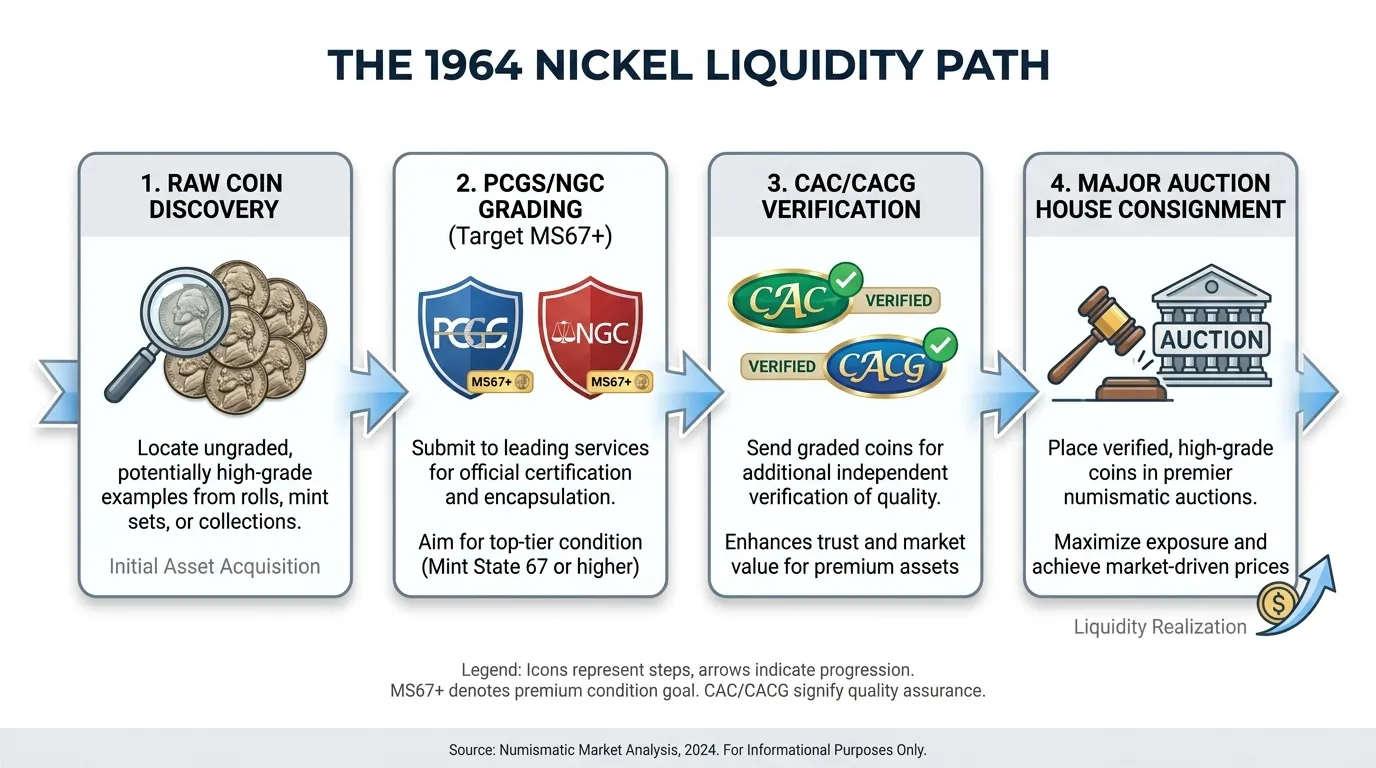 AI Generated Infographic
Step 2: Selecting the Venue
Do not sell high-value errors or SMS prototypes on eBay. The "Registry Set" collectors—those willing to pay record-breaking prices to outrank competitors—exclusively shop at specialized auction houses.
| Potential Grade/Type | Recommended Venue | Expected Fee Structure |
|---|---|---|
| 1964 SMS (All Grades) | Heritage Auctions / Stack's Bowers | 15-20% Buyer's Premium |
| 1964-D MS67 Full Steps | GreatCollections | 0-5% Seller Fee (Competitive) |
| Major Mint Errors | David Lawrence Rare Coins | Private Treaty or Auction |
| (Source: Numismatic News & Auction House Fee Schedules, Sept 2026) |
{
  "type": "line",
  "title": "1964 SMS Nickel Value Trend (SP67/68)",
  "index": "Year",
  "categories": ["Auction High (USD)"],
  "data": [
    {"Year": "2016", "Auction High (USD)": 32900},
    {"Year": "2021", "Auction High (USD)": 31200},
    {"Year": "2024", "Auction High (USD)": 26500},
    {"Year": "2025", "Auction High (USD)": 28000},
    {"Year": "2026 (Est)", "Auction High (USD)": 30500}
  ],
  "source": "Source: PCGS Auction Results & Market Analysis (2026)",
  "note": "2026 estimates account for the Sestercentennial demand surge."
}
Step 3: Timing the 2026 "Sestercentennial" Surge
Timing is your greatest lever. As the U.S. approaches the 250th anniversary of its founding in 2026, mainstream interest in "Historical American Relics" is peaking. We expect a liquidity surge in Q4 2026 as institutional-grade collectors rebalance their portfolios.
Target a Signature Auction (typically held during the ANA World's Fair of Money) to ensure your coin is viewed by the deepest pockets in the industry. For those leveraging data-driven insights to manage a high-value collection, maintaining an "always-on" pulse of the market is essential for maximizing ROI through professional Tritonix.ai research workflows.
FAQ
How much is the most valuable 1964 nickel worth?
The most valuable 1964 nickel is the SMS (Special Mint Set) prototype, which can command $30,000 or more in top-tier condition at elite auctions.
What makes a 1964 SMS nickel different from a regular strike?
The 1964 SMS nickel features a unique satin/matte finish, razor-sharp square rims, and an extreme level of detail with virtually no bag marks, unlike mirror-like proofs or grainy business strikes.
How can I identify a 1964 Full Steps (FS) nickel?
Using a 10x loupe, look for five or six crisp, uninterrupted horizontal lines at the base of Monticello on the coin's reverse. Any blurring or contact marks across the steps disqualifies the FS designation.
What are the most valuable 1964 nickel errors to look for?
The top errors include the 1964-D/D Repunched Mint Mark (FS-501), which has sold for over $19,000, and the Doubled Die Reverse (DDR) featuring thickening on 'MONTICELLO'.
Are regular circulated 1964 nickels worth more than five cents?
Generally, no. Because over 2.8 billion were minted, most circulated 1964 nickels are worth only face value ($0.05) unless they possess rare errors or the 'Full Steps' designation in high grades.