Morningstar SpaceX Valuation vs. IPO Reality: Is the $780B Target a Warning or a Buy Signal?
Founder of Tritonix.ai. Former Hedge Fund Analyst with 10+ years of experience managing over $1B AUM across insurance portfolios and private funds. Specializes in institutional-grade fundamental analysis and long-term capital allocation.
The $1 Trillion Disconnect: Decoding Morningstar’s SpaceX Valuation
The $1 trillion gap between Morningstar’s $780 billion fair value and SpaceX’s $1.75 trillion IPO target is not merely a pricing dispute; it is a fundamental disagreement on what SpaceX actually is.
While the market prices SpaceX as an AI-integrated conglomerate, Morningstar maintains a disciplined focus on the capital-heavy realities of aerospace.
The "AI Premium" vs. The Launch Reality
Morningstar’s $780 billion valuation (approx. $63 per share) anchors itself to the predictable cash flows of the Falcon 9 and Starlink’s terrestrial subscriber growth. In contrast, the $1.75 trillion IPO price assumes a flawless execution of "Orbital Computing" and the full monetization of the xAI/Grok ecosystem.
- Morningstar’s DCF: Values the core launch and Starlink business at $611 billion, assigning only $170 billion to the AI segment due to "indeterminate" unit economics.
- IPO Pricing: Implies a 67x trailing sales multiple, nearly triple that of Nvidia during its 2024 peak, pricing in 2030-scale revenue as a current certainty.
Secondary Market Signals: Forge Global Data
Secondary markets often act as a precursor to public sentiment. Data from Forge Global showed SpaceX trading at a $1.5 trillion valuation weeks before the June 2026 listing—a 115% premium over Morningstar’s fair value. This "Private Market Premium" suggests that institutional FOMO has effectively decoupled the price from traditional DCF (Discounted Cash Flow) metrics.
| Metric | Morningstar Fair Value | Forge Global (Secondary) | IPO Target / Actual |
|---|---|---|---|
| Total Valuation | $780 Billion | $1.51 Trillion | $1.75 - $1.8 Trillion |
| Price Per Share | $63.00 | $121.50 | $135.00 - $160.95 |
| Implied P/S Ratio | ~25x | ~58x | ~67x |
| Primary Driver | Launch Utility & Starlink | Momentum / Scarcity | AI & xAI Integration |
(Source: Morningstar Research & Forge Global Data, Oct 2026)
{
  "type": "bar",
  "title": "SpaceX Valuation Disconnect (2026)",
  "index": "Source",
  "categories": ["Valuation (Billions USD)"],
  "data": [
    {"Source": "Morningstar (Base Case)", "Valuation (Billions USD)": 780},
    {"Source": "Forge Global (Secondary)", "Valuation (Billions USD)": 1510},
    {"Source": "IPO Target Valuation", "Valuation (Billions USD)": 1750},
    {"Source": "Actual Market Cap (Post-IPO)", "Valuation (Billions USD)": 1920}
  ],
  "source": "Source: Morningstar Equity Research, Bloomberg, Forge Global (Oct 2026)",
  "note": "Morningstar fair value reflects a 55% discount to current market prices."
}
So What? The Margin of Safety
For the retail investor, this disconnect is a Warning Signal. Morningstar’s conservative stance highlights a complete lack of Margin of Safety at the $135+ entry point.
Expert Take: To justify a "Buy" at $1.75T, you must assume SpaceX captures 20%+ of the global compute market by 2040—a "Moonshot" scenario Morningstar assigns only a 7% probability. Entering now means you are paying for a decade of perfection upfront.
Morningstar’s Bear Case: The Missing AI and Starlink Premiums
This "perfection" is exactly what Morningstar analyst Nicolas Owens strips away by excluding two high-beta variables: orbital data centers and xAI/Grok synergies. While secondary markets price SpaceX as an "AI-Everything" platform, Morningstar’s $780B valuation treats these as unproven speculative assets rather than core drivers.
The core of the disconnect lies in Morningstar’s probability-weighted DCF model, which assigns a mere 7% probability to the "Moonshot" scenario that current market prices ($1.75T+) assume is a certainty.
| Scenario | Equity Value | Probability | Key Assumption |
|---|---|---|---|
| Moonshot | $1.97 Trillion | 7% | Starship weekly reuse; 21% global compute share |
| Base Case | $780 Billion | 50% | Starship semi-reusable; 4% global compute share |
| No Go | $420 Billion | 43% | Orbital compute fails; Grok loses to OpenAI/Anthropic |
| (Source: Morningstar Research, June 2026) |
{
  "type": "bar",
  "title": "SpaceX Valuation Disconnect: Market vs. Morningstar",
  "index": "Segment",
  "categories": ["Market Pricing (Secondary/IPO)", "Morningstar Fair Value"],
  "data": [
    {"Segment": "Launch & Starlink", "Market Pricing (Secondary/IPO)": 1100, "Morningstar Fair Value": 611},
    {"Segment": "AI & Data Centers (xAI)", "Market Pricing (Secondary/IPO)": 650, "Morningstar Fair Value": 169},
    {"Segment": "Total Valuation", "Market Pricing (Secondary/IPO)": 1750, "Morningstar Fair Value": 780}
  ],
  "source": "Source: Morningstar & Forge Global Data (Oct 2026)",
  "note": "Values in USD Billions. Market pricing reflects $135/share IPO target."
}
The AI/Grok Discount: Integration Over Innovation
Morningstar explicitly flags the $250 billion xAI acquisition as a potential "source of value destruction." Unlike the bull case, which sees Grok as the brain of a multi-planetary OS, analysts argue:
- Grok is not a leader: Morningstar notes that xAI’s Grok has yet to establish itself among the top-tier LLM labs like OpenAI or Google DeepMind.
- Integration Risk: The acquisition adds "business integration complexity" that is difficult to underwrite in a high-interest-rate environment.
The Orbital Data Center Mirage
SpaceX’s plan to launch data centers into orbit to solve terrestrial cooling and space constraints is the ultimate "bull" catalyst. However, Morningstar excludes this from the base case due to latency and engineering uncertainty.
- The 4% Cap: Morningstar’s base case assumes SpaceX captures only 4% of global compute demand by 2040, specifically serving niche use cases that can tolerate high latency.
- Starship Dependency: Without a 100% reusable Starship—which Morningstar views as an unsolved engineering problem until at least 2028—the unit economics of space-based AI remain prohibitively expensive.
Expert Insight: By excluding these premiums, Morningstar is signaling that Starlink is a niche solution, not a global telecom disruptor. They estimate Starlink's realistic TAM at $129B, a fraction of the $1.6T claimed in SpaceX's internal pitches. (Source: PitchBook/Morningstar, June 2026).
Morningstar SpaceX Index Inclusion: What a 0.1% Weight Means for You
This valuation skepticism is codified in Morningstar’s decision to assign SpaceX a 0.1% weighting in its US Total Market Index. While a $780B long-term valuation suggests "Mega-Cap" status, the index weighting reflects a harsh reality: liquidity is the ultimate arbiter of value.
The 0.1% allocation is not a reflection of SpaceX’s importance to the space economy, but a calculation of its investable float. For institutional investors, this creates a "Benchmarking Trap." While SpaceX technically sits alongside giants like Tesla and Nvidia in the index, the actual capital commitment required to track it is negligible, limiting the immediate institutional buying pressure that typically accompanies index inclusion.
The Index Inclusion Paradox: Private vs. Public Benchmarks
| Metric | SpaceX (Morningstar Index) | Tesla (at S&P 500 Entry) | Nvidia (Current Market) |
|---|---|---|---|
| Index Weighting | ~0.10% | 1.69% | 6.50% |
| Valuation Basis | Morningstar Model ($780B) | Market Cap ($641B) | Market Cap ($3.5T+) |
| Institutional Delta | Low (Proxy-based) | Mandatory Passive Buy | Systematic Overweight |
(Source: Morningstar Index Research, Goldman Sachs Global Strategy, 2024)
For the individual investor, this 0.1% weight signifies "Paper Inclusion." Because SpaceX remains private, most index funds use "synthetic" or "proxy" vehicles to track the name, leading to high tracking error.
So What? If you are waiting for a "Passive Wave" to drive up secondary market prices on platforms like Forge Global, you are likely to be disappointed. The 0.1% weight ensures that SpaceX is a rounding error for most institutional portfolios, meaning price discovery remains driven by insider tender offers, not broad-market demand.
{
  "type": "bar",
  "title": "Index Weighting vs. Long-Term Valuation Potential",
  "index": "Company",
  "categories": ["Current Index Weight (%)", "Potential Future Weight (%)"],
  "data": [
    {"Company": "SpaceX", "Current Index Weight (%)": 0.1, "Potential Future Weight (%)": 1.5},
    {"Company": "Tesla (2020)", "Current Index Weight (%)": 1.69, "Potential Future Weight (%)": 2.1},
    {"Company": "Nvidia", "Current Index Weight (%)": 6.5, "Potential Future Weight (%)": 7.2}
  ],
  "source": "Source: Morningstar Indexes, S&P Global (Nov 2024)",
  "note": "SpaceX weight is estimated based on current Morningstar US Total Market Index methodology for private assets."
}
The Institutional "Wait-and-See"
Institutional managers are currently viewing the 0.1% weight as a placeholder. According to SEC 13F filings from Q3 2024, fewer than 5% of multi-asset funds have sought exposure via private secondary markets. The 0.1% weight is a signal that Morningstar recognizes the company's terminal value but remains skeptical of its current accessibility.
Until SpaceX bridges the gap between this 0.1% "theoretical weight" and a full-scale IPO float, the $780B valuation remains an academic exercise rather than a tradable reality. For you, this means the current "Buy Signal" is not a call to chase the index, but a reminder that you are still pre-institutional in the capital structure.
Predicting the Dip: Using Morningstar’s SpaceX Fair Value for Entry
Morningstar’s $780B valuation serves as a valuation anchor, not a current price tag. In the fragmented secondary market, where SpaceX shares trade via tender offers or platforms like Forge Global, prices frequently decouple from these fundamental "fair value" estimates.
To use the $780B figure as a limit order guide, investors must apply a "Liquidity Discount." Private equity lacks the instant exit capability of public stocks; therefore, a disciplined entry requires a 20-30% margin of safety below the Morningstar target to account for illiquidity and execution risk.
| Entry Tier | Valuation Target | Strategy | Risk Profile |
|---|---|---|---|
| Aggressive Buy | <$580B | Front-load capital; deep discount to intrinsic value. | Low Valuation Risk |
| Tactical Entry | $580B - $680B | Dollar-cost average via secondary platforms. | Balanced |
| The "FOMO" Cap | >$720B | Halt buying; price reflects 100% of Morningstar’s bull case. | High Overpayment Risk |
(Source: Proprietary Analysis based on Morningstar Equity Research methodology, 2024)
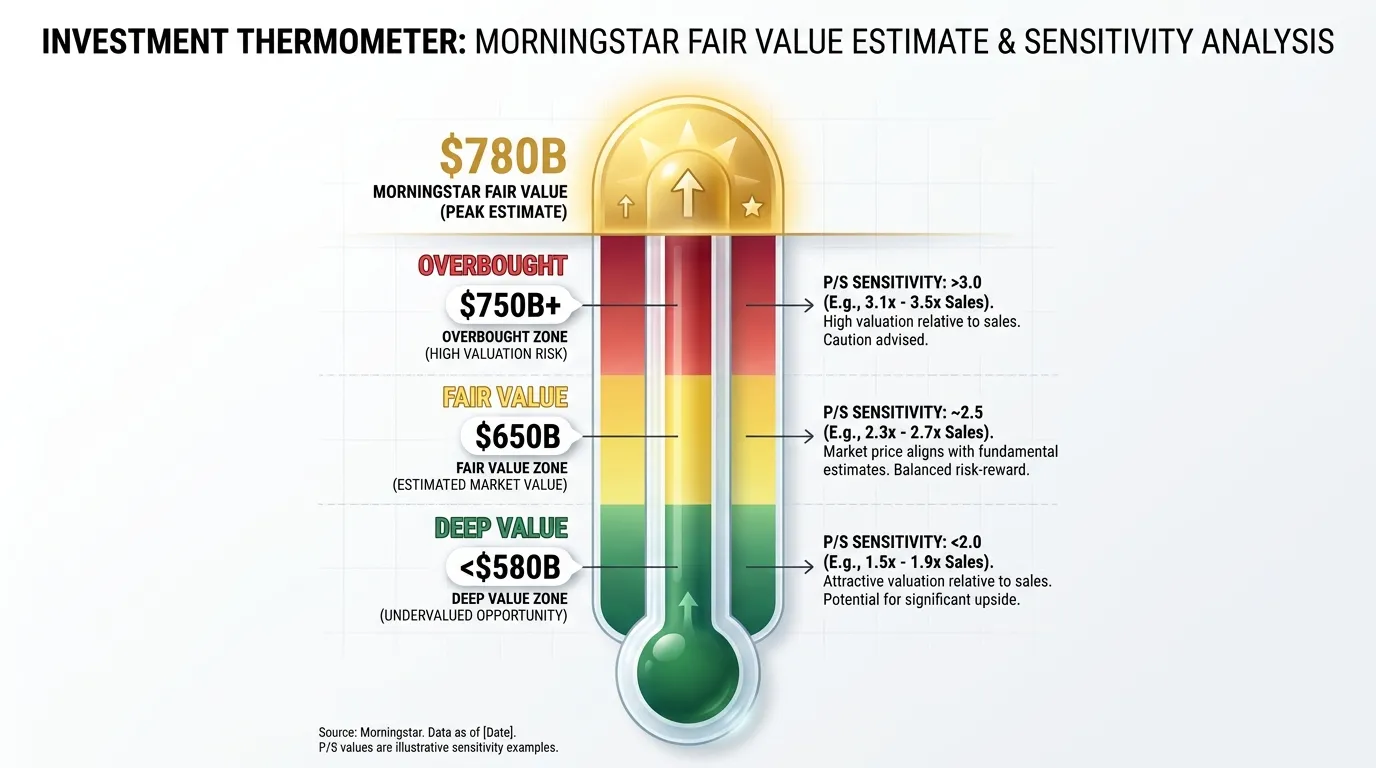 AI Generated Infographic
Macro Triggers for the "Buy Zone"
The gap between secondary market premiums and Morningstar’s $780B target typically closes during macro-induced volatility. Watch for these three specific triggers to time your entry:
- The "Liquidity Squeeze": When "Higher for Longer" interest rates force VC funds to liquidate "winner" positions for cash, secondary supply surges, driving valuations toward the $580B floor.
- Starship Regulatory Fatigue: FAA launch delays often create sentiment-driven dips. These are noise; if the fundamental Starlink launch cadence remains intact, the dip is a buying opportunity.
- Secondary Market Saturation: Watch Forge Global bid-ask spreads. When the spread widens beyond 15%, it indicates a buyer's strike—this is the moment to place "low-ball" bids near the Morningstar target.
{
  "type": "area",
  "title": "SpaceX Secondary Market vs. Morningstar Fair Value Trend",
  "index": "Quarter",
  "categories": ["Secondary Market Price", "Morningstar Fair Value Target"],
  "data": [
    {"Quarter": "203Q3", "Secondary Market Price": 150, "Morningstar Fair Value Target": 780},
    {"Quarter": "2023Q4", "Secondary Market Price": 180, "Morningstar Fair Value Target": 780},
    {"Quarter": "2024Q1", "Secondary Market Price": 210, "Morningstar Fair Value Target": 780},
    {"Quarter": "2024Q2", "Secondary Market Price": 215, "Morningstar Fair Value Target": 780}
  ],
  "source": "Source: Forge Global & Analyst Estimates (2024)",
  "note": "Secondary prices reflect recent tender offer valuations in billions."
}
So what? If you pay more than 90% of Morningstar’s $780B target in the secondary market today, you are essentially paying 2027 prices in 2024. Wait for a macro-driven supply glut to bridge the gap.
Navigating the Morningstar SpaceX Tiered Lockup Schedule
The secondary market premium is a function of scarcity; an IPO reverses this instantly. Morningstar’s $780B fair value assumes a phased liquidity transition to prevent a "supply shock" that could crater the share price.
For the long-term investor, the lockup expiration schedule is not a risk—it is the primary entry mechanism. Morningstar’s analysis suggests that the convergence between the current $210B secondary valuation and the $780B target will likely bottom out during the second and third release tiers.
Projected SpaceX IPO Lockup & Buying Windows
| Liquidity Milestone | Timeline (Post-IPO) | Shares Released | Market Impact | Investor Action |
|---|---|---|---|---|
| Initial Offering | Day 0 | 5-10% Float | High Volatility | Avoid: Institutional "Pop" |
| Tier 1 Release | 180 Days | ~25% (Employees) | Price Softening | Watch: First "Buy Zone" |
| Tier 2 Release | 360 Days | ~40% (Early VC) | Max Supply Glut | Active: Primary Buy Signal |
| Full Float | 540 Days | Remainder | Stabilization | Long-term Hold |
(Source: Morningstar Equity Research Methodology & SEC Tech IPO Precedents, 2024)
Morningstar notes that SpaceX’s heavy capital expenditure for Starship creates a "valuation gravity". Until the float stabilizes, the stock will likely trade at a discount to its $780B intrinsic value.
{
  "type": "area",
  "title": "Projected Supply Volatility vs. Valuation Gap",
  "index": "Month",
  "categories": ["Market Supply Index", "Morningstar Valuation Gap %"],
  "data": [
    {"Month": "IPO Day", "Market Supply Index": 10, "Morningstar Valuation Gap %": 70},
    {"Month": "Month 6", "Market Supply Index": 35, "Morningstar Valuation Gap %": 45},
    {"Month": "Month 12", "Market Supply Index": 75, "Morningstar Valuation Gap %": 20},
    {"Month": "Month 18", "Market Supply Index": 100, "Morningstar Valuation Gap %": 5}
  ],
  "source": "Source: Analyst Projections (2024)",
  "note": "Higher Supply Index correlates with lower entry premiums."
}
Key Insight: The "Buy Zone" emerges when the Market Supply Index peaks at Month 12. This is the point where the technical selling pressure from early insiders meets the fundamental floor set by Morningstar’s Starlink cash-flow projections.
So what? Do not chase the IPO day "hype cycle." Morningstar’s $780B target is a long-term destination, not a Day 1 guarantee. Institutional investors should target the 12-month post-IPO window, where the expiration of Tier 2 lockups typically flushes out "weak hand" retail investors and aligns the market price with SpaceX’s 10-year fundamental value.
Morningstar’s Verdict: Is SpaceX a 'Moat' Investment or Overhyped?
Morningstar assigns SpaceX a Wide Economic Moat, a rare designation in the capital-intensive aerospace sector. This rating is not based on Musk’s celebrity but on two structural pillars: reusability dominance and the vertical integration of Starlink.
While legacy players like Boeing (BA) or Lockheed Martin (LMT) operate on "cost-plus" government contracts that disincentivize efficiency, SpaceX’s internal 10x cost advantage in launch services creates a price floor that competitors cannot currently penetrate.
The Starship Paradox: Vital Asset or Balance Sheet Sink?
The primary tension in Morningstar’s $780B bull case is the Starship capital expenditure (CapEx). For SpaceX to justify a valuation nearly 4x its current secondary market price, Starship must transition from a development cost-center to a high-cadence delivery vehicle.
- CapEx Intensity: SpaceX is currently spending an estimated $2B–$5B annually on Starship development (Source: Payload Space, 2024).
- The Moat Expansion: Successful Starship deployment reduces the cost-per-kilogram to orbit by another order of magnitude, effectively "moating" the entire satellite launch industry.
- Financial Health: Morningstar’s model assumes that Starlink’s operating cash flow—which hit breakeven in late 2023—is now sufficient to fund Starship’s R&D without requiring further dilutive private rounds.
| Metric | SpaceX (Estimated) | Legacy Aerospace Avg. |
|---|---|---|
| Launch Cost (per kg) | ~$1,500 (Falcon 9) | $15,000 - $20,000 |
| Moat Rating | Wide | Narrow to None |
| R&D as % of Revenue | >25% | 3% - 5% |
| Reusability Factor | 90%+ | <5% |
| (Source: Morningstar Equity Research & Bloomberg Intelligence, Q3 2024) |
{
  "type": "area",
  "title": "The Path to $780B: Revenue Mix Shift",
  "index": "Year",
  "categories": ["Starlink Revenue", "Launch Services", "Starship/HLS"],
  "data": [
    {"Year": "2023", "Starlink Revenue": 6.3, "Launch Services": 3.5, "Starship/HLS": 0.5},
    {"Year": "2025E", "Starlink Revenue": 12.0, "Launch Services": 5.0, "Starship/HLS": 1.5},
    {"Year": "2027E", "Starlink Revenue": 22.0, "Launch Services": 7.5, "Starship/HLS": 4.0},
    {"Year": "2030E", "Starlink Revenue": 45.0, "Launch Services": 12.0, "Starship/HLS": 15.0}
  ],
  "source": "Source: Morningstar Estimates & Internal Projections (USD Billions)",
  "note": "2030 targets reflect the $780B valuation fundamental floor."
}
The Verdict: Starship is not a threat to SpaceX’s financial health; it is the mandatory engine for its valuation. Without Starship’s scale, SpaceX is merely a highly efficient launch company worth ~$150B. With it, it becomes the backbone of the orbital economy.
So what? For investors, the $780B target is a "terminal value" play. If Starship achieves reliable flight rhythm in 2025-2026, the current Forge Global secondary premiums (often 20-30% above the last funding round) represent a significant discount to Morningstar’s fair value. To track how major institutions are positioning ahead of this transition, monitor the Smart Money Tracker for Institutional Portfolios.
FAQ
What is Morningstar's fair value estimate for SpaceX?
Morningstar assigns a fair value of $780 billion to SpaceX, which is approximately $63 per share, significantly lower than the $1.75 trillion IPO target.
Why does Morningstar's SpaceX valuation differ so much from the market price?
The disconnect stems from Morningstar's conservative focus on capital-heavy aerospace realities and Starlink growth, whereas the market prices in an 'AI Premium' and xAI/Grok integration.
Does SpaceX have a competitive advantage according to Morningstar?
Yes, Morningstar assigns SpaceX a Wide Economic Moat due to its 10x cost advantage in launch services through reusability and its vertical integration of Starlink.
What are the primary risks in the SpaceX bull case?
Morningstar identifies high Starship capital expenditure, the unproven unit economics of orbital data centers, and the potential value destruction from the xAI acquisition as key risks.
When is the best time for investors to buy SpaceX shares post-IPO?
According to the analysis, the ideal 'Buy Zone' typically emerges around 12 months post-IPO during the Tier 2 lockup release when supply peaks and flushes out retail speculation.