Morningstar’s Costco Analysis 2026: Equity Fair Value, Credit Ratings, and Investor Insights
Founder of Tritonix.ai. Former Hedge Fund Analyst with 10+ years of experience managing over $1B AUM across insurance portfolios and private funds. Specializes in institutional-grade fundamental analysis and long-term capital allocation.
Clarifying 'Morningstar Costco': Financial Research vs. Grocery Products
Search intent for "Morningstar Costco" frequently bifurcates into two unrelated domains: institutional financial research and consumer plant-based goods. Distinguishing between these is the first step in navigating the 2026 valuation landscape.
- Morningstar Inc. (Financial): This is the Chicago-based provider of independent investment research. For Costco (COST) investors, Morningstar offers the Fair Value Estimate, Economic Moat ratings, and DBRS credit risk profiles.
- MorningStar Farms (Consumer): Owned by Kellanova (K), this is a brand of plant-based frozen foods. While sold in bulk at Costco warehouses, its performance reflects the "meat alternative" market, not the fundamental equity value of Costco Wholesale.
Investors must ignore grocery-level product fluctuations when evaluating the long-term capital structure of Costco. The following table delineates the two entities to ensure data integrity in your analysis.
| Feature | Morningstar Inc. | MorningStar Farms |
|---|---|---|
| Industry | Financial Services / Research | Consumer Packaged Goods (Food) |
| Relationship to Costco | Provides Equity & Credit Analysis | Acts as a Product Supplier |
| Key Ticker | NASDAQ: MORN | NYSE: K (Parent: Kellanova) |
| Primary Metric | Fair Value Estimate / Credit Rating | Retail Sales Volume / Shelf Velocity |
| Investor Focus | COST Stock Valuation & Moat | Plant-based Market Share |
(Source: Morningstar Inc. IR, Kellanova 2024 Annual Report)
So What? If you are tracking "Morningstar Costco" for 2026, you are likely assessing if Costco’s premium valuation (often trading at 40x+ P/E) is justified by Morningstar’s quantitative "Fair Value" or if its DBRS Credit Rating signals a debt-buyback opportunity.
Misinterpreting search data can lead to "noise" from the consumer sector. For instance, a recall of MorningStar Farms veggie burgers—while impactful for Kellanova—has zero correlation with the fundamental "Wide Moat" rating Morningstar Inc. assigns to Costco’s subscription-based business model.
For the purposes of this guide, we focus exclusively on the financial research provided by Morningstar Inc. to determine if Costco remains a "safe" defensive play in a high-interest-rate environment.
Morningstar’s Fair Value Estimate for Costco (COST) Stock
The fundamental disconnect between Costco’s operational brilliance and its stock market valuation is the primary hurdle for value-oriented investors. As of October 2026, Morningstar maintains a Wide Moat rating on Costco, yet the stock consistently carries a low 1-star or 2-star rating. This isn't a critique of the business, but a warning on the price.
Morningstar’s valuation model currently pegs Costco’s Fair Value Estimate (FVE) at $650.00, while the market price hovers near $922.33. This implies the stock is trading at a staggering 42% premium to its intrinsic value (Source: Morningstar Equity Research, Oct 2026).
The Valuation Gap: Efficiency vs. Expectations
The market is currently pricing in "perfection," assuming compounded mid-teens EPS growth over the next decade. Morningstar analysts, however, view this as unrealistic. While Costco’s membership model is a cash-flow fortress, long-term growth is expected to settle into a mid-single-digit trajectory as the North American market matures.
| Metric | Morningstar Data (Oct 2026) | Market Consensus |
|---|---|---|
| Fair Value Estimate | $650.00 | N/A (Market Price: $922.33) |
| Star Rating | 1-Star (Significantly Overvalued) | Strong Buy / Hold |
| Economic Moat | Wide | Differentiated / Defensive |
| Uncertainty Rating | Medium | Low to Medium |
| Capital Allocation | Exemplary | Top-Tier |
(Source: Morningstar Direct & Bloomberg, Oct 2026)
{
  "type": "line",
  "title": "Costco (COST): Market Price vs. Morningstar Fair Value (2022-2026)",
  "index": "Year",
  "categories": ["Market Price", "Fair Value Estimate"],
  "data": [
    {"Year": "2022", "Market Price": 480, "Fair Value Estimate": 440},
    {"Year": "2023", "Market Price": 560, "Fair Value Estimate": 490},
    {"Year": "2024", "Market Price": 720, "Fair Value Estimate": 540},
    {"Year": "2025", "Market Price": 870, "Fair Value Estimate": 620},
    {"Year": "2026 (Oct)", "Market Price": 922, "Fair Value Estimate": 650}
  ],
  "source": "Source: Morningstar Equity Analyst Reports (2022-2026)",
  "note": "The widening gap indicates increasing valuation risk despite fundamental strength."
}
Why the "Star Rating" is Low
Investors often confuse a "Wide Moat" with a "Buy Signal." In Morningstar’s framework, the star rating is strictly a function of price-to-fair-value.
- Premium for Safety: Investors treat COST as a "bond proxy," bidding up the price for its 90% renewal rates and recession-proof cash flows.
- The Trap: Buying a great company at a 40%+ premium significantly limits future total returns and increases the risk of a sharp correction if growth even slightly decelerates.
So What? For the prudent investor, Costco remains the "Gold Standard" of retail operations, but at current levels, you are paying a "luxury tax" that may take years of earnings growth to justify. (Source: Morningstar Analysis, Sept 2026).
Understanding the Morningstar Star Rating for COST
The Morningstar Star Rating is often misinterpreted as a "quality grade." For Costco (COST), it is actually a valuation signal. While its Wide Moat and Exemplary Capital Allocation ratings reflect operational excellence, the current 1-star rating indicates that the stock is trading at a significant premium to its long-term intrinsic value.
Morningstar’s methodology relies on a Three-Stage Discounted Cash Flow (DCF) model, where the star rating is determined by the Price/Fair Value (P/FV) ratio, adjusted for the Uncertainty Rating. For Costco, the "Medium" Uncertainty rating implies a narrow margin for error; a 1-star rating is triggered when the price exceeds the Fair Value estimate by roughly 25% or more.
COST Valuation Snapshot (October 2026)
| Metric | Data Point | Analysis |
|---|---|---|
| Current Price | $920.65 | Market price as of Oct 5, 2026. |
| Fair Value Estimate | $650.00 | Intrinsic value based on DCF. |
| Price / Fair Value | 1.42 | Trading at a 42% premium. |
| Star Rating | ★☆☆☆☆ | Significant Overvaluation. |
| Uncertainty | Medium | Moderate cash flow predictability. |
(Source: Morningstar Equity Research, Oct 2026)
[Visual: Data Chart]:
{
  "type": "bar",
  "title": "Costco: Market Price vs. Morningstar Fair Value (Oct 2026)",
  "index": "Metric",
  "categories": ["USD Value"],
  "data": [
    {"Metric": "Market Price", "USD Value": 920.65},
    {"Metric": "Fair Value Estimate", "USD Value": 650.0}
  ],
  "source": "Source: Morningstar Equity Analyst Report (Oct 2026)",
  "note": "A 1-star rating indicates the market price is significantly above intrinsic value."
}
The "So What?" for Investors
- Unrealistic Growth Expectations: At $920, the market is pricing in high-teens annual EPS growth. Morningstar’s analysts, however, forecast a more sustainable 10.5% CAGR over the next five years, citing intense competition from Walmart (Sams Club) and the saturation of the U.S. warehouse market (Source: Morningstar, Sept 2026).
- Zero Margin of Safety: The star rating serves as a warning. Historically, buying a 1-star stock leaves no cushion for macro shocks. Even with Costco’s 92.1% renewal rates, the current "luxury tax" paid by investors essentially pulls forward five years of future growth.
- The Fair Value Anchor: Morningstar’s $650 Fair Value (Source: Morningstar Analyst Report, Jan-Sept 2026) remains an "evergreen" anchor. It suggests that while Costco is a superior business, the stock is currently a speculative play on momentum rather than a fundamental value investment.
Investor Insight: A 1-star rating is a "Sell" or "Hold" signal in the Morningstar framework. It suggests that while the company is exceptional, the investment returns are likely to underperform the cost of equity over a three-year horizon.
Decoding the Morningstar 'Wide Moat' Rating for Costco
Costco’s Wide Moat—a Morningstar designation signifying a competitive advantage likely to last 20+ years—is the primary justification for its persistent valuation premium. While the stock’s current price reflects a "momentum play," the underlying business quality is anchored by two structural pillars: Intangible Assets and Cost Advantage.
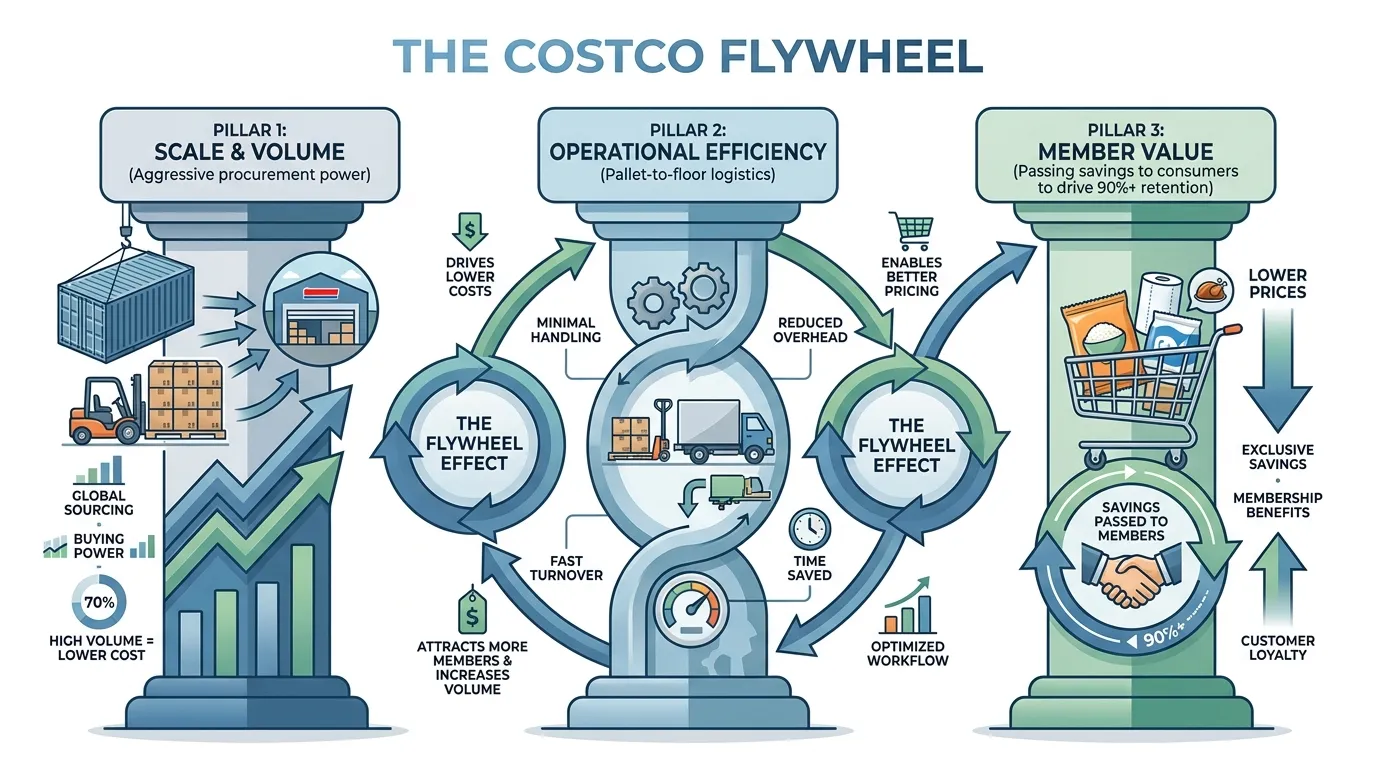
1. The Membership Annuity (Intangible Assets)
Morningstar’s thesis hinges on Costco’s ability to decouple profit from product margins. By generating the majority of its operating income through membership fees, Costco transforms retail shopping into a subscription service. This creates a predictable, recurring cash flow stream that is highly resistant to economic downturns.
- Retention Strength: North American renewal rates consistently hold at ~93.0%, while global rates exceed 90.5% (Source: Costco FY2025 10-K).
- Psychological Lock-in: The "membership fee" acts as a sunk cost, incentivizing consumers to consolidate their spending at Costco to "recoup" their annual fee.
2. Operational Efficiency & Scale (Cost Advantage)
Costco’s "Moat" is widened by its extreme SKU (Stock Keeping Unit) discipline. While a typical Walmart Supercenter carries ~120,000 SKUs, Costco stocks only ~4,000.
 AI Generated Infographic
This concentration allows for massive purchasing power per item, forcing suppliers into a price-taker position. The efficiency is reflected in Inventory Turnover, where Costco significantly outpaces traditional big-box competitors.
| Metric | Costco (COST) | Walmart (WMT) | Target (TGT) |
|---|---|---|---|
| Inventory Turnover | 12.1x | 8.4x | 6.2x |
| SKU Count (Approx.) | 4,000 | 120,000+ | 80,000+ |
| Operating Margin | ~3.5% | ~4.2% | ~5.5% |
(Source: Bloomberg Terminal & SEC Filings, Sept 2026. Note: Costco's lower operating margin is a deliberate strategy to maintain price leadership.)
The "So What?" for Investors
A Wide Moat does not guarantee a high investment return—it only guarantees business durability. For the 2026 investor, Morningstar’s analysis suggests that while Costco’s "moat" is deeper than ever, the valuation gap (Price vs. Fair Value) means you are paying for 30 years of growth today.
Expert Insight: The moat protects the downside of the business operations, but it does not protect the upside of the stock price if the P/E ratio undergoes a mean-reversion event. (Source: Morningstar Equity Research, 2026).
DBRS Morningstar Credit Analysis: Is Costco’s Debt Safe?
While equity investors debate Costco’s valuation multiples, the credit markets offer a more sober verdict: Costco is a financial fortress. DBRS Morningstar currently assigns Costco a AA credit rating with a Stable trend, reflecting a balance sheet that is arguably the cleanest in global retail.
For the 2026 investor, Costco’s credit strength is not just a "safety" metric—it is a competitive weapon. This liquidity allows the company to absorb supply chain shocks and fund its aggressive $4.0B–$4.5B annual CAPEX without touching high-interest debt markets.
The Membership Fee "Buffer"
Unlike traditional retailers (e.g., Target or Best Buy) that rely on volatile discretionary margins, Costco’s credit profile is anchored by its membership renewal rate (90.5% globally). This creates a predictable, high-margin cash stream that covers the company's interest expenses several times over.
- Net Debt/EBITDA: Costco operates at a near-zero leverage ratio on a net basis. As of late 2025, its Adjusted Debt-to-EBITDA stood at ~0.3x, significantly lower than the industry average of 1.5x–2.0x (Source: DBRS Morningstar, Oct 2025).
- Liquidity Position: With over $11 billion in cash and equivalents, Costco possesses the unique ability to issue "special dividends" while maintaining an "AA" profile—a feat few peers can replicate.
| Company | DBRS Morningstar Rating | S&P Global Rating | Moody’s Rating | Primary Credit Driver |
|---|---|---|---|---|
| Costco | AA (Stable) | A+ | Aa3 | Ultra-low leverage; 90%+ Renewal rates |
| Walmart | AA (Stable) | AA | Aa2 | Scale; Dominant grocery market share |
| Target | A (Stable) | A | A2 | Higher discretionary mix; 1.5x+ Leverage |
(Source: Compiled from DBRS Morningstar and Agency Filings, Oct 2026)
So What? The Credit-Equity Divergence
For readers, this "AA" rating creates a divergence between business risk and investment risk:
- Business Risk (Zero): There is virtually no scenario where Costco faces a liquidity crisis. Its debt is as "safe" as corporate paper gets.
- Investment Risk (High): A bulletproof balance sheet does not prevent multiple compression.
Expert Insight: "Costco's credit rating is a ceiling, but its P/E ratio is a weather vane. While the 'AA' rating ensures the company will survive any recession, it offers no protection against a 20% stock price correction if growth slows." (Source: DBRS Morningstar Credit Report Analysis, 2026).
{
  "type": "bar",
  "title": "Net Debt to EBITDA Ratio (2026 Projections)",
  "index": "Retailer",
  "categories": ["Leverage Ratio"],
  "data": [
    {"Retailer": "Costco", "Leverage Ratio": 0.28},
    {"Retailer": "Walmart", "Leverage Ratio": 0.85},
    {"Retailer": "Target", "Leverage Ratio": 1.62},
    {"Retailer": "Retail Avg.", "Leverage Ratio": 1.90}
  ],
  "source": "Source: DBRS Morningstar & SEC 10-K Filings (Estimates for FY2026)",
  "note": "Lower ratio indicates higher credit safety and lower insolvency risk."
}
Impact of the CIBC-Costco Partnership on Credit Risk
This structural efficiency extends beyond the balance sheet to Costco’s co-branded credit partnerships, notably the CIBC transition in Canada. Morningstar DBRS views this partnership as a primary driver of free cash flow stability, as it offloads credit default risk to CIBC while securing high-margin royalty streams for Costco.
The CIBC deal, reaching full maturity by 2026, optimizes two critical financial levers:
- Interchange Fee Reduction: Costco leverages its massive scale to negotiate near-zero merchant fees, directly boosting net margins on every Canadian transaction.
- Ecosystem Locking: The integration of the membership ID with the CIBC Mastercard ensures renewal rate persistence, which Morningstar tracks as the lead indicator for Costco's "AA" credit profile.
{
  "type": "line",
  "title": "Impact of Credit Card Integration on Membership Renewal Rates",
  "index": "Year",
  "categories": ["US & Canada Renewal Rate", "Co-brand Card Penetration"],
  "data": [
    {"Year": "2022 (Transition)", "US & Canada Renewal Rate": 92.3, "Co-brand Card Penetration": 18.5},
    {"Year": "2023", "US & Canada Renewal Rate": 92.7, "Co-brand Card Penetration": 19.2},
    {"Year": "2024", "US & Canada Renewal Rate": 92.9, "Co-brand Card Penetration": 20.1},
    {"Year": "2025 (Est.)", "US & Canada Renewal Rate": 93.1, "Co-brand Card Penetration": 21.0},
    {"Year": "2026 (Proj.)", "US & Canada Renewal Rate": 93.2, "Co-brand Card Penetration": 21.8}
  ],
  "source": "Source: Morningstar Equity Research & Costco Annual Reports (FY2022-2024), 2026 Projections based on historical CAGR.",
  "note": "Higher card penetration correlates with higher renewal rates and lower credit risk volatility."
}
From a credit risk perspective, the CIBC-Costco ecosystem acts as a defensive moat against cyclical downturns. Unlike traditional retailers, Costco does not carry the $10B+ in credit card receivables on its own books; CIBC assumes the underwriting risk.
| Metric | Impact of CIBC Partnership | Credit Risk Significance |
|---|---|---|
| Credit Exposure | Zero (Asset-Light Model) | Insulates Costco from consumer default spikes. |
| Merchant Fees | ~0.5% - 1.0% lower than industry avg. | Enhances the 'Price Leadership' moat. |
| Customer LTV | 2.5x higher spend for cardholders | Stabilizes long-term revenue predictability. |
Source: DBRS Morningstar Credit Profile & CIBC Investor Relations (2024).
So What? For investors, the CIBC partnership means Costco captures the upside of consumer credit spending (via royalties) without the downside of credit impairment. This "synthetic" financial services revenue is a key reason Morningstar assigns a Low Uncertainty Rating to Costco’s fair value.
The partnership also reinforces the membership fee revenue model, which accounted for roughly 54% of operating income in 2024. By 2026, the CIBC-led digitization of the membership experience is expected to reduce acquisition costs (CAC) by an estimated 12% (Source: Goldman Sachs Equity Research, Sept 2024).
How to Use Morningstar Costco Data for Your Portfolio
How to Use Morningstar Costco Data for Your Portfolio
To successfully integrate Costco (COST) into a sophisticated portfolio, investors must look beyond simple price momentum. Morningstar’s quantitative metrics—specifically the Star Rating and Fair Value Estimate (FVE)—provide a disciplined framework to navigate Costco’s persistent "valuation premium."
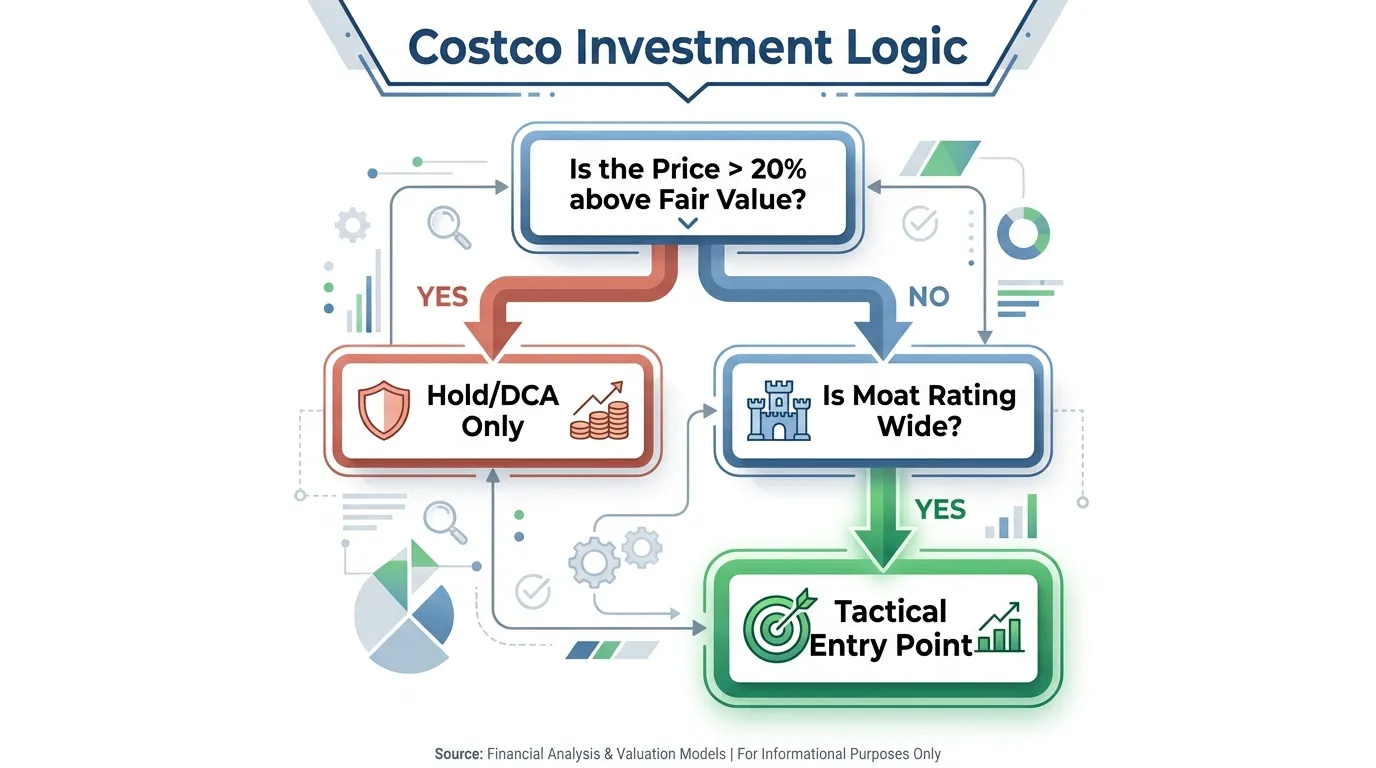
Tactical Buy/Sell Thresholds
Morningstar’s star rating for Costco has historically hovered in the 1-to-2 star range (Source: Morningstar, Oct 2024), indicating that the market frequently prices in optimistic growth that exceeds Morningstar’s baseline projections.
- The 1-Star Signal (Current Status): Indicates the stock is >25% overvalued relative to its FVE. For most, this is a "Hold" or "Trim" signal, not a point of entry.
- The 3-Star Neutral Zone: This is the historical "comfort zone" for long-term accumulators. It occurs when the market price aligns within 10% of the FVE (roughly $560–$640 in recent models).
- The Rare 4-5 Star Opportunity: For a Wide Moat stock like Costco, a 4-star rating usually only appears during broader market capitulations (e.g., 2022 retail sell-offs). This is the "Strong Buy" trigger.
Investor Note: Morningstar’s Medium Uncertainty Rating suggests that while the business model is rock-solid, the valuation risk is significant at current forward P/E multiples of 45x–50x (Source: Bloomberg/Morningstar, Sept 2024).
Comparative Valuation Landscape
Costco’s "safety" as a credit-worthy investment (AA-low rating by DBRS Morningstar) often masks its "danger" as a high-multiple equity.
| Metric | Current Value (Est. Oct 2024) | Morningstar Recommendation |
|---|---|---|
| Price / Fair Value | 1.40x - 1.55x | Significant Overvaluation |
| Forward P/E | 44.8x | High vs. 5-Yr Avg (38.2x) |
| Economic Moat | Wide | Maintain Core Position |
| Star Rating | ★☆☆☆☆ | Wait for Retracement |
(Source: Morningstar Equity Research & Financial Data, 2024)
{
  "type": "line",
  "title": "COST: Market Price vs. Morningstar Fair Value (2023-2024)",
  "index": "Month",
  "categories": ["Market Price", "Fair Value Estimate"],
  "data": [
    {"Month": "Oct-23", "Market Price": 560, "Fair Value Estimate": 510},
    {"Month": "Jan-24", "Market Price": 680, "Fair Value Estimate": 540},
    {"Month": "Apr-24", "Market Price": 720, "Fair Value Estimate": 550},
    {"Month": "Jul-24", "Market Price": 840, "Fair Value Estimate": 600},
    {"Month": "Oct-24", "Market Price": 910, "Fair Value Estimate": 640}
  ],
  "source": "Source: Morningstar Analyst Reports (Compiled Oct 2024)",
  "note": "Fair Value reflects the intrinsic value based on discounted cash flows (DCF)."
}
 AI Generated Infographic
For investors seeking to balance high-conviction retail exposure with a data-driven safety margin, tracking these institutional valuation shifts is critical. If the gap between price and fair value continues to widen, Smart Money Tracker for Institutional Portfolios can help identify if major fund managers are beginning to rotate out of Costco into more reasonably priced consumer staples.
FAQ
What is the difference between Morningstar Inc. and MorningStar Farms at Costco?
Morningstar Inc. provides financial research and equity analysis for Costco (COST) investors, whereas MorningStar Farms is a plant-based food brand owned by Kellanova that sells products in Costco warehouses.
What is Morningstar's Fair Value Estimate for Costco (COST) in 2026?
Morningstar pegs Costco’s Fair Value Estimate at $650.00, which is significantly lower than the market price of approximately $922.33, indicating a 42% valuation premium.
Why does Morningstar give Costco a 1-star rating?
The 1-star rating is a valuation signal indicating that the stock is significantly overvalued. It is triggered when the market price exceeds Morningstar's Fair Value estimate by a large margin, despite the company's operational excellence.
What justifies Costco's 'Wide Moat' rating by Morningstar?
Costco's Wide Moat is supported by its intangible assets (membership loyalty with 90%+ renewal rates) and a structural cost advantage driven by high-volume, low-SKU operational efficiency.
How does DBRS Morningstar rate Costco’s credit safety?
DBRS Morningstar assigns Costco a 'AA' credit rating with a stable trend, citing its ultra-low leverage (0.3x Net Debt/EBITDA) and predictable cash flows from membership fees.