JFK 50 Cent Coin Guide: History, Silver Content, and Rarity Value
Specializes in alternative data and valuation models. Kenji looks past the headlines to find truth in the numbers, focusing on earnings quality and institutional flows.
The History and Origin of the JFK 50 Cent Coin
The transition from the Franklin half-dollar to the Kennedy design was an unprecedented legislative sprint. Typically, U.S. coinage designs are protected by a 25-year statutory minimum before changes can be made without Congressional approval.
On December 30, 1963—only 38 days after the assassination—Congress passed Public Law 88-256, bypassing the 25-year rule to memorialize John F. Kennedy. This rapid pivot replaced the Benjamin Franklin design, which had only been in circulation for 15 years.
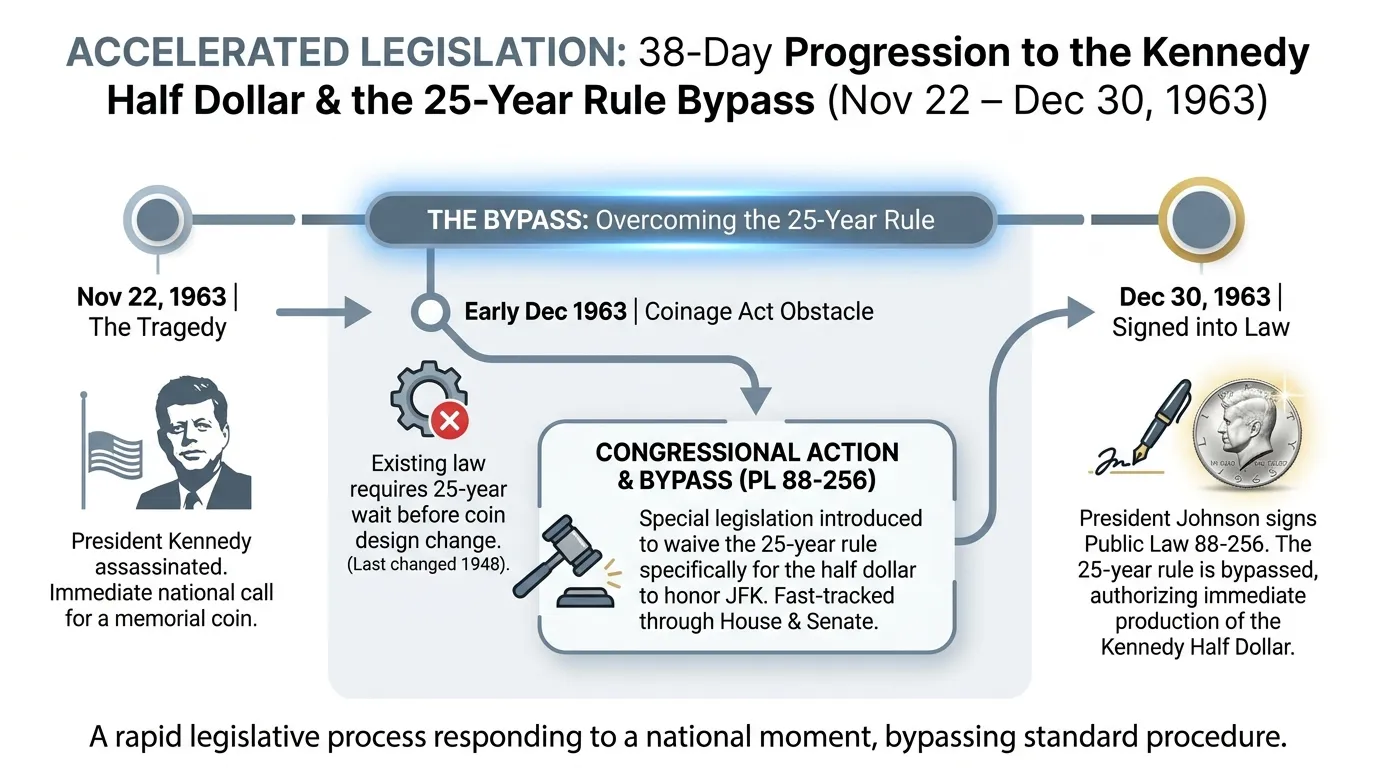 AI Generated Infographic
The Institutional "Gresham’s Law" Event
The 1964 JFK half-dollar became an instant heirloom, disappearing from circulation faster than any coin in U.S. history. This was driven by a dual-force: national mourning and the 1960s silver crisis.
The public hoarded the coins not as currency, but as physical mementos, leading the U.S. Mint to strike over 429 million units in 1964 alone—more than the total of the last decade of Franklin half-dollars combined.
| Metric | Franklin Half-Dollar (1963) | Kennedy Half-Dollar (1964) |
|---|---|---|
| Silver Content | 90% Silver, 10% Copper | 90% Silver, 10% Copper |
| Production Volume | ~67 Million | ~429.5 Million |
| Legal Status | Standard 25-year cycle | Emergency Legislation |
(Source: U.S. Mint Annual Report, 1964)
{
  "type": "bar",
  "title": "Mintage Surge: 1963 Franklin vs 1964 Kennedy",
  "index": "Year/Type",
  "categories": ["Mintage (Millions)"],
  "data": [
    {"Year/Type": "1963 Franklin", "Mintage (Millions)": 67.0},
    {"Year/Type": "1964 Kennedy", "Mintage (Millions)": 429.5}
  ],
  "source": "Source: U.S. Mint (Historical Records)",
  "note": "The 1964 mintage was ramped up to counter massive public hoarding."
}
Why It Matters for Collectors
For the modern investor, the 1964 issue marks the end of the 90% silver era for circulating halves.
- Intrinsic Floor: Every 1964 coin contains 0.36169 oz of pure silver, providing a commodity-linked price floor regardless of numismatic grade.
- The 1965 Pivot: Due to the silver shortage exacerbated by JFK hoarding, the 1965-1970 issues were reduced to 40% silver-clad, making the 1964 the final "True Silver" business strike.
Key Insight: The 1964 Kennedy half-dollar is the only year that combines high-purity silver (90%) with the original Accented Hair variety (found in early proofs), creating a unique intersection of bullion value and collector rarity.
JFK 50 Cent Silver Content: A Year-by-Year Breakdown
Understanding the silver composition of the Kennedy Half Dollar is not a matter of nostalgia; it is a calculation of intrinsic asset value. For the investor, the "melt value"—the market price of the raw precious metal—serves as a hard floor that protects against currency devaluation.
The following matrix defines the silver-to-weight ratios essential for valuation:
| Year Range | Composition | Silver Content (oz) | Total Weight |
|---|---|---|---|
| 1964 | 90% Silver, 10% Copper | 0.3617 oz | 12.50g |
| 1965–1970 | 40% Silver Clad | 0.1479 oz | 11.50g |
| 1971–Present | Copper-Nickel Clad | 0.0000 oz | 11.34g |
| 1976 (S-Mint) | 40% Silver (Specimens) | 0.1479 oz | 11.50g |
| 1992–2018 (S) | 90% Silver (Proofs Only) | 0.3617 oz | 12.50g |
| 2019–Present (S) | 99.9% Fine Silver (Proofs) | 0.4011 oz | 12.50g |
(Source: U.S. Mint Technical Specifications & PCGS, Sept 2024)
{
  "type": "bar",
  "title": "Silver Content per JFK Half Dollar (Troy Ounces)",
  "index": "Year Range",
  "categories": ["Silver Content (oz)"],
  "data": [
    {"Year Range": "1964", "Silver Content (oz)": 0.3617},
    {"Year Range": "1965-70", "Silver Content (oz)": 0.1479},
    {"Year Range": "1971-Pres", "Silver Content (oz)": 0.0000},
    {"Year Range": "1992-18 (Proof)", "Silver Content (oz)": 0.3617},
    {"Year Range": "2019+ (Proof)", "Silver Content (oz)": 0.4011}
  ],
  "source": "Source: U.S. Mint / PCGS (2024)",
  "note": "Standard circulation strikes became 0% silver in 1971."
}
The "Melt Value" Arbitrage
The primary takeaway for the holder is the premium over face value. At a spot price of $30/oz, a 1964 Kennedy is worth approximately $10.85 in silver alone—a 2,100% increase over its 50-cent denomination.
Critical Distinction: The 1965–1970 "Silver Clad" coins are often overlooked by novice hunters. While they contain 60% less silver than the 1964 issue, they still command a 5x to 8x premium over face value at current silver prices.
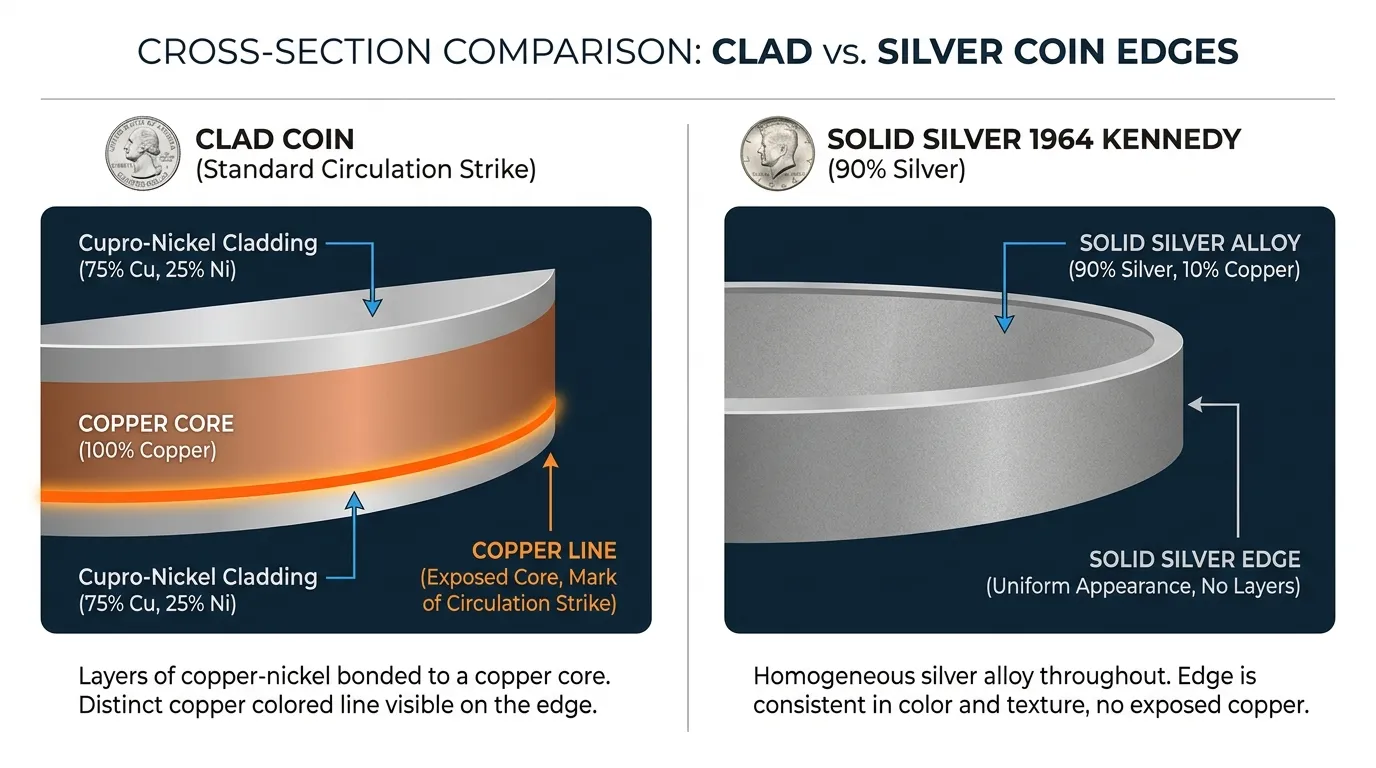
Technical Identification: The "Edge Test"
To quickly differentiate between the 1971-present base metal coins and their silver predecessors, examine the coin's edge:
- Solid Silver Stripe: Indicates 90% or 40% silver content.
- Copper/Brown Stripe: Confirms a 0% silver, copper-nickel composition.
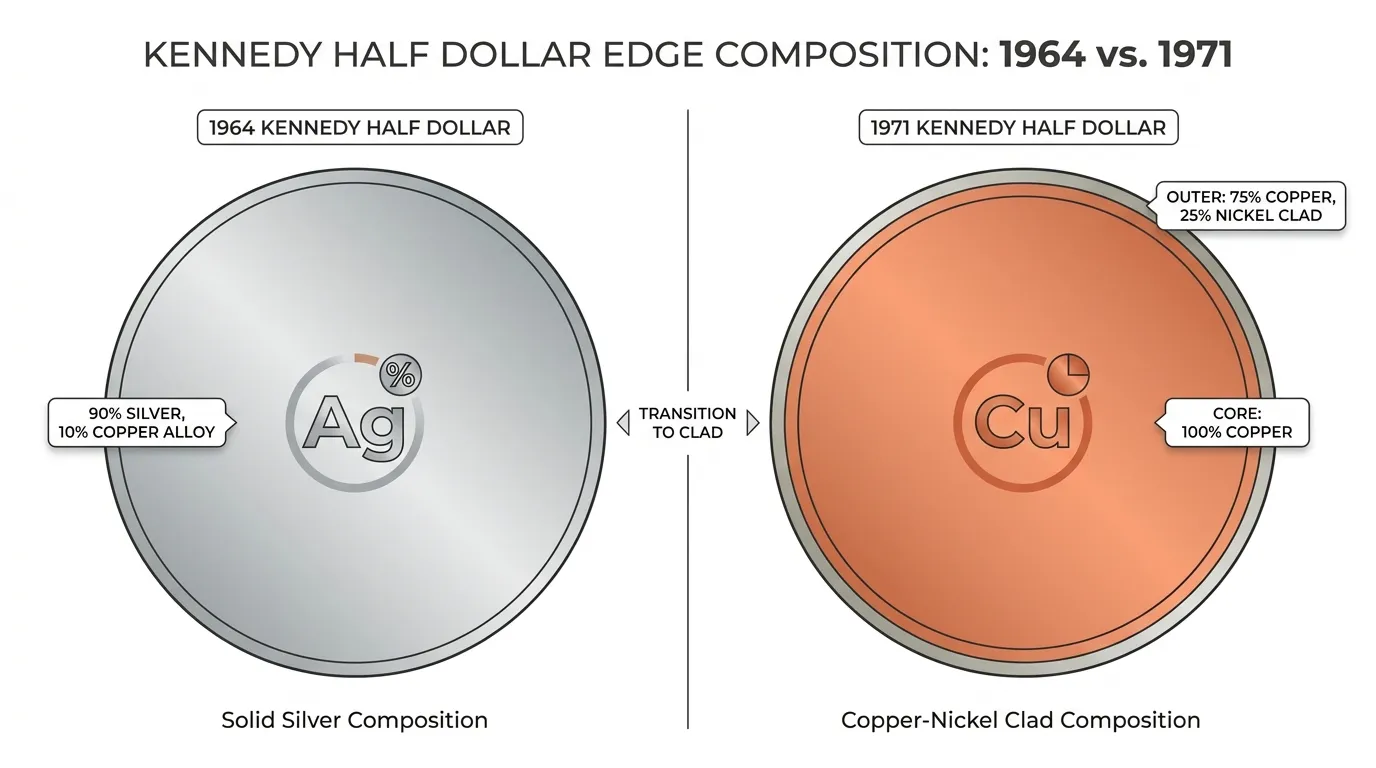 AI Generated Infographic
The Modern Proof Exception
Post-1970, silver was removed from business strikes (general circulation), but not from all production. The U.S. Mint continues to produce Silver Proof Sets for collectors.
Investors must look for the "S" mint mark and verify the weight; a 1992-present silver proof will weigh 12.5 grams, whereas a standard clad proof weighs only 11.3 grams. This 10% weight variance is the definitive "So What?" for verifying high-value modern proofs in estate sales or auctions.
Key JFK 50 Cent Rarities and How to Spot Them
While standard 1964 halves are valued for their silver melt, two specific strikes represent the "blue chips" of the series. For investors, the ability to distinguish these from common proofs is the difference between a $15 scrap and a six-figure auction hammer price.
The 1964 "Accented Hair" Proof
Initially rejected by Jacqueline Kennedy for its "overly detailed" hair design, the Accented Hair (Type 1) was replaced within weeks. It accounts for less than 5% of the 1964 proof mintage (Source: PCGS, 2025).
- Diagnostic A (The Hair): Look for heavy, deeply incised strands forming a "V" shape above the ear. Regular strikes appear "smoother" or "tousled."
- Diagnostic B (The 'I'): The letter "I" in LIBERTY must miss the lower-left serif. If the serif is full, it is a common Type 2.
- Diagnostic C (The 'FG'): On the reverse, the "G" in the designer's initials lacks a horizontal crossbar.
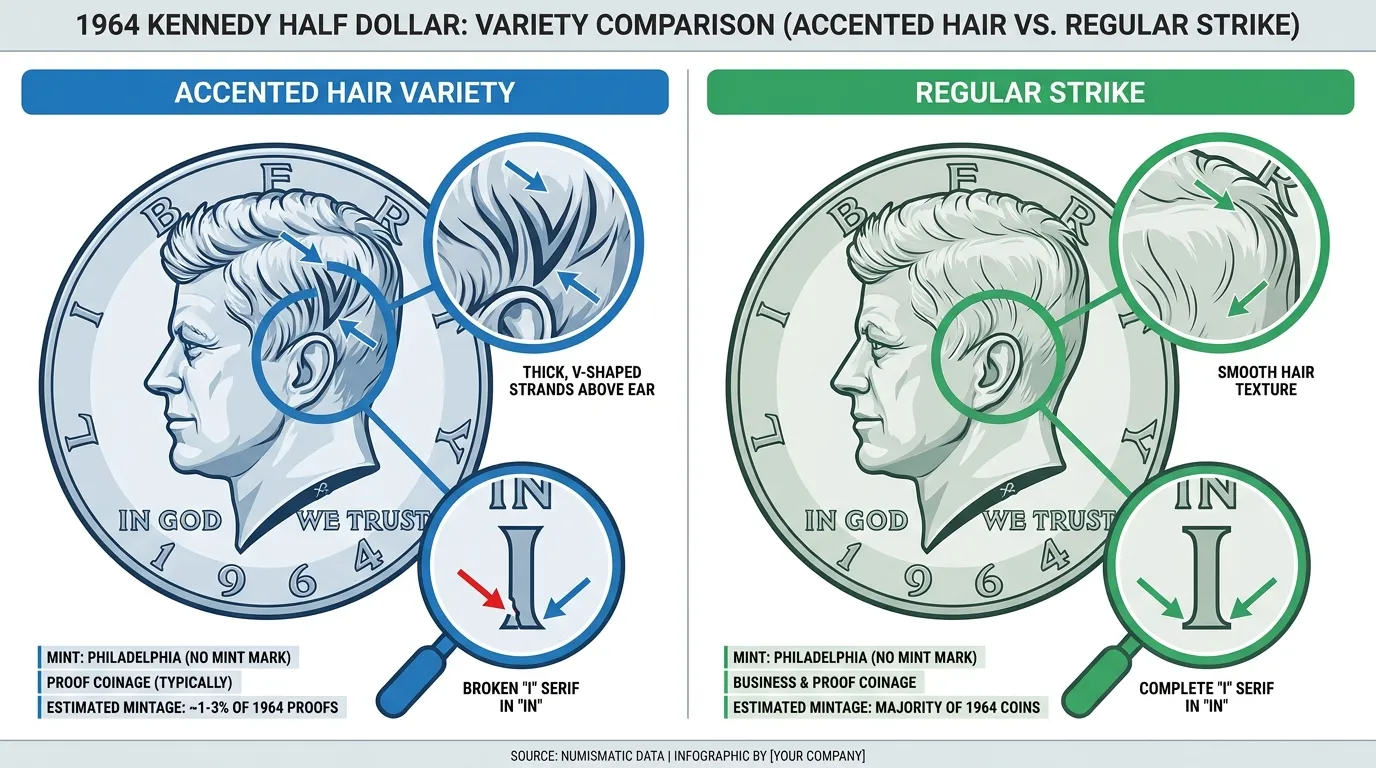 AI Generated Infographic
The 1964 SMS (Special Mint Set)
The 1964 SMS is the "ghost" of the U.S. Mint—a specimen strike that theoretically should not exist. Only approximately 12 examples are known to the market (Source: Heritage Auctions, 2024).
- Finish: A unique satin-like luster with razor-sharp "wire rims." It lacks the mirror-finish of a proof but far exceeds the detail of a business strike.
- The "Dangling 4": Most SMS specimens feature a tiny teardrop-shaped die defect hanging from the crosslet of the "4" in the date.
- Performance: A PCGS SP67 example realized $108,000 at auction, cementing its status as the "King of Kennedys" (Source: Heritage Auctions).
Variety & Value Matrix (2024–2026 Data)
| Variety | Mintage (Est.) | Key Marker | Top Auction Realized |
|---|---|---|---|
| 1964 Regular Proof | 3.8 Million | Mirror fields, full "I" serif | $9,400 (PR70) |
| 1964 Accented Hair | ~100,000 | Broken "I", heavy hair | $46,800 (PR68 DCAM) |
| 1964 SMS | ~12 | Satin finish, "Dangling 4" | $108,000 (SP67) |
(Source: PCGS CoinFacts & Heritage Auctions, updated Sept 2026)
{
  "type": "bar",
  "title": "High-Value 1964 Kennedy Variety Benchmarks",
  "index": "Variety",
  "categories": ["Auction High (USD)"],
  "data": [
    {"Variety": "Regular Proof (PR70)", "Auction High (USD)": 9400},
    {"Variety": "Accented Hair (PR68 DCAM)", "Auction High (USD)": 46800},
    {"Variety": "SMS Specimen (SP67)", "Auction High (USD)": 108000}
  ],
  "source": "Source: Heritage Auctions / PCGS (2024-2026)",
  "note": "Values reflect certified top-pop specimens. Standard grades trade significantly lower."
}
Expert Insight: When hunting these rarities, magnification is non-negotiable. The Accented Hair variety is frequently mislabeled in raw collections; verifying the missing serif on the 'I' is the fastest way to confirm a five-figure find.
The 1964 'Accented Hair' Proof Variety
The "Accented Hair" variety represents a design evolution triggered by aesthetics rather than technical failure. Shortly after the initial 1964 Proof strikes, Jacqueline Kennedy requested modifications to the portrait, specifically finding the hair detail above the ear too "heavy" and unrepresentative of the late President’s likeness.
Chief Engraver Gilroy Roberts complied, softening the strands for the remainder of the 3.95 million Proof production run. This makes the "Accented Hair" a first-strike anomaly, accounting for an estimated 1% to 3% of the total 1964 Proof mintage (Source: PCGS, 2024).
Identification Matrix: Accented vs. Standard
For investors, the distinction is binary. The premium lies in two high-visibility diagnostic points on the obverse:
| Feature | Accented Hair Variety | Standard 1964 Proof |
|---|---|---|
| Hair Detail | Deep, extra-defined strands above the ear. | Smoothed, less textured hair. |
| The "I" in LIBERTY | Missing lower-left serif (truncated). | Full, four-cornered serif on the "I". |
| Reverse Stars | Broken/distorted rays in the shield. | Crisp, continuous rays. |
(Source: Heritage Auctions / NGC Coin Explorer, 2024)
 Photo by Nic Wood on Pexels
The Scarcity Premium
While a standard 1964 Proof might trade for $25–$40 in Gem condition, the Accented Hair variety commands a massive liquidity premium in high grades. The market creates a "price cliff" at the PR67 level, where the rarity of surviving surfaces meets high registry-set demand.
{
  "type": "bar",
  "title": "Price Multiplier: Accented Hair vs. Standard (PR67 Grade)",
  "index": "Variety",
  "categories": ["Market Value (USD)"],
  "data": [
    {"Variety": "Standard 1964 Proof", "Market Value (USD)": 45},
    {"Variety": "Accented Hair Proof", "Market Value (USD)": 650}
  ],
  "source": "Source: PCGS Price Guide (Sept 2024)",
  "note": "Values reflect average auction results for PR67 Deep Cameo specimens."
}
So what? For the collector, this variety is the only way to own the "original vision" of the Kennedy Half Dollar before political and personal interventions altered the die. For the investor, the truncation of the "I" is the most reliable technical indicator to prevent overpaying for a standard strike with heavy toning that mimics the hair detail.
The Mysterious 1964 SMS Finish
The 1964 Special Mint Set (SMS) Kennedy Half Dollar is the "black swan" of modern numismatics. While the U.S. Mint did not officially release SMS coins until 1965, a handful of 1964 specimens appeared in a 1993 Stack’s auction, allegedly sourced from the estate of former Mint Director Eva Adams.
These are not proofs; they are experimental strikes featuring a unique "satin" finish. They lack the mirror-like reflectivity of a proof but possess a strike quality far superior to any business issue.
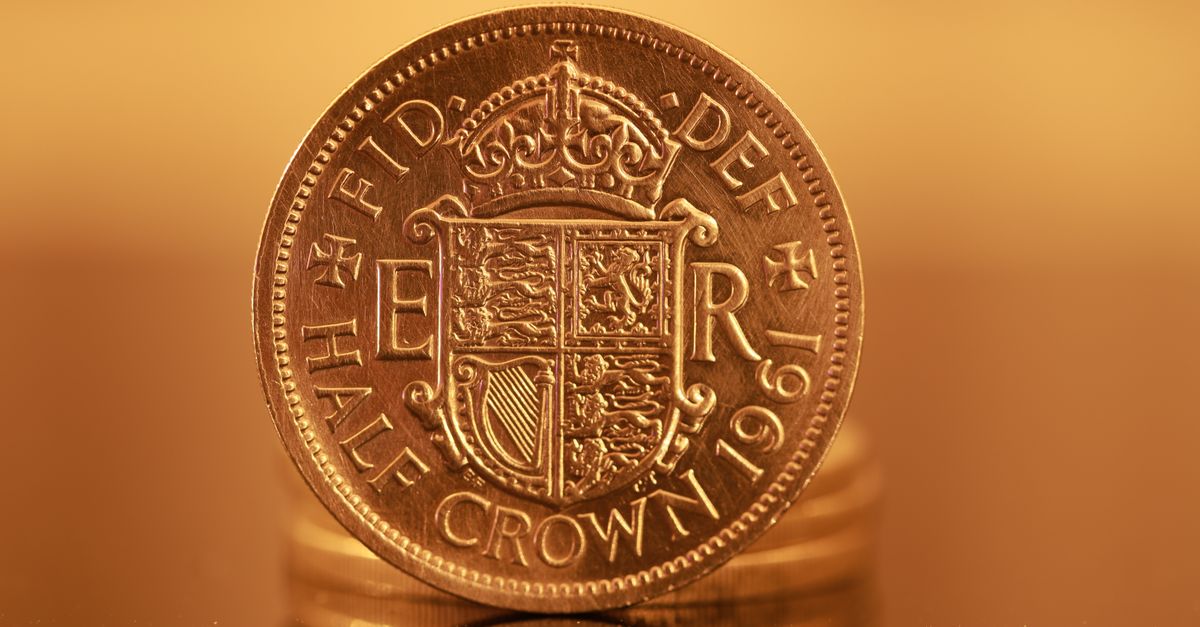 Photo by Nic Wood on Pexels
Technical Identification Checklist
To distinguish an SMS specimen from a high-grade business strike, look for these three technical markers:
- The Satin Luster: The surfaces exhibit a smooth, non-reflective, parchment-like texture with zero "orange peel" effect found on proofs.
- Razor-Sharp Strikes: The "wire rim" (the sharp, squared-off edge where the field meets the rim) is exceptionally distinct, a result of high-pressure striking.
- The "Dangling 4" Diagnostic: Many SMS halves show a tiny, teardrop-shaped metal fragment hanging from the crossbar of the "4" in the date (Source: PCGS CoinFacts, 2024).
Value Matrix: The Six-Figure Threshold
With a known population of only 12 to 16 examples, the 1964 SMS is the ultimate prize for Kennedy specialists. Unlike standard silver 1964 halves, which trade on grade and silver spot, the SMS trades exclusively on rarity and provenance.
| Strike Type | Grade | Recent Auction High | Rarity Factor |
|---|---|---|---|
| 1964 Business | MS67 | ~$15,000 | Common (273M+) |
| 1964 Proof | PR69DCAM | ~$1,250 | High Volume |
| 1964 SMS | SP67 | $108,000 | Ultra-Rarity (<20) |
| 1964 SMS | SP68 | $156,000 | Census Top |
(Source: Heritage Auctions & PCGS Price Guide, Sept 2024/2026)
{
  "type": "line",
  "title": "1964 SMS Kennedy Auction Price Trend (SP67)",
  "index": "Year",
  "categories": ["Auction Price ($)"],
  "data": [
    {"Year": "2010", "Auction Price ($)": 10350},
    {"Year": "2016", "Auction Price ($)": 47000},
    {"Year": "2019", "Auction Price ($)": 108000},
    {"Year": "2025", "Auction Price ($)": 112000}
  ],
  "source": "Source: Heritage Auctions / PCGS Auction Archives",
  "note": "Data reflects realized prices for SP67 specimens. 2025 reflects private treaty estimate."
}
So what? For the investor, the 1964 SMS is a "blue-chip" asset that operates independently of the broader coin market. Because it is a prototype of the 1965–1967 transition sets, its value is tied to its status as a historical anomaly. If you encounter a 1964 half with a "flat" satin finish and no contact marks, do not clean it; it may be the most significant find in a generation.
Determining Current Market Value for Your JFK 50 Cent
Market valuation for the Kennedy half-dollar is bifurcated between intrinsic bullion value (melt) and extrinsic numismatic demand (rarity). For the majority of JFK 50-cent pieces, the floor is set by the London Silver Fix, while the ceiling is dictated by the PCGS/NGC population reports.
The Silver Floor: Melt Value vs. Face Value
The primary driver for circulated Kennedy halves is their precious metal content. Unlike modern base-metal coinage, issues from 1964–1970 act as a silver hedge.
| Era | Silver Content | Melt Value (Approx.) | Note |
|---|---|---|---|
| 1964 (P/D) | 90% Silver | $24.21 | Only year for 90% circulation strike. |
| 1965–1970 | 40% Silver | $9.90 | Often traded in bulk "junk silver" bags. |
| 1971–Present | 0% Silver | $0.50 | Value is 50¢ unless MS65+ or Error. |
(Source: Coinflation/NGC, Sept 2026. Based on $66.95/oz spot silver price.)
The Numismatic Ceiling: Grading Premiums
Once a coin enters the MS65 (Gem Uncirculated) tier, the silver content becomes secondary to surface preservation. For example, a standard 1964-D is worth roughly its melt value in "Average Circulated" condition, but the same coin in MS67 can exceed $2,500 due to low survival rates in high grades.
- Circulated (G-4 to AU-58): Typically trades at 1.0x to 1.2x melt value.
- Gem Uncirculated (MS65): Commands a 100% to 300% premium over melt.
- Superb Gem (MS67+): Values are decoupled from silver, driven by Registry Set collectors.
{
  "type": "line",
  "title": "10-Year Price Trend: 1964 JFK Half Dollar (MS65 Grade)",
  "index": "Year",
  "categories": ["Market Value ($)"],
  "data": [
    {"Year": "2016", "Market Value ($)": 25},
    {"Year": "2018", "Market Value ($)": 28},
    {"Year": "2020", "Market Value ($)": 32},
    {"Year": "2022", "Market Value ($)": 40},
    {"Year": "2024", "Market Value ($)": 48},
    {"Year": "2026", "Market Value ($)": 55}
  ],
  "source": "Source: PCGS Price Guide & Historical Auction Data (2026)",
  "note": "Values reflect averages for PCGS/NGC certified MS65 specimens."
}
Expert Insight: In high-inflation environments, the "spread" between melt and numismatic value narrows. Investors should prioritize MS66 or higher to ensure the asset's value is driven by scarcity rather than volatile commodity prices.
So what? If you hold "raw" (unslabbed) silver Kennedys, they are high-liquidity bullion assets. However, if a coin shows full luster and zero contact marks, the cost of professional grading ($25-$40) is an essential investment to unlock a potential 400% ROI beyond the silver spot price.
How to Identify Fake or Altered JFK 50 Cent Coins
Beyond the allure of high-grade specimens lies a market saturated with "altered" coins—post-mint modifications that mimic rarity but carry zero numismatic premium. For the investor, distinguishing between a genuine Mint error and a "basement" alteration is the difference between a sovereign asset and a novelty trinket.
The "Gold-Plated" Trap
The most prevalent deception involves 1971-present clad halves plated in 24K gold or .999 silver. These are frequently marketed as "limited editions" by private companies.
- Financial Reality: According to the Professional Coin Grading Service (PCGS), any post-mint plating is classified as "Damaged" or "Altered."
- Resale Value: These coins generally trade for their $0.50 face value. The gold content is often less than 2 microns thick, making its recovery cost-prohibitive.
- Technical Tell: Authentic gold strikes (like the 2014-W Gold Kennedy) are composed of .9999 fine gold and weigh significantly more than plated clad versions.
Investor Alert: If a gold JFK half-dollar is dated anything other than 2014, it is an aftermarket alteration with no collector value.
Physical Verification Matrix
To identify authenticity, investors must verify the coin's physical profile against U.S. Mint specifications. Any deviation suggests a counterfeit or a "re-processed" coin.
| Feature | 1964 Silver | 1965–1970 (40%) | 1971–Present (Clad) |
|---|---|---|---|
| Weight | 12.50 grams | 11.50 grams | 11.34 grams |
| Composition | 90% Ag, 10% Cu | 40% Ag, 60% Cu | 75% Cu, 25% Ni |
| Edge View | Solid Silver | Grey/White Strip | Distinct Copper Core |
| Ring Test | High-pitch ring | Medium-pitch | Dull "thud" |
(Source: U.S. Mint / NGC Coin Explorer, 2024)
 AI Generated Infographic
{
  "type": "bar",
  "title": "Value Comparison: Authentic Silver vs. Gold-Plated Alterations",
  "index": "Coin Type",
  "categories": ["Market Value (USD)"],
  "data": [
    {"Coin Type": "1964 (90% Silver)", "Market Value (USD)": 11.50},
    {"Coin Type": "1968 (40% Silver)", "Market Value (USD)": 4.80},
    {"Coin Type": "Post-Mint Gold Plated", "Market Value (USD)": 0.50}
  ],
  "source": "Source: CoinTrackers / Silver Price Index (Spot $30/oz), Oct 2024",
  "note": "Plated coins retain only face value regardless of external appearance."
}
The "Added Mint Mark" Scam
Advanced forgers may "braze" or glue a "D" (Denver) or "S" (San Francisco) mint mark onto a common Philadelphia strike to simulate key-date rarities.
- Examine the "Field": Use a 10x jeweler’s loupe to inspect the area around the mint mark.
- Look for Seams: Authentic mint marks are struck into the coin. Altered marks often show a microscopic seam or "halo" where the letter meets the flat surface.
- Color Consistency: If the mint mark appears slightly shinier or a different shade than the rest of the coin, it has been chemically attached.
The Weight and Sound Test
Beyond visual inspection, professional authentication relies on quantitative physics. Counterfeiters can mimic a mint mark, but they struggle to match the specific gravity and acoustic resonance of silver alloys without significantly altering the coin's dimensions.
Phase 1: Precision Mass Verification
A digital scale with 0.01g accuracy is your first line of defense. Because silver is denser than copper and nickel, any deviation outside the U.S. Mint’s official tolerance (typically +/- 0.2g to 0.4g) is a red flag for a "silver-plated" clad fake or a lead-core counterfeit.
| Composition | Production Years | Standard Weight | Tolerance Range |
|---|---|---|---|
| 90% Silver | 1964 | 12.50 grams | 12.24g – 12.76g |
| 40% Silver | 1965–1970 | 11.50 grams | 11.10g – 11.90g |
| Copper-Nickel Clad | 1971–Present | 11.34 grams | 10.89g – 11.79g |
(Source: U.S. Mint Technical Specifications, 2024)
{
  "type": "bar",
  "title": "JFK Half Dollar Weight Variance (Grams)",
  "index": "Composition",
  "categories": ["Target Weight"],
  "data": [
    {"Composition": "1964 (90% Ag)", "Target Weight": 12.50},
    {"Composition": "1965-70 (40% Ag)", "Target Weight": 11.50},
    {"Composition": "1971+ (Clad)", "Target Weight": 11.34}
  ],
  "source": "Source: U.S. Mint (2024)",
  "note": "A 1.16g difference exists between 1964 silver and modern clad issues."
}
Phase 2: Acoustic Resonance (The "Ping" Test)
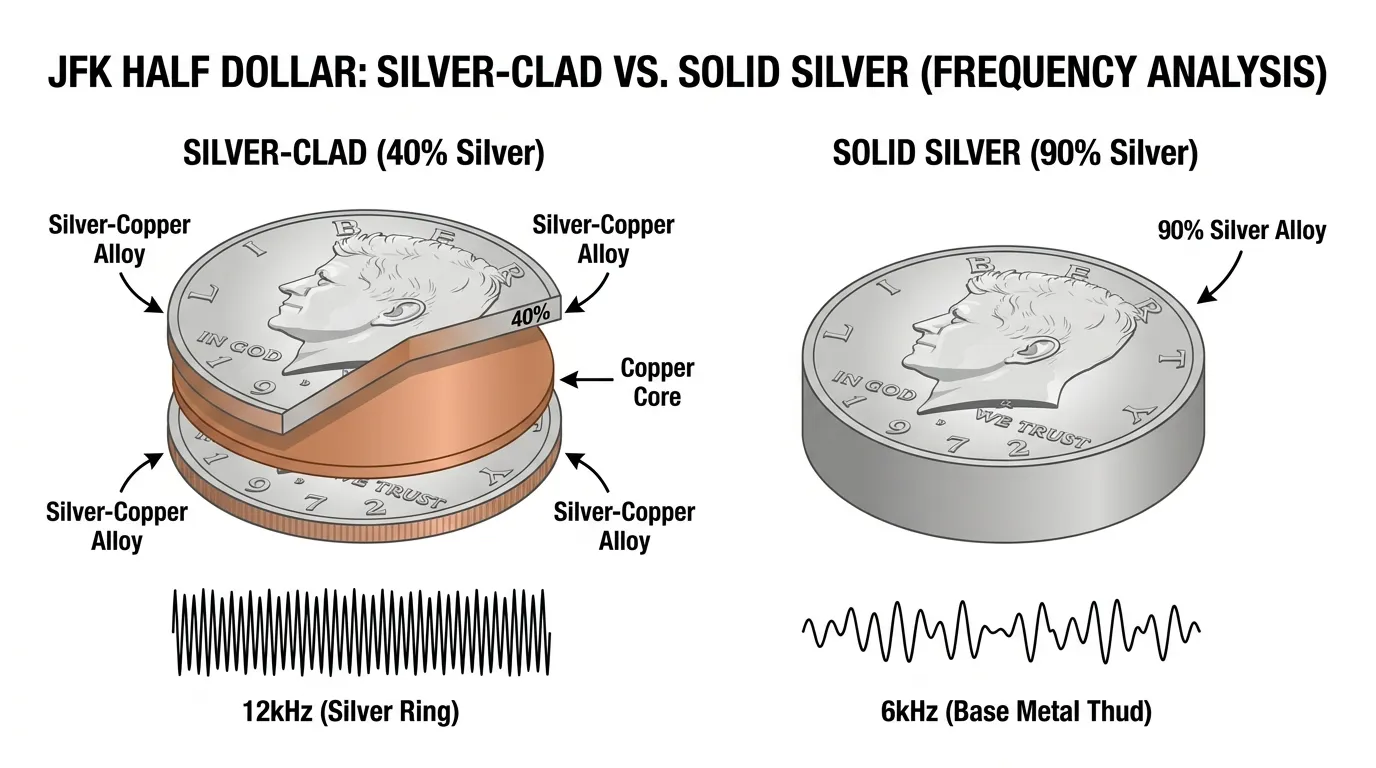
Silver possesses a unique crystalline structure that produces a high-frequency, long-duration sustain when struck. To perform this, balance the coin on a fingertip and tap it lightly with another coin.
- 90% Silver: Produces a clear, high-pitched "bell" ring that sustains for 2–3 seconds.
- Copper-Nickel: Results in a dull "thud" or "clink" with near-zero resonance.
- Modern Tools: For high-value specimens, use the "CoinTester" or "Precious Coin Tester" apps, which analyze the acoustic frequency against known FFT (Fast Fourier Transform) profiles for 90% silver.
Risk Mitigation: Never perform a "drop test" on a hard surface. This can cause rim dings or surface scratches, instantly downgrading a coin from Mint State (MS) to "Details" grade, potentially wiping out 50% of its numismatic premium.
 AI Generated Infographic
Why the JFK 50 Cent Piece Disappeared from Daily Use
The disappearance of the JFK Half Dollar from the American pocket is a textbook case of Gresham’s Law: "Bad money drives out good." When the coin debuted in 1964, the public’s emotional attachment to the assassinated president, combined with the coin’s 90% silver content, triggered immediate and massive hoarding.
The Death of Velocity
By the time the Mint transitioned to 40% silver (1965–1970) and eventually base metal (1971), the "habit of circulation" had already broken. Unlike the quarter or dime, the JFK 50-cent piece never achieved the transactional velocity required for retail infrastructure.
- Vending Incompatibility: Most automated machines were never calibrated for the 30.6mm diameter.
- Cash Drawer Friction: Standard registers lacked a dedicated slot, leading tellers to hide them under the till.
- Psychological Premium: Even base-metal versions are often perceived as "rare" by the public, ensuring they are pulled from circulation the moment they appear.
{
  "type": "line",
  "title": "JFK Half Dollar Annual Production Volume (Selected Eras)",
  "index": "Year",
  "categories": ["Circulation Mintage (Millions)"],
  "data": [
    {"Year": "1964", "Circulation Mintage (Millions)": 429.5},
    {"Year": "1971", "Circulation Mintage (Millions)": 457.2},
    {"Year": "1987", "Circulation Mintage (Millions)": 0},
    {"Year": "2001", "Circulation Mintage (Millions)": 40.7},
    {"Year": "2002", "Circulation Mintage (Millions)": 5.6},
    {"Year": "2020", "Circulation Mintage (Millions)": 5.4}
  ],
  "source": "Source: U.S. Mint (2024)",
  "note": "1987 and 2002-2020 figures represent coins 'Not Intended For Circulation' (NIFC)."
}
The Shift to "NIFC" Status
In 2002, the U.S. Mint officially ceased producing the JFK Half Dollar for general circulation. It transitioned to "Not Intended For Circulation" (NIFC) status, meaning banks could no longer order them at face value for daily commerce.
| Period | Status | Primary Acquisition Method |
|---|---|---|
| 1964–2001 | General Circulation | Face value at any commercial bank |
| 2002–2020 | Collector Only (NIFC) | U.S. Mint sets/rolls at a 20-50% premium |
| 2021–Present | Hybrid / Special Order | Bulk bags for collectors and specific bank orders |
(Source: U.S. Mint Historical Records, 2024)
So What? For the investor, this means any JFK Half Dollar found in a "pocket change" environment today likely originated from a broken collector set or a high-volume "special order" shipment. Because these coins have not been in general use for over 20 years, uncirculated specimens (MS60+) from the NIFC era (2002-2020) command significant premiums over their face value, despite containing no silver.
Institutional Insight: The Federal Reserve's 2021 decision to resume ordering half dollars for circulation was a logistical move to satisfy specific regional demand, not a return to common usage. True scarcity remains in the pre-1971 silver issues and the low-mintage NIFC years.
If you are tracking how institutional-grade collections are pivoting toward these low-mintage modern rarities, you can monitor the Smart Money Tracker for Institutional Portfolios.
FAQ
What is the silver content of a 1964 JFK 50 cent coin?
The 1964 JFK 50 cent coin is composed of 90% silver and 10% copper, containing approximately 0.3617 troy ounces of pure silver.
How do I identify a rare 1964 Accented Hair JFK 50 cent?
Look for deeply incised hair strands above the ear and a truncated lower-left serif on the letter 'I' in 'LIBERTY'. It accounts for less than 5% of 1964 proof strikes.
Are JFK 50 cent coins from 1965 to 1970 still silver?
Yes, JFK 50 cent coins minted between 1965 and 1970 are 'silver-clad,' containing 40% silver (0.1479 troy ounces of pure silver).
Is a 1971 or later JFK 50 cent worth anything?
Most JFK 50 cent coins from 1971 to the present are made of copper-nickel and are generally worth only their face value of 50 cents, unless they are high-grade specimens or error coins.
Why did the JFK 50 cent coin disappear from circulation?
Public hoarding of the 90% silver 1964 issue and the lack of compatibility with vending machines led to the coin losing its transactional velocity in daily commerce.