Is JFK on a Coin? The Complete Guide to Kennedy Half Dollars and $1 Coins
Founder of Tritonix.ai. Former Hedge Fund Analyst with 10+ years of experience managing over $1B AUM across insurance portfolios and private funds. Specializes in institutional-grade fundamental analysis and long-term capital allocation.
Which U.S. Coins Feature John F. Kennedy?
While John F. Kennedy’s image is synonymous with the 50-cent piece, he is legally authorized to appear on two distinct denominations of U.S. currency. Understanding the distinction is vital for collectors and investors tracking precious metal content versus numismatic rarity.
John F. Kennedy currently appears on:
- The Kennedy Half Dollar (1964–Present): The primary and most recognized vessel for his likeness.
- The Presidential $1 Coin (2015): A specific release within the Presidential $1 Coin Program.
 Photo by Katie Harp on Pexels
The Kennedy Half Dollar: The Standard-Bearer
Authorized by Congress just weeks after his assassination, the Kennedy Half Dollar replaced the Benjamin Franklin series in 1964. While the coin remains in production today, its composition has shifted drastically, moving from 90% silver to copper-nickel clad.
The 2015 Presidential $1 Coin: The Modern Alternative
Under the Presidential $1 Coin Act of 2005, the U.S. Mint issued a circulating-quality dollar coin for JFK in 2015. Unlike the Half Dollar, these were primarily minted for collectors and were not issued for general circulation through the Federal Reserve, making them significantly harder to find in pocket change.
| Feature | Kennedy Half Dollar | JFK Presidential $1 Coin |
|---|---|---|
| First Year of Issue | 1964 | 2015 |
| Denomination | $0.50 | $1.00 |
| Composition (Modern) | 91.67% Copper, 8.33% Nickel | 88.5% Copper, 6% Zinc, 3.5% Manganese, 2% Nickel |
| Edge Detail | Reeded | Lettered (Date, Mint Mark, E Pluribus Unum) |
| Status | Circulating (though rare in trade) | NIFC (Not Intended for Circulation) |
(Source: United States Mint, 2024)
The "So What?" for Investors
For the pragmatic holder, the denomination is secondary to metallurgy.
- Silver Value: Only Half Dollars minted between 1964 and 1970 contain intrinsic silver value. The $1 coin is a "golden dollar" in color only; it contains zero gold or silver.
- Scarcity: Since 2002, Half Dollars have largely been produced in lower volumes for collectors, mirroring the distribution strategy of the 2015 Presidential Dollar.
- Liquidity: The Half Dollar remains a staple of the silver bullion market (specifically the 1964 90% issues), whereas the $1 coin is strictly a numismatic play with limited upside unless found in "Proof" or "Specimen" condition.
Investor Note: If you are holding a JFK coin for its "melt value," ignore the $1 series entirely. Focus exclusively on the 1964-1970 Half Dollars. (Source: NGC Coin Explorer, Oct 2024).
Is Your JFK Coin Silver? The Composition Timeline
The single most common mistake in coin collecting is assuming every Kennedy Half Dollar contains silver. In reality, the U.S. Mint systematically debased the silver content over seven years, moving from high-purity bullion to base metal.
If you find a JFK coin in your change, its value is dictated strictly by its year of mintage.
The Three-Tier Silver Hierarchy
The composition of the Kennedy Half Dollar follows a steep decline in intrinsic value. Use this breakdown to categorize your holdings:
- 1964 (The "90% Silver" Standard): These are the most coveted for bullion investors. Minted in the year following JFK’s assassination, these coins contain 0.3617 oz of pure silver.
- 1965–1970 (The "40% Silver" Transition): As silver prices rose, the Mint switched to a "silver-clad" composition. These contain only 0.1479 oz of silver. Note: 1970 coins were not released for circulation and are found only in Mint Sets.
- 1971–Present (The "Base Metal" Era): These consist of a copper-nickel clad composition with 0% silver content. Unless they bear an "S" mint mark (indicating a special Silver Proof), they are worth exactly 50 cents.
| Mintage Years | Silver Content | Metal Composition | Estimated Melt Value (Spot @ $30/oz) |
|---|---|---|---|
| 1964 | 90% | 90% Ag / 10% Cu | ~$10.85 |
| 1965–1970 | 40% | 40% Ag / 60% Cu | ~$4.44 |
| 1971–Date | 0% | 75% Cu / 25% Ni | $0.50 |
(Source: U.S. Mint / Coinflation.com, Oct 2024. Values fluctuate with market spot prices.)
{
  "type": "area",
  "title": "The Debasement of the Kennedy Half Dollar",
  "index": "Year Range",
  "categories": ["Silver Percentage (%)"],
  "data": [
    {"Year Range": "1964", "Silver Percentage (%)": 90},
    {"Year Range": "1965", "Silver Percentage (%)": 40},
    {"Year Range": "1970", "Silver Percentage (%)": 40},
    {"Year Range": "1971", "Silver Percentage (%)": 0},
    {"Year Range": "2024", "Silver Percentage (%)": 0}
  ],
  "source": "Source: U.S. Mint Historical Records",
  "note": "Percentage reflects circulating currency standards."
}
So What? The Identification Hack
For the reader, the "So What" is simple: Check the edge.
- Solid Silver Edge: A bright, consistent white-silver edge indicates a 1964 90% coin.
- Striped Edge: If you see a faint copper/brown line sandwiched between silver layers, it is likely a 1965–1970 40% coin.
- Solid Copper Core: A distinct orange/red copper stripe signifies a post-1971 base metal coin.
Expert Insight: Do not overlook the 1976 Bicentennial halves. While most are copper-nickel, the Mint produced 40% silver uncirculated versions for collectors. Always verify the weight; a silver Bicentennial weighs 11.50g, while the copper-nickel version weighs 11.34g. (Source: PCGS, 2024).
How to Perform the 'Edge Test' for Silver
The Edge Test remains the most efficient, low-friction method for high-velocity sorting. Professionals use this visual shortcut to separate intrinsic bullion value from base-metal circulation currency in seconds.
By examining the "third side" of the coin, you bypass the need for scales or acid tests. The presence—or absence—of a copper stripe is the definitive indicator of the coin's metallurgy.
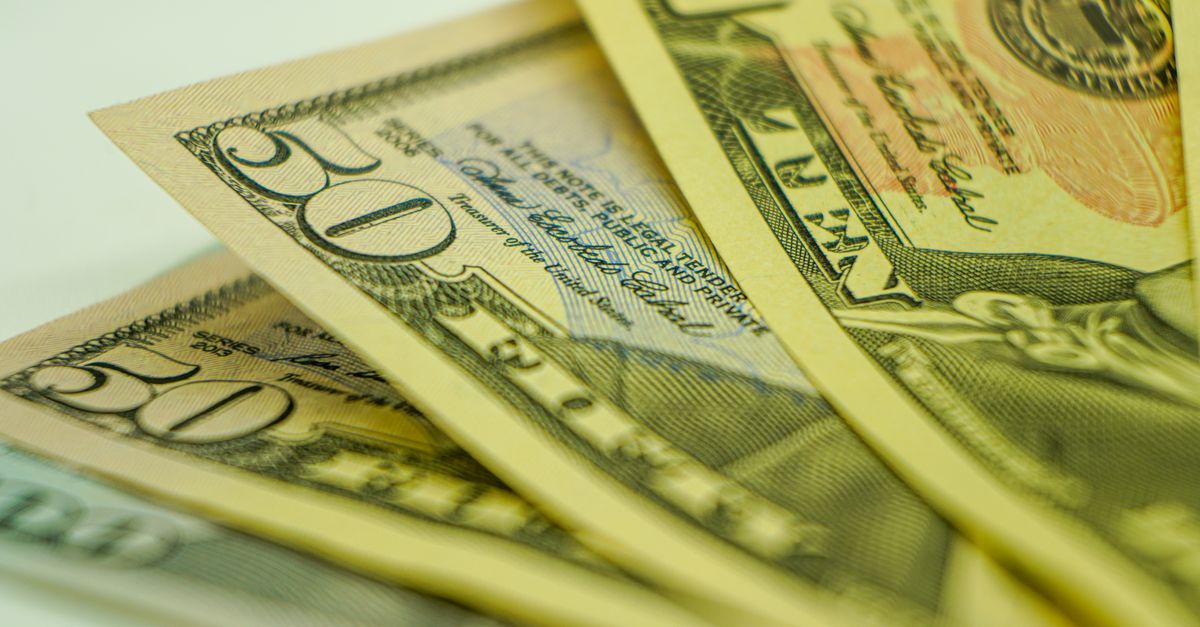 Photo by Goran Grudić on Pexels
The "Copper Sandwich" Identification
Most post-1970 Kennedy halves are copper-nickel clad. These coins feature a pure copper core bonded to outer layers of 75% copper and 25% nickel. On the edge, this manifests as a sharp, distinct orange or reddish-brown stripe.
Conversely, 90% silver coins (1964) show a solid, high-luster white edge with no layering. The 40% silver versions (1965–1970) present a more nuanced, duller grey edge; while they contain copper, the silver content (averaging 4.6 grams per coin) typically masks the bright orange stripe seen in later issues.
| Composition | Production Years | Edge Visual | Silver Content (oz) |
|---|---|---|---|
| 90% Silver | 1964 | Solid White / Brilliant Silver | 0.3617 oz |
| 40% Silver | 1965–1970 | Dull Grey / Faint Grey Line | 0.1479 oz |
| Clad (Base) | 1971–Present | Distinct Copper/Orange Stripe | 0.0000 oz |
(Source: U.S. Mint / PCGS, 2024)
The "Tissue Test" Corollary
For coins where the edge is toned or dirty, making visual confirmation difficult, use the Tissue Test. Lay the coin flat on a table and cover it with a single ply of a standard white facial tissue.
- Silver (90% or 40%): The coin will appear bright white or glow through the tissue.
- Clad: The coin will appear dark or greyish-black through the paper.
This optical phenomenon occurs because silver has a 95% reflectivity rate, the highest of any element, whereas nickel and copper absorb significantly more light.
Investor Note: As of late 2024, a 1964 Kennedy half dollar holds a melt value of ~$11.00, while a clad version is worth exactly $0.50. Mastering the edge test is the difference between identifying a 2,100% premium or holding a common circulation piece. (Source: Kitco Silver Spot Price, Sep 2024).
Key Dates: Which JFK Coins Are Actually Worth Money?
Beyond silver content, the "numismatic premium" of a Kennedy half dollar is driven by mintage scarcity and distribution methods. Most collectors mistakenly hunt for million-dollar errors, ignoring the consistent 200% to 1,000% premiums found in Not Intended for Circulation (NIFC) years.
The Scarcity Hierarchy
The market distinguishes between "Junk Silver" and "Key Dates." While a 1964 coin is valuable for its metal, the 1970-D is the series' primary bottleneck. It was never released for circulation and was only available in official Mint Sets.
Similarly, between 2002 and 2020, the U.S. Mint ceased producing half dollars for general commerce. These coins were sold directly to collectors at a premium, meaning any example found in a bank roll today likely escaped from a private collection.
[Visual: Data Table]
| Year | Significance | Silver % | Circulated Value | Uncirculated (MS65) |
|---|---|---|---|---|
| 1964 / 1964-D | First Year / Mass Produced | 90% | $11.00 - $13.00 | $20.00+ |
| 1970-D | Mint Set Only (Key Date) | 40% | $15.00 - $18.00 | $35.00+ |
| 1987 P/D | Low Mintage / NIFC | 0% | $1.50 - $3.00 | $8.00 - $12.00 |
| 2002–2020 | NIFC Era (Collector Only) | 0% | $1.00 - $2.50 | $4.00 - $6.00 |
| 2021–Present | Return to Circulation | 0% | $0.50 | $1.00 |
(Source: PCGS Price Guide & NGC Census Data, Oct 2024. Values based on $31/oz Silver Spot Price.)
Why NIFC Years Matter
For the modern hunter, the 2002-2020 gap represents the highest "real-world" find probability. Because these were never sent to banks, their presence in the wild is a statistical anomaly.
- The 1987 Anomaly: Only 2.8 million P and D strikes were produced. Despite being base metal, they command a 600% premium over face value in average condition.
- The 2021 Pivot: In 2021, the Mint resumed striking half dollars for general circulation due to increased demand. Post-2021 coins carry no significant premium unless they are high-grade proofs.
{
  "type": "bar",
  "title": "Mintage Scarcity: 1964 vs Key NIFC Years",
  "index": "Year",
  "categories": ["Mintage (Millions)"],
  "data": [
    {"Year": "1964-P", "Mintage (Millions)": 273.3},
    {"Year": "1970-D", "Mintage (Millions)": 2.1},
    {"Year": "1987-P", "Mintage (Millions)": 2.8},
    {"Year": "2010-P", "Mintage (Millions)": 1.7}
  ],
  "source": "Source: U.S. Mint Annual Reports (2024)",
  "note": "1964 mintage was massive to meet demand; 1970 and 2010 were restricted to collector sets."
}
So what? If you find a Kennedy dated between 2002 and 2020, stop and sleeve it. While not a "lottery ticket," it is a piece of "frozen" supply that collectors will always buy for a multi-dollar premium over its $0.50 face value.
The 1964 Accented Hair and Rare Errors
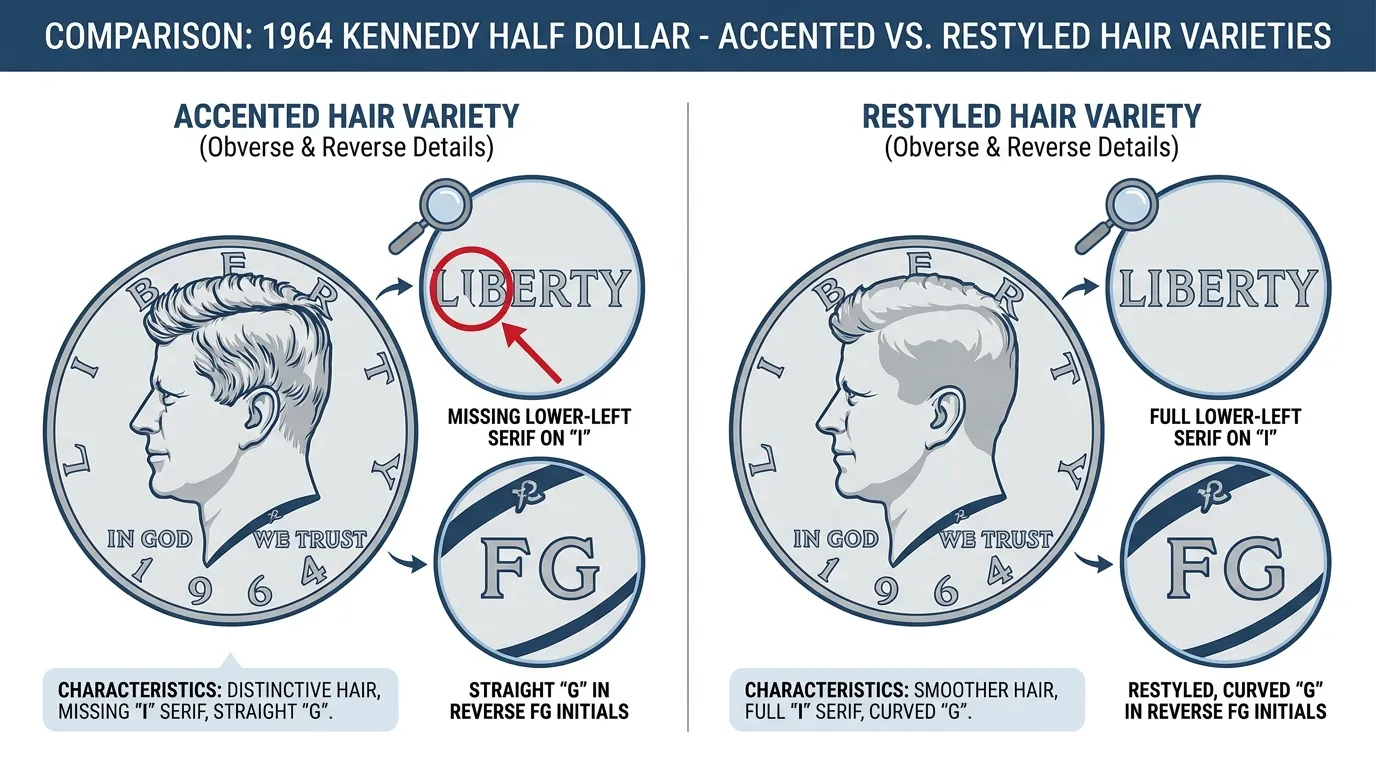
The 1964 "Accented Hair" variety is the most storied anomaly in the Kennedy series. In early 1964, Jacqueline Kennedy reportedly requested a redesign of her late husband’s portrait, finding the hair strands above the ear too "accentuated." The Mint complied, smoothing the design for 98% of the year's proof production.
The original "Accented Hair" versions are now premium assets. Accounting for only 1% to 3% of 1964 Proofs (approximately 100,000 units), they are non-negotiable for Registry Set collectors.
- Primary Diagnostic: Look at the "I" in "LIBERTY." On the Accented Hair variety, the lower-left serif is truncated or missing.
- Secondary Diagnostic: The "V-shaped" hair strands above the ear are significantly more pronounced than on the "Restyled" version.
"The 1964 Accented Hair is a hub variety, meaning it represents the very first chapter of the Kennedy legacy before the design was sanitized," notes numismatic specialist Kyle Franck (Source: VarietyErrors, June 2024).
Beyond the 1964 variety, high-alpha returns are found in "No FG" errors. These occur when excessive die polishing removes the designer Frank Gasparro’s initials from the reverse (located between the eagle’s tail and right leg).
| Variety / Error | Rarity Tier | High-Grade Valuation (PR/MS67+) | Key Marker |
|---|---|---|---|
| 1964 Accented Hair | Scarce | $120 - $800+ | Broken "I" serif; "V" hair strands |
| 1972-D "No FG" | Rare | $1,200 - $2,500 | Reverse initials completely missing |
| 1982-P "No FG" | Rare | $400 - $2,450 | No initials; often found in bank rolls |
| (Source: PCGS & NGC Price Guides, Sept 2024) |
 AI Generated Infographic
{
  "type": "bar",
  "title": "Valuation Premium: Variety vs. Regular Issue (Grade 67)",
  "index": "Coin Type",
  "categories": ["Premium Value ($)"],
  "data": [
    {"Coin Type": "1964 Reg. Proof", "Premium Value ($)": 35},
    {"Coin Type": "1964 Accented Hair", "Premium Value ($)": 150},
    {"Coin Type": "1972-D Regular", "Premium Value ($)": 5},
    {"Coin Type": "1972-D No FG", "Premium Value ($)": 450},
    {"Coin Type": "1982-P Regular", "Premium Value ($)": 2},
    {"Coin Type": "1982-P No FG", "Premium Value ($)": 380}
  ],
  "source": "Source: PCGS Auction Results (2024)",
  "note": "Premiums represent typical market prices for certified high-grade specimens."
}
So what? Most 1964 halves are worth their weight in silver (~$10–$12). However, a single diagnostic check for the "Accented Hair" or a missing "FG" can increase that value by 10x to 100x. If you are buying unsearched proof sets or hunting rolls, these are your primary targets for arbitrage.
The 2015 John F. Kennedy Presidential $1 Coin
While the half-dollar remains the most famous Kennedy coin, the 2015 John F. Kennedy Presidential $1 Coin represents a critical, often misunderstood chapter for collectors. Unlike its silver-clad predecessors, this coin was never intended for general circulation.
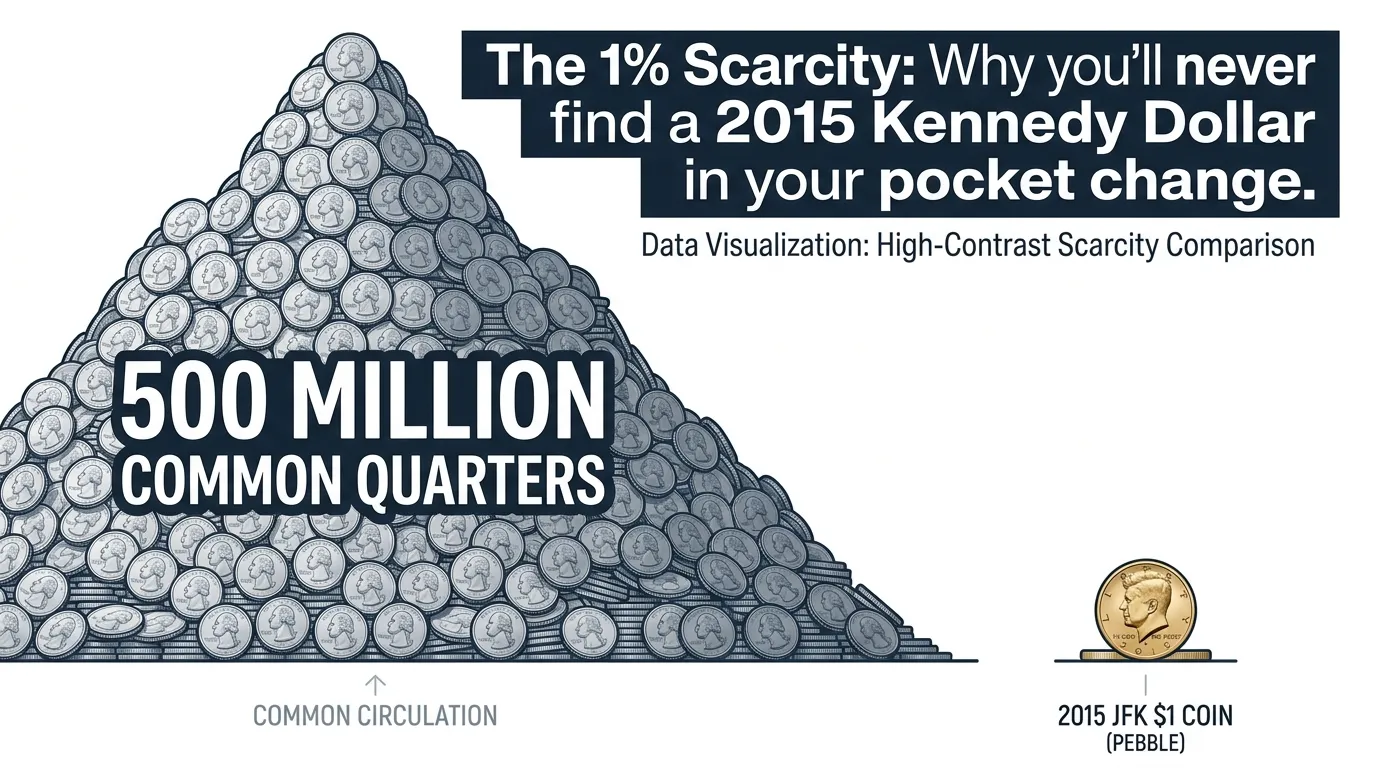
In 2011, the U.S. Treasury suspended the mass production of Presidential $1 coins for commerce due to a massive surplus of $1.4 billion in uncirculated coins sitting in Federal Reserve vaults. Consequently, the 2015 Kennedy $1 was only struck for collectors (NIFC - Not Intended For Circulation), available exclusively through U.S. Mint sets or rolls sold at a premium.
 AI Generated Infographic
The Scarcity Gap: Mintage Data
The rarity of the JFK $1 coin is best understood through its mintage volume compared to the coins we use daily. While the U.S. Mint produces billions of quarters annually, the JFK $1 mintage was restricted to professional numismatic demand.
| Coin Type (2015) | Mint Mark | Total Mintage (Approx.) | Status |
|---|---|---|---|
| JFK Presidential $1 | P (Philadelphia) | 5.18 Million | NIFC (Collector Only) |
| JFK Presidential $1 | D (Denver) | 4.62 Million | NIFC (Collector Only) |
| Saratoga Quarter | P & D Combined | 438.8 Million | General Circulation |
| Kennedy Half-Dollar | P & D Combined | 4.60 Million | NIFC (Collector Only) |
(Source: U.S. Mint Annual Report, 2015)
{
  "type": "bar",
  "title": "Mintage Comparison: 2015 JFK $1 vs. Standard Circulation Coins",
  "index": "Coin Type",
  "categories": ["Mintage (Millions)"],
  "data": [
    {"Coin Type": "JFK $1 (P+D)", "Mintage (Millions)": 9.8},
    {"Coin Type": "Saratoga Quarter", "Mintage (Millions)": 438.8},
    {"Coin Type": "Blue Ridge Quarter", "Mintage (Millions)": 603.4}
  ],
  "source": "Source: U.S. Mint Production Statistics (2015)",
  "note": "The JFK $1 coin represents less than 2% of the volume of a standard 2015 circulating quarter."
}
So what? If you find a gold-colored Kennedy dollar in your pocket change, it was likely broken out of a collector set and spent by accident. While it contains zero gold (it is a manganese-brass composition), its limited mintage ensures a baseline premium. High-grade (MS65+) specimens currently trade for $5 to $12, a significant markup over its $1 face value.
Investor Note: Do not confuse the Presidential $1 with the Half-Dollar. The $1 coin is smaller, gold in color, and features Kennedy’s profile facing left, whereas the half-dollar profile faces left but is significantly larger (30.6mm vs 26.5mm).
Selling Your JFK Coins: Melt Value vs. Numismatic Value
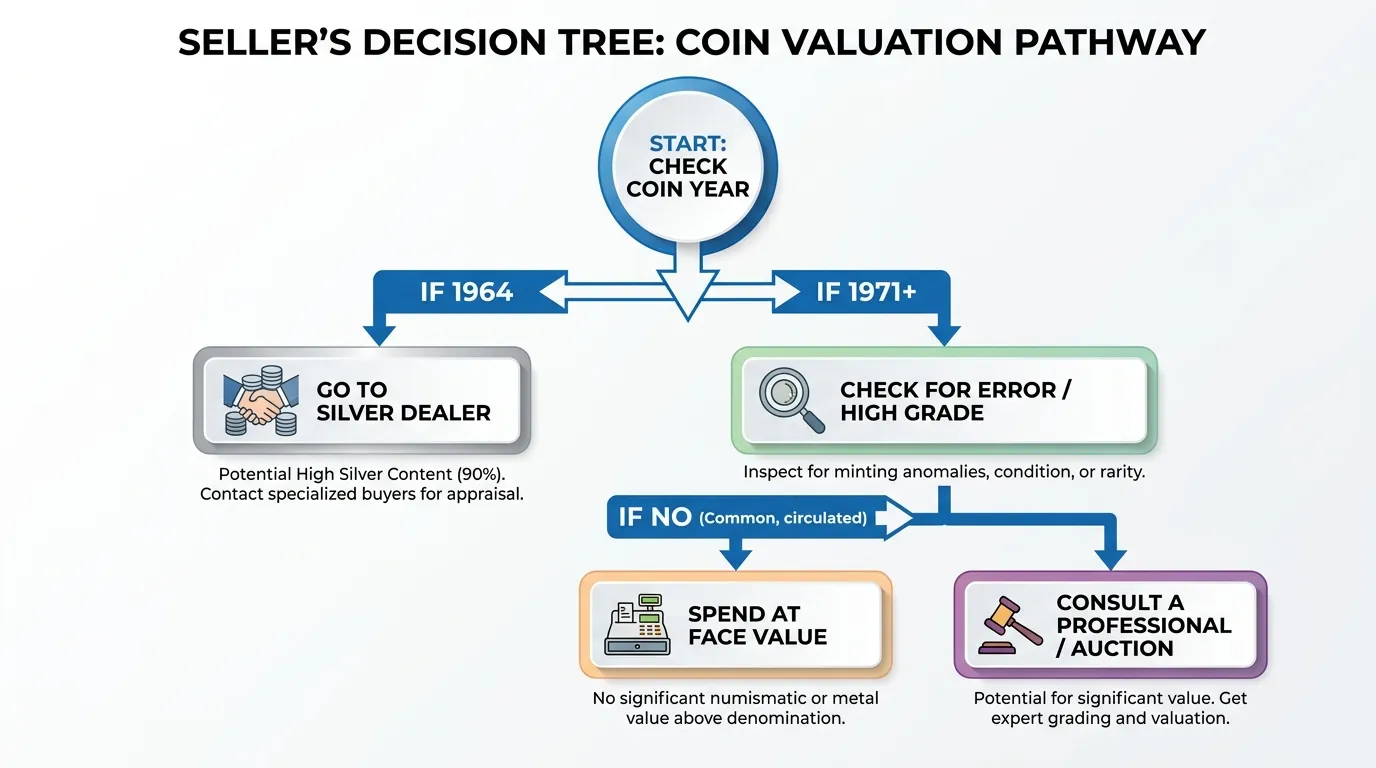
Before liquidation, you must distinguish between a coin’s intrinsic bullion value and its collector (numismatic) premium. Most JFK half-dollars found in circulation are worth exactly 50 cents, but silver-era issues possess a "melt value" that acts as a price floor, independent of condition.
The Silver Floor: Calculating Melt Value
For 1964–1970 issues, the market price of silver is the primary driver of value. According to Kitco Metals data (Sept 2024), with silver trading near $30.00/oz, a 1964 JFK half-dollar contains roughly $10.85 in raw silver.
Visual: Simple Formula Box (Current Spot Price per Oz) × (Actual Silver Weight) = Minimum Liquid Value
| Coin Year/Type | Silver Content | Actual Silver Weight (ASW) | Est. Melt Value ($30 Spot) |
|---|---|---|---|
| 1964 (90% Silver) | 90% Ag, 10% Cu | 0.3617 troy oz | $10.85 |
| 1965–1970 (40% Silver) | 40% Ag, 60% Cu | 0.1479 troy oz | $4.44 |
| 1971–Present (Clad) | 0% Ag (Cu-Ni) | 0.0000 troy oz | $0.50 |
| (Source: Coinflation & Kitco, 2024) |
The Numismatic Ceiling: Rarity and Condition
Numismatic value applies when a coin's scarcity or grade exceeds its metal content. Professional grading by PCGS or NGC is only economically viable for coins expected to fetch over $100.
- Key Varieties: Look for the 1964 "Accented Hair" Proof or the 1998-S Matte Finish. These carry premiums regardless of silver spot prices.
- The 1970-D Outlier: Because 1970-D halves were only issued in mint sets, they are inherently scarce, often trading for $15–$35 even in lower uncirculated grades.
- Condition Matters: A "Clad" (post-1971) coin is generally worth face value unless it achieves a Mint State 67 (MS67) grade or higher, where registry set collectors may pay hundreds for "top pop" specimens.
{
  "type": "bar",
  "title": "JFK Half Dollar Value Composition (Approx. 2024)",
  "index": "Year Range",
  "categories": ["Melt Value", "Numismatic Premium (Avg MS Grade)"],
  "data": [
    {"Year Range": "1964 (90%)", "Melt Value": 10.85, "Numismatic Premium (Avg MS Grade)": 5.15},
    {"Year Range": "1965-70 (40%)", "Melt Value": 4.44, "Numismatic Premium (Avg MS Grade)": 8.56},
    {"Year Range": "1971+ (Clad)", "Melt Value": 0.00, "Numismatic Premium (Avg MS Grade)": 0.50}
  ],
  "source": "Source: PCGS Price Guide & Kitco Silver Spot (Sept 2024)",
  "note": "Numismatic premium varies wildly based on specific Mint State (MS) grading."
}
Where to Sell: Maximizing Returns
- For Melt Value (Bulk Silver): Sell to reputable bullion dealers or local coin shops. Expect to receive 90%–95% of the spot price.
- For Numismatic Value (Rare Dates): Use specialized auction houses (e.g., Heritage Auctions) or eBay. Note that eBay takes ~13% in fees, which can negate the premium on mid-tier coins.
 AI Generated Infographic
Understanding these mechanics ensures you don't accidentally spend a $10 silver coin as 50 cents, or conversely, waste grading fees on a common clad coin. For serious collectors tracking broader market shifts and high-end specimen movements, maintaining an always-on market research workflow with Tritonix.ai can help identify the optimal windows for liquidating numismatic assets.
FAQ
Is JFK still on a U.S. coin?
Yes, John F. Kennedy is featured on the Kennedy Half Dollar, which has been in production from 1964 to the present, and the 2015 Presidential $1 Coin.
Which Kennedy half dollars are made of silver?
Half dollars from 1964 are 90% silver. Coins minted between 1965 and 1970 are 40% silver. Most coins minted from 1971 onwards are made of copper-nickel and contain no silver.
Is the 2015 JFK dollar coin made of real gold?
No, the 2015 JFK Presidential $1 coin is a manganese-brass composition. It has a golden color but contains zero gold or silver.
How can I tell if my JFK coin is silver using the edge test?
Check the coin's edge: a solid silver edge indicates 90% silver (1964), a dull grey edge often indicates 40% silver (1965-1970), and a distinct orange copper stripe signifies a post-1971 base metal coin.
What is a 1964 Kennedy half dollar worth today?
As of late 2024, a 1964 Kennedy half dollar has a melt value of approximately $10.85 to $11.00 based on silver spot prices, with uncirculated versions worth even more.