IBM Stock in 2026: Earnings, Cash Flow, and the Dividend Case
Founder of Tritonix.ai. Former Hedge Fund Analyst with 10+ years of experience managing over $1B AUM across insurance portfolios and private funds. Specializes in institutional-grade fundamental analysis and long-term capital allocation.
What IBM stock is pricing in November 2026
When investors search for IBM stock in November 2026, they are usually looking for a live read on International Business Machines Corporation, not a history of the old hardware franchise. The practical questions are the same ones that sit in any current quote: what did the last quarter earn, what cash comes back to shareholders, and whether the share price still discounts a slower year than management first advertised.
Yahoo Finance and StockAnalysis both show the shares closing at $246.11 on November 9, 2026, up $1.11, or 0.45%, on volume of about 4.63 million shares. That session’s range was $245.20 to $248.81. At 945,120,805 common shares outstanding on September 30, 2026, according to IBM’s third-quarter Form 10-Q, the close implies an equity value of about $232.7 billion.
The path to that price was not a straight line. The stock closed at $219.93 on September 30, then jumped 3.94% to $251.46 on October 21, the day IBM reported third-quarter results. It reached $258.28 on October 29 before fading back toward the mid-$240s. ChartExchange put the 52-week high at $332.46 on June 2, 2026, and the 52-week low at $199.19 on July 23, 2026. Its 200-day simple moving average on the November 9 snapshot was $247.97, a few dollars above the close.
That nearby moving average is useful context, not a trading rule. Investors who want a cleaner markup of the recent range can use Tritonix AI technical analysis to annotate the post-earnings advance and the pullback toward the 200-day line, then compare it with the fundamental record below.
IBM stock in November 2026 is a cash-and-software story trading well below its mid-year high, close to its 200-day average, after a third-quarter beat that did not restore the old peak.
{
  "type": "line",
  "title": "IBM Stock Closing Price, Late 2026",
  "index": "Date",
  "categories": ["Close"],
  "data": [
    {"Date": "2026-09-30", "Close": 219.93},
    {"Date": "2026-10-08", "Close": 226.61},
    {"Date": "2026-10-15", "Close": 234.12},
    {"Date": "2026-10-21", "Close": 251.46},
    {"Date": "2026-10-29", "Close": 258.28},
    {"Date": "2026-11-06", "Close": 245.00},
    {"Date": "2026-11-09", "Close": 246.11}
  ],
  "source": "StockAnalysis / Yahoo Finance, closing prices through November 9, 2026",
  "note": "October 21 is the third-quarter earnings date. Prices are unadjusted session closes."
}
The third-quarter results that reset the year
IBM’s October 21, 2026 earnings release is the document that still anchors the stock. For the quarter ended September 30, 2026, revenue was $17.103 billion, up 4.7% as reported and 5.6% adjusted for currency from $16.331 billion a year earlier. Gross profit was $9.714 billion, and the GAAP gross margin was 56.8%, down 50 basis points.
On the bottom line, GAAP income from continuing operations was $2.199 billion, or $2.31 a diluted share, compared with $1.744 billion, or $1.84, a year earlier. That 26% rise in GAAP earnings per share was helped by a much lower effective tax rate, 11.9% versus 28.2%. The cleaner operating, or non-GAAP, measure was $2.95 a share, up 11% from $2.65. Operating pre-tax income was $3.3 billion, and the operating pre-tax margin widened 70 basis points to 19.3%.
Cash generation was the other number the market could not ignore. IBM produced $4.0 billion of operating cash flow in the quarter and $3.0 billion of free cash flow, up $0.7 billion year over year. For the first nine months, free cash flow was $7.8 billion, up $0.6 billion. Chairman and CEO Arvind Krishna kept full-year constant-currency revenue growth in a 4% to 5% range and raised the free-cash-flow outlook to an increase of more than $1 billion year over year.
That revenue range is tighter than the one IBM set on January 28, 2026, when it reported 2025 results and said it expected more than 5% constant-currency growth in 2026. The company has not walked away from growth, but it is no longer selling a year that clears 5% as the base case. Profit and cash, not a raised top-line guide, are what management chose to upgrade after the beat.
| Measure | Q3 2026 | Q3 2025 | Change |
|---|---|---|---|
| Revenue ($ billions) | 17.103 | 16.331 | 4.7% |
| GAAP diluted EPS, continuing | 2.31 | 1.84 | 26% |
| Operating (non-GAAP) diluted EPS | 2.95 | 2.65 | 11% |
| GAAP gross margin | 56.8% | 57.3% | -0.5 pts |
| Operating pre-tax margin | 19.3% | 18.6% | 0.7 pts |
| Free cash flow ($ billions) | 3.027 | 2.373 | 0.654 |
Source: IBM earnings release and free-cash-flow reconciliation, October 21, 2026.
The quarter beat on revenue, operating earnings, and cash, while the full-year sales guide stayed at 4% to 5% constant currency. That mix is why a good print did not automatically re-rate the shares back to the June high.
Software, consulting, and a mainframe hangover
Software remains the economic core. The segment delivered $7.804 billion of revenue in the third quarter, up 8.2% as reported and 8.7% in constant currency, and $2.734 billion of segment profit, for a 35.0% margin, up 210 basis points. According to IBM’s third-quarter charts, software annual recurring revenue reached $24.9 billion, up 8%. Hybrid Cloud, which is Red Hat, grew 11%. Data grew 19%, or 20% in constant currency. Transaction Processing rose 9%, or 10% in constant currency. OpenShift ARR growth accelerated to more than 30%. Automation was the soft spot, down 3%.
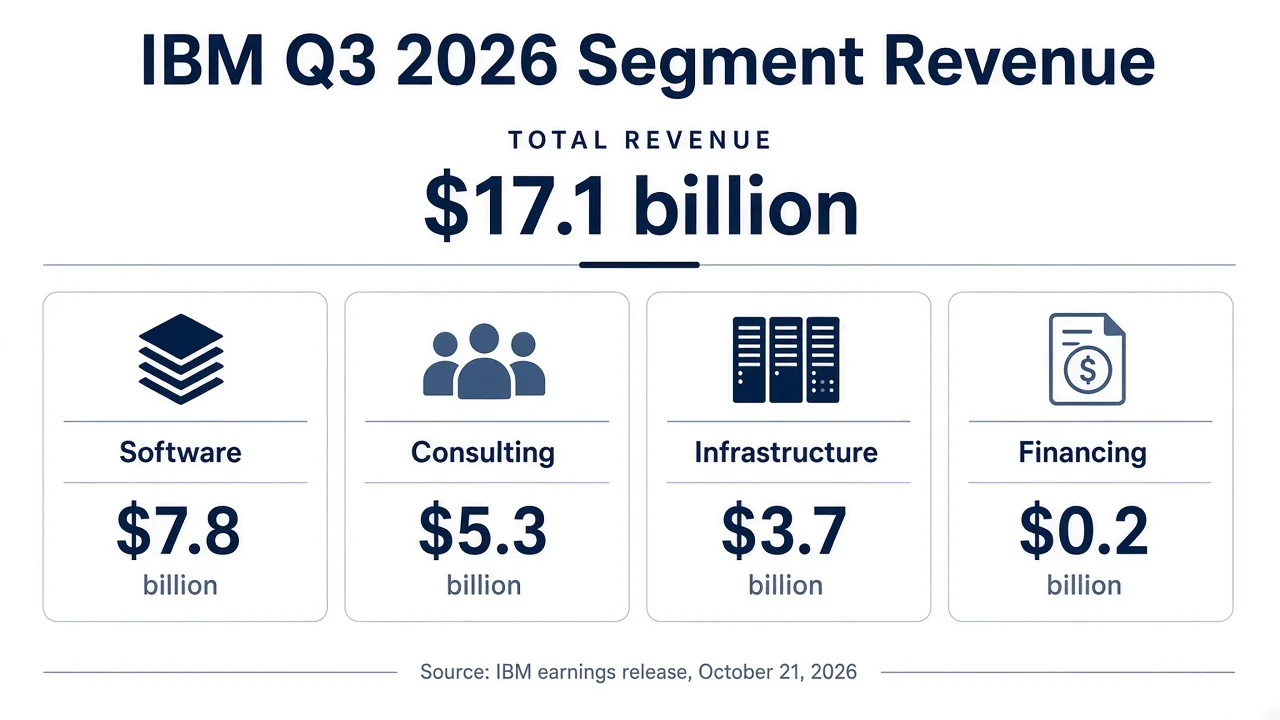 IBM’s third-quarter 2026 revenue mix, rounded from the October 21 earnings release. Software supplied about 46% of the $17.1 billion total.
Consulting, at $5.335 billion, was essentially flat as reported and up 1.8% in constant currency. Segment profit was $653 million, and the margin slipped to 12.2% from 12.9%. Strategy and Technology grew 2%, or 4% in constant currency, while Intelligent Operations fell 2% and was flat in constant currency. That is a usable but unspectacular services print, and it is the part of IBM most exposed to slower client spending.
Infrastructure tells a cycle story. Revenue was $3.707 billion, up 4.2%, or 4.9% in constant currency, and segment profit rose to $715 million, a 19.3% margin. Hybrid Infrastructure grew 8%, or 9% in constant currency, but the mix inside that line was lopsided: IBM Z fell 20%, or 19% in constant currency, while Distributed Infrastructure jumped 31%, or 32% in constant currency. The comparison is demanding. In the fourth quarter of 2025, IBM Z revenue had risen 67%, or 61% in constant currency, as clients adopted the newest mainframe generation.
{
  "type": "bar",
  "title": "IBM Segment Revenue, Q3 2025 vs Q3 2026 ($ billions)",
  "index": "Segment",
  "categories": ["Q3 2025", "Q3 2026"],
  "data": [
    {"Segment": "Software", "Q3 2025": 7.209, "Q3 2026": 7.804},
    {"Segment": "Consulting", "Q3 2025": 5.324, "Q3 2026": 5.335},
    {"Segment": "Infrastructure", "Q3 2025": 3.559, "Q3 2026": 3.707},
    {"Segment": "Financing", "Q3 2025": 0.200, "Q3 2026": 0.192}
  ],
  "source": "IBM earnings release, October 21, 2026",
  "note": "Software supplied 45.6% of third-quarter 2026 revenue. Figures are reported dollars, not constant currency."
}
Financing contributed $192 million, down 4%. Other revenue was $66 million. By geography, the Americas grew 5.3% as reported, EMEA 3.3%, and Asia Pacific 5.6%, or 9.6% in constant currency. Research and development spending rose to $2.378 billion from $2.082 billion, a reminder that IBM is still funding software, AI platforms, and quantum even as it talks about productivity.
The bull case lives in software recurring revenue and Red Hat. The cyclical risk lives in IBM Z, and the swing factor in any slower IT budget year is still consulting.
Cash flow, the dividend, and a heavier balance sheet
IBM’s dividend is not a marketing line. It is a cash commitment the company has kept, in some form, since 1916. On October 21 the board declared a regular quarterly dividend of $1.69 a share, payable December 10, 2026, to holders of record on November 10, 2026. At a $246.11 close, an annualized $6.76 rate yields about 2.75%. The company paid $1.596 billion of dividends in the third quarter and $4.762 billion in the first nine months.
That payout sits on a free-cash-flow base that is still back-end loaded. Nine-month free cash flow of $7.8 billion compares with $14.7 billion for all of 2025, when the fourth quarter alone produced $7.6 billion. If IBM delivers the raised 2026 outlook of a year-over-year increase of more than $1 billion, full-year free cash flow would exceed the $14.7 billion 2025 figure by that amount. The first nine months are only $0.6 billion ahead, so the fourth quarter has to do a large share of the work again.
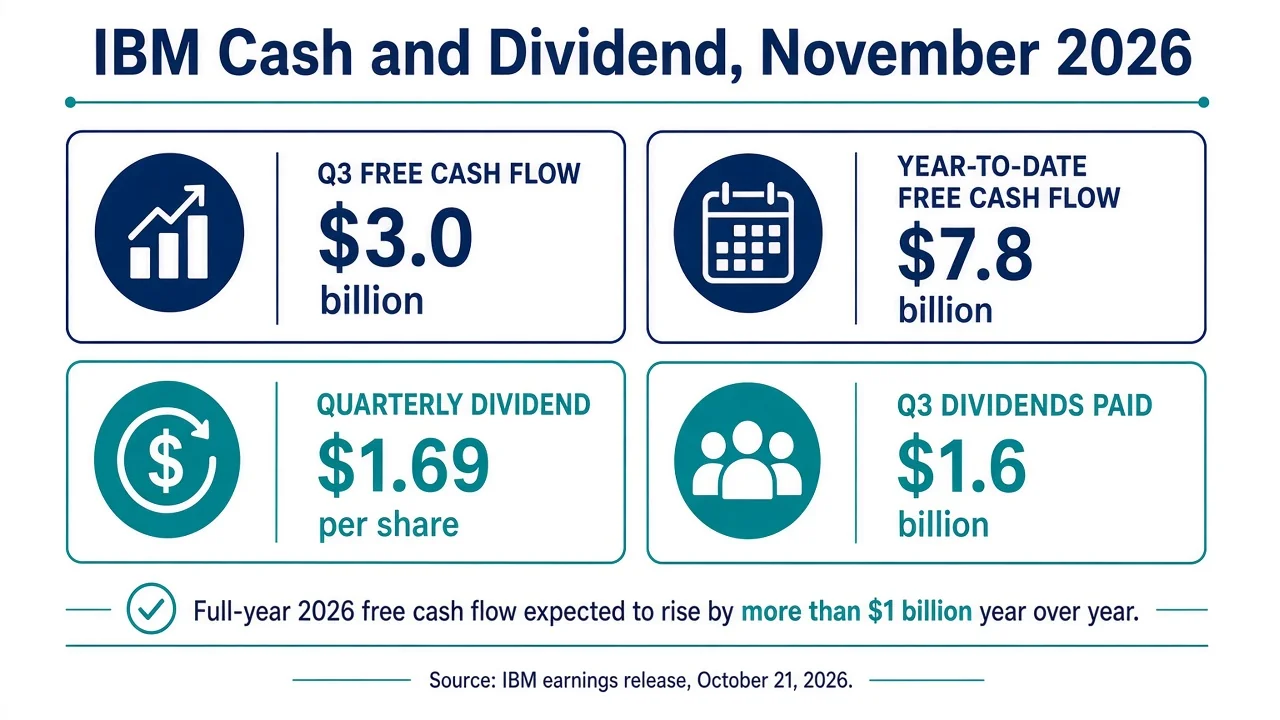 Cash and dividend snapshot from IBM’s October 21, 2026 earnings release. The $1.69 quarterly dividend was payable to holders of record on November 10, 2026.
The balance sheet shows why cash allocation still matters. At September 30, cash, restricted cash, and marketable securities were $11.1 billion, down $3.4 billion from year-end 2025. Total debt was $63.8 billion, including $12.7 billion of IBM Financing debt, and was up $2.6 billion year to date. IBM stockholders’ equity was $35.537 billion. Goodwill rose to $74.916 billion from $67.717 billion at year-end, and the company said it had invested $11.4 billion in acquisitions in 2026 through the third quarter.
Those purchases can support the software and data stack, but they also raise amortization, integration risk, and leverage. IBM is funding a long dividend record and a sizable acquisition program from the same cash engine. The third-quarter release is clear that the dividend remains a priority. It is equally clear that cash is no longer piling up unused on the balance sheet.
The $1.69 quarterly dividend is covered by current free cash flow, but 2026 cash allocation is a three-way split among the dividend, acquisitions, and a debt load that is already larger than equity.
How to value IBM stock after the retracement
A simple trailing multiple is a start, not a verdict. Add IBM’s fourth-quarter 2025 GAAP diluted earnings from continuing operations of $5.86 to the first nine months of 2026 at $5.86, and trailing GAAP earnings are $11.72 a share. At $246.11, that is about 21.0 times earnings. The comparison is imperfect, because the 2025 fourth-quarter GAAP figure included a large tax benefit. Using operating earnings instead — $4.52 in the fourth quarter of 2025 plus $7.79 for the first nine months of 2026 — gives trailing operating earnings of $12.31, or about 20.0 times the November 9 close.
Trailing revenue, built the same way from $19.686 billion in the fourth quarter of 2025 and $50.182 billion year to date, is about $69.9 billion. On that base, the $232.7 billion equity value is roughly 3.3 times sales. None of those ratios is extreme for a software-led enterprise franchise, and none is cheap if software growth fades back toward the mid-single digits or if the next mainframe cycle disappoints.
The stock’s 2026 drawdown from $332.46 is the market’s way of saying that the earlier multiple assumed a cleaner AI and hybrid-cloud acceleration than the company has been willing to guide. IBM is selling governance, hybrid deployment, and systems of record, not a hyperscaler growth rate. For holders who care what large funds are doing around that debate, Tritonix institutional smart-money tracking is a direct way to follow 13F-scale positioning in IBM rather than relying on the share price alone.
Risks are specific. Consulting can stall if clients pause projects. IBM Z will keep producing awkward year-over-year comparisons until the current cycle bottoms. Automation already shrank in the third quarter. A lower tax rate flattered GAAP earnings, so investors should keep watching operating margins and free cash flow. Acquisition integration, higher interest cost on $63.8 billion of debt, and any slippage in Red Hat or data growth would all argue for a lower multiple than 20 times trailing operating earnings.
| Valuation snapshot (as of Nov. 9, 2026) | Figure |
|---|---|
| Share price | $246.11 |
| Equity value (9/30 share count) | $232.7 billion |
| Trailing GAAP EPS, continuing | $11.72 |
| Trailing operating EPS | $12.31 |
| Price / trailing GAAP EPS | 21.0x |
| Price / trailing operating EPS | 20.0x |
| Annualized dividend / yield | $6.76 / 2.75% |
Sources: IBM filings and earnings releases; StockAnalysis and Yahoo Finance for the close. Multiples and the equity value are calculated from those figures.
At about 20 times trailing operating earnings and a 2.75% yield, IBM stock is no longer priced like a mid-year favorite. It is priced like a cash-generative software compounder that still has to prove 2026 growth can stay in the 4% to 5% band.
What to watch before the next report
The next useful test is not a slogan about artificial intelligence. It is a short list of hard numbers. Software, which just grew 8.7% in constant currency, needs to remain the engine, with Red Hat, Data, and OpenShift doing the heavy lifting. IBM Z comparisons should be read against the 2025 installation boom, not against an assumption of straight-line growth. Consulting constant-currency growth of about 2% is the line that tells you whether enterprise budgets are still open.
On cash, the raised outlook of a free-cash-flow increase of more than $1 billion puts a clear hurdle in front of the fourth quarter. On capital, investors should watch whether acquisition outlays slow after the $11.4 billion already spent, and whether debt and goodwill stop climbing as quickly. The $1.69 dividend looks secure on current cash flow, but it is not a substitute for growth in the software book.
IBM stock, at $246.11, sits between a June peak the company has not earned back and a July low it has already left behind. The third-quarter report improved the cash and earnings case. It did not, on its own, restore the higher valuation. The shares will have to do that the slow way: by delivering the guided 4% to 5% constant-currency growth, keeping software recurring revenue moving, and turning a seasonally strong fourth quarter into the extra billion dollars of free cash flow management has now promised.
FAQ
What was IBM's stock price on November 9, 2026?
IBM stock closed at $246.11 on November 9, 2026, up $1.11, or 0.45%, according to Yahoo Finance and StockAnalysis. Volume was about 4.63 million shares, and the day's range was $245.20 to $248.81.
How did IBM perform in the third quarter of 2026?
IBM reported $17.103 billion of revenue, up 4.7% as reported and 5.6% in constant currency. GAAP diluted earnings from continuing operations were $2.31 a share, and operating (non-GAAP) earnings were $2.95 a share. Free cash flow was $3.0 billion.
What is IBM's dividend in 2026?
The board declared a quarterly cash dividend of $1.69 a share, payable December 10, 2026, to holders of record on November 10, 2026. That is $6.76 annualized, or a yield of about 2.75% at the November 9 close of $246.11.
Why is IBM stock below its 2026 high if third-quarter earnings beat estimates?
The shares reached a 52-week high of $332.46 on June 2, 2026, then sold off to $199.19 on July 23 before recovering. After the October 21 report, IBM kept full-year constant-currency revenue growth at 4% to 5%, below the more-than-5% outlook it gave in January, and the stock faded from a post-earnings close of $258.28 on October 29.
Does IBM generate enough cash to cover its dividend?
Yes, on the latest figures. IBM paid $1.6 billion of dividends in the third quarter and $4.8 billion in the first nine months, against $3.0 billion and $7.8 billion of free cash flow in those periods. Full-year cash is historically fourth-quarter heavy; management now expects 2026 free cash flow to rise by more than $1 billion from 2025's $14.7 billion.