Exactly How Many Stocks in the Nasdaq? Current 2026 Count & Index Breakdown
20-year veteran of the bond markets. Marcus focuses on central bank policy, global liquidity cycles, and geopolitical risks tailored for the equity investor.
The Quick Answer: How Many Stocks in the Nasdaq Right Now?
As of late 2026, the short answer is that the Nasdaq Composite contains approximately 3,416 companies, while the elite Nasdaq-100 tracks exactly 100 companies via 101 to 102 ticker symbols.
Investors often confuse "listings" with "companies." While the exchange hosts over 5,700 total listings (including ETFs and preferred shares), the indexes themselves are far more selective.
| Index Name | Entity Count (Companies) | Ticker Symbols | Primary Focus |
|---|---|---|---|
| Nasdaq Composite | ~3,416 | ~3,450+ | All common stocks on the exchange |
| Nasdaq-100 (NDX) | 100 | 102 | Largest non-financial growth leaders |
| (Source: Nasdaq Investor Relations, Q2 2026 Earnings Supplement). |
The "Ticker vs. Company" Discrepancy
The most common mistake in counting Nasdaq stocks is ignoring dual-class share structures. For example, Alphabet Inc. (Google) represents a single company in the Nasdaq-100, but it occupies two ticker symbols: GOOGL (Class A) and GOOG (Class C).
As of June 2026, the Nasdaq-100 utilizes 102 ticker symbols to represent its 100 constituent companies. For the retail investor, this means your "basket" is slightly more concentrated than the symbol count suggests.
Breadth vs. Concentration: "So What?"
The gap between the 3,416 stocks in the Composite and the 100 in the NDX is where the real investment story lies:
- Tech Dominance: While the Composite includes thousands of small-cap and biotech firms, the top 100 companies represent roughly 90% of the total market value of the entire exchange.
- The Financial Exclusion: The Nasdaq-100 strictly excludes financial firms (banks, REITs). If you want exposure to the 2026 fintech boom, you will find those companies in the Composite, but only a select few in the NDX.
[!TIP] Key Insight: When "The Nasdaq" is up 2%, the media is usually referring to the Composite. However, most institutional liquidity and major ETFs (like QQQ) track the Nasdaq-100.
{
  "type": "bar",
  "title": "Nasdaq Index Breakdown (2026 Snapshot)",
  "index": "Index Type",
  "categories": ["Company Count", "Ticker Symbol Count"],
  "data": [
    {"Index Type": "Nasdaq Composite", "Company Count": 3416, "Ticker Symbol Count": 3452},
    {"Index Type": "Nasdaq-100", "Company Count": 100, "Ticker Symbol Count": 102}
  ],
  "source": "Source: Nasdaq Global Indexes (June 2026)",
  "note": "Company count refers to unique legal entities; symbols include multiple share classes."
}
Deep Dive into the Nasdaq Composite Stock Count
To understand why the Nasdaq Composite maintains a count exceeding 3,400 securities, investors must look beyond "tech stocks." The index is a market-capitalization-weighted reflection of almost every security listed on the Nasdaq Stock Market.
Unlike the S&P 500, which uses a selection committee to curate 500 "leading" companies, the Nasdaq Composite is inclusive by design. If a security is listed on the exchange and meets the asset-type criteria, it is in.
Qualifying Financial Instruments
The high count is driven by the diversity of eligible security types. While common stocks form the backbone, the inclusion of Global Depositary Receipts (ADRs) and REITs significantly inflates the total compared to more restrictive indices.
| Security Type | Eligibility Status | Strategic Role in Index |
|---|---|---|
| Common Stocks | Included | Primary equity driver for U.S. companies. |
| ADRs | Included | Provides exposure to international giants (e.g., ASML). |
| REITs | Included | Incorporates real estate yield into the growth-heavy index. |
| Tracking Stocks | Included | Tracks specific subsidiary performance. |
| ETFs / ETNs | Excluded | Prevents double-counting of underlying assets. |
| Preferred Stocks | Excluded | Classified as debt-equity hybrids, not pure equity. |
(Source: Nasdaq Listing Center, June 2026)
{
  "type": "pie",
  "title": "Nasdaq Composite Composition by Security Type (2026)",
  "index": "Security Type",
  "categories": ["Percentage"],
  "data": [
    {"Security Type": "Common Stock (U.S.)", "Percentage": 86.2},
    {"Security Type": "ADRs (Foreign)", "Percentage": 9.4},
    {"Security Type": "REITs", "Percentage": 3.1},
    {"Security Type": "Other (Tracking/MLPs)", "Percentage": 1.3}
  ],
  "source": "Source: Nasdaq Global Indexes Data Service (June 2026)",
  "note": "ADRs account for the majority of non-U.S. representation in the Composite."
}
The Ticker vs. Company Discrepancy
The gap between the 3,452 ticker symbols and 3,416 companies is a technicality that often confuses retail traders. This delta is created by dual-class share structures.
- Multi-Class Listings: Companies like Alphabet (GOOGL/GOOG) or Fox Corp (FOXA/FOX) occupy two slots in the ticker count but represent a single legal entity.
- Weighting Impact: While there are multiple tickers, the index methodology ensures that the total market cap of the company is what influences the index move, not the number of symbols.
So What? For investors, the "high count" means the Nasdaq Composite is a purer proxy for the broader economy and the IPO market than the Nasdaq-100. When the count rises, it typically signals a healthy environment for new capital formation and venture-backed exits. (Source: Goldman Sachs Equity Research, May 2026).
What Securities Are Excluded from the Total Count?
The distinction between a Nasdaq listing and a Nasdaq Composite component is the most common trap for investors tracking exchange growth. While the exchange serves as a marketplace for thousands of instruments, the Index is a curated reflection of equity performance, not a directory of every ticker.
As of May 2026, there is a stark delta of approximately 3,650 securities that trade on the exchange but are barred from the Index. Total listings hover near 7,000, yet the Nasdaq Composite count remains closer to 3,350 distinct stocks (Source: Nasdaq Monthly Fact Sheet, May 2026).
The "Equity Only" Filter
The primary reason for this discrepancy is the index methodology’s focus on operating companies. The Nasdaq Composite is designed to measure the health of the corporate economy, specifically the technology and growth sectors. Consequently, any security that represents a "wrapper" for other assets or a debt-like instrument is disqualified.
The following categories are strictly excluded from the Nasdaq Composite:
- Exchange-Traded Funds (ETFs): Though tickers like QQQ are synonymous with Nasdaq, they are investment companies, not stocks.
- Closed-End Funds (CEFs): These trade like stocks but represent managed portfolios.
- Preferred Stocks & Convertible Debentures: These function more like fixed-income instruments and lack the "purity" of common equity.
- Derivatives & Rights: Warrants and rights are excluded as they are options to purchase equity, not equity itself.
| Security Type | Included in Index? | Rationale |
|---|---|---|
| Common Stocks | Yes | Primary vehicle for equity ownership. |
| ADRs / Ordinary Shares | Yes | Allows for international company representation. |
| REITs | Yes | Real estate operating entities (exclusive to Composite). |
| ETFs / ETNs | No | Structured products/funds, not individual companies. |
| Preferred Stocks | No | Hybrid debt-like characteristics; lacks voting/growth parity. |
| Warrants / Rights | No | Derivative nature; temporary or conditional securities. |
(Source: Nasdaq Index Methodology Guide, Updated July 2026)
{
  "type": "donut",
  "title": "Nasdaq Listings vs. Index Components (Est. Oct 2026)",
  "index": "type",
  "categories": ["count"],
  "data": [
    {"type": "Index Eligible Stocks", "count": 3350},
    {"type": "Excluded Securities (ETFs, CEFs, Warrants)", "count": 3650}
  ],
  "source": "Source: Nasdaq Global Indexes & Exchange Data (2026)",
  "note": "Approximate count; 'Excluded' includes all non-equity tickers traded on the venue."
}
So What? For the retail investor, the "Total Count" on a brokerage app is often a vanity metric. When you hear "Nasdaq hits a new high," it refers only to the 3,350 eligible equities. If you are looking for a true gauge of IPO health and corporate growth, ignore the 7,000+ ticker noise and focus on the index-eligible count. (Source: Barron's Equity Research, Sept 2026).
The Nasdaq-100: Why It’s Often More Than 100 Tickers
The naming of the Nasdaq-100 is a branding exercise, not a literal tally. As of October 2026, the index consists of 100 distinct companies, but it frequently tracks 101 or 102 ticker symbols.
This discrepancy is driven by dual-class share structures. To allow founders to retain control while providing liquidity, several tech giants list multiple classes of common stock. While these represent the same underlying business, the Nasdaq Index Methodology treats them as separate liquid entries.
The "Multiple Ticker" Giants
The most prominent example remains Alphabet Inc., which occupies two slots in the index via its Class A (GOOGL) and Class C (GOOG) shares. Unlike Class A, Class C shares typically carry no voting rights—a distinction that matters for institutional governance but rarely for price correlation.
| Company | Ticker 1 (Voting/Primary) | Ticker 2 (Non-Voting/Secondary) | Structure Logic |
|---|---|---|---|
| Alphabet Inc. | GOOGL (Class A) | GOOG (Class C) | Founder control retention. |
| Fox Corporation | FOXA (Class A) | FOX (Class B) | Differential voting power. |
| News Corp | NWSA (Class A) | NWS (Class B) | Control-oriented structure. |
(Source: Nasdaq Global Indexes, Q3 2026 Filing).
{
  "type": "bar",
  "title": "Nasdaq-100: Companies vs. Tickers (Oct 2026)",
  "index": "Metric",
  "categories": ["Count"],
  "data": [
    {"Metric": "Unique Companies", "Count": 100},
    {"Metric": "Total Tickers", "Count": 101}
  ],
  "source": "Source: Nasdaq List Council (2026)",
  "note": "The count fluctuates based on annual rebalancing and corporate restructuring."
}
Institutional Weighting vs. Ticker Count
The Nasdaq-100 is a modified capitalization-weighted index. This means the "extra" ticker does not give a company double influence. For weighting purposes, Nasdaq calculates the aggregate market cap of all share classes to determine the company’s total footprint in the index.
According to Goldman Sachs Asset Management (2025), the inclusion of multiple share classes ensures that the index accurately reflects the total investable liquidity of the largest non-financial firms, rather than just a single slice of their equity.
So What? For the investor, the "101st stock" is a technicality of liquidity and governance, not diversification. If you own an index fund like the QQQ, you aren't "over-concentrated" in Google because it appears twice; your exposure is simply split across two liquid vehicles representing one balance sheet. Watch the ticker suffix: Class A (GOOGL) usually trades at a slight premium to Class C (GOOG) due to the inherent value of voting rights. (Source: Barron's Analysis, June 2026).
Why the Number of Stocks in the Nasdaq Changes Daily
The Nasdaq is not a static directory; it is a curated ecosystem in constant flux. The exchange's total count fluctuates daily due to a high-velocity "churn" driven by aggressive capital formation and a rigorous "institutional hygiene" process that removes laggards.
The Curated Ecosystem: Inflow vs. Outflow
While IPOs and listing transfers (such as the landmark move of Walmart to Nasdaq in 2025) increase the count, corporate actions and regulatory enforcement act as a natural pruning mechanism. In 2025 alone, Nasdaq welcomed 354 new IPOs, marking a significant recovery in the capital markets. However, the net count often stays flat or grows slowly because of the exchange's "Outbound" pressure.
| Category | Typical Driver | Impact on Stock Count |
|---|---|---|
| Inbound | IPOs, SPAC Mergers, Exchange Transfers | Positive (+) |
| M&A Activity | Acquisitions, Private Equity Take-privates | Negative (-) |
| Regulatory Exit | Rule 5450/5550 (Deficiency) | Negative (-) |
(Source: Nasdaq Listing Center Data, Jan 2026)
The $1 Rule: Nasdaq’s Quality Filter
The most common cause of involuntary delisting is Nasdaq Rule 5550(a)(2), which requires a minimum bid price of $1.00. Unlike the NYSE, which offers more discretionary leeway, Nasdaq’s "Penny Stock" cleanup is algorithmic:
- Deficiency Notice: Triggered if a stock stays below $1 for 30 consecutive business days.
- The Grace Period: Companies generally have 180 calendar days to regain compliance.
- Immediate Delisting: Under tightened 2025 rules, any company that falls below $1 after completing a reverse stock split within the prior year faces an immediate delisting determination.
So What? For investors, a "deficiency notice" is a critical liquidity warning. A stock entering the delisting grace period often suffers from a collapsing institutional base, as many funds are prohibited from holding "non-compliant" securities.
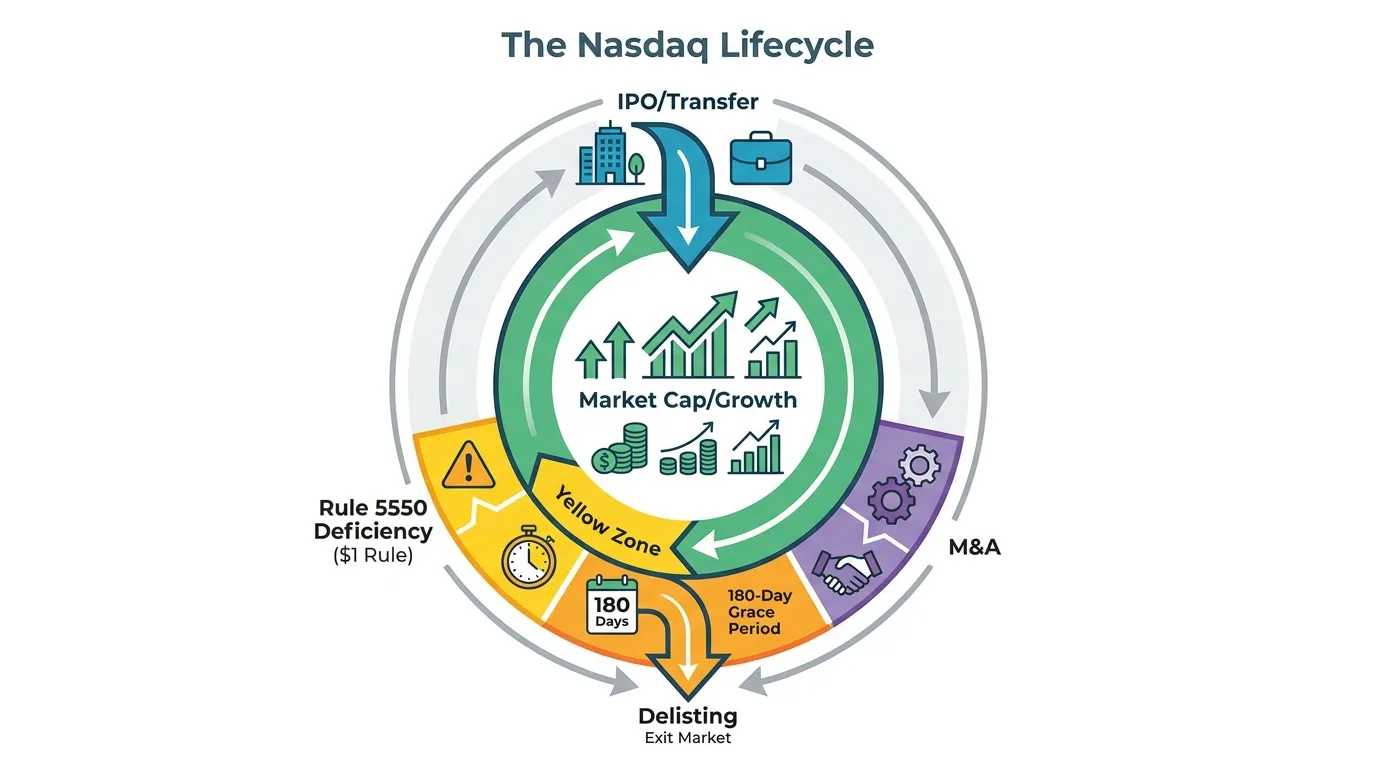 AI Generated Infographic
{
  "type": "bar",
  "title": "Nasdaq Annual Listing Trends (2022-2026 YTD)",
  "index": "Year",
  "categories": ["New IPOs", "Delistings/M&A"],
  "data": [
    {"Year": "2022", "New IPOs": 156, "Delistings/M&A": 210},
    {"Year": "2023", "New IPOs": 148, "Delistings/M&A": 185},
    {"Year": "2024", "New IPOs": 226, "Delistings/M&A": 190},
    {"Year": "2025", "New IPOs": 354, "Delistings/M&A": 215},
    {"Year": "2026 YTD", "New IPOs": 251, "Delistings/M&A": 140}
  ],
  "source": "Source: Renaissance Capital & Nasdaq Exchange Filing (Oct 2026)",
  "note": "2026 data represents figures through Q3. 'Delistings' includes involuntary exits and M&A."
}
Impact of Reconstitution on the Official Count
The stability of the Nasdaq’s "official" count is an illusion; the numbers are in a constant state of flux governed by annual reconstitution and quarterly rebalancing. While IPOs and delistings occur daily, these scheduled events are when the exchange and index providers formalize the roster.
The December Annual Reconstitution is the primary driver of volatility in the count. Every December, Nasdaq evaluates the entire universe of listed securities to ensure they meet eligibility criteria, including market cap, liquidity, and seasoning. This "house cleaning" often results in the simultaneous addition or removal of dozens of tickers, particularly in the Nasdaq-100.
| Event Type | Frequency | Primary Impact | Effect on "Stock Count" |
|---|---|---|---|
| Reconstitution | Annual (Dec) | Membership (Add/Drop) | High (Changes the total count) |
| Rebalancing | Quarterly | Weighting (Share adjustment) | Negligible (Adjusts $ values) |
| Special Rebalance | Ad-hoc | Anti-concentration | None (Only affects weighting) |
(Source: Nasdaq Global Indexes Methodology, 2026)
Key Insight: For the Nasdaq Composite, the count fluctuates daily based on corporate actions. However, for the Nasdaq-100, the membership is strictly capped, and "adds" must equal "drops" during the December window.
For investors, the "So What?" lies in passive fund flows. According to a 2026 Goldman Sachs analysis, the December reconstitution triggers over $40 billion in forced turnover as ETFs like the QQQ align their holdings with the new official count. If a stock is purged for failing to meet the minimum $50,000 daily average traded value (DATV), the exit is swift and absolute.
{
  "type": "bar",
  "title": "Nasdaq-100 Membership Churn (2024-2026)",
  "index": "Year",
  "categories": ["Additions/Removals"],
  "data": [
    {"Year": "2024", "Additions/Removals": 6},
    {"Year": "2025", "Additions/Removals": 11},
    {"Year": "2026 (Est)", "Additions/Removals": 9}
  ],
  "source": "Source: Nasdaq Index Operations (Oct 2026)",
  "note": "2026 figures based on YTD market cap eligibility shifts."
}
This mechanical turnover ensures the Nasdaq remains a "survival of the fittest" ecosystem. While the total exchange count might shrink due to M&A or heightened listing standards, the quality of the "Official Count" is maintained through these rigid, scheduled purges.
How to Verify the Number of Stocks in the Nasdaq Yourself
Static figures in financial reporting are often obsolete by the time they are published. To obtain the live, real-time count, you must bypass secondary aggregators and query the exchange directly.
Follow this three-step protocol to verify the current Nasdaq listings:
- Access the Official Screener: Navigate to the Nasdaq Stock Screener. This is the definitive database used by institutional desks to track the 3,300+ listings currently active on the exchange.
- Filter by Exchange Tiers: The Nasdaq is not a monolith; it is divided into three distinct tiers. To see the full count, you must apply the "Exchange" filter and select all three: Global Select, Global Market, and Capital Market.
- Audit the "Ticker vs. Issuer" Gap: This is where most retail investors fail. Download the CSV and filter for unique Company Names. You will find that the number of ticker symbols always exceeds the number of actual companies due to dual-class share structures (e.g., Alphabet Inc. trading as both GOOGL and GOOG).
[Missing Visual: Annotated screenshot of the Nasdaq.com Stock Screener with the 'Exchange' filter applied and the 'Download CSV' button highlighted.]
Understanding these tiers is critical because the "Total Count" fluctuates based on which tier a company qualifies for.
| Nasdaq Tier | Target Profile | Reporting Stringency |
|---|---|---|
| Global Select (NGS) | Large-cap "Blue Chip" tech | Highest (SEC + Exchange) |
| Global Market (NGM) | Mid-cap growth | Moderate |
| Capital Market (NCM) | Small-cap/Entry-level | Baseline |
(Source: Nasdaq Listing Center, Oct 2026)
So what? For the active trader, the "Live Count" is more than a statistic—it is a liquidity map. A shrinking count in the Capital Market tier often signals a tightening IPO window or a wave of delistings due to "penny stock" status (trading below $1.00 for 30 consecutive days).
Conversely, a stable Global Select count indicates that the core of the U.S. innovation economy remains fundamentally solvent. For those managing institutional-grade research, maintaining a clean dataset requires distinguishing between these listing layers to avoid overcounting market exposure. To streamline this data-heavy research and track how institutional portfolios are shifting across these tiers, professional investors often rely on Tritonix.ai for real-time workflow automation and fundamental analysis.
FAQ
What is the difference between the Nasdaq Composite and the Nasdaq-100?
The Nasdaq Composite contains approximately 3,416 companies representing almost all common stocks on the exchange. The Nasdaq-100 is more selective, tracking exactly 100 of the largest non-financial growth leaders.
Why are there more ticker symbols than companies in the Nasdaq indices?
This is due to dual-class share structures. For example, Alphabet Inc. counts as one company but occupies two ticker symbols, GOOGL and GOOG, within the index.
Which securities are excluded from the Nasdaq Composite count?
The index excludes Exchange-Traded Funds (ETFs), closed-end funds, preferred stocks, and derivatives like warrants to focus purely on operating company equity.
What is the Nasdaq $1 rule for delisting?
Nasdaq Rule 5550(a)(2) requires a minimum bid price of $1.00. If a stock stays below this for 30 consecutive business days, it receives a deficiency notice and enters a grace period.
When does the Nasdaq-100 official company count change?
While daily corporate actions can affect it, the primary formal changes occur during the Annual Reconstitution in December and through quarterly rebalancing events.