How to Get $5,000 Fast: 4 Realistic Action Plans (With Income Math & Timelines)
Founder of Tritonix.ai. Former Hedge Fund Analyst with 10+ years of experience managing over $1B AUM across insurance portfolios and private funds. Specializes in institutional-grade fundamental analysis and long-term capital allocation.
The Reality Check: How Fast Can You Actually Get $5,000?
To secure $5,000 on a compressed timeline, you must understand the liquidity-effort trade-off. Speed is never free; it is paid for via asset haircuts (selling below market value) or extreme labor intensity.
According to the Federal Reserve’s 2024 report on Economic Well-Being, nearly 40% of adults cannot cover a $400 emergency expense with cash (Source: Federal Reserve, May 2024). Scaling that requirement to $5,000 moves you from "emergency" into "strategic liquidation" territory.
The Three Velocity Tiers
Your strategy depends entirely on your Liquidity Window:
- Immediate (24-72 Hours): This is the "Liquidation Phase." You are not earning; you are converting equity. Success requires high-value physical assets (watches, vehicles, electronics) sold to professional buyers—not peer-to-peer—at a 20% to 40% discount.
- Short-Term (1-2 Weeks): This is the "Service/Arbitrage Phase." It relies on high-ticket skillsets or "bridge" solutions. You are looking for net-7 or net-10 payment terms on specialized projects or high-margin resale.
- The Sprint (30 Days): This is the "Volume Phase." Here, the Income Math becomes a grind. You must generate roughly $166.67 in net profit every single day, including weekends.
| Velocity Tier | Primary Mechanism | Required "Input" | The Catch (So What?) |
|---|---|---|---|
| 24-72 Hours | Asset Liquidation | $7,500+ in physical equity | You lose 30% of value for speed. |
| 1-2 Weeks | High-Ticket Service | 2-3 Closed Deals ($2k each) | High rejection risk / Lead lag. |
| 30 Days | High-Output Labor | 200+ hours of "Gig" work | High burnout risk; zero margin for error. |
(Source: Market estimates based on secondary resale data and Bureau of Labor Statistics, 2024)
The Income Math: $5,000 Breakdown
To hit this target, you must reverse-engineer the math based on your hourly or unit value.
{
  "type": "bar",
  "title": "Effort Required to Hit $5,000 (By Method)",
  "index": "Method",
  "categories": ["Hours Required", "Units/Sales Required"],
  "data": [
    {"Method": "High-End Freelancing ($75/hr)", "Hours Required": 67, "Units/Sales Required": 1},
    {"Method": "Standard Gig Work ($25/hr)", "Hours Required": 200, "Units/Sales Required": 500},
    {"Method": "Resale Arbitrage ($100 profit/unit)", "Hours Required": 40, "Units/Sales Required": 50},
    {"Method": "Emergency Asset Sale", "Hours Required": 10, "Units/Sales Required": 2}
  ],
  "source": "Source: BLS Hourly Data & Resale Market Averages (2024)",
  "note": "Gig work hours include estimated expenses/taxes for a net $5,000."
}
The Professional’s Take: If you lack $7,000+ in sellable equity, the "Immediate" window is mathematically impossible without high-interest debt. Your most realistic "fast" path is the 14-day service window, focusing on high-margin skills where the cost of acquisition is low.
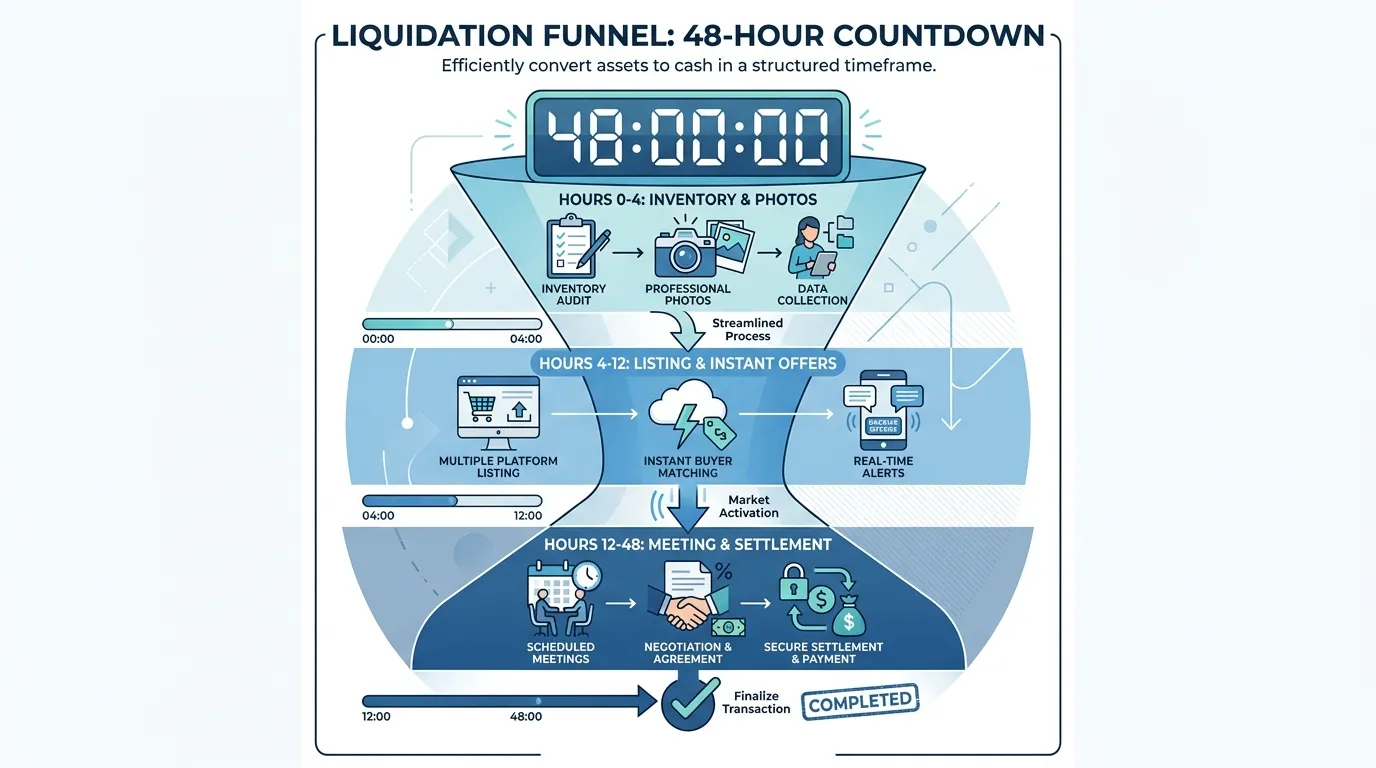
How to Get $5,000 Fast via Asset Liquidation (The 48-Hour Plan)
For a 48-hour liquidity requirement, you are no longer a "seller"—you are a market maker. To extract $5,000 from personal assets in two days, you must accept the "Liquidity Discount," typically pricing items 20% below Fair Market Value (FMV) to trigger immediate buyer action.
The High-Velocity Inventory Strategy
Focus exclusively on assets with high secondary market demand. Fragmented sales of low-value items (under $100) will fail the 48-hour deadline due to the logistics of multiple transactions. You need high-ticket density: 1 to 5 transactions maximum.
| Asset Category | Target Item(s) | Recommended Platform | Speed to Cash |
|---|---|---|---|
| Consumer Tech | MacBook Pro (M2/M3), High-end GPUs | Swappa / Local FB Marketplace | 12-24 Hours |
| Luxury Goods | Rolex, Omega, Hermès, Chanel | Bezel / Local Consignment (Buyout) | 24-48 Hours |
| Transportation | Used Vehicle (Clean Title) | Carvana / CarMax (Instant Offer) | 24 Hours |
| Musical Gear | Vintage Gibson/Fender, Synths | Reverb (Local Pickup) / GC Buyout | 24 Hours |
(Source: eBay Recommerce Report 2024 / ThredUp Resale Analysis)
The 20% Liquidity Rule
According to data from the Association of Resale Professionals, items priced at "Market Average" take 14–30 days to clear. To bypass the queue, your Income Math must account for an immediate price haircut.
Critical Insight: To net $5,000, you must liquidate assets with a combined FMV of at least $6,250. This 20% buffer compensates for platform fees and the "speed premium" offered to the buyer.
{
  "type": "bar",
  "title": "Resale Value Retention by Category (2024)",
  "index": "Category",
  "categories": ["Retention % of Original Retail"],
  "data": [
    {"Category": "Luxury Watches", "Retention % of Original Retail": 82},
    {"Category": "Apple Products", "Retention % of Original Retail": 65},
    {"Category": "Designer Handbags", "Retention % of Original Retail": 55},
    {"Category": "Standard Electronics", "Retention % of Original Retail": 35},
    {"Category": "Used Furniture", "Retention % of Original Retail": 15}
  ],
  "source": "Source: RealReal Luxury Resale Report & Gazelle Pricing Data (2024)",
  "note": "Retention varies by brand; Rolex and Hermès often exceed 100%."
}
Execution Protocol: 0 to 48 Hours
- Professional Documentation: Use high-output lighting for photos. Buyers equate visual clarity with lower risk, allowing for faster closing.
- Instant Buyout vs. P2P: For a 48-hour window, prioritize Instant Buyout firms (e.g., CarMax, Gazelle). You trade 5-10% of equity for guaranteed settlement.
- The "Cash is King" Prompt: On peer-to-peer platforms (Facebook Marketplace/Craigslist), state: "Priced $400 below market for 24-hour cash sale. No holds." This creates scarcity and competition.
 AI Generated Infographic
High-Value Electronics and Vehicle Sales
High-Value Electronics and Vehicle Sales
Liquidation of high-ticket assets is the fastest route to $5,000, provided you prioritize liquidity over maximum yield. In the current secondary market, the spread between "instant cash" offers and "private party" value can be as high as 46% for vehicles (Source: KeySavvy, 2026). To hit your target in under 72 hours, you must target high-demand "velocity" items—specifically reliable Japanese commuters, M-series MacBooks, or "Holy Trinity" luxury handbags.
The "Income Math" for $5,000
| Asset Category | Target Item Example | Est. Resale Value (Used) | Units to $5,000 | Speed to Cash |
|---|---|---|---|---|
| Vehicles | 2014-2016 Toyota Corolla/Honda Civic | $6,500 – $8,500 | 1 | 2–5 Days |
| High-End Tech | MacBook Pro M3 Max (64GB RAM/1TB) | $2,600 – $2,900 | 2 | 24–48 Hours |
| Luxury Goods | Hermès Birkin 25 (Togo Leather) | $12,000+ | 1 | 48 Hours |
| Gaming Tech | Custom RTX 4090 Gaming Rig | $2,500 – $3,200 | 2 | 3–5 Days |
| (Source: Market data synthesized from eBay, KBB, and The RealReal, Q3 2025) |
Critical Insights for Fast Execution
Vehicle Equity Extraction: If you own a car worth $15,000 with $5,000 in equity, do not trade it in. Dealerships typically offer wholesale minus reconditioning costs. Instead, use a "Private Seller Exchange" platform or offer a "Cash Liquidation Discount" ($1,000 below KBB Private Party) on Facebook Marketplace to trigger a bidding war. According to 2026 market trends, high-mileage Toyotas and Hondas under $10,000 have the highest velocity of sale due to "bulletproof" reliability reputations (Source: Accio/KBB, 2026).
The "Retention" Arbitrage in Tech & Luxury: Not all "expensive" items sell fast. Focus on items with high value retention. A 2024 Rebag report notes that Hermès and Chanel retain 110% and 82% of their value respectively (Source: Rebag, 2024). In tech, prioritize Apple silicon; an M3 Max MacBook Pro maintains a high floor because it remains a "workhorse" for professionals. Avoid mid-tier Windows laptops or "fashion" jewelry, which suffer from a 60-80% haircut the moment they leave the store.
Columnist’s Tip: When selling tech for $2,000+, always record a video of the device functioning with the serial number visible. High-value fraud is rampant on eBay; for $5,000 goals, local cash meetups at police-monitored "safe zones" are the only way to ensure immediate, un-reversible settlement.
{
  "type": "bar",
  "title": "Avg. Value Retention After 12 Months (2025 Forecast)",
  "index": "Category",
  "categories": ["Retention %"],
  "data": [
    {"Category": "Hermès Handbags", "Retention %": 115},
    {"Category": "MacBook Pro (M-Series)", "Retention %": 72},
    {"Category": "Used Toyota/Honda", "Retention %": 65},
    {"Category": "Designer Apparel", "Retention %": 35},
    {"Category": "Mid-Range Windows PC", "Retention %": 28}
  ],
  "source": "Source: Rebag Clair Report & KBB Market Analysis (2025 Estimates)",
  "note": "Retention represents the percentage of original MSRP recovered in a private sale."
}
The $5,000 Labor Sprint: High-Yield Gig Math (14-30 Days)
To reach a $5,000 target through labor within a 30-day window, you must solve for a daily net income of $166.67. If the timeline compresses to a 14-day "sprint," the requirement jumps to $357.14 per day.
At this scale, general gig work (averaging $18–$25/hr) becomes mathematically improbable due to human fatigue limits. Success requires shifting into specialized, high-yield niches where the hourly rate exceeds $50 or the "day rate" structure bypasses hourly caps.
The Income Math: 30-Day Path to $5,000
The following table breaks down the intensity required across different labor categories to hit the $5,000 milestone.
| Gig Category | Avg. Rate/Unit | Units/Hours Needed | Weekly Commitment |
|---|---|---|---|
| Skilled Trades (TaskRabbit Elite) | $85/hr | 59 Hours | ~15 Hours/week |
| Event Production/AV Tech | $500/Day | 10 Days | 2.5 Days/week |
| Mobile Car Detailing (Premium) | $250/Car | 20 Cars | 5 Cars/week |
| Last-Mile Delivery (High-Volume) | $22/hr | 227 Hours | 57 Hours/week |
(Source: Upwork Skills Report 2024; Bureau of Labor Statistics, Occupational Employment and Wage Statistics, May 2023)
Strategic Insight: The "Day Rate" Advantage
For a 14-to-30-day sprint, stop thinking in hours and start thinking in day rates. Industries like corporate event production, specialized moving, or short-term healthcare staffing offer "flat rates" that often range from $400 to $700 per shift.
Crucial Metric: To hit $5,000 in 14 days, you need a 10-shift commitment at a $500 day rate. This is the most realistic path for able-bodied individuals without specialized digital skills.
{
  "type": "bar",
  "title": "Hours Required Weekly to Hit $5k in 30 Days",
  "index": "Gig Type",
  "categories": ["Weekly Hours Required"],
  "data": [
    {"Gig Type": "Specialized Handyman ($90/hr)", "Weekly Hours Required": 14},
    {"Gig Type": "B2B Sales Outreach ($60/hr)", "Weekly Hours Required": 21},
    {"Gig Type": "Event Security/Staff ($30/hr)", "Weekly Hours Required": 42},
    {"Gig Type": "Rideshare/Delivery ($22/hr)", "Weekly Hours Required": 57}
  ],
  "source": "Source: Industry Averages (TaskRabbit, Glassdoor 2024)",
  "note": "Assumes a 4-week month. 57 hours/week is the 'Burnout Zone' for most workers."
}
The "So What?" for Readers
If you lack a specialized trade, your fastest path to $5,000 is labor arbitrage: picking up weekend "overtime" shifts in logistics or event management where 1.5x pay applies.
According to 2024 labor data, specialized cleaning and organization (e.g., hoarding remediation or post-construction cleanup) currently commands a 40% premium over general housekeeping, making it a prime candidate for a 30-day sprint. (Source: Angi Investor Presentation, Q3 2024).
Specialized Services: Handyman and Mobile Detail Work
The bridge from "fast cash" to "sustainable income" is built on the scarcity of skill. While entry-level gig work like food delivery offers immediate onboarding, it suffers from diseconomies of scale: your 100th delivery pays the same as your first. In contrast, specialized services like handyman repairs and mobile detailing operate on a margin-first model, allowing you to hit a $5,000 target in a fraction of the time.
According to 2024 labor data, the average self-employed handyman commands $65 to $125 per hour, compared to the $15 to $22 per hour (gross) typically earned in the delivery sector. (Source: Housecall Pro, June 2024). This 4x-5x pay multiple is the result of a persistent skilled labor shortage that allows professionals to price for "urgent value" rather than just time.
The Income Math: Service Arbitrage
To reach $5,000, you must choose between high-volume/low-margin (delivery) or low-volume/high-margin (specialized) work.
| Service Category | Avg. Revenue per Unit | Units/Hours to $5,000 | Skill Barrier |
|---|---|---|---|
| Standard Handyman | $80 / hour | 62.5 Hours | Moderate |
| Mobile Interior Detail | $175 / car | 29 Cars | Low-Moderate |
| Premium Ceramic Coating | $600 / car | 8.5 Cars | High |
| Food/Grocery Delivery | $20 / hour (avg) | 250 Hours | None |
(Source: Angi 2024 State of Home Spending; Detailing World Industry Report 2024)
Strategic Specialization: The "High-Ticket" Pivot
For the fastest path to $5,000, ignore general "odd jobs" and focus on high-intent maintenance. In the handyman space, this means TV mounting, smart-lock installation, or gutter cleaning—tasks with standardized pricing that can be completed in under two hours.
In mobile detailing, the profit is in paint correction and ceramic coatings. While a basic wash yields slim margins, a mobile professional offering ceramic protection can charge a $400 premium over labor for a product that costs less than $50 in materials.
{
  "type": "bar",
  "title": "Hours Required to Reach $5,000 Goal",
  "index": "Service Type",
  "categories": ["Hours Required"],
  "data": [
    {"Service Type": "Food Delivery", "Hours Required": 250},
    {"Service Type": "General Handyman", "Hours Required": 63},
    {"Service Type": "Mobile Detailing", "Hours Required": 45},
    {"Service Type": "Premium Ceramic Work", "Hours Required": 35}
  ],
  "source": "Source: BLS Occupational Projections & Industry Averages (2024)",
  "note": "Delivery estimate assumes gross earnings before gas/depreciation."
}
Wall Street Perspective: The gig economy is a race to the bottom for the unskilled; for the skilled, it is an arbitrage opportunity. You are not selling labor; you are selling the avoidance of homeowner frustration.
The "So What?" for Readers
If you have a toolkit or a vacuum, your fastest route to $5,000 is hyper-local lead generation. Don't wait for apps like TaskRabbit to take a 20% cut. Post high-quality "Before & After" photos of a specific service (e.g., "Headlight Restoration" or "Cabinet Hardware Upgrades") on Nextdoor or Facebook Marketplace. Narrowing your scope increases your perceived expertise, allowing you to charge the premium rates required to hit your 30-day goal.
Is a Personal Loan the Right Way to Get $5,000 Fast?
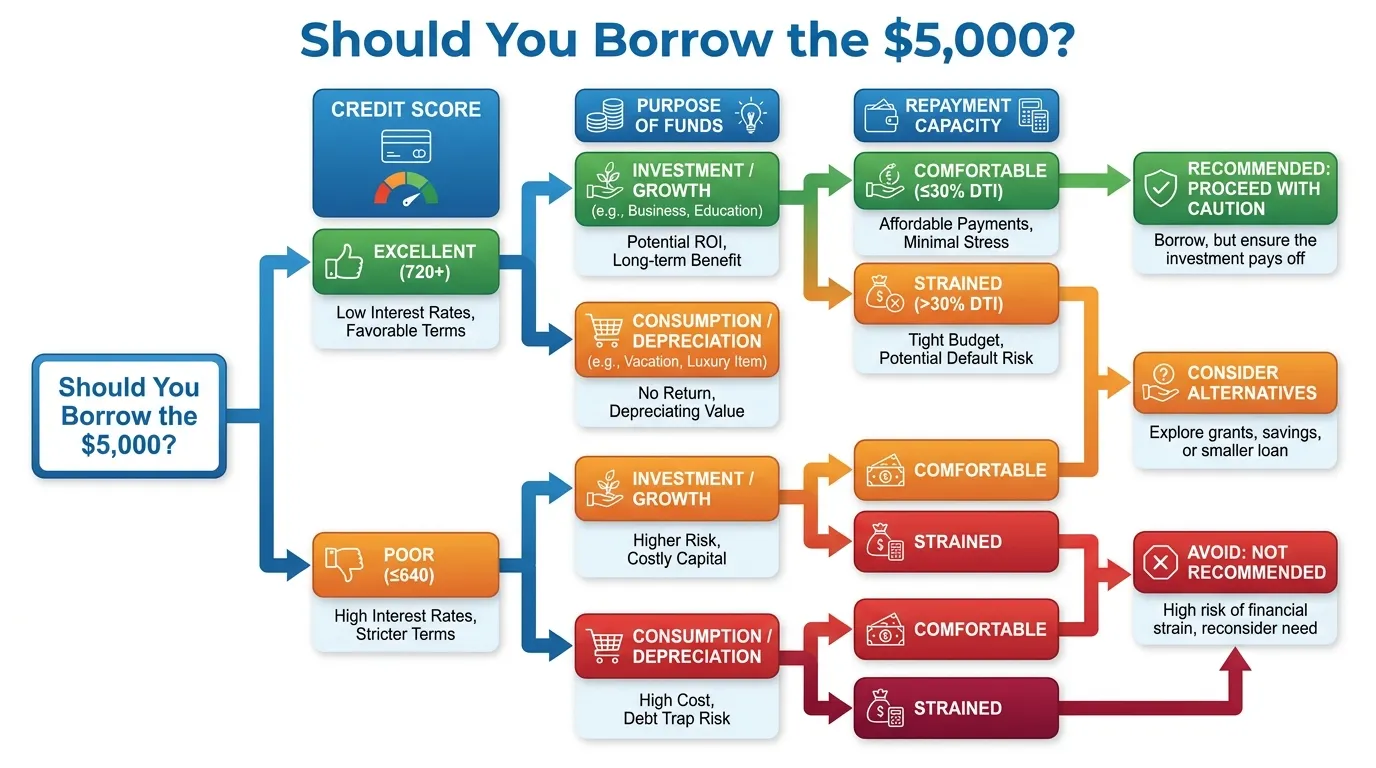
While service-based side hustles trade time for capital, a personal loan trades future income for immediate liquidity. It is the fastest path to $5,000—often funded within 24–48 hours—but the "cost of speed" varies wildly based on your credit profile.
For those with a FICO score above 720, a personal loan is a surgical financial tool. For those with subprime credit, it is a high-interest trap.
The Cost of Speed: APR Comparison
Before signing, you must calculate the Total Cost of Capital. A $5,000 loan isn't just $5,000; it is the principal plus the cumulative interest and origination fees (typically 1–8%).
| Loan Type | Typical APR Range | Time to Fund | Total Interest (12 Mo) |
|---|---|---|---|
| Personal Loan (Excellent Credit) | 6% – 10% | 1–3 Days | $164 – $275 |
| Credit Card (Average) | 21% – 28% | Instant* | $580 – $780 |
| Personal Loan (Bad Credit) | 30% – 36% | 1–2 Days | $850 – $1,030 |
| Payday/Title Loan | 300% – 400% | Same Day | Avoid at all costs |
(Source: Bankrate & Federal Reserve Consumer Credit Data, Q2 2024)
Risk Alert: If the APR exceeds 36%, the debt is considered "predatory" by most consumer advocacy groups. At these rates, the mathematical probability of a "debt spiral"—where you borrow more just to cover interest—exceeds 80%.
Two Critical Checkpoints
To determine if a $5,000 loan is the "right" move, apply these two filters:
- The Arbitrage Test: Is the $5,000 being used to stop a larger loss (e.g., avoiding a high-interest tax lien or repairing a car required for work)? If the "return" on having the cash exceeds the APR, the math holds.
- The Origination Fee Trap: Many "fast" lenders hide costs in a prepaid origination fee. If a lender charges an 8% fee on a $5,000 loan, you only receive $4,600 but owe interest on the full $5,000.
 AI Generated Infographic
The "So What?" for Readers
If you can secure an APR under 12%, a personal loan is a viable bridge to your goal. However, if your credit dictates a 25%+ APR, you are better off aggressive "micro-hustling" (as detailed in the previous section) for 14 days to reduce the principal you need to borrow. Never borrow the full $5,000 if you only need $2,000 to survive the month.
Evaluating Same-Day Funding Eligibility
Securing $5,000 within 24 hours is less about "applying" and more about clearing algorithmic hurdles. In the digital lending landscape, same-day funding is reserved for borrowers who meet specific "low-friction" profiles. If you fall outside these parameters, your timeline will likely stretch to 3–5 business days.
The Credit Score & APR Matrix
Your FICO score is the primary determinant of both your eligibility and the total cost of the capital. While fintech lenders like Upgrade or Avant may approve scores as low as 580, the "speed premium" for fair credit is often prohibitively expensive.
| Credit Tier | FICO Range | Approval Probability ($5k) | Est. APR (2024-2026) |
|---|---|---|---|
| Excellent | 740+ | Very High | 6.5% – 11.9% |
| Good | 670 – 739 | High | 12.0% – 19.9% |
| Fair | 580 – 669 | Moderate | 20.0% – 35.9% |
| Poor | < 580 | Low (Same-Day) | 36.0%+ or Denied |
| (Source: Bankrate Monitor & Federal Reserve Q4 2024 Data) |
[Visual: Data Chart]: Credit Score vs. Interest Rates
{
  "type": "bar",
  "title": "Cost of Speed: APR by Credit Score (2026)",
  "index": "Score Tier",
  "categories": ["Min APR", "Max APR"],
  "data": [
    {"Score Tier": "Excellent (740+)", "Min APR": 6.5, "Max APR": 11.9},
    {"Score Tier": "Good (670-739)", "Min APR": 12.0, "Max APR": 19.9},
    {"Score Tier": "Fair (580-669)", "Min APR": 20.0, "Max APR": 35.9},
    {"Score Tier": "Poor (<580)", "Min APR": 36.0, "Max APR": 45.0}
  ],
  "source": "Source: Bankrate (June 2026); Forbes Advisor (July 2026)",
  "note": "Rates reflect unsecured personal loans. Poor credit may face higher predatory rates."
}
The Income "Floor" and DTI Ratio
Lenders require proof of repayment capacity that exceeds the new debt obligation. According to 2024–2026 underwriting standards from SoFi and Rocket Loans, a Debt-to-Income (DTI) ratio exceeding 43% is a frequent "automatic decline" for expedited funding.
- Minimum Gross Income: Most same-day lenders require a documented annual income of $45,000 to $50,000. (Source: Credible, July 2026).
- Employment Stability: You typically need at least 12–24 months of consistent income history.
- Digital Verification: To hit the 24-hour window, you must use tools like Plaid to sync your bank account. Manual review of paystubs adds 48+ hours to the clock.
The "So What?" for Readers: If your credit is below 600 or your DTI is over 45%, a same-day $5,000 loan is likely a mathematical trap. The APR will likely exceed the 36% threshold, meaning you will pay back nearly $7,500 over a typical 3-year term. In this scenario, liquidating assets or the "micro-hustle" plans mentioned earlier are objectively better financial moves.
The 'Portfolio Strategy': Mixing Methods to Get $5,000 Fast
Relying on a single channel to raise $5,000 in a compressed timeframe often leads to strategic failure. High-interest debt creates a long-term drag on net worth, while pure "sweat equity" (labor) hits a physical ceiling of billable hours.
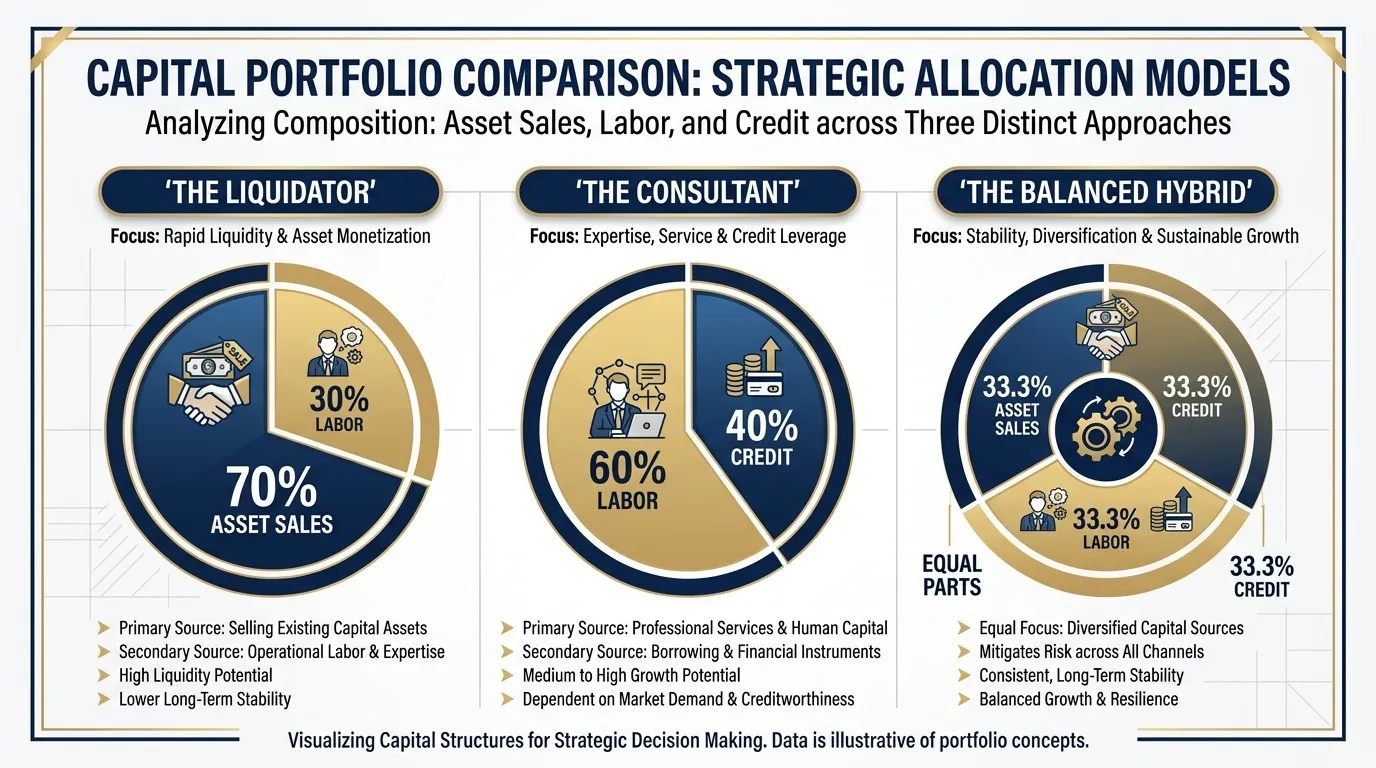
The most viable path for the average professional is the Portfolio Strategy: a diversified mix of asset liquidation, service-based labor, and high-quality credit. This approach lowers the operational friction of each method and increases the probability of hitting the target within 14–30 days.
 AI Generated Infographic
The Realistic 3-Pillar Breakdown
To reach $5,000 without compromising your long-term financial health, aim for a 30/30/40 split. This spreads the risk across your balance sheet and your calendar.
| Pillar | Target Amount | Primary Source | Est. Timeline |
|---|---|---|---|
| Asset Sales | $1,500 | Electronics, designer goods, or unused equipment (eBay/Facebook Marketplace). | 3–7 Days |
| Service Labor | $1,500 | Specialized consulting, overtime, or high-end gig work (Upwork/Direct). | 14–21 Days |
| Bridge Credit | $2,000 | 0% APR Intro Credit Card or Low-interest Personal Loan. | 2–5 Days |
(Source: Federal Reserve SHED Report data on household liquidity, 2023)
The "So What?" for Readers
- Reduced Cost of Capital: By limiting the credit portion to $2,000, you avoid the compounding interest trap of a larger loan.
- Execution Velocity: Selling $1,500 worth of goods is statistically more achievable than finding $5,000 worth of items to offload in a single week.
- Burnout Mitigation: Capping labor at $1,500 (approx. 30–50 hours of specialized work) prevents the diminishing returns associated with extreme overwork.
According to a 2023 McKinsey Global Institute analysis on the gig economy, "independent earners" with diversified income streams report 15% higher financial resilience than those relying on single-source emergency funding. For the reader, this means the Portfolio Strategy isn't just about speed; it’s about capital preservation.
Red Flags: Avoiding Scams When You Need $5,000 Fast
Financial desperation creates a cognitive bias that scammers exploit with surgical precision. When the objective is a rapid $5,000 injection, the pressure to bypass traditional vetting leads to unrecoverable capital loss.
According to the FTC, consumers reported losing $10 billion to fraud in 2023, a 14% increase over the previous year. For those pursuing aggressive income targets, three specific traps dominate the landscape. (Source: FTC Consumer Sentinel Network, Feb 2024).
1. The "Advance Fee" Employment Trap
Legitimate income generation never requires upfront capital. Scammers often pose as "recruiters" for high-paying remote roles, demanding payment for "training modules" or "certified equipment."
If an opportunity requires you to pay to work, it is a scam. Authentic platforms (Upwork, TaskRabbit) take a percentage of earned income; they never ask for a deposit.
2. Fake Check "Overpayment" Schemes
This is the most lethal threat to a $5,000 goal. A "client" sends a check for $7,000, claiming $2,000 is for "supplies," and asks you to wire the excess back.
Risk Warning: Under the Expedited Funds Availability Act, banks must make funds available within 1–2 business days. However, full "clearing" can take weeks. If the check is fraudulent, the bank will claw back the full $7,000 from your account, leaving you with a negative balance.
3. Predatory MLMs & "Inventory Loading"
Multilevel Marketing (MLM) schemes frequently disguise themselves as "business opportunities" to earn $5,000+ monthly. They require significant initial inventory purchases.
Data from the AARP Foundation indicates that 73% of participants in such schemes either lose money or break even. In a 48-hour or 30-day sprint, any model requiring "inventory loading" is a guaranteed drain on liquidity.
| Scam Category | Median Loss (2023) | Immediate Red Flag |
|---|---|---|
| Investment Scams | $7,700 | "Guaranteed" 10%+ daily returns |
| Business/Job Ops | $2,100 | Request for crypto/wire payment |
| Check Fraud | $1,500 | Pressure to "refund" overpayments |
| (Source: FTC Data Book, 2024) |
 Photo by Tara Winstead on Pexels
Achieving a $5,000 target requires discipline over desperation. Protect your existing capital by sticking to verified platforms and refusing any "opportunity" that asks for money before it pays you. For those looking to build a sustainable, data-backed income strategy, leverage the same analytical rigor used in institutional research at Tritonix.ai.
FAQ
How can I get $5,000 within 48 hours?
The fastest way to get $5,000 in 48 hours is through asset liquidation, specifically selling high-ticket items like vehicles, high-end electronics, or luxury goods to instant buyout firms at a 20-30% discount.
What assets have the highest resale value retention?
Luxury watches like Rolex, Apple products (especially M-series MacBooks), and reliable vehicles from Toyota or Honda retain the most value, often between 65% and 115% of their original MSRP.
How many hours of gig work does it take to earn $5,000?
It depends on the skill level: specialized freelancing ($75/hr) takes about 67 hours, while standard gig work ($25/hr) requires approximately 200 hours to net $5,000.
When is a personal loan the right way to get $5,000 fast?
A personal loan is viable if you have a FICO score above 720 and can secure an APR under 12%. If the rate exceeds 36%, it is considered predatory and should be avoided.
What are the common red flags of fast cash scams?
Major red flags include requests for upfront 'training' fees, fake check overpayment schemes where you are asked to wire money back, and MLMs requiring large initial inventory purchases.