General Motors Stock at $86: The North America Cash Engine and 2026 Outlook
Founder of Tritonix.ai. Former Hedge Fund Analyst with 10+ years of experience managing over $1B AUM across insurance portfolios and private funds. Specializes in institutional-grade fundamental analysis and long-term capital allocation.
What the latest general motors stock quote is actually pricing
General Motors stock closed at $86.00 on Friday, November 13, 2026, down $0.25, or 0.29%, from Thursday's $86.25. The session was quiet. Volume was only 3.38 million shares against a 20-day average of 8.66 million, and the day's range ran from $85.91 to $87.54.
U.S. cash markets were closed Saturday, November 14, and Sunday, November 15. As of this writing, before the Monday, November 16 open in New York, that Friday print is the latest official close. It is also the last weekend before a mechanical change in the tape: on October 27, GM said its common stock is expected to remain listed on the New York Stock Exchange through the close on Monday, November 16, and to begin trading on the Nasdaq Global Select Market on Tuesday, November 17, still under the ticker GM. Existing holders do not need to take any action.
| Metric | November 13, 2026 |
|---|---|
| Official close | $86.00 |
| Day change | −$0.25 (−0.29%) |
| Open / high / low | $86.50 / $87.54 / $85.91 |
| Volume / 20-day average | 3.38 million / 8.66 million |
| Market capitalization | $72.55 billion |
| Shares outstanding | 843.55 million |
| 52-week range | $67.06 – $93.70 |
| 50-day / 200-day averages | $83.54 / $80.91 |
| Trailing P/E / forward P/E | 20.35 / 6.26 |
| Annualized dividend (yield) | $0.72 (0.84%) |
| Trailing free cash flow (yield) | $14.40 billion (19.84%) |
Source: StockAnalysis GM quote and statistics, as of the November 13, 2026 official close. Statistics were last updated November 16, 2026.
The stock is not extended. It finished 2.95% above its 50-day average and 6.29% above its 200-day average, with a 14-day RSI of 51.66. It sits 8.22% below the 52-week high of $93.70 and 28.24% above the 52-week low of $67.06. StockAnalysis calculates a 52-week price change of +19.71%. After-hours trading printed $85.72, down another $0.28, but those prints are not the official close.
Investors who want to mark the $86 close against those moving averages, or to compare Friday's light volume with the heavier October sessions, can do that work with Tritonix AI technical analysis.
Yahoo Finance total-return figures through November 13 show general motors stock up 6.45% year to date, trailing the S&P 500's 10.46%, but ahead over 12 months at 20.66% versus 12.23% for the index. The three-year total return of 229.47% still dwarfs the S&P 500's 71.41%.
The $86 quote is not a momentum peak. It is a mid-range price on a stock whose 2026 story is about cash generation, a shrinking share count, and a full-size truck changeover — not about a breakout.
North America is still the profit engine
The November 13 close is easier to interpret once the third-quarter map is on the table. On October 20, GM reported revenue of $50.02 billion, up 2.9% from $48.59 billion a year earlier, and EBIT-adjusted of $4.11 billion, up 21.6%, for a margin of 8.2%. Net income attributable to stockholders was $3.34 billion, or $3.73 on a diluted GAAP basis. Adjusted diluted EPS was $3.70, up 32.2% from $2.80.
Almost all of that profit still comes from one region. GM North America delivered EBIT-adjusted of $3.59 billion, up 43.4% from $2.51 billion, and a margin of 8.7%, up 2.5 percentage points from 6.2%. That North America result was 87.5% of company EBIT-adjusted. On the earnings call, CFO Paul Jacobson said the improvement was driven by a richer mix of full-size pickups, lower warranty expense, and smaller EV losses after the company rightsized capacity, partly offset by higher commodity and onshoring costs.
Jacobson also said the company has worked through much of the tariff pressure that hit a year earlier and is "solidly back within" its 8%–10% North America margin target. ICE volumes rose 8% year over year, while EV volumes declined as GM lapped the expiration of the U.S. consumer purchase incentive in the third quarter of 2025 and aligned EV production with demand.
That concentration is a strength and a risk. The next several quarters are a truck-changeover year. Jacobson said GM had already completed four down weeks at Silao Assembly before starting production of the new truck, and that Fort Wayne is scheduled for four down weeks beginning in mid-December, with production restarting in January. The sell-down of the outgoing truck was described as on track, with incentives as a percentage of MSRP several hundred basis points lower than in prior changeovers. Inventory is expected to finish the year in the 50–60 day target range.
Chair and CEO Mary Barra, in her October 20 letter to shareholders, said the portfolio will strengthen as GM completes the launches of the all-new 2027 Chevrolet Silverado and GMC Sierra light-duty pickups, then follows them with next-generation heavy-duty pickups, next-generation full-size SUVs, and new Cadillac sedans and crossovers.
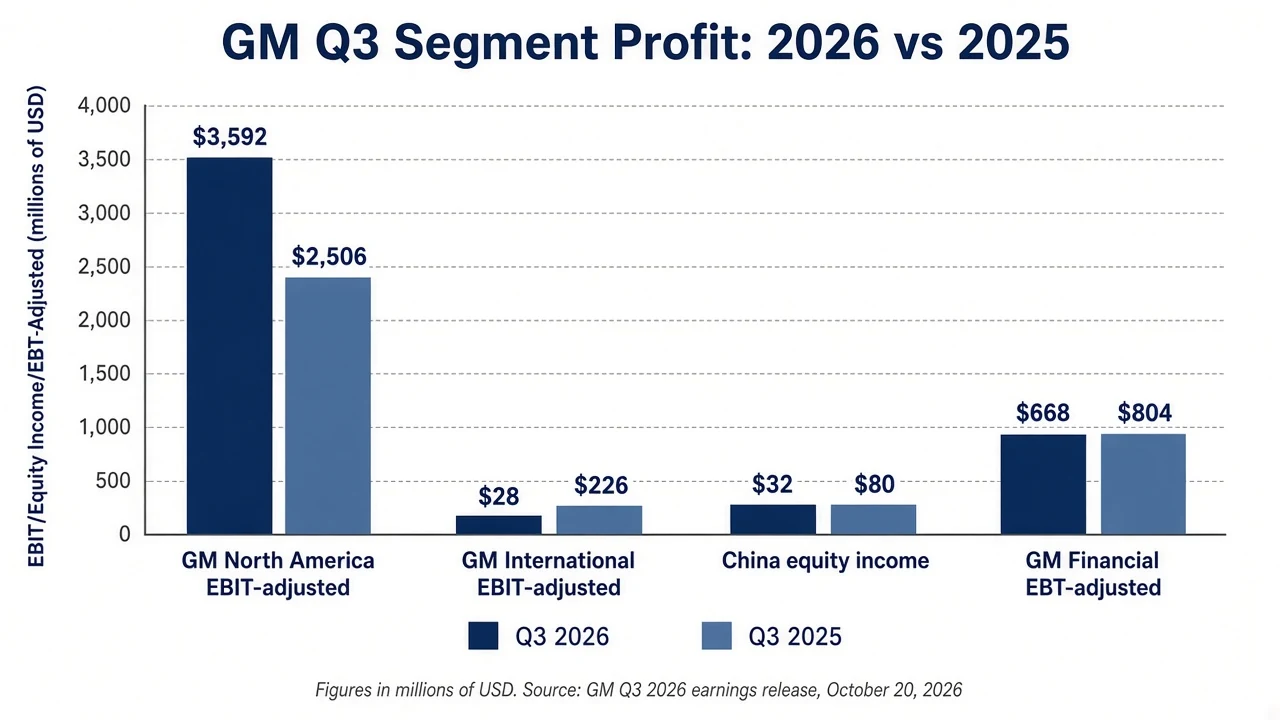
GM's third-quarter profit map, 2026 versus 2025. Source: GM earnings release, October 20, 2026.
The EV reset, China, and the finance company
The rest of the map is smaller, and more mixed.
GM International EBIT-adjusted was only $28 million, down 87.7% from $226 million. Excluding China equity income, the international operations were break-even, down about $200 million year over year. Jacobson pointed to a $100 million mark-to-market charge on an investment in Momenta, plus higher manufacturing and logistics costs, partly offset by higher volume in South America and foreign exchange.
China equity income was $32 million, down 60.3% from $80 million, but it was the eighth consecutive profitable quarter, a streak management said it expects to continue in the fourth quarter. New energy vehicles accounted for more than 60% of GM China's third-quarter sales.
GM Financial, the captive lender, produced EBT-adjusted of $668 million, down 16.9% from $804 million. Combined GM Financial revenue in the quarter was $4.31 billion, slightly below $4.34 billion a year earlier.
The EV story has shifted from capacity build-out to capacity discipline. Jacobson said GM has "substantially completed the material cash charges" expected as it aligns EV capacity with changes in regulatory policy. The company incurred an additional $0.2 billion of cash charges in the third quarter, bringing the total since the end of the first half of 2025 to $7.4 billion. Of that, $4.6 billion had been paid, including $4.2 billion in 2026 year to date, with roughly another $1 billion expected in the fourth quarter and the rest in 2027. Free cash flow available for shareholders next year should benefit from a sharp year-over-year drop in those supplier settlement payments.
Full-year guidance still assumes EV losses improve by $1 billion to $1.5 billion. Software is the quieter offset. Barra said GM is on track to approach $7.5 billion in margin-accretive deferred revenue from software and services for the full year, and that Super Cruise penetration in the truck portfolio is expected to grow 4–5 times in 2027 as the system becomes standard on high-end Silverado and Sierra trims and optional on most others.
The non-North America pieces of general motors stock are no longer a crisis, but they are not a second engine either. The 2026 earnings power is still a U.S. truck-and-SUV story, with an EV cash bleed that is shrinking on a schedule.
Cash flow, a $20 billion authorization, and a shrinking share count
The cash statement is the cleaner way to look at general motors stock than the trailing earnings multiple.
Adjusted automotive free cash flow was $5.88 billion in the third quarter, up 40.0% from $4.20 billion. Automotive operating cash flow was $8.05 billion, up 32.6%. GM raised and narrowed its full-year 2026 guidance on the same morning:
| 2026 guidance | Updated (Oct. 20) | Previous |
|---|---|---|
| EBIT-adjusted | $14.5B – $15.5B | $14.0B – $16.0B |
| Adjusted automotive free cash flow | $11.5B – $12.5B | $9.5B – $11.5B |
| EPS-diluted-adjusted | $12.75 – $13.75 | $12.00 – $14.00 |
| Net income attributable to stockholders | $8.9B – $9.5B | $8.4B – $9.8B |
| Automotive operating cash flow | $17.3B – $20.3B | $15.4B – $19.4B |
| Capital expenditures | $10.0B – $12.0B | $10.0B – $12.0B |
Source: GM Q3 2026 earnings release, October 20, 2026. Net income and operating-cash-flow prior ranges are from the same release's guidance reconciliations.
The free-cash-flow midpoint of $12.0 billion is $1.5 billion above the prior midpoint. GAAP diluted EPS guidance is $9.72 to $10.72. At $86.00, the forward multiple on the high end of the adjusted EPS guide is 6.25 times, in line with the 6.26 forward P/E on StockAnalysis.
The company also said it had completed the $6.0 billion repurchase program announced in January 2026 and that the board had approved a new $20.0 billion multi-year authorization with no expiration date. Jacobson said the company bought back $2.5 billion of stock in the third quarter, reducing the diluted share count by about 27 million shares to around 866 million, and had already bought another $1 billion in October, bringing year-to-date buybacks to $6.3 billion. The new authorization is more than 25% of the $72.55 billion market capitalization at Friday's close; at $86.00, $20 billion is about 27.6% of equity value. It can be suspended or discontinued at any time.
The share count has already done a lot of work. GM had 1.2 billion shares outstanding at the end of 2023, 995 million at the end of 2024, 904 million at the end of 2025, and 849 million on September 30, 2026. StockAnalysis now shows 843.55 million shares outstanding, down 8.44% year over year. Institutions own 92.84% of the stock.
{
  "type": "bar",
  "title": "General Motors Shares Outstanding, 2023–2026",
  "index": "Period",
  "categories": ["Shares (millions)"],
  "data": [
    {"Period": "Year-end 2023", "Shares (millions)": 1200},
    {"Period": "Year-end 2024", "Shares (millions)": 995},
    {"Period": "Year-end 2025", "Shares (millions)": 904},
    {"Period": "Sep 30, 2026", "Shares (millions)": 849},
    {"Period": "Mid-Nov 2026", "Shares (millions)": 843.55}
  ],
  "source": "Source: GM Q3 2026 earnings release for 2023–September 30, 2026; StockAnalysis share count as of November 16, 2026",
  "note": "Year-end 2023 was reported by GM as 1.2 billion shares. Later figures are as reported, in millions."
}
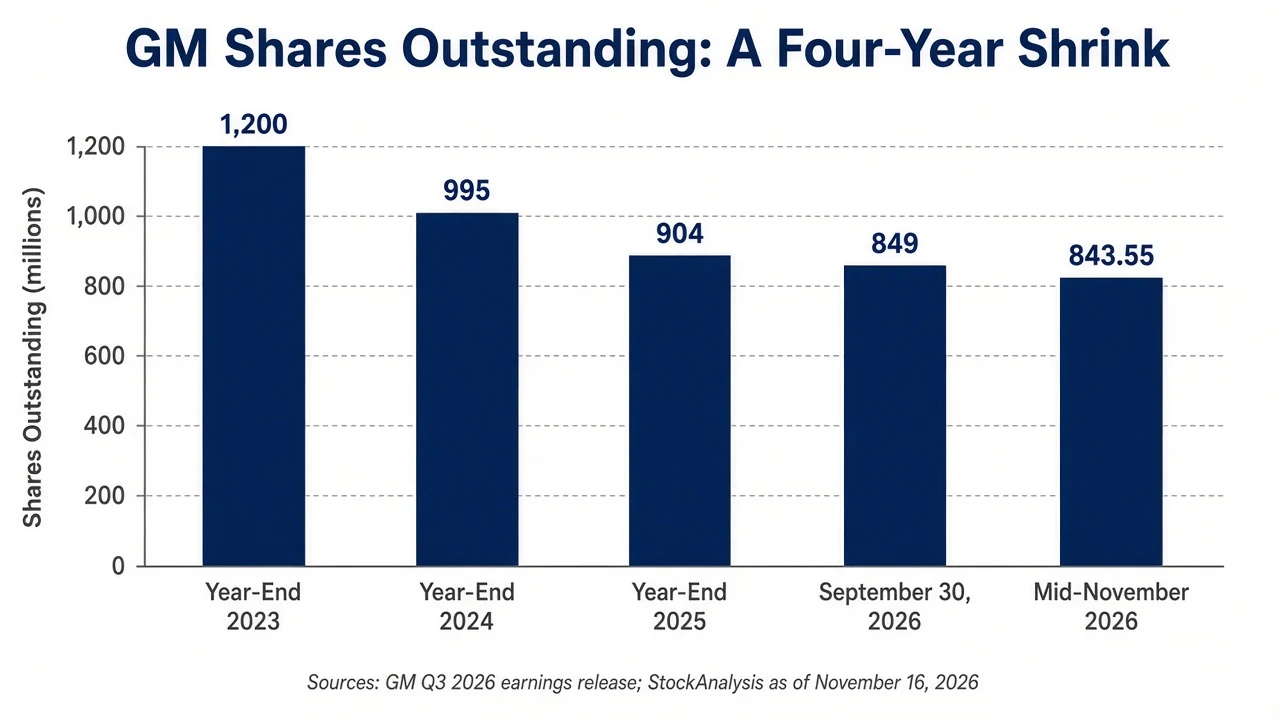
General Motors has cut its share count by roughly 30% since the end of 2023. Sources: GM Q3 2026 earnings release; StockAnalysis.
The dividend is the smaller of the two capital-return tools. The board declared a quarterly cash dividend of $0.18 per share, or $0.72 annualized, payable December 17, 2026, to holders of record on December 4. At $86.00, the yield is 0.84%. StockAnalysis puts the payout ratio at 17.04% of trailing earnings and only 4.22% of free cash flow. Shareholder yield, including the 8.44% buyback yield, is 9.28%.
On the September 30 balance sheet, cash and marketable debt securities were $27.81 billion, matching StockAnalysis's cash figure. Automotive debt was modest: $529 million short-term and $15.27 billion long-term. The much larger $130.71 billion of total debt, and the $175.45 billion enterprise value, are dominated by GM Financial's funding. That is why a simple net-debt or Altman Z-Score screen — StockAnalysis shows a Z-Score of 1.28 — is a poor way to underwrite an automaker with a captive finance arm.
How general motors stock compares with Ford and Stellantis
At the same official close, Ford Motor finished at $11.91, up $0.01, with a market capitalization of $47.56 billion. Stellantis finished at $3.82, down $0.04, or 1.04%, with a market capitalization of $11.28 billion, and it closed at its 52-week low. General Motors, at $72.55 billion, is now larger than Ford and Stellantis combined.
| Metric (Nov. 13 close) | General Motors | Ford | Stellantis |
|---|---|---|---|
| Official close | $86.00 | $11.91 | $3.82 |
| Day change | −0.29% | +0.08% | −1.04% |
| Market capitalization | $72.55B | $47.56B | $11.28B |
| Trailing P/E | 20.35 | n/a (loss) | n/a (loss) |
| Forward P/E | 6.26 | 6.70 | 4.26 |
| Dividend yield | 0.84% | 5.04% | n/a |
| 52-week range | $67.06 – $93.70 | $11.11 – $17.78 | $3.82 – $12.22 |
| Analyst consensus (target) | Buy ($101.17) | Buy ($15.02) | Hold ($6.39) |
Source: StockAnalysis quotes for GM, Ford, and Stellantis at the November 13, 2026 official close. Stellantis income-statement figures on that page are reported in euros; the market-cap and price figures above are in U.S. dollars.
GM's trailing P/E of 20.35 on EPS of $4.23 still looks expensive against a year that included heavy special items. The forward P/E of 6.26 lines up with the high end of the $12.75 to $13.75 adjusted EPS guide. On StockAnalysis's trailing free cash flow of $14.40 billion, the FCF yield is 19.84% and the price-to-FCF ratio is 5.04. The PEG ratio is 0.38. Book value is $73.98 a share, so the stock trades at 1.16 times book. Those figures do not prove the 2026 earnings power will last through a truck changeover, but they show the market is still unwilling to pay a mid-cycle multiple for it.
StockAnalysis's consensus from 24 analysts is a Buy, with an average 12-month target of $101.17, or 17.64% above the $86.00 close. A November 13 Barchart wrap, drawing on a 25-analyst set, called the rating a Strong Buy and put the mean target at $100.92, with a Street-high target of $132. Citi analyst Michael Ward, on November 9, reiterated a Buy with a $131 target and pointed to the Nasdaq listing as a possible path into the Nasdaq-100.
Investors who want to line those targets up against institutional positioning — institutions already own more than 90% of the stock — can do that work with the Tritonix institution smart money tools, rather than treating a single price target as a forecast.
The risks still sitting under the $86 close
The bull case for general motors stock is simple: North America margins are back inside the target band, cash conversion is running ahead of the old guide, the EV cash drain is scheduled to fade in 2027, and a $20 billion authorization can keep shrinking the share count. The bear case is just as compact.
First, the truck changeover is the earnings risk of the next two quarters. Measured launches at Silao and a mid-December shutdown at Fort Wayne can be well managed and still leave a hole in wholesale volume. If incentives have to rise to clear leftover outgoing trucks, or if the new 2027 Silverado and Sierra ramp more slowly than planned, North America's 8.7% margin will not automatically repeat.
Second, the guidance raise is not unlimited. GM narrowed the EBIT-adjusted range by lifting the floor from $14.0 billion to $14.5 billion and cutting the ceiling from $16.0 billion to $15.5 billion. The midpoint did not move. The stock still fell after the October 20 report — Barchart put the decline at 6.8% — which is a reminder that a beat and a buyback do not automatically re-rate an automaker.
Third, EV demand, tariffs, and commodity costs are still live variables. Management has taken the large cash charges, but the income statement still assumes $1 billion to $1.5 billion of EV-loss improvement, and Jacobson flagged higher commodity and onshoring costs as offsets in the third quarter. China is profitable again, but equity income is falling, and more than 60% of local sales are already new energy vehicles in a fiercely competitive market.
Fourth, GM Financial's earnings are moving the wrong way, down 16.9%, at a moment when auto credit and residual values can change quickly. And the listing transfer, while mostly mechanical, will put general motors stock into a different index and peer set beginning November 17. That may help liquidity over time. It will not, on its own, change the cash engine.
At $86, general motors stock is a cash-flow and buyback story anchored in North American trucks. That story works if the 2027 pickup launch stays clean and if EV settlement payments shrink as scheduled. It breaks if the changeover slips or if the finance company and China quietly take back the margin the U.S. plants just recovered.
The next fundamental checkpoint will be the fourth-quarter report and the 2027 outlook, including inventory days, the Fort Wayne restart, and how much of the $20 billion authorization has actually been used. Until then, the November 13 close is the number that matters, and the business underneath it is narrower — and more cash generative — than the trailing multiple suggests.
FAQ
What is the latest general motors stock price?
General Motors stock closed at $86.00 on Friday, November 13, 2026, down $0.25, or 0.29%, from Thursday's $86.25. U.S. cash markets were closed November 14–15, so that official New York close is the latest print as of this writing.
How did GM perform in the third quarter of 2026?
GM reported revenue of $50.02 billion, EBIT-adjusted of $4.11 billion, and adjusted diluted EPS of $3.70. North America produced $3.59 billion of EBIT-adjusted, or 87.5% of the company total, on an 8.7% margin.
Does General Motors pay a dividend?
Yes. The board declared a quarterly cash dividend of $0.18 per share, or $0.72 annualized, payable December 17, 2026, to holders of record on December 4. At the $86.00 close, the yield is 0.84%.
How large is GM's share repurchase program?
GM completed a $6.0 billion program announced in January 2026 and, on October 20, approved a new $20.0 billion multi-year authorization with no expiration date. Shares outstanding have fallen from 1.2 billion at the end of 2023 to 843.55 million.
What are the biggest risks for general motors stock now?
The near-term risks are the full-size truck changeover at Silao and Fort Wayne, still-elevated EV settlement payments into early 2027, softer GM Financial earnings, and a China joint-venture profit stream that is positive but shrinking.