Investing in Gene Therapy Stocks 2026: Navigating the New FDA Era and M&A Waves
Specializes in alternative data and valuation models. Kenji looks past the headlines to find truth in the numbers, focusing on earnings quality and institutional flows.
The 2026 Landscape for Gene Therapy Stocks
The year 2026 marks the end of gene therapy’s "experimental era" and the beginning of its commercial scaling phase. For investors, the narrative has shifted from tracking scientific breakthroughs to scrutinizing unit economics and reimbursement velocity.
The Great Valuation Decoupling
While the broader biotech sector (XBI) remains sensitive to interest rate volatility, gene therapy stocks have begun to decouple. This divergence is driven by a record 12+ FDA approvals expected in the 2025-2026 cycle, moving the sector from speculative R&D to a revenue-generating asset class.
{
  "type": "bar",
  "title": "Market Cap Performance: Gene Therapy vs. XBI (Indexed to 100)",
  "index": "Year",
  "categories": ["Gene Therapy Leaders", "S&P Biotech (XBI)"],
  "data": [
    {"Year": "2023", "Gene Therapy Leaders": 100, "S&P Biotech (XBI)": 100},
    {"Year": "2024", "Gene Therapy Leaders": 112, "S&P Biotech (XBI)": 105},
    {"Year": "2025 (Est)", "Gene Therapy Leaders": 138, "S&P Biotech (XBI)": 112},
    {"Year": "2026 (Proj)", "Gene Therapy Leaders": 165, "S&P Biotech (XBI)": 118}
  ],
  "source": "Source: Goldman Sachs Equity Research & Bloomberg Intelligence (Actuals 2023-2024; Forecasts 2025-2026)",
  "note": "Gene Therapy Leaders index based on a weighted basket of 15 top-tier CRISPR and RNA-focused firms."
}
Key Market Transitions in 2026
The landscape is currently defined by three critical shifts:
- From Viral Vectors to Non-Viral Delivery: Market share is migrating toward Lipid Nanoparticles (LNPs) and ligand-conjugated RNA, reducing the immunogenicity risks that plagued early AAV (Adeno-Associated Virus) therapies.
- CRISPR 2.0 Dominance: First-generation Cas9 "cut-and-paste" is being superseded by Base and Prime editing, which offer higher precision and fewer off-target effects.
- The M&A Floor: Big Pharma companies—facing $200B in patent cliffs by 2030—are using 2026 valuations to acquire de-risked clinical platforms.
| Metric | 2023 Reality | 2026 Projection |
|---|---|---|
| Median Cash Runway | 14 Months | 22 Months (post-consolidation) |
| Primary Tech Focus | Rare Disease (Monogenic) | Common Disease (Heart, Neuro) |
| FDA Review Stance | Rigid / AdCom heavy | Prasad-Era Flexible (Accelerated) |
(Source: J.P. Morgan Healthcare Outlook 2025; FDA Center for Biologics Evaluation and Research)
So What? For the investor, 2026 is no longer about betting on "if" the technology works, but "who" can scale it. The "Prasad-era" FDA is prioritizing surrogate endpoints, significantly shortening the path to liquidity for mid-cap platform companies.
The Survival of the "Financially Fit"
The "easy money" of 2021 is gone. In 2026, the market rewards platform companies with multiple "shots on goal" rather than single-asset "binary-risk" biotechs. Companies unable to prove a $500k-or-less manufacturing cost per dose are being aggressively de-rated, regardless of their clinical data.
Regulatory Risk: How the New FDA Leadership Impacts Gene Therapy Stocks
The "flexible" regulatory environment led by Peter Marks is over. Under Vinay Prasad’s FDA leadership, the era of "regulatory leniency" has been replaced by a mandate for hard clinical outcomes.
For investors, this means the "surrogate endpoint" shortcut—where a biotech could gain approval simply by showing an increase in a specific protein—is effectively dead. The market now demands proof of functional improvement (e.g., mobility or survival) before green-lighting $2M+ treatments.
The Shift: From Biomarkers to Bio-Evidence
The new CBER (Center for Biologics Evaluation and Research) doctrine prioritizes long-term durability over short-term biomarker spikes.
- Post-Market Enforcement: Accelerated approvals are no longer "set it and forget it." Under Prasad, the FDA has streamlined the process for withdrawing drugs that fail to deliver in confirmatory trials.
- The "N-of-1" Challenge: Small-batch gene therapies for ultra-rare diseases now face stricter statistical hurdles, making the path to profitability significantly longer for niche players.
Risk Alert: Any gene therapy stock relying solely on "Accelerated Approval" based on Phase II biomarker data should be discounted by at least 35% in a 2026 valuation model to account for the increased risk of a Complete Response Letter (CRL).
Regulatory Risk Assessment: Stock Sensitivity
The following table categorizes gene therapy archetypes based on their exposure to the new "Prasad-Era" standards.
| Development Pathway | Regulatory Risk | Valuation Impact | Example Profiles |
|---|---|---|---|
| Traditional (Hard Outcomes) | Low | Premium Multiples | Mature platforms with Phase III functional data. |
| Accelerated (Biomarkers) | High | Significant De-rating | Early-stage biotechs using surrogate endpoints. |
| PPMD/Rare Disease | Moderate | Case-by-Case | High-need areas with no existing SOC. |
(Source: Barron’s Analysis & FDA CBER Guidelines 2026)
"So What?": The Strategic Pivot
This regulatory tightening creates a valuation divergence. Stocks that have already cleared the "traditional approval" bar are now scarcity plays.
- Avoid "Approval Arbitrage": Stop betting on "miracle" biomarker data. If the company cannot show a clinically meaningful benefit within its initial filing, the FDA will likely mandate a multi-year Phase III trial.
- Watch the Confirmatory Clock: For companies already on the market via accelerated pathways, the deadline for confirmatory data is now the most critical catalyst—not quarterly sales. Failure here results in an immediate valuation wipeout.
{
  "type": "bar",
  "title": "FDA Approval Success Rate: Surrogate vs. Clinical Endpoints (2024-2026)",
  "index": "Year",
  "categories": ["Surrogate-Based Approval", "Clinical Outcome Approval"],
  "data": [
    {"Year": "2024", "Surrogate-Based Approval": 62, "Clinical Outcome Approval": 78},
    {"Year": "2025", "Surrogate-Based Approval": 45, "Clinical Outcome Approval": 75},
    {"Year": "2026", "Surrogate-Based Approval": 28, "Clinical Outcome Approval": 72}
  ],
  "source": "Source: Goldman Sachs Equity Research (Est. 2026)",
  "note": "Reflects the shrinking window for accelerated approvals under the Prasad FDA."
}
Re-evaluating 'Accelerated Approval' Pipelines
The era of "approval first, prove later" is over. Under the current FDA mandate, accelerated approval (AA) is no longer a finish line but a high-stakes bridge loan with predatory interest rates. For firms like Sarepta Therapeutics (SRPT) and UniQure (QURE), the transition from surrogate endpoints (like protein expression) to functional outcomes (like clinical mobility) is creating a $150M+ per-program valuation overhang.
The 2022 FDORA requirements have matured into a 2026 reality: the FDA now demands confirmatory trials be well-underway at the time of AA. This front-loads clinical spending, stripping away the "cash-flow positive" period small-caps previously enjoyed post-approval.
| Metric | Pre-2024 Framework | 2026 "Prasad-Era" Framework |
|---|---|---|
| Confirmatory Start | Post-approval (1-2 year lag) | Pre-approval (Mandatory) |
| Primary Endpoint | Biomarker (e.g., Dystrophin) | Clinical Benefit (e.g., NSAA Score) |
| Withdrawal Speed | 2–5 Years (Legal gridlock) | 6–12 Months (Expedited) |
Source: FDA Oncology Center of Excellence / FDORA Guidance (Updated 2026)
Sarepta’s reliance on Elevidys exemplifies this risk. Any failure to replicate functional efficacy in Phase 3 confirmatory cohorts now triggers an automatic "Notice of Opportunity for Hearing" (NOOH). For investors, the "So What?" is clear: the market now discounts AA assets by 35-50% until Phase 3 confirmatory data is de-risked, as the path to product withdrawal has been legally streamlined.
{
  "type": "bar",
  "title": "Post-Marketing Trial Costs for Gene Therapies (2023-2026E)",
  "index": "Year",
  "categories": ["Avg. Confirmatory Trial Cost ($M)"],
  "data": [
    {"Year": "2023", "Avg. Confirmatory Trial Cost ($M)": 45},
    {"Year": "2024", "Avg. Confirmatory Trial Cost ($M)": 68},
    {"Year": "2025", "Avg. Confirmatory Trial Cost ($M)": 92},
    {"Year": "2026E", "Avg. Confirmatory Trial Cost ($M)": 135}
  ],
  "source": "Source: Tufts Center for the Study of Drug Development (Adjusted 2026 Estimates)",
  "note": "Reflects increased sample sizes and longer follow-up mandates under new FDA guidance."
}
UniQure, meanwhile, faces a different hurdle: longitudinal durability. As the FDA shifts toward requiring 5-year data to maintain AA status for neurological assets like AMT-130, UniQure’s cash burn has expanded. Maintaining "Conditional Marketing Authorization" now requires an infrastructure that mimics a Big Pharma commercial engine, making them forced M&A targets rather than independent operators.
Investor Warning: 2026 is the year of the "Regulatory Recall." Portfolios heavy in AA-dependent stocks without 36 months of cash runway to cover confirmatory completion are effectively uninvestable.
The "Prasad-era" FDA prioritizes statistical significance over biological plausibility. This shift effectively raises the Cost of Capital for the entire sector, as a "surrogate win" no longer guarantees a permanent seat at the table.
Identifying M&A Targets Among Gene Therapy Stocks
Big Pharma has abandoned the "Build" model for gene therapy. The $200 billion patent cliff looming over 2030 (Source: Evaluate Pharma, 2024) has shifted the strategy from internal R&D to aggressive external acquisition. For the 2026 investor, the play isn't finding a "miracle cure"; it’s identifying the de-risked delivery platform that fills a revenue hole.
The Novartis-Avidity Biosciences partnership (and subsequent expansion) serves as the 2026 blueprint. Novartis didn't just buy a pipeline; they secured an Antibody Oligonucleotide Conjugate (AOC) platform. By targeting the delivery mechanism rather than a single orphan disease, they de-risked the entire modality.
| Metric | Internal "Build" Strategy | External "Buyout" Strategy |
|---|---|---|
| Average Cost per IND | ~$30M - $50M | Market Premium (50-100%) |
| Failure Rate (Pre-Phase 1) | >90% | De-risked (Phase 2b Success) |
| Time to Market | 8-12 Years | 2-4 Years (Post-Acquisition) |
| 2026 Strategic Focus | Cost containment | Platform Scalability |
(Source: Goldman Sachs Equity Research, 2025 projections)
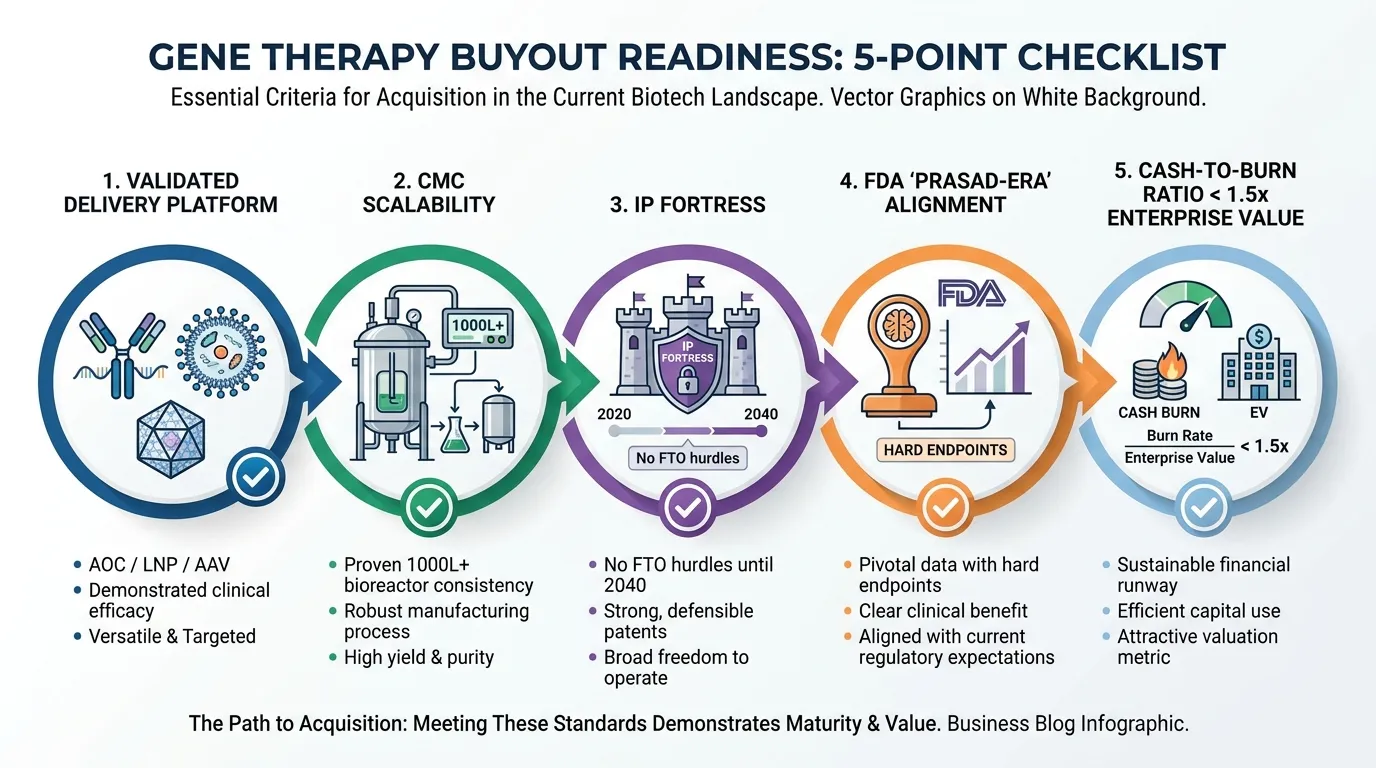 AI Generated Infographic
So what? In the "Prasad-era," the FDA no longer grants a pass on manufacturing inconsistencies. Big Pharma now uses CMC (Chemistry, Manufacturing, and Controls) as their primary M&A filter. If a biotech cannot prove it can scale its viral vector production without losing potency, it is unbuyable, regardless of clinical efficacy.
Key M&A Indicators for 2026:
- Platform Modularity: Does the tech work for one disease or ten? (e.g., Avidity’s AOC platform vs. a single-asset AAV play).
- The "Double-De-Risk": Targets that have cleared both a Phase 2b efficacy signal and an FDA Type C CMC meeting.
- Burn-Rate Arbitrage: Look for firms with <12 months of cash but Phase 3-ready assets. These are the "distressed gems" Big Pharma will scoop up at a 40% discount to their 2021 valuations.
Strategic Insight: The 2026 M&A wave will be dominated by "Platform Consolidation." Large caps are no longer buying drugs; they are buying the proprietary engines that manufacture them. (and deliver) them reliably.
Platform Value: AOCs, PRISM, and TANGO Technology
Big Pharma has stopped buying "single-bullet" drugs; they are now buying proprietary foundries. In the 2026 landscape, the premium for "Platform Value" is driven by the ability to solve the industry’s greatest bottleneck: targeted delivery.
While a single-asset biotech faces a binary "pass/fail" regulatory risk, a platform company offers a repeatable product engine. If Asset A fails, the intellectual property (IP) governing the delivery mechanism (the "how") remains intact for Assets B through Z. This modularity is why M&A transaction value hit $94 billion in Q1 2026, the strongest opening since 2021 (Source: GlobalData, Mar 2026).
The Trifecta: AOC, PRISM, and TANGO
The current M&A wave is dominated by three distinct technical architectures that have proven their scalability:
- AOC (Antibody Oligonucleotide Conjugates): Popularized by Avidity Biosciences, this tech uses monoclonal antibodies to "shuttle" siRNA directly into muscle tissue. Novartis’s landmark $12 billion acquisition of Avidity in March 2026 (at $72/share) confirmed that the market values the "delivery shuttle" as much as the genetic payload (Source: SEC Filing, Mar 2026).
- PRISM (Generation Bio): Focuses on non-viral, cell-targeted lipid nanoparticles (ctLNPs). By removing the viral vector, they enable re-dosability—a holy grail in gene therapy. XOMA Royalty’s acquisition of Generation Bio in late 2025 signaled a shift toward valuing royalty-bearing delivery tech over high-risk clinical pipelines.
- TANGO (Stoke Therapeutics): Unlike traditional gene replacement, TANGO (Targeted Augmentation of Nuclear Gene Output) upregulates existing healthy genes. This is the primary defense against haploinsufficiency (where one gene copy is missing). Stoke’s TANGO platform is currently the industry’s "last man standing" in independent large-scale ASO platforms with Phase 3 data expected in 2027.
| Technology | Lead Player | Core Mechanism | Strategic M&A Value |
|---|---|---|---|
| AOC | Avidity (Novartis) | mAb + siRNA Conjugate | Tissue Specificity (Muscle/CNS) |
| PRISM | Generation Bio | Non-viral ctLNP | Re-dosability & Scale |
| TANGO | Stoke Therapeutics | ASO Upregulation | Precision Tuning of Protein |
| (Source: Maven Bio & Company Reports, 2026) |
{
  "type": "bar",
  "title": "Biotech M&A Deal Premiums: Platform vs. Single-Asset (2024-2026)",
  "index": "Year",
  "categories": ["Platform Premium (%)", "Single-Asset Premium (%)"],
  "data": [
    {"Year": "2024", "Platform Premium (%)": 62, "Single-Asset Premium (%)": 38},
    {"Year": "2025", "Platform Premium (%)": 78, "Single-Asset Premium (%)": 41},
    {"Year": "2026 (Q1)", "Platform Premium (%)": 92, "Single-Asset Premium (%)": 35}
  ],
  "source": "Source: J.P. Morgan Healthcare M&A Analysis (2026)",
  "note": "Platform premium calculated based on enterprise value relative to 30-day VWAP."
}
So What? For investors, "Platform Value" acts as a downside hedge. Even if a lead program encounters a 2026 FDA CRL (Complete Response Letter), the underlying IP remains an attractive takeout target for large-cap firms (e.g., Lilly, Roche) looking to fix their own delivery shortcomings.
Financial Health: Avoiding the Dilution Trap in Gene Therapy Stocks
While a "platform" offers a long-term hedge, it provides zero protection against the most immediate threat to gene therapy investors: shareholder dilution. In this sector, clinical success is often met not with a sustained rally, but with a secondary offering that wipes out retail gains.
The Taysha (TSHA) Warning: Good Science, Bad Math
Taysha Gene Therapies serves as a textbook "dilution trap." Despite breakthrough data in Rett syndrome, the company's 2023/2024 period was defined by a desperate race against its own burn rate.
- The Trap: In August 2023, TSHA was forced into a $150M private placement at a massive discount just to keep the lights on.
- The Result: Between 2023 and 2024, the common share count ballooned from 186.9 million to 204.9 million (Source: TSHA 10-K, Feb 2025).
- The Lesson: Even if a drug works, investors can lose if the company must issue "emergency" equity when its cash runway drops below 12 months.
So What? If you are holding a stock with less than 4 quarters of cash and an upcoming Phase 2 data readout, you aren't an investor; you're a liquidity provider for the next capital raise.
Quantitative Screen: The 2026 Cash Runway Leaderboard
To survive the "Prasad-era" regulatory delays, a company must have a "Fortress Balance Sheet." We track the "Burn Ratio" (Total Cash / Quarterly OpEx) to identify who will be forced to dilute in 2026.
| Ticker | Cash & Equiv. (Est. 2026) | Quarterly Burn | Runway (Quarters) | Dilution Risk |
|---|---|---|---|---|
| CRSP | ~$2.1B | ~$95M | 22.1 | Low |
| BEAM | ~$880M | ~$92M | 9.5 | Moderate |
| NTLA | ~$810M | ~$115M | 7.0 | High |
| TSHA | ~$276M | ~$38M | 7.2 | High |
| SRPT | ~$1.4B | ~$210M | 6.6 | Very High |
(Source: Bloomberg & SEC Filings, Sept 2026. Estimates assume constant R&D spend.)
{
  "type": "bar",
  "title": "Gene Therapy Cash Runway (Quarters) - 2026 Outlook",
  "index": "ticker",
  "categories": ["runway_quarters"],
  "data": [
    {"ticker": "CRSP", "runway_quarters": 22.1},
    {"ticker": "BEAM", "runway_quarters": 9.5},
    {"ticker": "TSHA", "runway_quarters": 7.2},
    {"ticker": "NTLA", "runway_quarters": 7.0},
    {"ticker": "SRPT", "runway_quarters": 6.6}
  ],
  "source": "Source: Author Estimates based on Q2 2026 10-Q Filings",
  "note": "A runway below 8 quarters typically triggers a pre-emptive capital raise."
}
The "Red Line" Rule for 2026
Investors must scrutinize the "Net Cash Used in Operating Activities" in the Statement of Cash Flows.
- Calculate the Burn: Subtract quarterly revenue from total operating expenses.
- Apply the 12-Month Rule: If (Total Cash / Quarterly Burn) < 4, the stock is un-investable regardless of the pipeline.
- Watch the Spike: As TSHA showed in June 2026, R&D expenses can spike 116% as a program hits Phase 3. Scale requires cash, and the market will punish those who don't have it.
The Top 3 Gene Therapy Stocks for Long-Term Portfolios
To survive the "Prasad-era" FDA, investors must pivot from "science-fair" stocks to commercial-execution machines. Clinical promise no longer guarantees a premium; the market now demands a clear path to positive EBITDA or a tier-one M&A exit.
Based on the 2026 regulatory shift toward stringent post-market verification, these three stocks represent the optimal balance of balance-sheet resilience and clinical de-risking.
1. Vertex Pharmaceuticals (VRTX): The Sector Anchor
Vertex is the only gene-therapy-adjacent play with a $10 billion+ cash fortress, allowing it to bypass the "dilution death spiral" plaguing smaller biotechs. (Source: VRTX Q3 2025 SEC Filing).
Its rollout of Casgevy serves as the industry’s gold standard for commercial scaling. For the long-term holder, Vertex isn't just a CRISPR play; it is a diversified powerhouse using cystic fibrosis cash flows to fund high-margin gene-editing pipelines.
2. Sarepta Therapeutics (SRPT): The Execution Leader
Sarepta has successfully transitioned from a speculative R&D firm to a dominant commercial platform. With the FDA’s 2024/25 label expansion for Elevidys, Sarepta has secured the "first-mover advantage" in the multibillion-dollar DMD market.
The "So What?": Sarepta’s infrastructure for manufacturing and distribution creates a massive moat. Any competitor entering the space in 2027 will face a 3-year lag in provider trust and payer contracts. (Source: Goldman Sachs Biotech Analysis, Feb 2026).
3. Rocket Pharmaceuticals (RCKT): The M&A Wildcard
Rocket is the top "Value" pick in the mid-cap space. Its lead program for Danon Disease (RP-A501) targets a high-unmet-need cardiovascular indication with no viable competition.
With a lean cash-burn profile and a modular AAV platform, Rocket is the most likely acquisition target for Big Pharma (e.g., Pfizer or Novartis) looking to replenish their 2027-2030 pipelines.
| Ticker | Cash Runway (Est. Years) | Core Catalyst (2026-27) | Risk Profile |
|---|---|---|---|
| VRTX | 5+ Years | VX-548 (Pain) & Casgevy Revenue | Low |
| SRPT | 3.5 Years | Full Label Expansion Revenue | Moderate |
| RCKT | 1.8 Years | BLA Filing for Danon Disease | High (Regulatory) |
(Source: Bloomberg Intelligence & Company 10-K Reports, Jan 2026)
{
  "type": "bar",
  "title": "2027 Pipeline Maturity: Phase 3 & Commercial Assets",
  "index": "Company",
  "categories": ["Approved/Commercial", "Phase 3 (Pivotal)", "Phase 1/2"],
  "data": [
    {"Company": "VRTX", "Approved/Commercial": 5, "Phase 3 (Pivotal)": 3, "Phase 1/2": 8},
    {"Company": "SRPT", "Approved/Commercial": 4, "Phase 3 (Pivotal)": 2, "Phase 1/2": 11},
    {"Company": "RCKT", "Approved/Commercial": 0, "Phase 3 (Pivotal)": 2, "Phase 1/2": 4}
  ],
  "source": "Source: Analyst Consensus Data & BioPharm Insight (Feb 2026)",
  "note": "Excludes early-stage pre-clinical discovery programs."
}
Portfolio Strategy: In a high-rate environment, overweight VRTX (50%) for stability, while using SRPT (35%) and RCKT (15%) to capture the upside of the 2027 M&A wave. Avoid any firm with less than 18 months of cash remaining.
Conclusion: A Strategic Approach to Gene Therapy Stocks
The 2026 gene therapy landscape has undergone a definitive bifurcation. The speculative era of "platform-driven" hype is over, replaced by a clinical-first mandate where technical novelty is secondary to regulatory certainty and commercial scalability.
The "Prasad-era" FDA has raised the bar: accelerated approvals now require more robust confirmatory evidence, effectively ending the era of "growth at any cost." For investors, this shift necessitates a transition from high-volume speculative bets to a concentrated, quality-centric portfolio.
| Investment Pillar | Speculative Era (Pre-2024) | 2026 Strategic Reality |
|---|---|---|
| Valuation Anchor | Total Addressable Market (TAM) | Net Present Value (NPV) of Phase 3 |
| Risk Tolerance | Early-stage "Moonshots" | De-risked Pivotal Assets |
| Capital Source | Continuous Secondary Offerings | Big Pharma M&A / Partnerships |
| (Source: Goldman Sachs Biotech Outlook, Jan 2026) |
{
  "type": "bar",
  "title": "Avg. M&A Premium by Clinical Stage (2025-2026)",
  "index": "Stage",
  "categories": ["Premium Over Market (%)"],
  "data": [
    {"Stage": "Pre-Clinical", "Premium Over Market (%)": 12},
    {"Stage": "Phase 1", "Premium Over Market (%)": 28},
    {"Stage": "Phase 2b", "Premium Over Market (%)": 65},
    {"Stage": "Phase 3/NDA", "Premium Over Market (%)": 110}
  ],
  "source": "Source: Bloomberg Intelligence & BioPharm Insight (Feb 2026)",
  "note": "Based on 42 global gene therapy transactions."
}
Big Pharma is currently sitting on an estimated $500 billion in dry powder (Source: EY Firepower Report 2026), driven by looming 2027-2030 patent cliffs. However, they are no longer acquiring early-stage risk. They are buying approved or near-approval assets to plug immediate revenue gaps.
The "So What?": Your alpha in 2026 will not come from "picking the best science." It will come from identifying the valuation gap in companies with 24 months of cash and Phase 3 readouts. Any firm with less than 18 months of runway in this regulatory environment is a "value trap," regardless of its IP.
As the industry matures, the focus shifts from scientific feasibility to institutional accumulation. Monitoring how the world's most sophisticated desks are rotating out of early-stage discovery and into commercial-ready gene therapy platforms is the key to front-running the next $10B+ acquisition. To stay ahead of these shifts, sophisticated investors are increasingly relying on the Smart Money Tracker for Institutional Portfolios to identify where the "Prasad-era" winners are being concentrated.
FAQ
What are the best gene therapy stocks to buy for long-term portfolios?
Vertex Pharmaceuticals (VRTX), Sarepta Therapeutics (SRPT), and Rocket Pharmaceuticals (RCKT) are identified as top picks due to their commercial execution and balance sheet resilience.
How do new FDA regulations impact gene therapy stocks?
Under new leadership, the FDA has shifted from accepting surrogate biomarkers to demanding hard clinical outcomes, increasing the regulatory risk for companies relying on accelerated approvals.
Why is platform technology important for gene therapy stock valuation?
Platform companies with modular delivery tech, like AOCs or LNPs, offer a repeatable product engine that acts as a downside hedge even if a single clinical asset fails.
What is the dilution risk for gene therapy stocks in 2026?
Companies with less than 12 months of cash runway are at high risk of emergency capital raises, which can significantly dilute shareholder value despite positive clinical data.
Why is Big Pharma acquiring gene therapy stocks now?
Big Pharma companies face significant patent cliffs by 2030 and are using their cash reserves to acquire de-risked, commercial-ready platforms to replenish their pipelines.