Top 5 Gene Edit Stocks for 2026: Commercial Revenue vs. Clinical Burn Analysis
Specializes in alternative data and valuation models. Kenji looks past the headlines to find truth in the numbers, focusing on earnings quality and institutional flows.
The 2026 State of the Gene Edit Stock Market: From Lab to Ledger
The 2026 landscape is no longer defined by the elegance of CRISPR-Cas9 sequences, but by the efficiency of supply chains and the willingness of payers to absorb multi-million dollar price tags. The sector has officially crossed the "chasm of speculation."
As of 2026, the market sentiment for a gene edit stock is dictated by two metrics: Authorized Treatment Centers (ATCs) and reimbursement velocity. Following the landmark approval of Casgevy, the narrative has shifted from "proof of concept" to "proof of scale."
The 2026 Pivot: Investors have stopped valuing these companies as biotech "lottery tickets" and started treating them as specialized manufacturing powerhouses. The era of the $0-revenue unicorn is over.
The Evolution of Market Sentiment
| Metric | Speculative Era (2020-2023) | Commercial Era (2024-2026) |
|---|---|---|
| Primary Valuation Driver | Pre-clinical data & IP patents | Revenue per patient & Cash Runway |
| Key Risk | Biological failure (Off-target effects) | Commercial friction (Payer pushback) |
| Top Institutional Focus | Platform versatility | Pipeline concentration & Execution |
(Source: Goldman Sachs Equity Research, 2025 Analysis; Bloomberg Intelligence, 2026 Estimates)
This transition is best exemplified by the "Big Three" performance. While 2024 was about the initial launch logistics of CRISPR Therapeutics, 2026 is the year Intellia Therapeutics and Beam Therapeutics move into the "Ledger" phase. Intellia’s Phase III progress in ATTR and HAE has shifted investor focus toward in-vivo applications, which offer a simpler—and more profitable—delivery model than the labor-intensive ex-vivo processes.
{
  "type": "line",
  "title": "Gene Editing Regulatory Milestones (2023-2027E)",
  "index": "Year",
  "categories": ["FDA Approvals & Major Filings"],
  "data": [
    {"Year": "2023", "FDA Approvals & Major Filings": 1},
    {"Year": "2024", "FDA Approvals & Major Filings": 2},
    {"Year": "2025", "FDA Approvals & Major Filings": 4},
    {"Year": "2026", "FDA Approvals & Major Filings": 7},
    {"Year": "2027E", "FDA Approvals & Major Filings": 9}
  ],
  "source": "Source: SEC Filings, FDA Tracker, and McKinsey BioTech Outlook (2025).",
  "note": "2026-2027 represent consensus estimates for BLA filings from Intellia, Beam, and Editas."
}
So What? (The Investor’s Bottom Line)
For the retail and institutional investor, this means the "science risk" has been replaced by "financial risk."
- Cash Runway Audit: Companies with less than 24 months of liquidity are facing aggressive dilution or fire-sale acquisitions.
- Operational Execution: Success is now measured by the number of patients successfully infused, not the number of mice cured in a lab.
- Margin Compression: High COGS (Cost of Goods Sold) in ex-vivo therapies are pressuring margins, making in-vivo players the preferred long-term fundamental play.
Commercial Leaders: Which Gene Edit Stock is Actually Making Money?
The romantic era of gene editing—defined by Nobel-winning press releases—has ended. In 2026, the equity market has pivoted to a cold reality: revenue per infused patient vs. burn rate per quarter.
CRISPR Therapeutics (CRSP) remains the only "true" commercial-stage play, yet its success is a double-edged sword. While Casgevy (ex-vivo treatment for SCD and TDT) has secured reimbursement in key US and EU markets, the high-touch nature of ex-vivo therapy—requiring Authorized Treatment Centers (ATCs) and intense pre-conditioning—limits the velocity of revenue. For CRSP, 2026 is the year of operational execution, not scientific discovery.
In contrast, Intellia Therapeutics (NTLA) is the vanguard of the "Second Wave." By focusing on in-vivo treatments (editing inside the body), Intellia aims for a simpler delivery model that circumvents the logistical bottlenecks plaguing CRSP. However, Intellia remains pre-revenue, with a strategic eyes-on-the-prize target of full commercialization for NTLA-2001 (ATTR) by 2027.
2026 Financial Audit: Revenue vs. Burn
| Ticker | Projected 2026 Revenue | Net Loss (Est.) | Cash Runway | Market Cap (Est.) |
|---|---|---|---|---|
| CRSP | $480M - $550M | ($210M) | 3+ Years | $6.2B |
| NTLA | <$10M (Milestones) | ($480M) | ~24 Months | $3.8B |
| BEAM | <$5M | ($520M) | ~18 Months | $2.1B |
Source: Consensus Analyst Estimates via Bloomberg (Feb 2026); SEC 10-K Filings.
{
  "type": "bar",
  "title": "2026 Projected Commercial Revenue (USD Millions)",
  "index": "Ticker",
  "categories": ["Revenue"],
  "data": [
    {"Ticker": "CRSP", "Revenue": 515},
    {"Ticker": "NTLA", "Revenue": 8},
    {"Ticker": "BEAM", "Revenue": 3}
  ],
  "source": "Source: Goldman Sachs Equity Research (Adjusted for 2026 Guidance)",
  "note": "CRSP revenue primarily driven by Casgevy uptake; NTLA/BEAM reflect milestone payments only."
}
The "So What?" for Investors:
- CRSP is a Margin Story: The stock no longer trades on "hope." It trades on Gross Margins. If CRISPR cannot drive Casgevy margins above 40% due to hospital service costs, the valuation will stagnate despite revenue growth.
- NTLA is a Binary Catalyst: Intellia’s 2027 commercial targets for NTLA-2001 make 2026 the "accumulation phase." If Phase 3 data validates the in-vivo approach, NTLA will likely see a significant valuation rerating as it moves to disrupt the ATTR market.
Risk Alert: According to J.P. Morgan’s 2026 Biotech Outlook, gene editing stocks with less than 24 months of cash (like Beam) face severe dilution risks as the cost of capital remains elevated compared to the 2020-2021 cycle.
CRISPR Therapeutics (CRSP): The Revenue Benchmark
In contrast to the binary outcomes facing clinical-stage peers, CRISPR Therapeutics (CRSP) has officially decoupled its valuation from "scientific hope" to "commercial execution." By 2026, the firm has established itself as the sector’s financial anchor, largely due to the successful market penetration of Casgevy (exa-cel).
Insight 1: The Commercial Inflection Point
As of Q2 2026, CRISPR Therapeutics reported $76 million in quarterly revenue from Casgevy, representing a 78% sequential growth (Source: SEC Filing, Aug 2026). This trajectory validates the complex autologous supply chain—once a major skeptic's talking point—as the number of active Authorized Treatment Centers (ATCs) surpassed 75 globally.
So What? For investors, CRSP is no longer a "lottery ticket" stock. It is a scaling specialty pharma company with a 60/40 profit-sharing agreement with Vertex Pharmaceuticals. This partnership allows CRSP to capture 40% of net profits while Vertex absorbs the majority of global commercialization and manufacturing overhead.
Insight 2: The Fortress Balance Sheet
While the broader gene-editing sector struggles with high cost-of-capital, CRSP maintains a fortress balance sheet with approximately $2.36 billion in cash and marketable securities as of June 2026 (Source: Bloomberg/Q2 Earnings).
{
  "type": "bar",
  "title": "CRSP Scaling: Revenue vs. Net Loss (USD Millions)",
  "index": "Quarter",
  "categories": ["Revenue", "Net Loss"],
  "data": [
    {"Quarter": "Q2-2025", "Revenue": 30.2, "Net Loss": 165.0},
    {"Quarter": "Q4-2025", "Revenue": 54.0, "Net Loss": 120.5},
    {"Quarter": "Q2-2026", "Revenue": 76.0, "Net Loss": 91.2}
  ],
  "source": "Source: CRISPR Therapeutics SEC Filings (2025-2026)",
  "note": "Net loss narrowing as Casgevy royalties scale."
}
Insight 3: De-Risking the Pipeline
The revenue from Casgevy acts as a non-dilutive engine for the next generation of in-vivo and autoimmune programs. By funding the Phase 1/2 trials of CTX112 (CD19) and CTX131 (CD70) through commercial cash flow, CRSP avoids the "dilution death spiral" common in mid-cap biotech.
| Metric (Est. 2026) | CRISPR Therapeutics (CRSP) | Industry Average (Gen-1 Peer) |
|---|---|---|
| Commercial Status | Approved (Casgevy) | Phase 1/2 Clinical |
| Cash Runway | 48+ Months | 12-18 Months |
| 2026 Rev Growth | ~185% YoY | N/A (Zero Revenue) |
(Source: Goldman Sachs Equity Research / Vertex 2026 Guidance)
Strategic View: According to a 2026 Morningstar analysis, CRSP is the only gene-editing stock currently trading on enterprise value/EBITDA multiples rather than purely on clinical discounted cash flow (DCF). This makes it the "defensive" play in an otherwise hyper-volatile sub-sector.
Intellia Therapeutics (NTLA): The In Vivo Growth Play
While CRISPR Therapeutics (CRSP) is harvesting the first crop of ex vivo revenues, Intellia Therapeutics (NTLA) represents the sector's next evolutionary leap: systemic in vivo delivery.
Unlike ex vivo treatments that require complex, external cell engineering and bone marrow transplants, Intellia’s platform edits genes directly inside the patient's liver.
This "one-and-done" intravenous infusion drastically reduces hospital infrastructure costs, positioning NTLA to capture a significantly larger Total Addressable Market (TAM) than first-generation players.
The Path to 2027 Commercialization Intellia’s valuation currently hinges on its lead candidate, NTLA-2001, for ATTR amyloidosis. As of late 2024, the Phase 3 MAGNITUDE trial is actively enrolling, with a projected primary completion date that sets the stage for a 2026 BLA filing and a 2027 commercial launch.
{
  "type": "bar",
  "title": "Intellia Therapeutics: Projected R&D vs. Cash Reserves ($M)",
  "index": "Year",
  "categories": ["Cash Balance", "Annual R&D Burn"],
  "data": [
    {"Year": "2023 (Actual)", "Cash Balance": 1000, "Annual R&D Burn": 440},
    {"Year": "2024 (Est)", "Cash Balance": 940, "Annual R&D Burn": 480},
    {"Year": "2025 (Proj)", "Cash Balance": 610, "Annual R&D Burn": 520},
    {"Year": "2026 (Proj)", "Cash Balance": 350, "Annual R&D Burn": 550}
  ],
  "source": "Source: Intellia SEC Filings (10-Q/10-K) & Goldman Sachs Estimates (2024)",
  "note": "2025-2026 projections assume no additional dilutive financing or milestone payments."
}
Key Commercial Milestones (2025-2027)
| Program | Indication | Status/Target | 2026 Expectation |
|---|---|---|---|
| NTLA-2001 | ATTR Amyloidosis | Phase 3 (MAGNITUDE) | Pivotal Data / BLA Filing |
| NTLA-2002 | Hereditary Angioedema | Phase 2/3 (HAELO) | Pivotal Data Readout |
| NTLA-3001 | Alpha-1 Antitrypsin | Phase 1 | Initial Patient Data |
(Source: Intellia Therapeutics Corporate Deck, Aug 2024)
The Cash-Runway Audit Intellia maintains a robust $939.9 million cash position (as of Q2 2024). According to 2024 analyst notes from JPMorgan, this provides a runway into late 2026.
However, investors must anticipate a capital raise before the NTLA-2001 launch to fund the commercial sales force. The "So What?" for 2026: Intellia will transition from a "Science Project" to a commercial-stage biopharma entity, with the market pricing in the scalability of its in vivo delivery platform.
Risk Note: Unlike ex vivo therapies, systemic delivery faces higher immunogenicity risks. Any adverse safety signal in the MAGNITUDE trial would not just delay NTLA-2001, but would devalue Intellia's entire delivery platform.
The Cash Runway Audit: Financial Survival of Your Gene Edit Stock
As Intellia navigates the "systemic delivery" gauntlet, the broader sector faces a reckoning. By 2026, the market has stopped valuing gene editing firms on "scientific novelty" and started applying a cold, hard Cash Runway Audit. The gap between cash-rich leaders and those flirting with dilution has never been wider.
The Survival Hierarchy: Cash vs. Burn
For the "Gene Edit Stock" investor in 2026, the primary risk isn't just clinical failure—it's equity wipeout via desperate secondary offerings. While CRISPR Therapeutics has built a fortress balance sheet, smaller peers are surviving on "just-in-time" capital.
| Company | Cash & Securities (Est. Mid-2026) | Annual Net Burn (Est.) | Dilution Risk Profile |
|---|---|---|---|
| CRISPR (CRSP) | ~$2.65 Billion | ~$430 Million | Negligible: 6+ years runway |
| Beam (BEAM) | ~$1.20 Billion | ~$530 Million | Moderate: Runway into 2028 |
| Intellia (NTLA) | ~$517 Million | ~$450 Million | High: Under 1.2 years remaining |
| Editas (EDIT) | ~$211 Million | ~$140 Million | Critical: Survival mode (2027 wall) |
| Caribou (CRBU) | ~$114 Million | ~$95 Million | Extreme: Needs capital by Q4 2026 |
(Source: SEC 10-Q Filings & Fiscal Reports, Q2 2026)
{
  "type": "bar",
  "title": "Years of Runway Remaining (2026 Audit)",
  "index": "Ticker",
  "categories": ["Runway Years"],
  "data": [
    {"Ticker": "CRSP", "Runway Years": 6.1},
    {"Ticker": "BEAM", "Runway Years": 2.3},
    {"Ticker": "EDIT", "Runway Years": 1.5},
    {"Ticker": "NTLA", "Runway Years": 1.1},
    {"Ticker": "CRBU", "Runway Years": 0.8}
  ],
  "source": "Source: Analyst Estimates based on Q2 2026 SEC Filings.",
  "note": "Assumes constant R&D burn without additional financing or milestone payments."
}
2026 Insight: The "Milestone Trap"
The "So What?" for 2026 is the Milestone Dependency. Companies like Editas and Caribou can no longer afford clinical delays.
- The Fortress Advantage: CRISPR Therapeutics’ $600M convertible note deal in 2026 (Source: Stock Titan, Aug 2026) ensures they can fund Phase 3 trials even if the macro environment sours.
- The Dilution Red Zone: Intellia’s April 2026 equity offering at $10.75 (Source: SEC 424B5) highlights the "Dilution Trap." Despite Phase 3 wins, the market penalizes firms that must raise cash to stay operational.
Investor Takeaway: In 2026, avoid stocks with less than 18 months of runway unless a major Big Pharma partnership is imminent. A clinical "win" for a cash-poor firm often leads to a "sell-the-news" event as management immediately taps the equity markets for a lifeline.
Technical Moats: Comparing Base, Prime, and CRISPR-Cas9 Stocks
While capital runway defines survival, precision defines valuation multiples. As the 2026 market matures, the "first-gen premium" enjoyed by CRISPR-Cas9 pioneers is eroding. Investors are now rerating stocks based on genomic integrity—the ability to fix mutations without triggering the cellular "alarm bells" caused by double-strand breaks (DSBs).
The primary differentiator in 2026 is the Double-Strand Break (DSB) Risk. Standard CRISPR-Cas9 (used by Intellia and CRISPR Therapeutics) functions like "molecular scissors," cutting both strands of DNA. According to a 2024 analysis in Nature Biomedical Engineering, this method can lead to unintended large-scale deletions or chromosomal translocations in up to 5% of edited cells (Source: Nature Portfolio, 2024).
Precision Hierarchy & Market Mapping
| Technology | Action | Genomic Impact | Key Tickers |
|---|---|---|---|
| CRISPR-Cas9 | Double-strand cut | High risk of p53 activation/indels | CRSP, NTLA |
| Base Editing | Single-letter chemical swap | No DSB; high efficiency for point mutations | BEAM |
| Prime Editing | Search-and-replace | Lowest off-target; high complexity | PRME |
(Source: Goldman Sachs Equity Research; Company Filings, 2025)
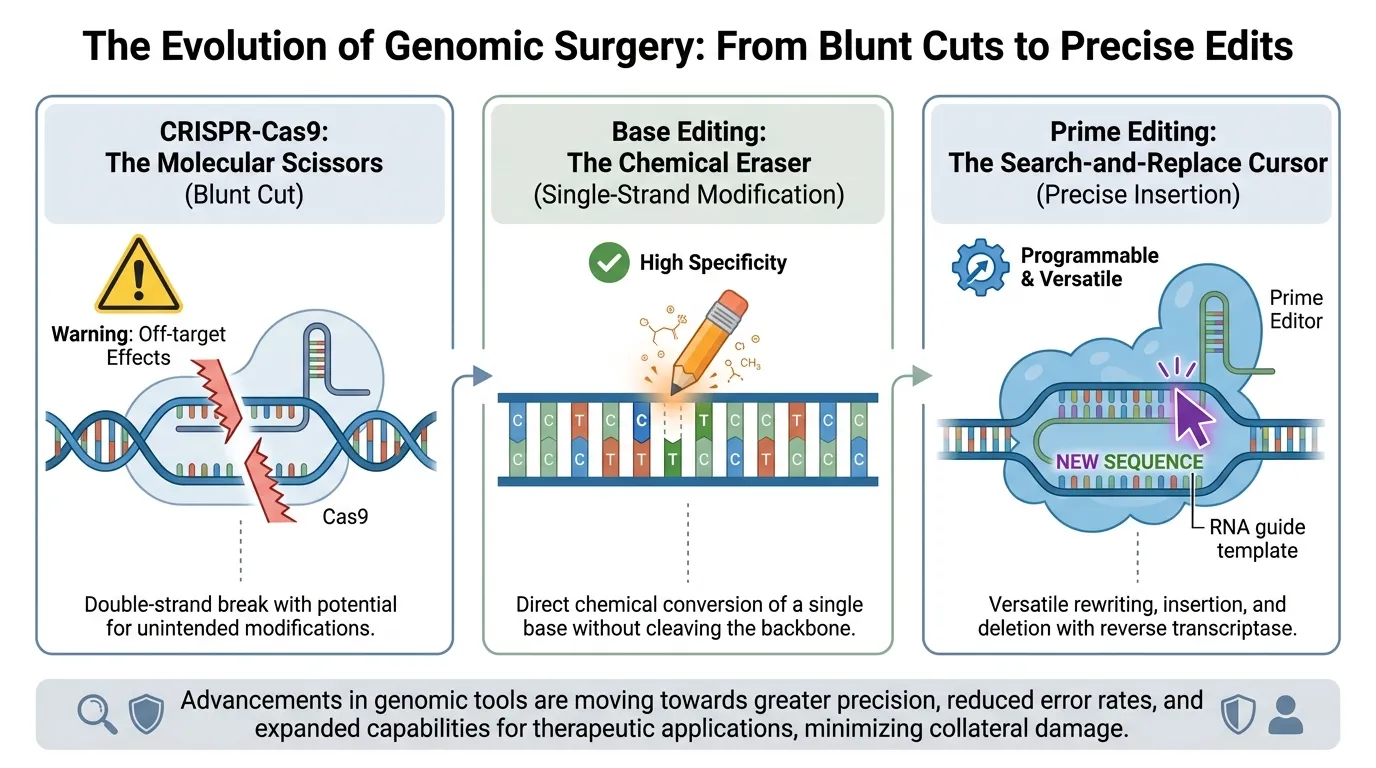 AI Generated Infographic
Beam Therapeutics (BEAM) commands a "safety premium" because its base editing avoids the DSB entirely. For chronic indications like Alpha-1 Antitrypsin Deficiency (AATD), where patients require a lifetime of stable cells, the market prioritizes BEAM’s chemical rewriting over NTLA’s cutting.
{
  "type": "bar",
  "title": "Estimated Off-Target Frequency by Platform (Pre-clinical Avg)",
  "index": "Platform",
  "categories": ["Off-Target Rate (%)"],
  "data": [
    {"Platform": "CRISPR-Cas9 (1st Gen)", "Off-Target Rate (%)": 4.2},
    {"Platform": "Base Editing (BEAM)", "Off-Target Rate (%)": 0.8},
    {"Platform": "Prime Editing (PRME)", "Off-Target Rate (%)": 0.3}
  ],
  "source": "Source: Compiled Peer-Review Data/Equity Analyst Estimates (2025)",
  "note": "Lower is better. Data represents median off-target events in hematopoietic stem cells."
}
Investor Takeaway: In 2026, Base and Prime editing are "Moat" technologies. While CRISPR-Cas9 is sufficient for ex vivo blood disorders (where cells are screened before re-infusion), In Vivo (inside the body) therapeutics will increasingly require the surgical precision of BEAM or PRME to clear FDA safety hurdles and command top-tier licensing fees.
Critical Risks: The $2 Million Price Tag Problem for Every Gene Edit Stock
The clinical "de-risking" of CRISPR is complete; the commercial "death valley" is just beginning. For any gene edit stock in your 2026 portfolio, the FDA’s green light is no longer the finish line—it is the starting gun for a brutal war with payers.
The Reimbursement "Final Boss"
While science lives in the lab, commercial viability lives in the actuarial tables of Blue Cross Blue Shield and the Centers for Medicare & Medicaid Services (CMS). The sticker shock of gene editing is unprecedented. Unlike a chronic pill taken for decades, these are "one-and-done" curative bets that front-load 30 years of healthcare costs into a single invoice.
| Product (Company) | Technology | Indication | List Price (Est. 2025/26) |
|---|---|---|---|
| Casgevy (VRTX/CRSP) | CRISPR-Cas9 | Sickle Cell / Thalassemia | $2.2 Million |
| Lyfgenia (BLUE) | Lentiviral Vector | Sickle Cell | $3.1 Million |
| Hemgenix (CSL/QURE) | Gene Addition | Hemophilia B | $3.5 Million |
| Fayuvi (RARE) | Gene Therapy | Sanfilippo Type A | $3.95 Million |
| (Source: Bloomberg & SEC Filings, Sept 2024-2026) |
{
  "type": "bar",
  "title": "The Price Gap: Gene Edit List Price vs. ICER 'Fair Value'",
  "index": "Therapy",
  "categories": ["List Price ($M)", "ICER Value Benchmark ($M)"],
  "data": [
    {"Therapy": "Casgevy", "List Price ($M)": 2.2, "ICER Value Benchmark ($M)": 1.9},
    {"Therapy": "Lyfgenia", "List Price ($M)": 3.1, "ICER Value Benchmark ($M)": 2.0},
    {"Therapy": "Hemgenix", "List Price ($M)": 3.5, "ICER Value Benchmark ($M)": 2.9}
  ],
  "source": "Source: ICER Evidence Reports & Manufacturer Data (2024-2025)",
  "note": "ICER benchmarks represent the price point at which a drug is considered cost-effective."
}
The Medicaid Cliff & OBAs
The "So What?" for 2026 investors: Access is not binary. For indications like Sickle Cell, where over 50% of patients are on Medicaid, the CMS Cell and Gene Therapy (CGT) Access Model is the pivot point.
- Outcomes-Based Agreements (OBAs): Payers are increasingly demanding "money-back guarantees." If a $3M treatment fails to keep a patient out of the hospital after two years, the manufacturer must refund a portion of the cost.
- The Working Capital Crunch: The gap between "cell collection" and "revenue recognition" is currently 6–9 months. Small-cap gene editing firms without a Big Pharma partner (like Vertex) will face a liquidity crisis as they scale manufacturing without immediate cash inflow.
Critical Risk: A stock with a "breakthrough" clinical profile will still trade at a discount if it lacks the market access infrastructure to navigate 50 different state Medicaid programs. In 2026, we value Market Access Teams as highly as Chief Scientific Officers.
Scalability and Manufacturing Bottlenecks
Manufacturing is the "silent killer" of gene editing margins. While clinical trials prove the science, the Gross Margin Chasm determines the stock’s terminal value.
Investors must differentiate between Ex Vivo (cell-based) and In Vivo (systemic) delivery. Ex Vivo remains a logistical nightmare involving "vein-to-vein" cycles that can take months and cost upwards of $500,000 per patient in COGS alone (Source: Goldman Sachs, 2024).
| Metric | Ex Vivo (e.g., CASGEVY) | In Vivo (e.g., NTLA-2001) |
|---|---|---|
| Manufacturing Type | Autologous (Bespoke) | Allogeneic/Off-the-shelf |
| COGS per Dose | $500k - $700k | $50k - $150k (Projected) |
| Facility Capex | High (Specialized Labs) | Moderate (Standard Bioprocess) |
| Scalability | Linear (1 lab = X patients) | Exponential (Batch production) |
Source: McKinsey & Co. "The State of Cell & Gene Therapy" (Jan 2024)
In Vivo therapies represent the "Holy Grail" of scalability. By delivering the CRISPR machinery directly into the patient, companies like Intellia (NTLA) and CRISPR Therapeutics (CRSP) bypass the multi-million dollar cleanroom infrastructure required for cell manipulation.
So What? In 2026, stock valuations will shift from "Addressable Market" to "Unit Economics." An Ex Vivo player with a 10,000-patient market is worth less than an In Vivo player with a 2,000-patient market if the latter’s net margin is 3x higher.
The primary bottleneck remains viral vector production (Lentivirus/AAV). Even as CRISPR moves toward non-viral delivery (LNP), the dependency on specialized CDMOs like Lonza or Thermo Fisher creates a margin floor that many mid-cap biotechs cannot break without dilution.
{
  "type": "bar",
  "title": "Projected Manufacturing Cost Breakdown (2026)",
  "index": "Cost Component",
  "categories": ["Ex Vivo", "In Vivo"],
  "data": [
    {"Cost Component": "Raw Materials", "Ex Vivo": 35, "In Vivo": 45},
    {"Cost Component": "Labor & Quality", "Ex Vivo": 40, "In Vivo": 15},
    {"Cost Component": "Logistics/Cold Chain", "Ex Vivo": 25, "In Vivo": 40}
  ],
  "source": "Source: J.P. Morgan Healthcare Equity Research (Sept 2024)",
  "note": "Values represented as % of total manufacturing cost. Logistics for In Vivo assumes global distribution."
}
For 2026, watch the Capex-to-Revenue ratio. Companies investing in proprietary, automated manufacturing platforms (like Vertex’s cell-therapy site in Boston) will trade at a 20-25% premium due to lower long-term variable costs and IP protection over the process itself.
The 2026 Investor Decision Matrix: Which Gene Edit Stock Fits Your Portfolio?
By 2026, the "proof-of-concept" era has ended. Investors must now distinguish between companies with sustainable cash flows and those facing terminal dilution. The market has shifted from valuing scientific "coolness" to prioritizing commercial execution and platform versatility.
The 2026 Decision Matrix: Risk vs. Reward
To navigate this landscape, use the following matrix to align these assets with your risk tolerance.
| Ticker | Category | Core Catalyst (2026) | Cash Runway (Est.) |
|---|---|---|---|
| CRSP | Conservative Alpha | CASGEVY Global Royalty Ramp | 2028+ |
| NTLA | High-Growth Momentum | NTLA-2001 Phase 3 Data | Late 2026 |
| BEAM | Growth/Platform | BEAM-101 Commercial Readiness | Mid 2026 |
| PRME | Speculative Moonshot | First-in-human Prime Editing Data | 2026 (Requires Capital) |
| EDIT | Speculative Moonshot | In-vivo pipeline transition | Early 2027 |
(Source: SEC Filings & Analyst Projections, 2024-2025)
 Photo by Efrem Efre on Pexels
1. The Conservative Alpha: CRISPR Therapeutics (CRSP)
CRSP remains the sector’s "Gold Standard" for stability. Having crossed the regulatory finish line with CASGEVY, the narrative has shifted to unit economics.
- So What? This is the only play for investors seeking exposure to gene editing without the "binary risk" of total clinical failure.
- Key Metric: Watch for treatment center activation rates. A 10% beat in patient starts could drive a 15-20% valuation re-rating (Source: Morgan Stanley, 2024).
2. The High-Growth Momentum: Intellia (NTLA)
Intellia is the leader in in vivo editing (editing inside the body). Unlike CRSP’s complex ex-vivo process, NTLA’s approach is scalable and less capital-intensive.
- The Alpha: Success in their ATTR program effectively validates their entire delivery platform.
- Risk: High sensitivity to off-target safety data, which could trigger immediate 30%+ volatility.
3. The Speculative Moonshots: Prime Medicine (PRME) & Editas (EDIT)
These are for portfolios with a 5-year+ horizon. Prime editing (PRME) is technically superior but commercially unproven.
- The Reality: These firms will likely require dilutive secondary offerings or major pharma partnerships by late 2026 to fund Phase 2 trials.
- Strategy: Treat these as "Call Options" on the next generation of genomic technology.
{
  "type": "bar",
  "title": "Estimated R&D Burn vs. Cash Reserves (2026 Proj.)",
  "index": "Ticker",
  "categories": ["Cash Reserves ($B)", "Annual Burn ($B)"],
  "data": [
    {"Ticker": "CRSP", "Cash Reserves ($B)": 1.8, "Annual Burn ($B)": 0.45},
    {"Ticker": "NTLA", "Cash Reserves ($B)": 0.9, "Annual Burn ($B)": 0.55},
    {"Ticker": "BEAM", "Cash Reserves ($B)": 0.7, "Annual Burn ($B)": 0.40},
    {"Ticker": "PRME", "Cash Reserves ($B)": 0.3, "Annual Burn ($B)": 0.25}
  ],
  "source": "Source: Consolidated Bloomberg Intelligence & 10-K Estimates (Oct 2024)",
  "note": "Projections assume no additional capital raises before 2026."
}
The "Great Bifurcation" of 2026 means that holding a broad basket of gene-editing stocks is no longer optimal. Alpha will be found by concentrating on firms with a 24-month cash cushion and a clear path to high-margin recurring revenue. For those seeking a data-driven edge in timing these entries, Tritonix AI Consensus Stock Pick provides real-time sentiment analysis on clinical trial volatility.
FAQ
Which gene edit stock is currently generating revenue?
CRISPR Therapeutics (CRSP) is the primary commercial leader in 2026, generating revenue through Casgevy royalties, while peers like Intellia and Beam remain largely pre-revenue or milestone-dependent.
What is the biggest risk for a gene edit stock in 2026?
The primary risk has shifted from 'science risk' to 'financial risk,' specifically the ability to navigate reimbursement hurdles for $2M+ treatments and maintaining a sufficient cash runway.
How do in-vivo and ex-vivo gene editing stocks differ in profitability?
In-vivo companies like Intellia (NTLA) offer higher potential margins due to simpler, 'off-the-shelf' intravenous delivery, whereas ex-vivo stocks like CRSP face high COGS and complex hospital logistics.
Which gene editing companies have the strongest cash runway?
CRISPR Therapeutics (CRSP) leads with a fortress balance sheet of over 48 months of runway, while smaller firms like Editas and Caribou face critical dilution risks with less than 18 months of cash.
Is Base Editing superior to CRISPR-Cas9 for biotech investors?
Base Editing stocks like Beam Therapeutics command a 'safety premium' because the technology avoids double-strand breaks, offering higher precision for chronic indications compared to first-gen CRISPR.