GE Electric Stock Analysis 2026: GE Aerospace After Q3 Earnings
Founder of Tritonix.ai. Former Hedge Fund Analyst with 10+ years of experience managing over $1B AUM across insurance portfolios and private funds. Specializes in institutional-grade fundamental analysis and long-term capital allocation.
What "GE Electric Stock" Searches Actually Mean
People typing ge electric stock are almost always looking for one equity: GE Aerospace (NYSE: GE). That is the company that remained after General Electric spun off GE HealthCare in January 2023 and GE Vernova in April 2024. The old conglomerate ticker still trades, but the economic story is now jet engines, aftermarket services, and defense propulsion.
GE closed at $323.24 on November 6, 2026, up $8.51, or 2.70%, according to Yahoo Finance. The session ranged from $315.06 to $325.16, and after-hours trading left the stock near $323.10.
That print sat well above the 52-week low of $268.91 and about 17% below the 52-week high of $388.84. Yahoo Finance listed a market value of about $335.4 billion, a trailing P/E of 36.94x on $8.75 of trailing-twelve-month EPS, and a $1.88 annual dividend, a 0.58% yield.
The performance split is the useful context. Through November 6, GE returned 5.38% year to date versus 7.76% for the S&P 500, and 6.46% over one year versus 9.77% for the index. The longer tape still reflects the breakup and the aerospace rerating: three-year and five-year total returns of 268.59% and 389.04% far outpaced the S&P 500's 68.96% and 57.04%.
GE electric stock is no longer a conglomerate cleanup trade. It is a debate about whether a wide-moat engine-and-aftermarket franchise can keep compounding fast enough to justify a mid-30s earnings multiple.
Yahoo Finance estimates the next report around January 21, 2027. Until then, the live argument is Q3's beat-and-raise against a premium valuation and a softer implied fourth quarter.
Q3 2026 Scorecard: A Beat, a Raise, and a Dip
GE Aerospace reported third-quarter results on October 20, 2026, for the period ended September 30, 2026. Total orders jumped 49% to $19.0 billion. GAAP revenue rose 16% to $14.118 billion, while adjusted revenue increased 18% to $13.285 billion.
Profit under GAAP increased 12% to $2.805 billion. Operating profit, the company's preferred measure, surged 30% to $2.988 billion, and the operating margin expanded 220 basis points to 22.5%. Continuing EPS was $2.32, up 14%; adjusted EPS was $2.25, up 36%, according to the earnings release filed with the SEC.
Free cash flow told a less celebratory story. Cash from operating activities fell 14% to $2.203 billion, and free cash flow declined 14% to $2.042 billion. Year to date, the cash picture remains healthier: nine-month free cash flow still rose 13% to $6.728 billion.
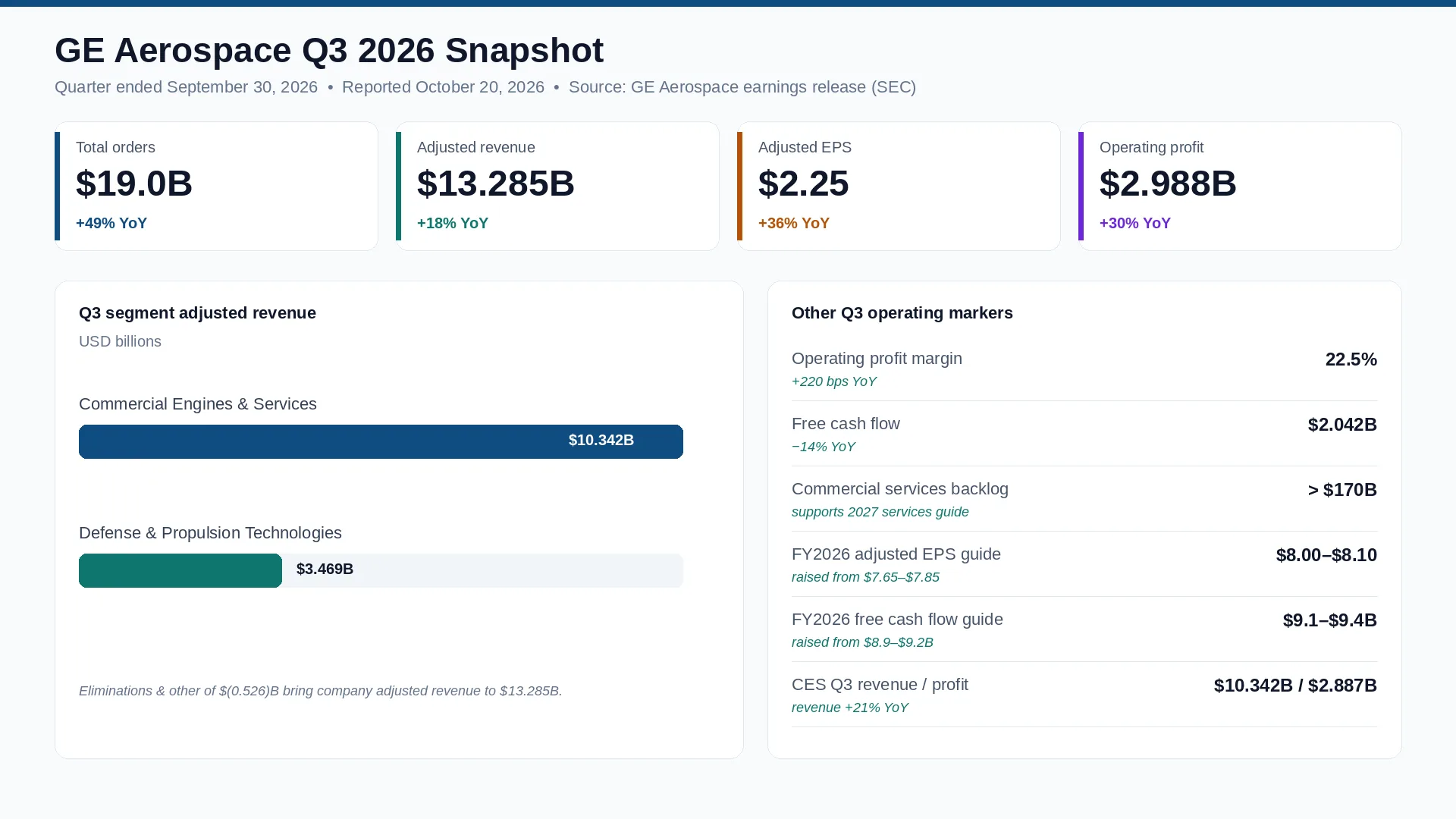 Q3 2026 snapshot: orders, adjusted revenue, adjusted EPS, operating profit, and segment mix. Source: GE Aerospace earnings release, October 20, 2026.
Analysts had expected about $2.00 to $2.02 of adjusted EPS and roughly $12.65 to $12.88 billion of sales, according to contemporaneous recaps from Motley Fool, TIKR, and Zacks (via Yahoo Finance). The company cleared those bars and still watched the stock slide.
| Metric (Q3 2026) | Result | Year-over-year |
|---|---|---|
| Total orders | $19.0B | +49% |
| Revenue (GAAP) | $14.118B | +16% |
| Adjusted revenue | $13.285B | +18% |
| Profit (GAAP) | $2.805B | +12% |
| Operating profit | $2.988B | +30% |
| Operating profit margin | 22.5% | +220 bps |
| Continuing EPS (GAAP) | $2.32 | +14% |
| Adjusted EPS | $2.25 | +36% |
| Free cash flow | $2.042B | −14% |
Source: GE Aerospace third-quarter 2026 earnings release, filed with the SEC on October 20, 2026.
{
  "type": "bar",
  "title": "GE Aerospace Q3 2025 vs Q3 2026 Operating Results",
  "index": "Metric",
  "categories": ["Adjusted revenue ($B)", "Operating profit ($B)", "Adjusted EPS ($)"],
  "data": [
    {"name": "Q3 2025", "values": [11.305, 2.299, 1.66]},
    {"name": "Q3 2026", "values": [13.285, 2.988, 2.25]}
  ],
  "source": "GE Aerospace Q3 2026 earnings release, filed with the SEC on October 20, 2026.",
  "note": "Adjusted revenue, operating profit, and adjusted EPS are company non-GAAP measures. GAAP revenue was $14.118 billion and continuing EPS was $2.32."
}
The stock still sold off. TIKR reported a drop of about 4% on October 20, while Motley Fool noted a 2.1% decline by mid-morning. The issue was not the quarter itself. It was the implied fourth quarter sitting inside an otherwise higher full-year guide.
Orders of $19.0 billion against GAAP revenue of $14.1 billion imply a book-to-bill near 1.35, the ratio Motley Fool highlighted as evidence that demand is still running ahead of shipments. That backlog math is why bulls stayed constructive even as the tape went red.
Guidance Went Up, but Q4 Math Got Tighter
Management raised 2026 guidance "across the board." Adjusted revenue growth is now expected at about 19%–20%, versus a prior "high-teens" outlook. Operating profit moved to $10.9–$11.0 billion from $10.55–$10.75 billion.
Adjusted EPS rose to $8.00–$8.10 from $7.65–$7.85. Free cash flow is now guided to $9.1–$9.4 billion, from $8.9–$9.2 billion. For comparison, 2025 adjusted EPS was $6.37 and free cash flow was $7.7 billion.
Nine-month adjusted EPS already stands at $6.13. Subtracting that from the new full-year range implies a fourth-quarter print near $1.87–$1.97. TIKR, citing TD Cowen, noted that band sits about 6% below the $2.04 Wall Street had been modeling for Q4.
CEO H. Lawrence Culp, Jr. pointed to demand rather than one-off accounting. He said commercial services were up 23% in the quarter and that the company now expects 2027 commercial services to grow at a low-double-digit rate, supported by an over $170 billion commercial services backlog.
The October 20 print was a quality beat on orders, margins, and the full-year guide — and a reminder that a mid-30s multiple leaves little room for a sequential earnings downshift.
The Commercial Engine Flywheel Behind the Multiple
Commercial Engines & Services is the franchise that pays GE's multiple. The segment delivered $10.342 billion of revenue, up 21%, and $2.887 billion of operating profit, also up 21%. The operating margin was 27.9%, down a modest 10 basis points on mix and inflation.
CES orders jumped 58% to $15.265 billion, with services up 23% and equipment more than tripling. Services revenue grew 17%. Internal shop-visit revenue rose 12%, including LEAP activity up more than 40%, while spare-parts revenue grew over 20%.
Equipment revenue increased 38%. Total engine deliveries rose 8%, with LEAP deliveries up 5% and GEnx contributing additional growth. GE did deliver GE9X engines in the quarter, but the company said the financial impact will be recognized only after midseal certification.
{
  "type": "bar",
  "title": "GE Aerospace Q3 2026 Segment Adjusted Revenue",
  "index": "Segment",
  "categories": ["Commercial Engines & Services", "Defense & Propulsion Technologies"],
  "data": [
    {"name": "Q3 2026 revenue ($B)", "values": [10.342, 3.469]}
  ],
  "source": "GE Aerospace Q3 2026 earnings release, filed with the SEC on October 20, 2026.",
  "note": "Excludes eliminations and other of $(0.526) billion. Company adjusted revenue was $13.285 billion."
}
Investors who want a structured way to compare GE's order book, services mix, and guidance revisions against other aerospace names can use an AI investment agent to pull filings and earnings transcripts into one research workflow.
Fleet Wins That Refill the Backlog
The backlog is not a static trophy number. At the Farnborough International Airshow, GE and CFM International — the 50/50 joint venture with Safran Aircraft Engines that builds the CFM56 and LEAP families — announced commitments for more than 1,800 engines. That haul included what the company called the largest LEAP agreement ever: more than 1,000 LEAP-1A engines with IndiGo.
In October, CFM signed Turkish Airlines for more than 300 LEAP-1B engines plus a long-term services agreement covering that carrier's entire LEAP-1B fleet of over 600 engines. Those contracts matter because new-engine shipments seed decades of shop visits and spare parts.
For 2026, CES now expects revenue growth in the low 20s, better than the prior guide of about 20%. Segment operating profit is expected at $10.5–$10.6 billion, up from $10.25–$10.35 billion, helped by higher services growth and a smaller GE9X drag.
CES is a razor-and-blade system at industrial scale: equipment growth restocks an installed base of about 50,000 commercial engines, while shop visits, spare parts, and long-term agreements convert that base into margin.
Defense, Capacity, and Certification Timing
Defense & Propulsion Technologies is the steadier, lower-margin complement. Third-quarter revenue rose 7% to $3.469 billion. Operating profit increased 8% to $475 million, and the margin improved 20 basis points to 13.7%. Orders were $4.269 billion, up 18%.
Defense & Systems revenue grew 5%, with engine deliveries up 4%. Propulsion & Additive Technologies revenue increased 10%, led by Avio Aero and Unison. For the full year, DPT still expects low-double-digit revenue growth and operating profit of $1.6–$1.7 billion.
Recent defense work includes a contract worth up to $2.9 billion to support F414 engines powering the U.S. Navy's F/A-18 and EA-18G fleets. Management also highlighted the GEK800 (F143) as a second-source propulsion solution for the Joint Air-to-Surface Standoff Missile with Kratos, and continued progress on the XA102 adaptive-cycle engine as the U.S. Air Force's Next Generation Adaptive Propulsion program moves into hardware procurement.
Capacity is now a strategic variable, not a footnote. Culp said the company is investing in customer needs through an agreement to acquire Consolidated Precision Products to expand mission-critical castings capacity, alongside over $3 billion in annual research and development. GE also completed what it called the world's first high-altitude hybrid-electric flight above 30,000 feet, in partnership with NASA, BETA Technologies, and Boeing.
The near-term product-cycle swing factor is the GE9X. Management delivered engines in the third quarter but will recognize the shipment impact only after midseal certification. Investing.com's October 20 analysis said FAA certification is targeted by the end of 2026 and that unit assumptions for the year were cut because of timing.
Investing.com also put the Defense & Propulsion Technologies backlog at over $30 billion, up more than $5 billion since the start of the year. That is useful ballast. It is not a substitute for commercial services if shop-visit growth cools.
Defense is growing more slowly than commercial services, but F414 support work, adaptive-cycle progress, and the castings-capacity deal are what keep an installed military base of about 30,000 engines from becoming an afterthought.
Valuation, Dividends, and Who Owns GE Electric Stock
At $323.24, ge electric stock screens expensive on simple multiples and less extreme against its own post-breakup history. Yahoo Finance's trailing P/E of 36.94x sits close to StockAnalysis figures of 37.30x trailing and 36.38x forward as of the same November 6 close. The PEG ratio was 2.32, price-to-sales 6.35, and price-to-free-cash-flow 41.66.
Wall Street is still constructive. Yahoo Finance and StockAnalysis both show an average price target of $378.43, about 17% above the last close, with StockAnalysis characterizing consensus as Strong Buy across 23 analysts. Yahoo Finance's listed target range ran from $280 on the low end to $431 on the high end.
Fresh rating actions were not uniformly higher, but they stayed positive. UBS maintained a Buy rating on October 21, 2026, and raised its target from $377 to $380, according to Yahoo Finance's ratings log. Morningstar is more restrained: after the quarter it lifted its fair-value estimate only to $350 from $347, kept a wide moat rating, and assigned four stars.
Morningstar also noted that GE plans to return 100% of available free cash flow to shareholders over the next three years through a mix of dividends and buybacks. That policy matters more than the headline yield, because the cash return is designed to come mostly from repurchases.
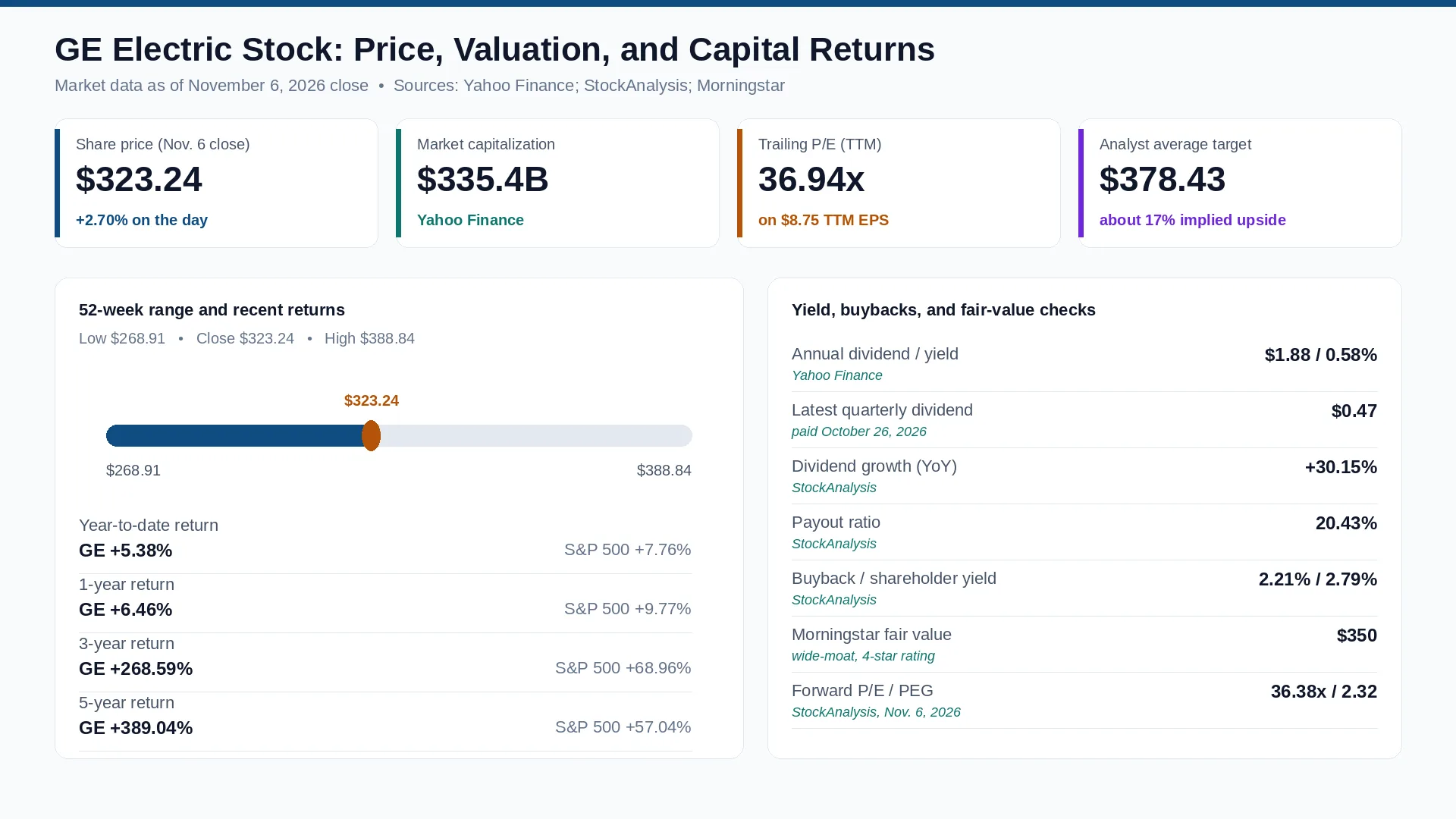 Price, valuation, dividend, and return snapshot as of the November 6, 2026 close. Sources: Yahoo Finance, StockAnalysis, and Morningstar.
The income piece is still a token. The $1.88 annualized dividend yields only 0.58%. The latest $0.47 quarterly payment went to holders of record on October 5 and was paid on October 26, 2026. StockAnalysis shows dividend growth of 30.15% year over year, a payout ratio of about 20.43%, a buyback yield of 2.21%, and a shareholder yield of 2.79%.
Institutions remain the dominant owners. 13F data for the quarter ended June 30, 2026, compiled by Stocknear, put institutional ownership at 80.4%, up from 78.56% in the first quarter, across 3,544 holders. The largest positions included BlackRock at 89.2 million shares (8.58%), Vanguard at 68.1 million (6.56%), Fidelity's FMR at 49 million (4.72%), TCI Fund Management at 47.4 million (4.56%), and State Street at 46.5 million (4.48%).
Those 13F shifts are easier to follow on a dedicated institutional smart-money tracker than by downloading every manager's filing by hand. Active-manager moves, such as TCI's concentrated stake, can matter as much as the passive index bid from BlackRock, Vanguard, and State Street.
A 0.58% dividend does not underwrite this valuation. The bull case needs services compounding, continued buybacks, and a multiple that does not compress if 2027 shop-visit growth cools from this year's peak.
The Risks That Still Justify a Margin of Safety
The cleanest risk is already visible in the guide. If fourth-quarter adjusted EPS lands near $1.87–$1.97 instead of the $2.04 that had been in consensus, investors may treat the raise as a timing shift rather than an acceleration. Yahoo Finance's estimated next report date of January 21, 2027, is the first hard test of that math.
Services growth is also set to decelerate from a hot print. Investing.com, summarizing the October 20 call, said the CFO guided LEAP shop visits to roughly 25%–26% growth in 2027, down from about 40% in the third quarter. CFM56 shop visits should stay near 2,300–2,400. That is still growth. It is not the same slope a mid-30s multiple has been paying for.
Certification and supply remain live operational risks. A slip in GE9X midseal certification beyond late 2026 would extend the revenue-recognition delay management already flagged. Culp's own comments cited supplier collaboration and "FLIGHT DECK" operating discipline as reasons year-to-date commercial services revenue and total engine deliveries were both up over 20% — language that also admits the constraint is execution, not demand.
Valuation leaves little cushion. Motley Fool argued on October 20 that even the raised free-cash-flow outlook would leave GE priced north of 36 times free cash flow against an 18% growth rate, "at the upper edge" of a fair price. StockAnalysis's later 41.66x price-to-free-cash-flow multiple and 2.32 PEG, measured at the November 6 close, make the same point with updated market prices.
Defense is not a complete shock absorber if the commercial aftermarket cools. DPT grew only 7% in the quarter. A backlog above $30 billion is useful ballast, but it cannot replace CES services if spare-parts and shop-visit growth roll over faster than investors expect.
The company's own caution list is familiar and still relevant: air-travel demand, supplier constraints, jet-fuel and commodity prices, tariffs and trade tension, and "actual or potential safety or quality issues" on GE products or third-party products they integrate with, as spelled out in the October 20 forward-looking statements.
GE electric stock works if the $170 billion services backlog converts into durable profit growth without a multiple reset. It fails if shop-visit growth, GE9X timing, or fourth-quarter earnings force investors to pay a mid-cycle price for a peak-cycle story.
FAQ
What does ge electric stock refer to after the GE breakup?
Searches for ge electric stock almost always mean GE Aerospace (NYSE: GE), the company that remained after General Electric spun off GE HealthCare in January 2023 and GE Vernova in April 2024. It is now a commercial-engine, aftermarket-services, and defense-propulsion business, not the old industrial conglomerate.
Why did GE Aerospace stock fall after beating third-quarter 2026 earnings?
GE beat estimates on October 20, 2026, with $2.25 of adjusted EPS and $13.285 billion of adjusted revenue, and it raised full-year guidance. The stock still slipped because the new $8.00–$8.10 adjusted EPS range implied fourth-quarter earnings near $1.87–$1.97, about 6% below the $2.04 Wall Street had been modeling, according to TIKR and TD Cowen.
How fast did GE Aerospace grow in the third quarter of 2026?
In the quarter ended September 30, 2026, orders rose 49% to $19.0 billion, adjusted revenue increased 18% to $13.285 billion, operating profit jumped 30% to $2.988 billion, and adjusted EPS rose 36% to $2.25. Commercial Engines & Services revenue grew 21% to $10.342 billion, while Defense & Propulsion Technologies revenue grew 7% to $3.469 billion.
Is GE electric stock expensive after the Q3 2026 report?
At the November 6, 2026 close of $323.24, Yahoo Finance showed a trailing P/E of 36.94x and StockAnalysis showed a 36.38x forward P/E, a 2.32 PEG, and a 41.66x price-to-free-cash-flow multiple. Analysts' average target was $378.43, while Morningstar's fair-value estimate was $350. The multiple leaves limited room if 2027 shop-visit growth or fourth-quarter earnings disappoint.
Does GE Aerospace pay a meaningful dividend?
GE pays a $1.88 annualized dividend, or $0.47 a quarter, for a yield of about 0.58% at the November 6, 2026 close. The latest payment went to holders of record on October 5 and was paid on October 26, 2026. The payout ratio is only about 20%, and most of the planned cash return is expected to come from buybacks rather than income.