Dividend Stocks for Passive Income in November 2026: Yields, Coverage, and Trade-offs
Founder of Tritonix.ai. Former Hedge Fund Analyst with 10+ years of experience managing over $1B AUM across insurance portfolios and private funds. Specializes in institutional-grade fundamental analysis and long-term capital allocation.
Why dividend stocks for passive income look different after the November 12 close
Dividend stocks are often sold as a simple way to generate passive income: buy shares in companies that pay cash, collect the checks, and let the yield do the work. After Thursday's close, that pitch has to compete with a risk-free alternative that now pays more than most high-quality payouts.
The U.S. Treasury put the 10-year note at 5.10% on November 12, 2026, up from 4.98% on November 10 and 4.84% on November 5. The same day, Multpl estimated the S&P 500's trailing 12-month dividend yield at 1.07%, near the lowest readings in its modern series.
On $100,000, that index yield is about $1,070 of cash over the past year. The same $100,000 in a 10-year Treasury would pay $5,100 a year if the note is held to maturity. Individual dividend stocks for passive income sit between those two figures — and a few higher-yielding names still clear the Treasury rate, with more risk and, in some cases, a different tax form.
The latest official U.S. cash session as of Friday, November 13, 2026, is Thursday, November 12. Forward yields below use that close and each company's indicated annual dividend or distribution, as listed on Yahoo Finance.
| Holding | Nov. 12 close | Indicated annual payout | Forward yield | Cash on $100,000 |
|---|---|---|---|---|
| S&P 500 (trailing 12-month yield) | — | — | 1.07% | $1,070 |
| Johnson & Johnson (JNJ) | $283.52 | $5.36 | 1.89% | $1,890 |
| Coca-Cola (KO) | $97.44 | $2.12 | 2.18% | $2,180 |
| AbbVie (ABBV) | $294.45 | $6.92 | 2.35% | $2,350 |
| ExxonMobil (XOM) | $169.78 | $4.28 | 2.52% | $2,520 |
| Procter & Gamble (PG) | $168.03 | $4.35 | 2.59% | $2,590 |
| AT&T (T) | $22.18 | $1.11 | 5.00% | $5,000 |
| 10-year U.S. Treasury | — | — | 5.10% | $5,100 |
| Enterprise Products Partners (EPD) | $37.40 | $2.24 | 5.99% | $5,990 |
Source: Yahoo Finance quote pages for KO, PG, XOM, JNJ, ABBV, T, and EPD, session of November 12, 2026; Multpl for the S&P 500 trailing yield; U.S. Treasury daily yield curve for the 10-year rate. EPD's figure is a partnership distribution, not a corporate dividend.
{
  "type": "bar",
  "title": "Forward Cash Yields After the November 12, 2026 Close",
  "index": "Holding",
  "categories": ["Yield %"],
  "data": [
    {"Holding": "S&P 500 (trailing)", "Yield %": 1.07},
    {"Holding": "JNJ", "Yield %": 1.89},
    {"Holding": "KO", "Yield %": 2.18},
    {"Holding": "ABBV", "Yield %": 2.35},
    {"Holding": "XOM", "Yield %": 2.52},
    {"Holding": "PG", "Yield %": 2.59},
    {"Holding": "AT&T", "Yield %": 5.00},
    {"Holding": "10-year Treasury", "Yield %": 5.10},
    {"Holding": "EPD", "Yield %": 5.99}
  ],
  "source": "Yahoo Finance quotes and indicated annual payouts as of the November 12, 2026 close; Multpl S&P 500 trailing dividend yield; U.S. Treasury 10-year par yield",
  "note": "EPD is a midstream partnership distribution. The S&P 500 figure is a trailing 12-month index yield, not a forward indicated yield."
}
The November 12 setup is not a simple "stocks yield more than bonds" story. Dividend stocks for passive income have to justify themselves with coverage, a record of raising the payout, and total return, because a 5.10% Treasury already beats the market's 1.07% cash yield and most Dividend Aristocrat starting yields.
Investors who want to watch those yields, prices, and ex-dividend dates in one place can use Tritonix market data alongside the company filings cited below.
How the cash from dividend stocks actually arrives
A dividend yield is just the indicated annual cash dividend divided by the share price. Yahoo Finance's forward dividend and yield figures in the table above use each company's current quarterly rate annualized. They will move the next time the stock price changes, or the next time the board changes the payout.
To receive a declared dividend, an investor generally must own the shares before the ex-dividend date and still be a shareholder of record on the record date. Cash is then paid on the payment date. Several large payers have cash dates clustered in late November and mid-December:
- ExxonMobil declared a fourth-quarter dividend of $1.07 per share, payable December 10, 2026, to shareholders of record at the close of business on November 16, 2026.
- Johnson & Johnson declared a $1.34 quarterly dividend, payable December 8, 2026, to shareholders of record on November 24, 2026, which is also the ex-dividend date.
- Coca-Cola declared a regular quarterly dividend of 53 cents, payable December 15, 2026, to shareowners of record as of the close of business on December 1, 2026.
- Procter & Gamble declared a $1.0885 quarterly dividend, payable on or after November 16, 2026, to common-stock shareholders of record at the close of business on October 23, 2026. That November payment is already locked for holders who owned the stock through the October record date.
Most dividends from U.S. C-corporations are eligible for the qualified-dividend tax rates of 0%, 15%, or 20%, depending on taxable income and holding period, rather than ordinary-income rates. Midstream partnerships such as Enterprise Products Partners generally issue a Schedule K-1, and the cash distribution is not the same as a qualified corporate dividend. That distinction matters if the goal is spendable after-tax income, not just a headline yield.
A dividend reinvestment plan can turn those checks back into more shares. That can be a useful compounding tool, but it is not a separate source of return: the investor is still exposed to the stock price, and "passive" does not mean risk-free or tax-free.
Dividend growth versus high yield
The S&P 500 Dividend Aristocrats index is built around companies in the S&P 500 that have raised their dividends for at least 25 consecutive years. Starting yield is not the membership test. In November 2026, that shows up clearly in the gap between long-running consumer and energy payers and higher-yielding telecom and midstream names.
Coca-Cola approved its 64th consecutive annual dividend increase on February 19, 2026, lifting the quarterly rate about 4%, from 51 cents to 53 cents, or $2.12 annualized. At the November 12 close of $97.44, that is a 2.18% forward yield. The company's third-quarter release on October 27 showed year-to-date cash from operations of $12.5 billion and free cash flow of $11.4 billion, and it raised full-year guidance. Yahoo Finance listed a trailing P/E of 28.74 and a year-to-date total return of 42.09%, versus 10.91% for the S&P 500.
Procter & Gamble has paid a dividend for 136 consecutive years and has increased it for 70 consecutive years. The April 2026 increase took the quarterly rate up 3% to $1.0885, or $4.35 a year. At $168.03, the forward yield is 2.59%. In fiscal 2026, P&G generated adjusted free cash flow of $15.835 billion and paid $10.2 billion in dividends, or about 64% of that free cash flow, according to its year-end release. It also bought back $5.0 billion of stock.
ExxonMobil said on October 30 that it had reached 44 consecutive years of increases in annual dividends per share and declared the $1.07 fourth-quarter rate, or $4.28 annualized. At $169.78, the forward yield is 2.52%. Third-quarter free cash flow was $19.1 billion. Shareholder distributions in the quarter were $9.4 billion, including $4.3 billion of dividends and $5.1 billion of share repurchases. The dividend alone was covered more than four times by that quarter's free cash flow; total distributions were still covered about 2.0 times.
AT&T and Enterprise sit on the other side of the Treasury line. AT&T's $1.11 indicated annual dividend produces a 5.00% yield at $22.18, almost identical to the 10-year note, but Yahoo Finance lists a 52-week range of $19.89 to $29.44 and a trailing total debt-to-equity ratio of 144.77%. Enterprise's $2.24 annualized distribution yields 5.99% at $37.40. In its third-quarter 2026 earnings release, the partnership reported distribution coverage of about 1.9 times. The extra yield comes with midstream cyclicality and K-1 tax reporting.
High starting yield is not the same as durable passive income. AT&T and Enterprise clear the 10-year on cash coupon alone; Coca-Cola, P&G, and ExxonMobil do not. The growth names are asking investors to accept a 2% handle today in exchange for a longer raise record and, in Exxon's latest quarter, very wide cash coverage.
A practical screen for dividend stocks
A useful screen for dividend stocks starts with the yield, then asks whether the cash can last. Five checks cover most of the work: how the starting yield compares with Treasuries, whether free cash flow covers the payout, how long the company has raised the dividend, what tax form the income arrives on, and what happens if rates stay high or the board cuts the check.
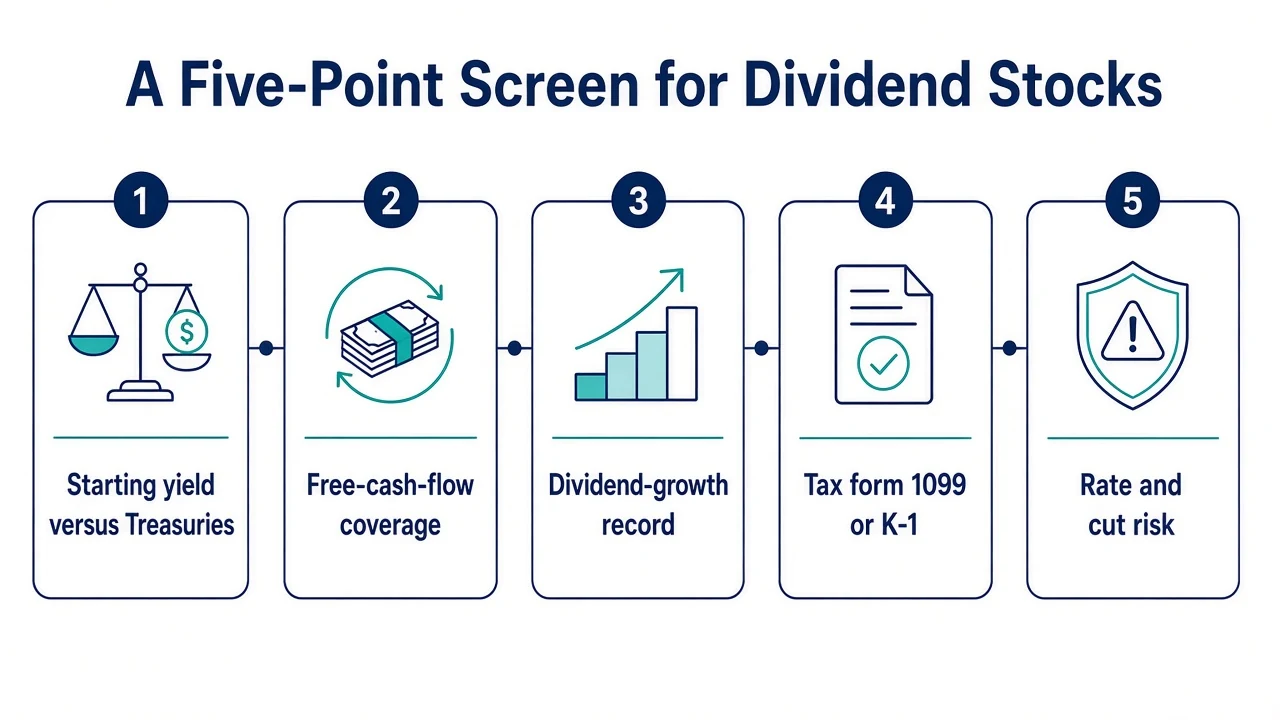
A five-point screen for dividend stocks: starting yield versus Treasuries, free-cash-flow coverage, the dividend-growth record, the tax form, and rate or cut risk. AI-generated infographic.
Coverage is the test that most often separates a sustainable income stream from a yield trap. P&G's fiscal 2026 dividend used about two-thirds of adjusted free cash flow, leaving room for buybacks and a 70-year raise streak. ExxonMobil's third-quarter free cash flow of $19.1 billion was large relative to the $4.3 billion dividend, but the company is also returning cash through buybacks, and energy cash flow can swing with oil and refining margins. Enterprise's 1.9 times coverage is wide for a midstream partnership, yet the payout is still a distribution tied to throughput and commodity volumes, not a corporate dividend backed by a 70-year consumer-staples record.
Earnings-based payout ratios can mislead in a single quarter, especially when a company books a large charge or a one-off gain. Free cash flow after maintenance-style capital spending is usually the better denominator, and it should be read over more than one period. A research workflow that lines up payout history, cash-flow coverage, and peer yields is what Tritonix's AI investment agent is built to support, particularly when the question is whether a 5% yield is earned or only advertised.
Valuation belongs on the same worksheet. Coca-Cola at 28.74 times trailing earnings is pricing durability and a 42% year-to-date total return, not a fat starting yield. AT&T at 11.86 times trailing earnings and a 5.00% yield is pricing more leverage and less recent price appreciation: Yahoo Finance's year-to-date total return was 6.45%, below the S&P 500's 10.91%. Neither multiple answers the income question by itself.
The risks that can shrink "passive" income
The first risk is a cut. A board can reduce or suspend a dividend, and the stock often falls as the income disappears. A long raise streak is evidence that management has protected the payout through prior recessions, not a guarantee that it will do so again.
The second is inflation and interest-rate competition. A 2.2% dividend that does not grow loses purchasing power. A 2.2% dividend that grows can still look expensive next to a 5.10% Treasury if the investor needs cash this year rather than a larger check in 2030. That comparison tightened in a hurry this month.
{
  "type": "line",
  "title": "U.S. 10-Year Treasury Yield in Early November 2026",
  "index": "Date",
  "categories": ["10-Year Yield"],
  "data": [
    {"Date": "2026-10-30", "10-Year Yield": 4.94},
    {"Date": "2026-11-02", "10-Year Yield": 4.91},
    {"Date": "2026-11-03", "10-Year Yield": 4.95},
    {"Date": "2026-11-04", "10-Year Yield": 4.90},
    {"Date": "2026-11-05", "10-Year Yield": 4.84},
    {"Date": "2026-11-06", "10-Year Yield": 4.86},
    {"Date": "2026-11-09", "10-Year Yield": 4.88},
    {"Date": "2026-11-10", "10-Year Yield": 4.98},
    {"Date": "2026-11-12", "10-Year Yield": 5.10}
  ],
  "source": "U.S. Treasury daily Treasury par yield curve rates, 10-year column, October 30 through November 12, 2026",
  "note": "November 11, 2026 was Veterans Day; no Treasury curve was published that day."
}
The 10-year yield rose 26 basis points from the November 5 close of 4.84% to 5.10% on November 12, according to the official Treasury curve. Every dividend stock in the table except AT&T and Enterprise now trails that cash rate on day one. If yields stay here, income-oriented buyers have a clearer alternative; if they fall, the same 2% handle on an aristocrat becomes more competitive and the price of the stock may rise, which would then compress the yield again.
Price risk is the third issue. AT&T's November 12 close is about 25% below its $29.44 52-week high. A 5% yield does not help much if the capital account falls by a quarter. ExxonMobil's 52-week range of $114.19 to $188.50 is a reminder that a 44-year dividend streak can coexist with a wide trading band. Coca-Cola, by contrast, closed at $97.44, just under its $98.38 52-week high, so more of its recent return is already in the price.
Tax and structure are the fourth. Qualified dividends, ordinary dividends, and K-1 distributions do not hit after-tax income the same way. A tax-advantaged account can blunt some of that difference, but a partnership K-1 can still add filing complexity even inside a retirement account.
None of this is a buy or sell recommendation. Dividend stocks can still be a rational way to build a growing income stream, especially for investors who want inflation protection from rising payouts and who can live with equity volatility. They are a weaker substitute for a 5.10% Treasury if the only goal is the highest, safest cash yield available on November 12.
What to watch from here
The near-term calendar is specific. ExxonMobil goes to record on November 16. Johnson & Johnson's ex-dividend and record date is November 24. Coca-Cola's record date is December 1. Those dates matter for anyone buying shares only to capture the next check; they matter less for a long-term income plan, because the stock usually drops by about the dividend amount on the ex-date.
The more important tests will show up in the next earnings season and in the Treasury market. If ExxonMobil's fourth-quarter free cash flow stays large relative to the $1.07 dividend, the 2.52% yield remains well supported even if oil prices cool. If P&G's fiscal 2027 cash conversion stays near the 100% adjusted free-cash-flow productivity it reported for fiscal 2026, the 70-year raise streak has a current cash foundation. If the 10-year yield remains at or above 5.10%, high-quality 2% dividend yields will keep looking modest on a starting-income comparison.
For investors building dividend stocks for passive income, the November 12 close frames a clear choice rather than a single best idea. One path accepts a 2% handle from companies with long raise records and documented cash coverage. The other reaches for 5% to 6% in telecom or midstream and has to underwrite leverage, cyclical cash flow, or K-1 tax reporting. A 10-year Treasury at 5.10% sits in the middle as the benchmark those equity income claims now have to beat.
FAQ
What are dividend stocks for passive income?
They are shares of companies, or in some cases publicly traded partnerships, that pay cash to owners on a regular schedule. The income is often called passive because it does not require the shareholder to operate the business, but the cash still depends on the board's dividend policy, the company's free cash flow, and the share price. After the November 12, 2026 close, quality names such as Coca-Cola, Procter & Gamble, and ExxonMobil yielded about 2.2% to 2.6%, while the 10-year Treasury yielded 5.10% and the S&P 500's trailing dividend yield was 1.07%.
How much income can dividend stocks produce right now?
It depends on the yield. On $100,000, the S&P 500's 1.07% trailing yield is about $1,070 a year. Coca-Cola's 2.18% forward yield at the November 12 close of $97.44 is about $2,180, Procter & Gamble's 2.59% yield at $168.03 is about $2,590, AT&T's 5.00% yield at $22.18 is about $5,000, and Enterprise Products Partners' 5.99% distribution yield at $37.40 is about $5,990. Those figures are pretax and will change if prices or payouts change.
Are high-yield dividend stocks better than Dividend Aristocrats?
Not automatically. Dividend Aristocrats are S&P 500 companies that have raised their dividends for at least 25 consecutive years, which favors durability over a high starting yield. In November 2026, Coca-Cola, Procter & Gamble, and ExxonMobil yielded 2.18% to 2.59% but came with long raise records and documented cash coverage. AT&T and Enterprise cleared or exceeded the 5.10% 10-year Treasury yield, but that extra cash comes with higher leverage, midstream cyclicality, or K-1 tax reporting. The better choice depends on whether the investor needs maximum cash today or a growing payout over time.
How do Treasuries compare with dividend stocks in November 2026?
The U.S. Treasury 10-year par yield was 5.10% on November 12, 2026, up from 4.84% on November 5. That is higher than the S&P 500's 1.07% trailing dividend yield and higher than the forward yields on Coca-Cola, Procter & Gamble, ExxonMobil, Johnson & Johnson, and AbbVie. AT&T's 5.00% yield was almost even with the note, and Enterprise's 5.99% distribution yield was higher. The Treasury coupon is backed by the U.S. government if the note is held to maturity; dividend stocks can raise the payout over time but can also cut it and can fall in price.
What should investors check before buying dividend stocks for income?
Start with the indicated yield versus the 10-year Treasury, then check whether free cash flow covers the dividend over more than one period, how long the company has raised the payout, and whether the income arrives as a qualified dividend on a Form 1099 or as a partnership distribution on a Schedule K-1. Also look at upcoming ex-dividend dates, leverage, and valuation. A high yield with thin coverage is often a warning, not a bargain.