DIS Stock Stock Analysis 2026: Disney Before Q4 Earnings
Founder of Tritonix.ai. Former Hedge Fund Analyst with 10+ years of experience managing over $1B AUM across insurance portfolios and private funds. Specializes in institutional-grade fundamental analysis and long-term capital allocation.
What "DIS Stock Stock" Searches Actually Mean
People typing dis stock stock are almost always looking for one equity: The Walt Disney Company (NYSE: DIS). The doubled word is a search artifact, not a second share class. Disney's economically relevant security for most investors is the common stock that closed at $116.75 on November 6, 2026, according to Yahoo Finance.
That print sat just under the 52-week high of $120.80 and well above the 52-week low of $92.19. The market value was about $201.6 billion, with a trailing P/E near 24.1x on $4.85 of TTM EPS and a $1.50 annual dividend (1.28% yield). Disney reports fiscal fourth-quarter and full-year 2026 results on November 17, 2026, at 8:30 a.m. ET, per the company's investor-relations webcast notice.
The setup is more nuanced than a simple pre-earnings bounce. Fiscal 2026 has a 53rd week, which management says should add about $600 million to fourth-quarter segment operating income. Shares are also digesting a leadership transition: Josh D'Amaro succeeded Bob Iger as CEO on March 18, 2026, according to Deadline, and the company is simultaneously buying back stock, investing in parks and cruises, and evaluating further cost cuts.
DIS stock stock is a franchise-compounder debate: whether parks, streaming margins, and buybacks can outweigh theatrical volatility and rights-cost pressure before the November 17 print.
Year to date through November 6, 2026, DIS returned 3.41%, trailing the S&P 500's 7.76% (Yahoo Finance). The one-year return of 7.20% also lagged the index's 9.77%. That gap is the valuation opening bulls emphasize — and the execution discount bears refuse to close until Q4 confirms the guide.
Q3 2026 Scorecard: An Earnings Beat With a Revenue Miss
Disney's latest completed quarter is fiscal Q3, ended June 27, 2026, and reported on August 5, 2026. Revenue rose 7% to $25.248 billion. Income before income taxes increased 14% to $3.645 billion. Total segment operating income jumped 21% to $5.555 billion and modestly exceeded prior guidance (company shareholder letter filed with the SEC).
Adjusted EPS, which Disney reports as diluted EPS excluding certain items, rose 28% to $2.06 from $1.61. That beat the Zacks consensus of $1.88. Reported revenue of $25.25 billion missed the Zacks estimate of $25.48 billion (Zacks, August 6, 2026). GAAP diluted EPS fell 48% to $1.51 from $2.92 — a comparison that is not useful without adjustment.
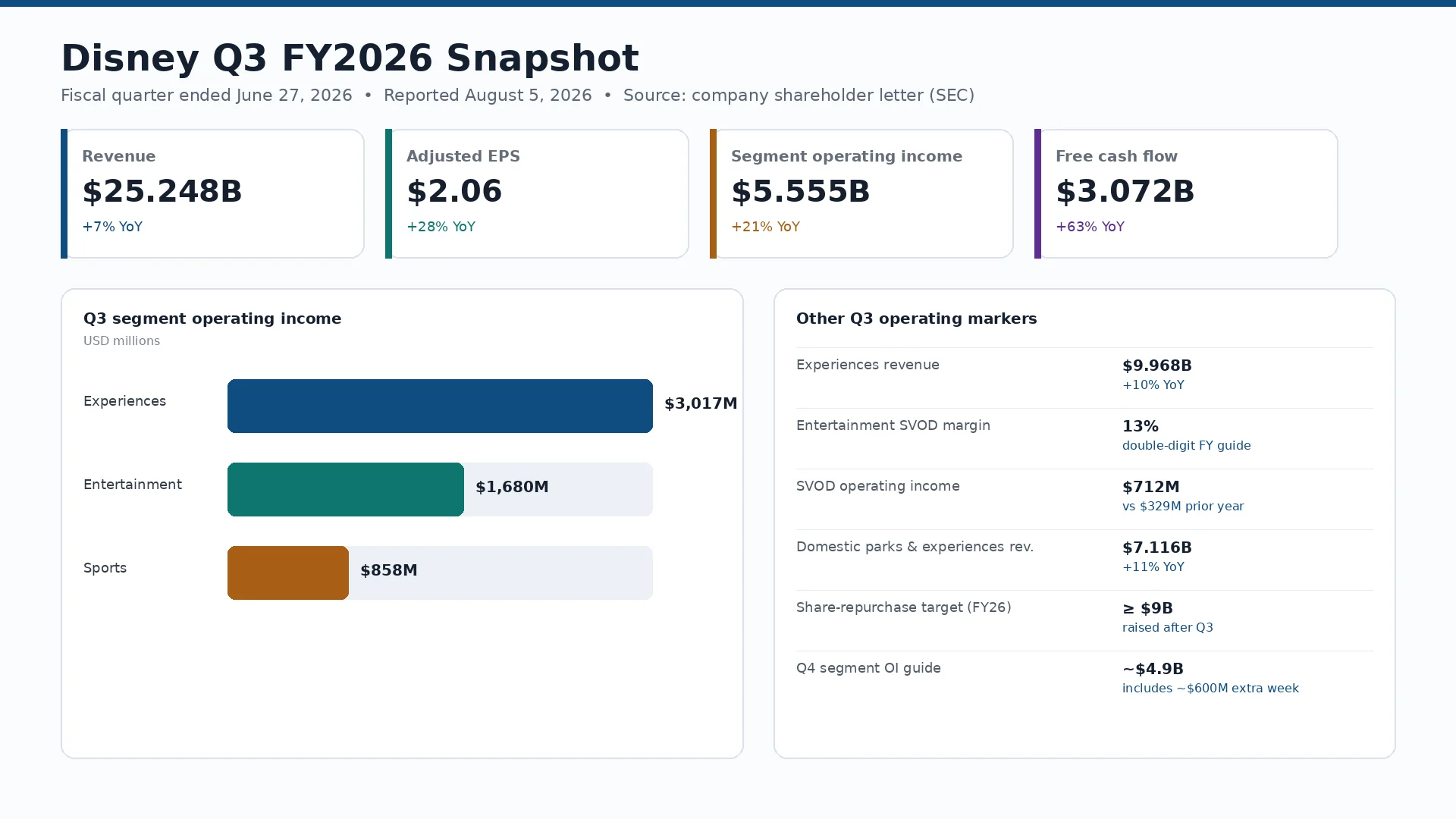 Q3 FY2026 snapshot: revenue, adjusted EPS, segment operating income, and capital-return targets. Source: Disney shareholder letter, August 5, 2026.
The prior-year GAAP figure included a $3.277 billion non-cash tax benefit tied to Hulu's U.S. tax classification, worth $1.56 per share. This year's GAAP result included $900 million of restructuring and impairment charges, of which $812 million was an impairment of Disney's A+E Global Media investment and $88 million was severance. Stripping those items is why adjusted earnings accelerated while the headline EPS number contracted.
| Metric (Q3 FY2026) | Result | Year-over-year |
|---|---|---|
| Revenue | $25.248B | +7% |
| Income before taxes | $3.645B | +14% |
| Total segment operating income | $5.555B | +21% |
| Diluted EPS (GAAP) | $1.51 | −48% |
| Adjusted EPS | $2.06 | +28% |
| Cash from operations | $4.866B | +33% |
| Free cash flow | $3.072B | +63% |
Source: The Walt Disney Company Q3 FY2026 shareholder letter, filed with the SEC on August 5, 2026.
{
  "type": "bar",
  "title": "Disney Q3 FY2026 Segment Operating Income",
  "index": "Segment",
  "categories": ["Operating Income ($M)"],
  "data": [
    {"Segment": "Experiences", "Operating Income ($M)": 3017},
    {"Segment": "Entertainment", "Operating Income ($M)": 1680},
    {"Segment": "Sports", "Operating Income ($M)": 858}
  ],
  "source": "Disney Q3 FY2026 shareholder letter (SEC exhibit, Aug. 5, 2026)",
  "note": "Experiences contributed about 54% of the $5.555 billion total segment operating income."
}
Nine-month figures keep the quarter in context. Through June 27, 2026, revenue was $76.397 billion (+6%), segment operating income was $14.758 billion (+5%), and adjusted EPS was $5.25 versus $4.82 (+9%). Free cash flow for the nine months fell 24% to $5.735 billion, even though the third quarter itself was strong, because of higher tax payments and elevated sports-content spend.
Those tax payments included U.S. federal and California liabilities deferred under wildfire-related relief. Nine-month capital spending also rose to $6.780 billion from $6.108 billion, led by new attractions.
The clean read on Q3 is a 28% adjusted-EPS beat built on Experiences and streaming, not a collapse in earnings power.
Experiences: Parks, Cruises, and the Physical Growth Engine
Experiences remains the ballast under DIS stock stock. The segment produced $9.968 billion of revenue (+10%) and $3.017 billion of operating income (+20%) in Q3. Global guests increased 4%, domestic park attendance rose 3%, and domestic per-capita spending advanced 4%, according to both the shareholder letter and D'Amaro's remarks on the August 5 call.
Management broke the 10% Parks & Experiences revenue gain into roughly 6% volume and 3% rate. Theme-park admissions rose 9% to $3.253 billion, split between 5% higher average ticket yield and 3% more attendance. Resorts and vacations jumped 17% to $2.766 billion, including a 10% lift from additional passenger cruise days after the Disney Destiny (November 2025) and Disney Adventure (March 2026) entered service and lifted stateroom capacity by about 50%.
Where the margin expansion came from
Domestic Parks & Experiences revenue rose 11% to $7.116 billion, and domestic operating income climbed 27% to $2.088 billion. International Parks & Experiences revenue grew 6% to $1.787 billion, but operating income fell 13% to $369 million. Consumer Products revenue increased 7% to $1.065 billion, and operating income rose 26% to $560 million, helped by Toy Story 5 and Star Wars merchandise.
A roughly $100 million tariff refund aided cost of goods sold and accounted for about four points of the segment's 20% operating-income growth; it did not affect Experiences revenue. Management said any additional refunds should be insignificant. Nine-month Experiences operating margin was about 30%, and Disney said future capital projects are expected to deliver double-digit lifetime returns.
Walt Disney World stood out on attendance from domestic tourists and annual passholders. Disneyland Paris benefited from World of Frozen. Asian parks were soft, and management expects that softness to persist in Q4. Forward bookings at Walt Disney World and at Disney Cruise Line were described as healthy on the earnings call (Zacks recap, August 6, 2026).
Domestic parks and new cruise capacity are carrying Experiences; Asia and international park margins are the offset investors must keep in the model.
Toy Story 5, released theatrically on June 19, 2026, surpassed $1 billion in global box office and lifted the five-film franchise above $4 billion lifetime, the company said. That title also contributed to Disney's strongest Consumer Products revenue growth in 20 quarters. The film is a reminder that theatrical results matter less as isolated opening weekends than as fuel for parks, merchandising, and streaming engagement.
Beginning in fiscal Q1 2027, Disney plans to move much of Consumer Products from Experiences into Entertainment so studio-created IP and merchandise returns sit in the same segment. That is a presentation change, not a cash-flow event, but it will break segment comparability.
Entertainment and Streaming: The SVOD Margin Test
Entertainment revenue rose 6% to $11.345 billion, while segment operating income surged 64% to $1.680 billion. Subscription and affiliate fees increased 12% to $7.545 billion. Advertising slipped 1% to $1.625 billion, and content sales fell 6% to $1.596 billion. The operating-income jump was driven by subscription fees and lower marketing costs, not a box-office boom.
Entertainment SVOD — Disney+, Hulu SVOD, and, historically, Disney+ Hotstar through November 14, 2024 — generated $5.532 billion of revenue (+11%) and $712 million of operating income, more than double the prior-year $329 million. Subscription fees rose 15% to $4.715 billion, from 9% more subscribers, 3% higher effective rates, and 1% favorable foreign exchange. Advertising increased 3% to $851 million.
The SVOD operating margin was 13% in Q3, or 12.9% on the company's more precise reconciliation, helped in part by the timing of marketing and programming spend. Management continues to expect a double-digit Entertainment SVOD margin for full-year fiscal 2026, excluding the 53rd week. That is the strategic pivot investors have waited years to see: streaming as a profit contributor rather than a subsidy for subscriber growth.
What still has to go right digitally
D'Amaro has said Disney+ should become the company's "digital centerpiece." In Q3, Hulu standalone and bundle subscribers gained the ability to link profiles, watch history, and subscription management on Disney+. Live television and add-ons are expected by the end of calendar 2026. Management also reported lower Disney+ churn domestically and internationally and said product improvements in search and discovery are lifting engagement.
Theatrical results were mixed beneath that streaming progress. Toy Story 5 and, internationally, The Devil Wears Prada 2 performed well. Star Wars: The Mandalorian and Grogu and the live-action Moana posted strong audience scores but missed internal box-office expectations. Management already warned that Q4 Entertainment will reflect the Moana shortfall and a softer domestic SVOD advertising market.
Disney is also using sports and social video to keep users inside the app, including a broader subset of ESPN games on Disney+ this fall and a TikTok agreement, announced August 5, to bring curated creator content onto Disney+ Verts.
Streaming has cleared the double-digit margin bar, but advertising softness and film miss-risk can still bend the Entertainment line in any single quarter.
Sports, Buybacks, and the Cost-Cut Overlay
Sports revenue increased 4% to $4.500 billion, but operating income fell 17% to $858 million from $1.037 billion. That decline was steeper than management's prior guide of about 14%. Subscription and affiliate fees rose 8% to $3.142 billion, including 5% from higher effective rates and 4% from the NFL transaction. Advertising increased 5% to $1.204 billion on higher impressions.
The profit pressure came from programming and production costs, which rose 10% to $3.050 billion. Drivers included contractual rate increases, new rights, and the timing of NBA-contract costs that shifted into the third quarter. Early-round NBA Playoff sweeps and a network carriage dispute also hurt. Other revenue dropped 41%, primarily because UFC pay-per-view comparisons disappeared after those rights expired in December 2025.
Audience metrics were strong even as margins compressed. Disney said the 2026 NBA and NHL championship series more than doubled prior-year ratings, the playoffs were the most-viewed ever on its networks, and fiscal Q3 was the most-watched for ESPN, ESPN2, and ESPN on ABC since 2016. In June, ESPN reached nearly 230 million unique fans and more than 80% of the U.S. internet population, per the company's Comscore citation.
Two portfolio moves are reshaping the perimeter. On January 31, 2026, ESPN acquired NFL Network and related assets for a 10% noncontrolling interest; Disney's effective ESPN stake is now 72%, with Hearst at 18%. In July 2026, Disney agreed to sell its 50% A+E stake to a Hearst affiliate for about $1.2 billion, with closing expected by the end of fiscal 2026 subject to approvals.
Capital returns versus restructuring headlines
Management raised the fiscal 2026 repurchase target to at least $9 billion, up from the $8 billion target stated after Q2 and the $7 billion goal outlined earlier in the year. Nine-month buybacks already totaled $7.245 billion. Treasury stock increased to 148 million shares at June 27, 2026, from 79 million at fiscal 2025 year-end. Diluted weighted-average shares fell to 1.743 billion in Q3 from 1.805 billion a year earlier.
CFO Hugh Johnston said the higher buyback target reflected cash previously reserved for an OpenAI transaction and expected A+E sale proceeds (Zacks recap of the August 5 call). Full-year guidance still calls for at least $19 billion of operating cash flow and about $9 billion of capital expenditures. Johnston also kept content investment near $24 billion for fiscal 2026, according to that same recap.
Cost cutting is the other side of the capital-return story. In the August 5 letter, D'Amaro and Johnston wrote that Disney is "evaluating a variety of levers, including reductions in labor and SG&A." On November 2, 2026, Variety, citing Bloomberg, reported that some managers had been asked to cut expenses by 20% on an annualized basis and that another sizable layoff round could follow earlier 2026 reductions. Disney declined to comment.
Those reports should be treated as unconfirmed operating color, not official guidance. The investable question is whether savings are recycled into content, technology, parks, and cruises — the reinvestment hierarchy Johnston emphasized — without damaging the creative engine that feeds parks and streaming. Tracking how large holders respond to that trade-off is easier with tools such as institution smart money than by reacting only to headline job-cut estimates.
Buybacks of at least $9 billion signal management thinks the shares are cheap; unverified 20% cost targets add execution and morale risk around the same thesis.
Valuation and the November 17 Q4 Setup
At $116.75, DIS trades at about 24.1x trailing GAAP earnings of $4.85 (Yahoo Finance, November 6, 2026). That multiple overstates the cash earnings load if Q3's A+E impairment and last year's Hulu tax benefit stay in the trailing mix. A cleaner cross-check uses management's fiscal 2026 adjusted-EPS guide against fiscal 2025 adjusted EPS of $5.93.
Approximately 12% growth excluding the 53rd week implies about $6.64 of adjusted EPS. Including the extra week, about 16% growth implies roughly $6.88. At the November 6 close, those figures equate to roughly 17.6x and 17.0x forward adjusted earnings, respectively. Yahoo Finance's displayed average 12-month target was $126.83, about 9% above the last close, with a published analyst range of $86 to $144.
Citigroup, in a rating note dated October 16, 2026, and shown on Yahoo Finance, maintained a Buy rating and raised its price target from $135 to $140. That is one bank, not a consensus. The more important near-term marker is internal: Q4 total segment operating income of about $4.9 billion, including roughly $600 million from the extra week.
| Fiscal 2026 guide (as of Aug. 5, 2026) | Company outlook |
|---|---|
| Adjusted EPS growth, ex-53rd week | About +12% |
| Adjusted EPS growth, including 53rd week | About +16% |
| Q4 total segment operating income | About $4.9B (extra week ~$600M) |
| Experiences operating income, ex-53rd week | High end of high-single-digit growth |
| Entertainment operating income, ex-53rd week | Double-digit growth |
| Sports operating income, ex-53rd week | Mid-single-digit growth |
| Cash from operations | At least $19B |
| Capital expenditures | About $9B |
| Share repurchases | At least $9B |
| Fiscal 2027 adjusted EPS, ex-53rd week | Double-digit growth |
Source: Disney Q3 FY2026 shareholder letter (August 5, 2026) and FY2025 earnings release for the $5.93 adjusted-EPS base.
{
  "type": "bar",
  "title": "Disney Quarterly Adjusted EPS",
  "index": "Quarter",
  "categories": ["Adjusted EPS ($)"],
  "data": [
    {"Quarter": "Q4 FY25", "Adjusted EPS ($)": 1.11},
    {"Quarter": "Q1 FY26", "Adjusted EPS ($)": 1.63},
    {"Quarter": "Q2 FY26", "Adjusted EPS ($)": 1.57},
    {"Quarter": "Q3 FY26", "Adjusted EPS ($)": 2.06}
  ],
  "source": "Disney FY2025 earnings release; Q1, Q2, and Q3 FY2026 shareholder letters",
  "note": "Q3 FY2026 adjusted EPS of $2.06 was the strongest print in this four-quarter span."
}
The Q4 checklist is specific. Experiences should again show global guest growth excluding the extra week, even with Asia soft. Entertainment must absorb the Moana miss and weaker domestic streaming ads while still delivering double-digit full-year operating-income growth. Sports is guided back to mid-single-digit full-year growth as rights-cost timing normalizes. Any update on the A+E closing, repurchase pacing versus the $9 billion target, or quantified cost actions will move the multiple.
Price action into the print already reflects a tighter risk/reward. DIS closed November 6 only about 3.4% below its 52-week high after a sharp early-November advance that included a 4.18% gain on November 4 and a session high of $120.80 on November 5 (Yahoo Finance). Investors who want to map that strength against support, volume, and prior bases can use Tritonix AI technical analysis alongside the fundamental checklist above.
A mid-teens forward multiple on guided adjusted EPS is not optically expensive, but it leaves less room if Q4 Entertainment or Asia parks disappoint.
The core debate around dis stock stock is whether Disney can keep compounding Experiences and streaming profits while theatrical results stay uneven and sports rights stay expensive. Q3 argued that the first two engines are working. November 17 will show whether the 53rd-week math, the buyback, and management's still-unquantified cost program can convert that operating progress into a cleaner full-year scorecard.
FAQ
What does DIS stock stock mean?
It is a common search phrase for The Walt Disney Company (NYSE: DIS). There is no separate “stock stock” share class; investors are looking up Disney’s common shares, which closed at $116.75 on November 6, 2026, according to Yahoo Finance.
When does Disney report Q4 2026 earnings?
Disney will host its fiscal fourth-quarter and full-year 2026 earnings webcast at 8:30 a.m. ET on November 17, 2026, according to the company’s investor-relations event notice.
How did Disney perform in Q3 FY2026?
For the quarter ended June 27, 2026, Disney reported $25.248 billion of revenue (+7%), $5.555 billion of segment operating income (+21%), and adjusted EPS of $2.06 (+28%). GAAP diluted EPS fell to $1.51, largely because the year-ago period included a large Hulu-related tax benefit (SEC shareholder letter, August 5, 2026).
Is DIS stock expensive after the early-November rally?
At $116.75 on November 6, 2026, DIS traded near 24.1x trailing GAAP EPS of $4.85 and only about 3.4% below its $120.80 52-week high (Yahoo Finance). Applying management’s FY2026 adjusted-EPS growth guide to FY2025 adjusted EPS of $5.93 implies roughly 17.0x–17.6x forward adjusted earnings. Yahoo Finance showed an average 12-month target of $126.83.
What should DIS investors watch on November 17?
Key items are Q4 segment operating income versus the roughly $4.9 billion guide (including about $600 million from the 53rd week), Experiences guest trends outside Asia, Entertainment results after the Moana miss and softer domestic SVOD ads, repurchase pacing toward the $9 billion target, and any quantified update on cost actions.