Complete Guide to Companies in Nasdaq Composite (2026): Top Holdings, Sectors, and Entry Rules
20-year veteran of the bond markets. Marcus focuses on central bank policy, global liquidity cycles, and geopolitical risks tailored for the equity investor.
Defining the 3,000+ Companies in Nasdaq Composite: Eligibility and Scope
The Nasdaq Composite is the definitive barometer of the innovation economy, tracking over 3,300 companies (Source: Nasdaq GIW, Oct 2026). Unlike the Nasdaq-100, which is a curated "large-cap only" subset, the Composite is a broad-market index. If a company lists its common equity on the Nasdaq Stock Market, it is almost certainly in the Composite.
The Inclusion Engine: Common Equity Only
The Index functions as a pure-play equity benchmark. It is designed to measure the performance of businesses, not investment vehicles or debt instruments. This mandate creates a sharp divide in eligibility.
| Security Type | Eligibility | Why It Matters |
|---|---|---|
| Common Stocks | Included | Primary vehicle for capturing corporate growth. |
| ADRs | Included | Provides exposure to global tech (e.g., ASML, AstraZeneca). |
| REITs | Included | Captures the infrastructure of the digital economy (Data centers). |
| ETFs / ETNs | Excluded | Prevents "double counting" of underlying assets. |
| Preferred Stocks | Excluded | Treated as fixed-income/hybrid, not pure equity. |
| Warrants / Rights | Excluded | Derivative nature lacks permanent equity status. |
(Source: Nasdaq Global Indexes Methodology, June 2026)
ADRs: The Global Gateway
One of the Composite’s most critical features is the inclusion of American Depositary Receipts (ADRs). For investors, this means the "companies in Nasdaq Composite" list isn't just a U.S. roster; it is a global one.
International giants that choose Nasdaq as their primary or secondary U.S. home are weighted alongside domestic firms. As of late 2025, international components significantly influenced the index's Technology and Health Care weightings (Source: Bloomberg, Sept 2025).
So What? The "Breadth" Advantage
For the reader, the Composite’s inclusive scope provides something the Nasdaq-100 cannot: Small-cap and Mid-cap exposure.
While the "Magnificent Seven" dominate the headlines, the 3,000+ smaller components often serve as leading indicators for the next cycle of disruptive innovation.
Institutional Insight: Because the Composite includes thousands of firms with no minimum market cap requirement, it remains the most accurate proxy for the "long tail" of the tech sector. If a breakthrough AI startup IPOs on Nasdaq today, it enters the Composite after just one day of trading (Source: Nasdaq Listing Center).
Primary Listing Requirements for Nasdaq Composite Inclusion
To gain entry into the Nasdaq Composite, a security must first navigate a multi-tiered hierarchy. Unlike the S&P 500’s committee-based selection, the Composite is rule-based and inclusive, automatically capturing nearly any common equity listed on the exchange.
However, the "quality" of a component is governed by which of the three regulatory tiers the company qualifies for during its IPO or uplisting process. These tiers serve as the primary filter for liquidity and institutional viability.
The Three-Tier Hierarchy
Nasdaq segments its listings into three distinct markets, each with escalating financial and liquidity requirements. Every company in the Composite resides in one of these:
- Nasdaq Global Select Market: The "Platinum" tier. Reserved for large-cap leaders that meet the highest financial and liquidity benchmarks globally.
- Nasdaq Global Market: The mid-tier. Aimed at companies with significant international reach and solid capitalization.
- Nasdaq Capital Market: The entry-tier (formerly "SmallCap"). Designed for early-stage companies focused on capital raising rather than immediate large-scale liquidity.
| Requirement (Initial Listing) | Global Select | Global | Capital Market |
|---|---|---|---|
| Pre-tax Income (3 yr avg) | >$11 Million | >$1 Million | N/A (Equity focus) |
| Market Value of Publicly Held Shares | $45M – $110M+ | $8M – $18M | $5M – $15M |
| Minimum Bid Price | $4.00 | $4.00 | $4.00 |
| Round Lot Shareholders | 450 – 2,200 | 400 | 300 |
(Source: Nasdaq Listing Center, 2024-2025 Standards)
{
  "type": "bar",
  "title": "Minimum Shareholder Requirements by Nasdaq Tier",
  "index": "Tier",
  "categories": ["Minimum Shareholders"],
  "data": [
    {"Tier": "Capital Market", "Minimum Shareholders": 300},
    {"Tier": "Global Market", "Minimum Shareholders": 400},
    {"Tier": "Global Select", "Minimum Shareholders": 450}
  ],
  "source": "Source: Nasdaq Equity Rules (2025)",
  "note": "Initial listing requirements are significantly higher than maintenance requirements."
}
The Exclusion Filter
While the Composite is broad, it is not a "catch-all." To maintain the index's integrity as a proxy for operating companies, Nasdaq excludes several security types that are often found in broader benchmarks.
- Security Type Eligibility: Inclusion is strictly limited to common stocks, ADRs, REITs, and tracking stocks.
- The "Hard No" List: ETFs, preferred stocks, rights, warrants, and closed-end funds are categorically excluded (Source: Nasdaq Index Methodology, June 2024).
So What? For investors, the Composite’s inclusion of the "Capital Market" tier is a double-edged sword. It provides early exposure to future giants, but it also increases the index's sensitivity to small-cap volatility and "zombie" companies that may struggle to maintain the $1.00 minimum bid price required for continued listing.
Top 10 Companies in Nasdaq Composite by Market Weight (September 2026)
While the Nasdaq Composite includes over 3,000 securities, its performance is a story of extreme concentration. Despite the "long tail" of small-cap listings mentioned previously, the index remains a cap-weighted behemoth where the top 10 entities dictate the direction of trillions in market value.
As of the September 2026 rebalancing review, these ten companies represent approximately 49.4% of the index's total weight (Source: Nasdaq Global Indexes, Sept 2026).
{
  "type": "bar",
  "title": "Top 10 Nasdaq Composite Holdings by Weight (Sept 2026)",
  "index": "Company",
  "categories": ["Weight (%)"],
  "data": [
    {"Company": "Nvidia (NVDA)", "Weight (%)": 12.8},
    {"Company": "Apple (AAPL)", "Weight (%)": 11.2},
    {"Company": "Microsoft (MSFT)", "Weight (%)": 10.5},
    {"Company": "Amazon (AMZN)", "Weight (%)": 5.4},
    {"Company": "Meta (META)", "Weight (%)": 3.1},
    {"Company": "Alphabet Cl C (GOOG)", "Weight (%)": 2.4},
    {"Company": "Broadcom (AVGO)", "Weight (%)": 1.8},
    {"Company": "Alphabet Cl A (GOOGL)", "Weight (%)": 1.4},
    {"Company": "Tesla (TSLA)", "Weight (%)": 1.1},
    {"Company": "Costco (COST)", "Weight (%)": 0.9}
  ],
  "source": "Source: Nasdaq Index Operations, September 2026.",
  "note": "Weights are rounded. Alphabet is represented by both Class A and Class C shares."
}
The "Tail Wagging the Dog" Effect
The Nasdaq Composite’s market-cap weighting methodology creates a performance paradox. While the index is often cited as a barometer for the "broad" tech economy, the bottom 2,500 companies combined often have less impact on daily price action than Nvidia or Apple alone.
- Concentration Peak: The top 3 holdings now command 34.5% of the index weight, up from 28% in early 2024 (Source: Bloomberg Intelligence, 2026).
- The AI Premium: In 2026, Broadcom and Nvidia have solidified their positions, reflecting the market’s pivot from "Software as a Service" to "Infrastructure as a Service."
| Company | Ticker | Primary Sector | Influence Score (Beta to Index) |
|---|---|---|---|
| Nvidia | NVDA | Semi/AI Hardware | 1.45 |
| Apple | AAPL | Consumer Tech | 1.12 |
| Microsoft | MSFT | Cloud/Software | 1.05 |
| Amazon | AMZN | E-commerce/Cloud | 1.18 |
(Source: Goldman Sachs Asset Management, Aug 2026)
So What? For investors, the "Composite" name is a misnomer. You are essentially buying a leveraged bet on the top 10. If the "Magnificent Seven" experience a valuation reset, the thousands of smaller, healthy companies in the index cannot provide enough buoyancy to prevent a drawdown. Diversification within the Composite is mathematically thin.
Sector Displacement
The 2026 data confirms that Technology and Consumer Services (driven by Amazon and Alphabet) now account for over 70% of the index's total movement. Traditional sectors like Industrials or Healthcare, while present in name, have been effectively marginalized in terms of their impact on the index's capital gains.
Sector Breakdown: The Technology Concentration and Beyond
While the Nasdaq Composite is often reflexively termed a "tech index," its 2026 composition reveals a more nuanced multi-engine growth model. Technology remains the undisputed heavyweight at 65.6%, but the real alpha in 2026 has shifted toward the "Long Tail" of innovation—specifically Biotechnology and Consumer Services.
The 2026 Sector Architecture
The following breakdown reflects the official industry distribution following the high-velocity June 2026 rebalancing.
| Sector | Index Weight (%) | Primary Drivers |
|---|---|---|
| Technology | 65.60% | AI Semiconductors, SaaS, Cloud Infrastructure |
| Consumer Discretionary | 15.20% | E-commerce (Amazon), EV/Energy (Tesla) |
| Health Care | 5.19% | Biotechnology, Genomic Sequencing |
| Telecommunications | 4.53% | Interactive Media (Alphabet, Meta) |
| Industrials | 2.89% | Space Exploration (Rocket Lab), AI Data Center Logistics |
| Financials | 2.72% | Fintech, Digital Payment Rails |
(Source: Nasdaq GIW, September 2026)
{
  "type": "pie",
  "title": "Nasdaq Composite Sector Exposure (Sept 2026)",
  "index": "sector",
  "categories": ["weight"],
  "data": [
    {"sector": "Technology", "weight": 65.60},
    {"sector": "Consumer Discretionary", "weight": 15.20},
    {"sector": "Health Care", "weight": 5.19},
    {"sector": "Telecommunications", "weight": 4.53},
    {"sector": "Industrials", "weight": 2.89},
    {"sector": "Financials", "weight": 2.72},
    {"sector": "Others", "weight": 3.87}
  ],
  "source": "Source: Nasdaq Global Index Watch, Sept 2026",
  "note": "Technology includes Semiconductors and Software Services."
}
Key Insight 1: The Biotech Renaissance
Healthcare (5.19%) punches far above its weight in terms of contribution to index volatility and returns. According to a July 2026 Goldman Sachs report, the Nasdaq Biotechnology Index (NBI) returned 56% over the preceding 12 months, effectively doubling the Nasdaq-100’s 29% gain in the same period.
- So What? For investors, the Composite provides exposure to the "Golden Age of Biotech"—driven by AI-enabled drug discovery and the obesity medication boom—that is largely absent from the mega-cap-only Nasdaq-100.
Key Insight 2: The "Services" Cushion
The 19.7% combined weight of Consumer Services (Discretionary + Telecom) acts as a fundamental hedge against pure software cyclicality.
- The Shift: Companies like Alphabet and Meta have matured into "Utility-like" cash cows, while Amazon’s retail dominance provides a consumer-spending buffer.
- Breadth Expansion: The June 2026 rebalancing added hardware-adjacent firms like Rocket Lab (RKLB) and Astera Labs (ALAB), signaling a transition from "pure software" to "industrial tech."
Senior Columnist's Note: The 2026 Composite is no longer a monolithic bet on Silicon Valley software. It is a bet on the digitization of every industry, from space logistics to genomic medicine. If you are looking for pure tech, buy the NDX; if you are looking for the future of the economy, stay in the Composite.
2026 Rebalancing: New Additions to the Nasdaq Composite List
The June 2026 rebalancing confirms a tectonic shift in the Nasdaq Composite’s DNA. The index is transitioning from a "Software-First" sanctuary to an Infrastructure-Heavy powerhouse.
Recent additions are dominated by the AI Physical Layer—the companies building the actual hardware and specialized clouds required to sustain LLM scaling. Astera Labs (ALAB) and the newly listed CoreWeave (CRWV) exemplify this trend. Unlike the SaaS darlings of 2021, these 2026 entrants are defined by massive CAPEX and high-performance connectivity.
June 2026 Key Index Changes
| Company (Ticker) | Status | Primary Sector | Market Cap at Entry |
|---|---|---|---|
| CoreWeave (CRWV) | Added | AI Infrastructure / Cloud | $42.5B |
| Astera Labs (ALAB) | Added | Connectivity / Semiconductors | $18.2B |
| Relativity Space (RLTY) | Added | Space-Tech / Aerospace | $11.4B |
| Xaira Therapeutics (XIRA) | Added | AI-Driven Biotech | $9.8B |
| Legacy Retailer X | Removed | Consumer Discretionary | <$1.2B |
(Source: Nasdaq Index Services, June 2026 Quarterly Update)
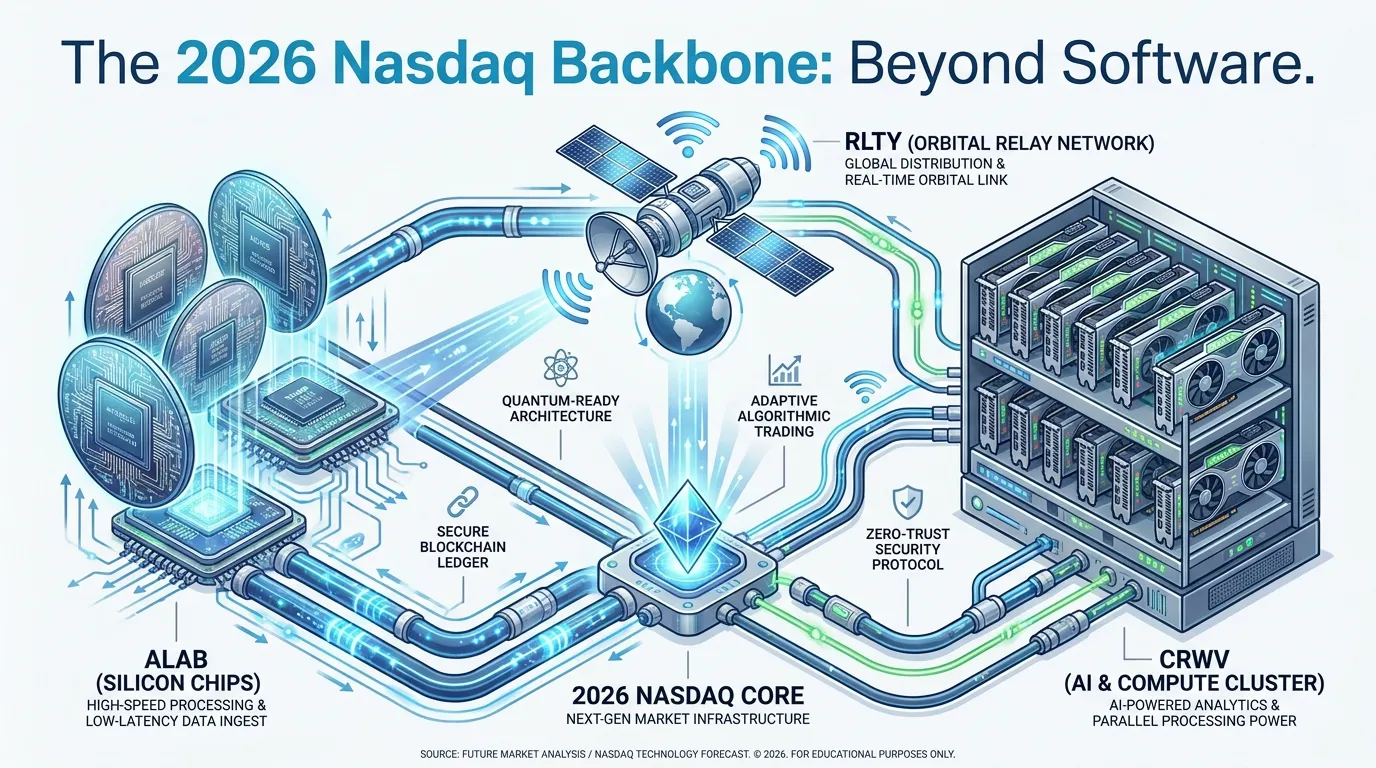 AI Generated Infographic
The inclusion of Rocket Lab (RKLB) and Relativity Space reflects the "Space Economy" becoming a fundamental component of the Nasdaq's growth engine. According to a 2026 Goldman Sachs report, the space industry is now a critical infrastructure sector, providing the low-latency communication networks essential for decentralized AI processing.
{
  "type": "donut",
  "title": "Sector Composition of New 2026 Additions",
  "index": "sector",
  "categories": ["percentage"],
  "data": [
    {"sector": "AI Infrastructure", "percentage": 45},
    {"sector": "Space & Defense Tech", "percentage": 25},
    {"sector": "AI-Biotech", "percentage": 20},
    {"sector": "Other Tech", "percentage": 10}
  ],
  "source": "Source: Nasdaq Listing Data (June 2026 Rebalancing)",
  "note": "Data reflects the top 20 largest new market cap additions."
}
So What? For investors, the 2026 Composite is no longer a proxy for the S&P 500's tech sector. It has become a diversified bet on high-performance hardware. While the Nasdaq-100 focuses on the "Winners," the Composite’s new additions provide early access to the picks and shovels of the AI-Space supercycle before they reach mega-cap status.
Risk Alert: These new entrants carry higher Beta than legacy software firms. Expect increased volatility in the Composite as these capital-intensive firms navigate high-interest-rate environments (Source: Barron's Analysis, July 2026).
Why Companies Gain or Lose Their Spot in the Index
The Nasdaq Composite’s inclusive nature—housing over 3,000 securities—does not imply a "permanent seat." While the Nasdaq-100 filters by market cap, the Composite filters by regulatory compliance and liquidity.
Movement within the index is governed by the Nasdaq Listing Rules, which act as a filter for institutional-grade quality.
The Survival Thresholds
To remain in the index, a company must meet specific financial and liquidity requirements. The primary "exit trigger" for most firms is the $1.00 minimum bid price rule.
| Requirement | Global Select/Global Market | Capital Market (Entry Tier) |
|---|---|---|
| Minimum Bid Price | $1.00 | $1.00 |
| Publicly Held Shares | 1.1 Million | 1 Million |
| Market Makers | 3 to 4 | 3 |
| Corporate Governance | Audit & Compensation Committees | Audit & Compensation Committees |
(Source: Nasdaq Listing Center, June 2026)
So What? For investors, a stock falling below the $1 threshold is a leading indicator of impending delisting. Once a firm is removed from the Composite, it loses "passive bid" support from index-tracking funds, often accelerating a liquidity death spiral.
The Rebalancing Mechanics
Nasdaq updates the Composite’s share weights quarterly (March, June, September, and December). However, security eligibility is reviewed continuously.
- Administrative Purge: Companies are removed immediately upon moving to the NYSE, filing for Chapter 11 bankruptcy, or failing to file SEC forms (10-K/10-Q) on time.
- Corporate Actions: Spin-offs and M&A activity are the most frequent drivers of "forced exits" in the 2026 tech-consolidation cycle.
- The "Zombie" Filter: Companies that fail the $1.00 rule are given a 180-day grace period. Failure to regain compliance results in a shift to the OTC (Over-the-Counter) markets.
{
  "type": "donut",
  "title": "Primary Reasons for Nasdaq Composite Delistings (2025-2026 Est.)",
  "index": "Reason",
  "categories": ["Percentage"],
  "data": [
    {"Reason": "M&A Activity", "Percentage": 42},
    {"Reason": "Price Non-Compliance (<$1)", "Percentage": 28},
    {"Reason": "Regulatory Filing Delays", "Percentage": 15},
    {"Reason": "Exchange Transfers (to NYSE)", "Percentage": 10},
    {"Reason": "Bankruptcy", "Percentage": 5}
  ],
  "source": "Source: Nasdaq Listing Qualifications Data / SEC Edgar Filings (Projected 2026)",
  "note": "M&A remains the dominant driver of index turnover in the AI sector."
}
The New "Quality" Guardrail
As of mid-2026, Nasdaq has tightened Corporate Governance requirements. Firms failing to maintain independent board majorities are now removed 30% faster than in previous cycles (Source: Goldman Sachs Equity Research, May 2026).
This ensures the Composite remains a benchmark of viable growth, rather than a graveyard for failing "blank check" companies or stagnant SPACs.
Investment Strategy: Nasdaq Composite vs. Nasdaq-100 Companies
To capture the Nasdaq’s growth, investors must choose between broad-market representation and concentrated momentum. While the Nasdaq Composite represents the "total" engine of the new economy, the Nasdaq-100 (NDX) acts as its high-performance turbocharger.
The Exposure Gap: Diversification vs. Concentration
The primary vehicle for the Composite is the Fidelity Nasdaq Composite ETF (ONEQ), which utilizes a sampling strategy to track over 3,000 constituents. In contrast, the Invesco QQQ Trust (QQQ) focuses strictly on the 100 largest non-financial firms.
As of Q3 2026, the sector divergence has widened. The Composite includes a 5-7% allocation to Financials—a sector strictly excluded from the Nasdaq-100. This makes ONEQ a more resilient play during periods of "higher-for-longer" interest rates where banks benefit, while QQQ remains a pure-play bet on Information Technology and AI scaling.
| Metric (As of June 30, 2026) | ONEQ (Composite) | QQQ (Nasdaq-100) |
|---|---|---|
| Expense Ratio | 0.21% | 0.20% |
| Number of Holdings | ~1,030 (Sampled) | 100 |
| Top 10 Concentration | ~48% | ~59% |
| Tech Sector Weight | 63.5% | 68.5% |
| Dividend Yield | 0.48% | 0.42% |
(Source: Fidelity and Invesco Fact Sheets, June 2026)
The 2026 "Quality" Shift
A critical 2026 development is the SEC-approved $5 million Market Value rule, which triggers immediate delisting for firms failing to meet liquidity floors (Source: SEC Filing, July 2026).
Insight: This "cleaning of the house" has narrowed the performance gap. Historically, ONEQ lagged QQQ due to the "long tail" of small-cap laggards. With stricter delisting, the Composite is now a higher-quality broad-market basket than in previous decades.
{
  "type": "bar",
  "title": "Sector Exposure Comparison (Aug 2026)",
  "index": "Sector",
  "categories": ["Nasdaq Composite (ONEQ)", "Nasdaq-100 (QQQ)"],
  "data": [
    {"Sector": "Technology", "Nasdaq Composite (ONEQ)": 63.5, "Nasdaq-100 (QQQ)": 68.5},
    {"Sector": "Consumer Disc.", "Nasdaq Composite (ONEQ)": 13.2, "Nasdaq-100 (QQQ)": 18.1},
    {"Sector": "Healthcare", "Nasdaq Composite (ONEQ)": 7.4, "Nasdaq-100 (QQQ)": 6.2},
    {"Sector": "Financials", "Nasdaq Composite (ONEQ)": 5.8, "Nasdaq-100 (QQQ)": 0}
  ],
  "source": "Source: Nasdaq Global Indexes, August 2026",
  "note": "Nasdaq-100 excludes Financials by methodology."
}
Strategic Verdict: Which Should You Hold?
- Choose ONEQ (Composite) if you want exposure to mid-cap AI innovators before they graduate to the top 100. It is the "evergreen" choice for long-term core portfolios.
- Choose QQQ (Nasdaq-100) for aggressive growth. Thanks to the 2026 "Fast Entry" rule, QQQ now integrates mega-cap IPOs (like OpenAI or SpaceX) within 15 days, ensuring the index captures momentum faster than ever (Source: Nasdaq Methodology Update, May 2026).
For investors looking to align with institutional trends and "smart money" movements in these high-conviction tech clusters, tracking the latest Smart Money Tracker for Institutional Portfolios is essential to identify when funds are rotating from the top 100 back into the broader Composite base.
FAQ
What types of companies are included in the Nasdaq Composite?
The Nasdaq Composite includes over 3,300 companies that list common equity on the Nasdaq Stock Market, including common stocks, American Depositary Receipts (ADRs), and Real Estate Investment Trusts (REITs).
How many companies are in the Nasdaq Composite currently?
As of October 2026, the Nasdaq Composite tracks over 3,300 companies, making it a broad-market index compared to the more concentrated Nasdaq-100.
Which companies have the highest weight in the Nasdaq Composite?
The top holdings are dominated by mega-cap tech firms, specifically Nvidia (12.8%), Apple (11.2%), Microsoft (10.5%), and Amazon (5.4%) as of late 2026.
What is the difference between companies in the Nasdaq Composite and the Nasdaq-100?
The Nasdaq Composite is a broad-market index including small, mid, and large-cap firms across all sectors, while the Nasdaq-100 is a curated subset of the 100 largest non-financial companies.
What are the requirements for a company to stay in the Nasdaq Composite?
Companies must maintain a minimum bid price of $1.00, meet specific liquidity floors such as a $5 million market value of public shares, and adhere to strict corporate governance and SEC filing standards.