BYD Stock Price, Listings, and Valuation After the Q3 Miss
Founder of Tritonix.ai. Former Hedge Fund Analyst with 10+ years of experience managing over $1B AUM across insurance portfolios and private funds. Specializes in institutional-grade fundamental analysis and long-term capital allocation.
The latest BYD stock prices, dated carefully
U.S. investors searching for byd stock are looking at three related securities, not one. This article was written on Wednesday morning, November 18, 2026, in Asia/Shanghai, after Hong Kong and Shenzhen had opened and before the U.S. cash session.
The official last closes are therefore Tuesday, November 17. Hong Kong-listed 1211.HK finished at HK$64.15, down HK$0.95, or 1.46%, from Monday's HK$65.10. The session low of HK$62.85 was also the 52-week low, on 20.43 million shares versus an average of about 20.07 million.
Shenzhen-listed A-shares, 002594.SZ, closed at CNY 80.35, down CNY 0.14, or 0.17%, from CNY 80.49, on 18.69 million shares. The most liquid U.S. proxy, unsponsored OTC ADR BYDDY, closed at $8.04, down $0.11, or 1.35%, and printed a 52-week low in the same session. The thinner ordinary OTC line, BYDDF, closed at $8.10.
| Listing | Official close (Nov 17, 2026) | Day change | Session range | 52-week range |
|---|---|---|---|---|
| 1211.HK (Hong Kong, HKD) | 64.15 | −1.46% | 62.85–64.80 | 62.85–113.40 |
| 002594.SZ (Shenzhen, CNY) | 80.35 | −0.17% | 79.39–80.49 | 77.60–111.82 |
| BYDDY (OTC ADR, USD) | 8.04 | −1.35% | 8.04–8.14 | 8.04–14.46 |
| BYDDF (OTC ordinary, USD) | 8.10 | −1.34% | 8.07–8.17 | 7.97–14.95 |
Source: Yahoo Finance official November 17, 2026 closes for 1211.HK, 002594.SZ, BYDDY, and BYDDF.
Early on November 18, both Asian lines were only marginally higher. As of about 9:45–9:50 a.m. Hong Kong and Shenzhen time, 1211.HK was quoted near HK$64.25–HK$64.35, and 002594.SZ near CNY 80.52–CNY 80.57. Those are live prints, not settlement prices.
The Hong Kong line has taken the larger drawdown. From the December 31, 2025 close of HK$95.10, 1211.HK is down 32.5%, and it is down 43.4% from the April 16 session high of HK$113.40. The A-shares have fallen 17.8% from their December 31 close of CNY 97.72, and 28.1% from the March 23 session high of CNY 111.82. They sit only 3.5% above the June 29 low of CNY 77.60.
{
  "type": "line",
  "title": "BYD Hong Kong Shares (1211.HK) from the April High to November 17",
  "index": "Date",
  "categories": ["Close (HK$)"],
  "data": [
    {"Date": "Dec 31", "Close (HK$)": 95.10},
    {"Date": "Jan 2", "Close (HK$)": 98.75},
    {"Date": "Apr 16", "Close (HK$)": 113.20},
    {"Date": "May 5", "Close (HK$)": 101.00},
    {"Date": "Jun 10", "Close (HK$)": 86.60},
    {"Date": "Jun 30", "Close (HK$)": 72.45},
    {"Date": "Sep 30", "Close (HK$)": 75.60},
    {"Date": "Oct 22", "Close (HK$)": 67.40},
    {"Date": "Oct 29", "Close (HK$)": 68.65},
    {"Date": "Nov 5", "Close (HK$)": 75.70},
    {"Date": "Nov 17", "Close (HK$)": 64.15}
  ],
  "source": "Source: Yahoo Finance official daily closes for 1211.HK.",
  "note": "April 16 close HK$113.20 followed a session high of HK$113.40, the 52-week high. November 17's session low of HK$62.85 is the 52-week low. October 29 is the third-quarter results close."
}
Readers who want to mark those official closes against the April high or the November 17 low can do that with Tritonix AI technical analysis.
The official last U.S. print is still Tuesday's $8.04 on BYDDY. The Hong Kong line tagged a 52-week low in the same session.
Which BYD stock listing U.S. investors actually get
BYD Company Limited is a Shenzhen-headquartered automaker and battery maker listed in two primary markets. A-shares trade in Shenzhen as 002594.SZ. H-shares trade in Hong Kong as 1211.HK, with an RMB counter at 81211.HK. The company's 2026 interim report showed 5.434 billion A-shares and 3.683 billion H-shares outstanding as of June 30, 2026, or 9.117 billion in total.
U.S. investors do not get a New York or Nasdaq listing. They get unsponsored OTC receipts. J.P. Morgan's ADR profile and a 2025 SEC filing show that BYDDY is a 1-for-1 unsponsored ADR on the Hong Kong H-share, a ratio effective July 29, 2025. OTC Markets lists the same ratio. BYDDF is a thinly traded ordinary OTC line on that H-share, not a claim on the A-share.
Using the CFETS central parity rates published by Xinhua on November 17 — CNY 6.7132 per dollar and CNY 0.85562 per Hong Kong dollar, or about 7.846 Hong Kong dollars per U.S. dollar — the HK$64.15 close was worth about $8.18. BYDDY's $8.04 close was a modest OTC discount to that parity. Liquidity is not comparable: BYDDY traded only 456,585 shares, against an average of about 1.37 million, while 1211.HK turned over more than 20 million.
The same fix converts the H-share close to about CNY 54.89. Against the A-share close of CNY 80.35, that is an A-H premium of about 46.4%. Quote pages that apply one price to all 9.12 billion shares can therefore show market caps that look irreconcilable. A blended value is more useful: about CNY 436.6 billion for the A-shares and HK$236.3 billion, or CNY 202.2 billion, for the H-shares, or about CNY 638.8 billion ($95.2 billion) in total.
| Component (Nov 17 official closes) | Shares | Price | Value |
|---|---|---|---|
| A-shares (002594.SZ) | 5.434 billion | CNY 80.35 | CNY 436.6 billion |
| H-shares (1211.HK) | 3.683 billion | HK$64.15 | HK$236.3 billion (CNY 202.2 billion) |
| Blended company value | 9.117 billion | — | CNY 638.8 billion (~$95.2 billion) |
Source: Share counts from BYD's 2026 interim report as of June 30, 2026; official November 17 closes from Yahoo Finance; CFETS central parity rates published by Xinhua on November 17, 2026.
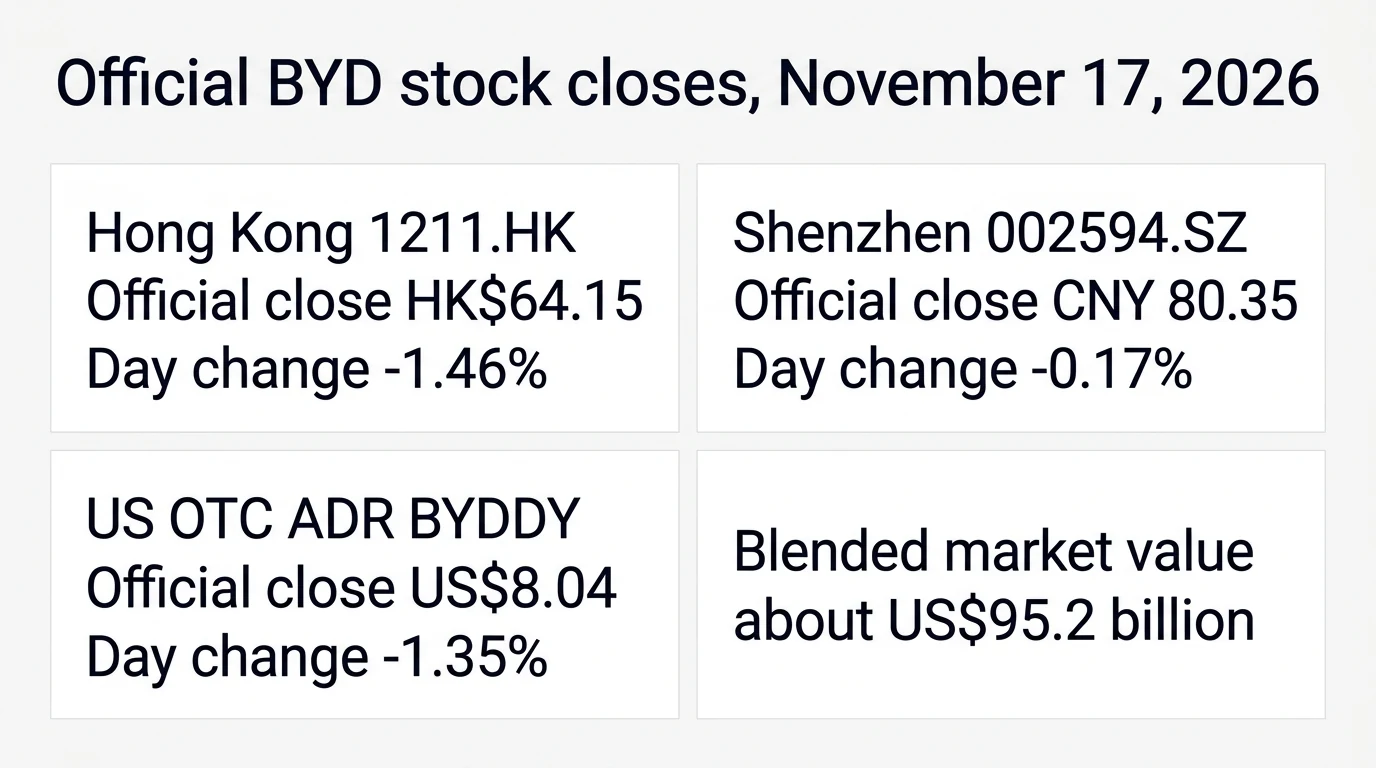
Official November 17, 2026 closes for 1211.HK, 002594.SZ, and BYDDY, plus a blended market value of about $95.2 billion.
BYDDY is a 1-for-1 receipt on the cheaper H-share, not a claim on the premium-priced A-share. Compare it with 1211.HK, not with 002594.SZ.
What the third-quarter report changed in the numbers
BYD reported third-quarter and nine-month results on October 29, 2026, in a Hong Kong filing. Quarterly revenue was CNY 221.49 billion, up 13.6% from a year earlier. Net profit attributable to shareholders was CNY 10.02 billion, up 28.1%. Basic earnings per share were CNY 1.10.
That was a genuine turn in the top line. It ended four straight quarters of revenue contraction, as Reuters noted the same day. It was also a miss: Reuters said three broker estimates clustered between CNY 11.4 billion and CNY 12.95 billion of net profit, so CNY 10.02 billion landed well below that range.
The first nine months still look like a repair. Revenue was CNY 566.30 billion, essentially unchanged. Attributable net profit was CNY 22.34 billion, down 4.2%. Profit after extraordinary items rose 2.5% to CNY 21.00 billion, and operating cash flow improved 33.4% to CNY 54.47 billion. Nine-month gross margin was 18.5%, based on operating revenue and operating costs in the same filing, after a first-half margin of 18.85% reported by CnEVPost from the interim results. The third-quarter margin therefore eased to about 18.0%.
The earlier quarters show the climb. In the first-quarter filing dated April 28, revenue was CNY 150.23 billion, down 11.8%, and attributable profit was CNY 4.08 billion, down 55.4%. Subtracting that quarter from first-half totals leaves second-quarter revenue of about CNY 194.59 billion and profit of about CNY 8.24 billion.
| Period | Revenue | Attributable net profit | Notes |
|---|---|---|---|
| Q1 2026 | CNY 150.23 billion | CNY 4.08 billion | −11.8% / −55.4% year on year |
| Q2 2026 (H1 less Q1) | CNY 194.59 billion | CNY 8.24 billion | Implied from interim and Q1 filings |
| Q3 2026 | CNY 221.49 billion | CNY 10.02 billion | +13.6% / +28.1%; missed broker estimates |
| First nine months 2026 | CNY 566.30 billion | CNY 22.34 billion | Revenue flat; profit −4.2% |
| Full year 2025 | CNY 803.96 billion | CNY 32.33 billion | Revenue +3.5%; profit −19.6% |
Source: BYD's April 28 and October 29, 2026 Hong Kong filings and the 2026 interim results. Full-year 2025 figures are from StockAnalysis. Q2 2026 equals first-half totals less the first quarter.
{
  "type": "bar",
  "title": "BYD Attributable Net Profit by Quarter, 2026",
  "index": "Period",
  "categories": ["Net profit (CNY billion)"],
  "data": [
    {"Period": "Q1 2026", "Net profit (CNY billion)": 4.08},
    {"Period": "Q2 2026", "Net profit (CNY billion)": 8.24},
    {"Period": "Q3 2026", "Net profit (CNY billion)": 10.02}
  ],
  "source": "Source: BYD Hong Kong filings dated April 28 and October 29, 2026, and the 2026 interim results.",
  "note": "Q2 is first-half attributable profit less first-quarter profit. Q3 missed the Reuters broker range of CNY 11.4 billion to CNY 12.95 billion."
}
On trailing figures compiled by Yahoo Finance, revenue is about CNY 804 billion and net income about CNY 31.34 billion. That puts the Hong Kong line at a trailing P/E of 16.6 and the A-share at 23.3, a gap that reflects the A-H premium rather than a different business. StockAnalysis shows a forward P/E of 11.8 on the H-share and 14.3 on the Shenzhen quote. Trailing profit margin is 3.93%, and return on equity is 11.94%. The H-share yield is about 0.6%; the A-share dividend of CNY 0.36 yields about 0.4%.
Those multiples are lower than when 1211.HK was above HK$110 in April, but they are not a verdict on their own. Yahoo Finance's 1211.HK estimates page, citing 17 analysts, puts 2026 revenue at about CNY 850 billion, or roughly 6% above 2025. The average 12-month H-share target is HK$106.59, against a low of HK$59.93 and a high of HK$134.83. The width of that range is the point.
Revenue has started to grow again, but the third-quarter profit miss and a still-flat nine-month top line are what the November price is wrestling with.
Sales are improving, but the mix has shifted overseas
The operating story underneath those filings is visible in the monthly delivery reports. In a voluntary announcement on November 1, BYD said it sold 490,168 new energy vehicles in October, up 11.0% from 441,706 a year earlier, and produced 488,104 units. Passenger vehicles were 483,125, including a record 305,743 battery-electric cars, up 37.4%, and 177,382 plug-in hybrids, down 17.2%. Exports were 170,194 units.
That was the sixth straight month of year-on-year growth and the strongest month of 2026, as CnEVPost documented from the same company reports. It was not a domestic reacceleration. China sales were 319,974 vehicles, down 10.6%. Reuters, writing on November 1, said BYD was "relying on overseas markets to counter sluggish demand and intense price competition at home."
Through October, BYD sold 3,621,744 NEVs, down 2.2% from 3,701,852. CnEVPost's compilation of the monthly announcements puts exports at 1,513,154, up 93.8%, and domestic sales at 2,108,590, down 27.8%. Management had earlier talked about a 1.5 million export target for 2026; that threshold has already been crossed.
{
  "type": "bar",
  "title": "BYD Monthly NEV Sales, 2025 vs 2026",
  "index": "Month",
  "categories": ["2025", "2026"],
  "data": [
    {"Month": "Jan", "2025": 300538, "2026": 210051},
    {"Month": "Feb", "2025": 322846, "2026": 190190},
    {"Month": "Mar", "2025": 377420, "2026": 300222},
    {"Month": "Apr", "2025": 380089, "2026": 321123},
    {"Month": "May", "2025": 382476, "2026": 383453},
    {"Month": "Jun", "2025": 382585, "2026": 403472},
    {"Month": "Jul", "2025": 344296, "2026": 419211},
    {"Month": "Aug", "2025": 373626, "2026": 440293},
    {"Month": "Sep", "2025": 396270, "2026": 463561},
    {"Month": "Oct", "2025": 441706, "2026": 490168}
  ],
  "source": "Source: BYD monthly production and sales announcements, compiled by CnEVPost; October 2026 confirmed against the November 1 Hong Kong filing.",
  "note": "Year-on-year growth resumed in May. The ten-month total is still down 2.2%."
}
| October 2026 | Units | Year-on-year |
|---|---|---|
| Total NEV sales | 490,168 | +11.0% |
| Passenger battery-electric | 305,743 | +37.4% |
| Passenger plug-in hybrid | 177,382 | −17.2% |
| Commercial NEVs | 7,043 | +45.2% |
| Exports | 170,194 | +102.8% |
| China domestic sales | 319,974 | −10.6% |
| Year-to-date NEV sales | 3,621,744 | −2.2% |
Source: BYD's November 1, 2026 Hong Kong announcement for October and year-to-date totals; domestic sales and the export year-on-year rate as compiled by CnEVPost from company reports, consistent with Reuters for October exports.
The mix shift matters for margins as well as volume. Battery-electric passenger cars were 63.3% of passenger-vehicle sales in October, up from 51.0% a year earlier. The second-generation Seagull, launched in China on October 20 from about $9,810, is part of that cheaper, fully electric push, according to CnEVPost. Overseas growth is carrying the recovery — and is also the channel that must absorb more competition, longer shipping times, and a less generous tax regime in 2027.
October's 490,168 deliveries look strong until they are split: exports more than doubled, while China was still down 10.6%.
The risks that still sit under the valuation
The first risk is already on the balance sheet. Reuters, citing the October 29 filing, said trade receivables were up 52.6% from the end of 2025 by September 30, and inventories were up 60.1%, "primarily because of growth in the company's overseas automotive business." The interim results had already shown inventory days stretching to 109 from 79. Yahoo Finance's trailing levered free cash flow is a deficit of CNY 107.39 billion, even though nine-month operating cash flow was positive. Export growth can be real and still consume cash while cars and receivables sit on the water.
The second risk is that overseas markets are getting crowded and politicized at the same time. Reuters quoted analyst Felipe Munoz saying rapid expansion is moderating "because all the other Chinese makers are arriving too." The same report said Executive Vice President Stella Li called geopolitics the biggest challenge to expansion, and that Chinese hybrid exports to the European Union could face tighter restrictions. BYD is also seeking approval to double annual capacity at its Brazil plant to 600,000 vehicles.
The third risk is policy support being pulled back just as exports become the growth engine. On October 12, China's Ministry of Finance and the State Taxation Administration said the NEV export VAT rebate will fall from 13% to 9% on April 1, 2027, a change covered by CnEVPost. Deutsche Bank, in a note reported the same day, estimated a hit of about CNY 5,000 to BYD's net profit per exported vehicle from the second quarter of 2027. That is a forecast, not company guidance, but it belongs in any 2027 earnings work-up.
Domestic competition has not faded in the meantime. Reuters pointed to Geely's faster-charging system and to Leapmotor's share gains. BYD's China sales are still shrinking year on year, even after six months of improving global totals. A stock that now depends on exports cannot be read as a pure China-recovery name.
The export story is genuine, but it is also the source of higher inventories, higher receivables, geopolitical friction, and a smaller tax rebate in 2027.
How to think about BYD stock from here
The question is whether Tuesday's prices already reflect a weaker China franchise, the working-capital cost of the export push, and a third-quarter miss — or still assume a cleaner 2027 than policy and competition may allow.
Start with the listing. A U.S. buyer of BYDDY is buying the H-share, at a slight OTC discount and with thinner trading, not the A-share that still commands a 46% premium. On the Hong Kong line, the official close is HK$64.15, a 52-week low was tagged at HK$62.85, and the trailing multiple is about 16.6 times earnings. On the A-share, the close is CNY 80.35 and the trailing multiple is about 23.3.
Then separate volume from profitability. October sales of 490,168 vehicles and year-to-date exports of 1.51 million show the overseas build-out is no longer a footnote. Nine-month profit of CNY 22.34 billion on flat revenue, a third-quarter miss, and a large trailing free-cash-flow deficit show that scale is not automatically flowing to shareholders. Next tests are the November sales print, fourth-quarter results, and the April 2027 rebate cut.
Analyst targets still sit well above the Hong Kong price — Yahoo's average is HK$106.59, and StockAnalysis lists a Buy consensus from 26 analysts at HK$106.70 — but Yahoo's low end is HK$59.93, below this week's print. That dispersion is a better guide than any single target. This is not a buy or sell recommendation. Price the H-share, the A-share, and the ADR separately, alongside the cash and policy costs of the export mix.
Those filings, monthly sales prints, and the 2027 rebate change can be kept in one workflow with the Tritonix AI investment research agent.
Treat BYD stock as a three-listing name whose growth is now exported, whose China business is still shrinking, and whose official U.S. close is still Tuesday's $8.04.
FAQ
What is the U.S. ticker for BYD stock?
BYD does not have a New York or Nasdaq listing. U.S. investors typically use BYDDY, an unsponsored OTC ADR that represents one Hong Kong H-share (1211.HK) as of the July 29, 2025 ratio change. A thinner ordinary OTC line trades as BYDDF. The Shenzhen A-share is 002594.SZ.
Why do BYD's Hong Kong and Shenzhen shares trade at different prices?
They are different share classes. On November 17, 2026, 1211.HK closed at HK$64.15 and 002594.SZ closed at CNY 80.35. Using that day's CFETS central parity rates, the H-share was worth about CNY 54.89, implying an A-H premium of about 46.4%.
When did BYD last report earnings, and what did they show?
BYD reported third-quarter and nine-month 2026 results on October 29. Quarterly revenue was CNY 221.49 billion, up 13.6%, and attributable net profit was CNY 10.02 billion, up 28.1%, but that profit missed broker estimates compiled by Reuters. Nine-month revenue was flat at CNY 566.30 billion, and profit fell 4.2% to CNY 22.34 billion.
How has BYD stock performed in 2026?
Hong Kong shares are down 32.5% from the December 31, 2025 close of HK$95.10, and down 43.4% from the April 16 session high of HK$113.40. They tagged a 52-week low of HK$62.85 on November 17. The A-shares are down 17.8% from their December 31 close of CNY 97.72.
Does BYD stock pay a dividend?
Yes. The H-share dividend is about HK$0.41 to HK$0.42, for a yield near 0.6% at the November 17 close. The A-share dividend is CNY 0.36, or about 0.4%. J.P. Morgan's ADR record shows a 2026 cash distribution of $0.052349 per BYDDY receipt, payable August 20, 2026.