Buffett in 2026: Berkshire After the CEO Handoff, Cash, and Buybacks
Founder of Tritonix.ai. Former Hedge Fund Analyst with 10+ years of experience managing over $1B AUM across insurance portfolios and private funds. Specializes in institutional-grade fundamental analysis and long-term capital allocation.
What searching "Buffett" actually points to in 2026
When U.S. investors type Buffett into a search bar in November 2026, they are rarely looking for a biography of a 20th-century folk hero. They want a read on Warren Buffett, on Berkshire Hathaway, and on whether the investment method attached to that name still governs a company that is no longer run day to day by the man who built it.
The facts have moved quickly. Buffett, now 96, stepped down as chief executive at the end of 2025. On September 18, 2026, Berkshire named him chairman emeritus, while his son Howard G. Buffett became chairman. Greg Abel has been president and CEO since January 1, 2026.
The economic object behind the search term is still enormous. Reuters, writing after the November 7, 2026 earnings release, described Berkshire as a $1.21 trillion conglomerate. Yahoo Finance showed Class B shares closing at $575.25 on November 9, 2026, up 0.76% on the day.
The Buffett search in 2026 is a question about stewardship: who allocates Berkshire's capital, and whether the old rules still bind the new officers.
That is the right question. Buffett's public identity was never only a stock-picking record. It was a capital-allocation system: patience, concentration, a fortress balance sheet, and a preference for owning businesses over cash. The rest of this guide looks at what the latest filings say about that system after the handoff.
How the CEO and chairman handoff was completed
The CEO transition was telegraphed in public, then executed on a fixed date. At the question-and-answer session before Berkshire's annual meeting on May 3, 2025, Buffett said he would recommend that Abel, then vice chairman for non-insurance operations, become CEO effective January 1, 2026. The board voted unanimously the next day, and Berkshire confirmed the decision in a May 5, 2025 news release. Buffett remained chairman at that point.
The second step came more than eight months into Abel's tenure. In its September 18, 2026 announcement, the board named Buffett chairman emeritus and elected Howard Buffett, a director since 1993, as chairman. Buffett remains a director and, in the attached shareholder letter, said he would continue to offer judgment and perspective.
The letter drew a clean line between the two jobs. "Greg runs the company; Howard will guard its culture and values – both worth more than anything on our balance sheet," Buffett wrote. He added a sentence investors should keep: "Think of Howard as a policy the shareholders own and hope never to claim against."
Abel, writing earlier in his first annual letter as CEO, struck the same theme in a different key. He said investing in Berkshire had long been "a vote of trust in our founder – a trust that now rests with Berkshire." Capital, he wrote, is commingled with management's but "does not belong to us."
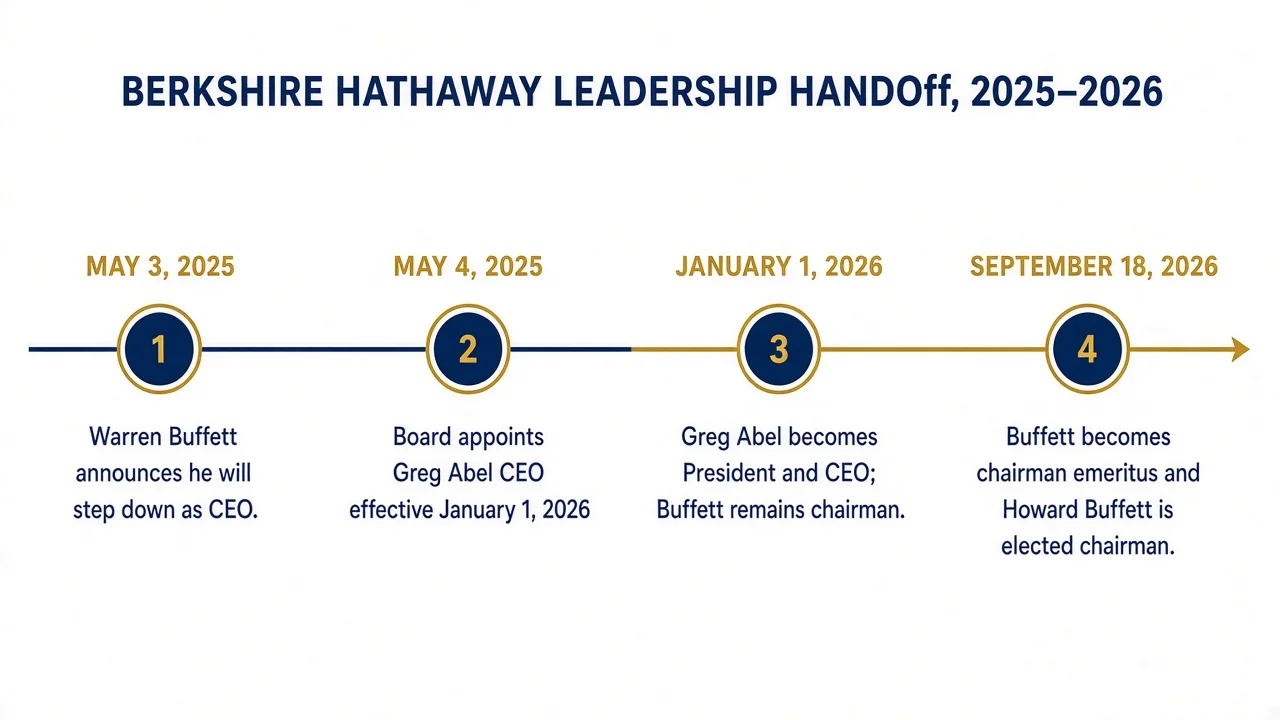 Berkshire's leadership handoff ran from the May 2025 CEO announcement to the September 2026 chairman change. Source: Berkshire Hathaway news releases, May 5, 2025 and September 18, 2026.
For investors, the operational meaning is narrower than the headlines. Abel already had formal authority over operations and capital deployment from January 1. The September change removed Buffett from the chairman's chair and assigned culture-watch to a non-executive chairman. It did not create a new investment committee, a dividend, or a breakup plan.
The Q3 2026 scorecard: cash, buybacks, and operating earnings
Berkshire posted third-quarter results on Saturday, November 7, 2026. The company news release is the cleanest place to start, because it separates operating earnings from the GAAP investment swings that regularly distort net income.
After-tax operating earnings were $12.705 billion, down 5.8% from $13.485 billion a year earlier. Net earnings attributable to Berkshire shareholders were $22.112 billion, down 28% from $30.796 billion, mainly because investment gains fell to $9.407 billion from $17.311 billion. Revenue still rose 11% to $105.65 billion.
The mix inside operating earnings matters more than the top line. Insurance underwriting and insurance investment income both declined. The railroad, energy, and manufacturing-service-retailing groups all increased.
| Segment | Q3 2026 | Q3 2025 | Change |
|---|---|---|---|
| Insurance – underwriting | 1.352 | 2.369 | −42.9% |
| Insurance – investment income | 2.734 | 3.181 | −14.1% |
| BNSF | 1.729 | 1.449 | +19.3% |
| Berkshire Hathaway Energy | 1.612 | 1.489 | +8.3% |
| Manufacturing, service and retailing | 4.042 | 3.616 | +11.8% |
| Other | 1.236 | 1.381 | −10.5% |
| Operating earnings | 12.705 | 13.485 | −5.8% |
Source: Berkshire Hathaway news release, November 7, 2026; after-tax figures in $ billions.
{
  "type": "bar",
  "title": "Berkshire after-tax operating earnings by segment, Q3 2026 vs Q3 2025 ($ billions)",
  "index": "Segment",
  "categories": ["Q3 2025", "Q3 2026"],
  "data": [
    {"Segment": "Insurance underwriting", "Q3 2025": 2.369, "Q3 2026": 1.352},
    {"Segment": "Insurance investment income", "Q3 2025": 3.181, "Q3 2026": 2.734},
    {"Segment": "BNSF", "Q3 2025": 1.449, "Q3 2026": 1.729},
    {"Segment": "Berkshire Hathaway Energy", "Q3 2025": 1.489, "Q3 2026": 1.612},
    {"Segment": "Manufacturing, service and retailing", "Q3 2025": 3.616, "Q3 2026": 4.042},
    {"Segment": "Other", "Q3 2025": 1.381, "Q3 2026": 1.236}
  ],
  "source": "Berkshire Hathaway news release, Nov. 7, 2026",
  "note": "Figures are after tax, in billions of dollars. 'Other' includes foreign-currency effects on non-U.S. dollar debt."
}
The nine-month view is less gloomy than the third-quarter snapshot. Operating earnings for the first nine months of 2026 were $37.034 billion, up 8.0% from $34.286 billion a year earlier. A single soft insurance quarter does not, by itself, rewrite the year.
GEICO and the insurance drag
The insurance gap was concentrated and documented. Pre-tax underwriting earnings at GEICO fell to $982 million from $1.773 billion, a decline of about 45%. Berkshire's third-quarter Form 10-Q put GEICO's loss ratio at 76.6% in the third quarter, up 5.1 percentage points from 71.5% a year earlier, as claim frequencies and severities rose and average earned premiums per policy fell.
Abel is not required to run GEICO for a peak margin every quarter. Still, insurance float remains the cheap funding that has always made the Buffett model work. The November 7 release put float at about $178.5 billion on September 30, 2026, up $2.1 billion since year-end 2025. Underwriting quality is what keeps that float from becoming expensive.
Cash, Treasuries, and a faster buyback pace
The cash debate is mostly a measurement debate. The 10-Q shows cash, cash equivalents, and short-term U.S. Treasury bills of $377.4 billion on September 30, 2026, including railroad and utility cash. That total includes $20.5 billion of Treasury bills purchased but not yet settled. Net of those payables, the pile is $356.9 billion.
CNBC, working from the same filing, reported a still tighter figure of $352.3 billion after also excluding rail and utility cash. Equity securities stood at $335.5 billion. On the headline 10-Q totals, cash and bills still exceeded the stock portfolio.
{
  "type": "bar",
  "title": "Berkshire cash and Treasury bills vs equity securities ($ billions)",
  "index": "Date",
  "categories": ["Cash and T-bills", "Equity securities"],
  "data": [
    {"Date": "Dec 31, 2025", "Cash and T-bills": 373.3, "Equity securities": 297.8},
    {"Date": "Sept 30, 2026", "Cash and T-bills": 377.4, "Equity securities": 335.5}
  ],
  "source": "Berkshire Hathaway Form 10-Q for the quarter ended Sept. 30, 2026",
  "note": "Cash and T-bills is cash, cash equivalents, and short-term U.S. Treasury bills, including railroad and utility cash, before subtracting $20.5 billion of unsettled bill purchases at Sept. 30, 2026."
}
Buybacks are the clearest sign that Abel is willing to use that liquidity on Berkshire's own shares. The company acquired about $9.6 billion of treasury shares in the third quarter, lifting the nine-month total to about $14.4 billion. Reuters reported roughly $2 billion more in October.
The repurchase rule is unchanged. The 10-Q says the CEO may buy stock, after consultation with the chairman, when the price is below a conservatively determined estimate of intrinsic value, and not if doing so would cut consolidated cash, cash equivalents, and Treasury bills below $30 billion.
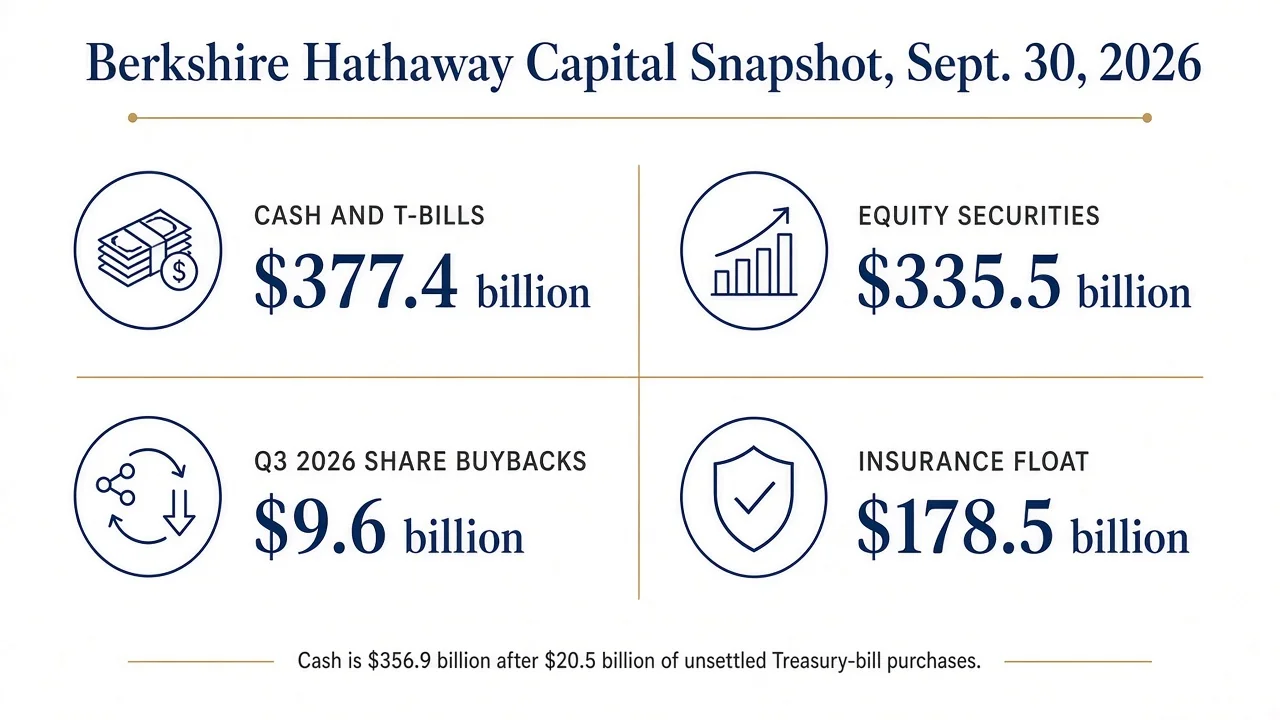 Berkshire's September 30, 2026 capital snapshot, with cash shown before and after unsettled Treasury-bill purchases. Source: Berkshire Hathaway 10-Q and November 7, 2026 news release.
The stock market noticed the shift in tone. CNBC, on November 7, said Berkshire was up 13% year to date against a 7.8% gain for the S&P 500, and that Class A shares had risen more than 12% over the prior month while the index had dropped 5.5%. Reuters added that, since the end of September, Berkshire had outgained the S&P 500 by more than 18 percentage points.
What is still Buffett-like about the portfolio and deals
The public equity portfolio still looks like a Buffett portfolio in structure, even if Abel now signs the tickets. The 10-Q says the five largest holdings on September 30, 2026 were Alphabet, American Express, Apple, Bank of America, and Coca-Cola, together representing 65% of the $335.5 billion portfolio — the same concentration share as at year-end 2025.
The portfolio's industry mix shifted even as that top-five share held still. Banks, insurance, and finance holdings fell to $85.9 billion from $104.1 billion. Consumer products rose to $112.5 billion, and the commercial, industrial, and other bucket jumped to $137.2 billion from $98.7 billion.
| Category | Sept. 30, 2026 fair value | Dec. 31, 2025 fair value |
|---|---|---|
| Banks, insurance and finance | 85.9 | 104.1 |
| Consumer products | 112.5 | 95.0 |
| Commercial, industrial and other | 137.2 | 98.7 |
| Total equity securities | 335.5 | 297.8 |
Source: Berkshire Hathaway Form 10-Q, Note 4; figures in $ billions, rounded.
Cost basis on the equity portfolio was $108.5 billion, against a fair value of $335.5 billion, leaving $227.1 billion of net unrealized gains. That is a long-compounded book, not a trading book. American Express remains a signature example: Berkshire owned 151.6 million shares, or 22.6% of the company, and has had a voting-and-passivity agreement in place since 1995.
Cash-flow data show Abel was a net buyer of stocks over nine months, not a hoarder by default. Purchases of equity securities were $41.8 billion in the first nine months of 2026, against sales of $30.6 billion, a net $11.2 billion. That sits alongside two whole-company deals already closed: OxyChem, completed January 2, 2026 for about $9.4 billion in cash, and Taylor Morrison, completed July 24, 2026 for $72.50 a share, or about $6.8 billion in cash.
Investors who want to put those concentrated public holdings in the context of other large-fund positioning can use Tritonix's institutional smart money tools to compare 13F-style ownership around names such as Apple, Bank of America, and Alphabet, rather than treating Berkshire's list as a secret formula.
The post-Buffett portfolio is still concentrated, still net long high-quality American businesses, and still willing to buy entire companies when the price and the people fit.
What the 10-Q does not do is publish the exact share counts or weights for the five largest common-stock holdings, other than American Express. Until the next 13F is out, the honest statement is the one Berkshire made: those five names remain the core, and they still account for about two-thirds of the marketable equity book.
The Buffett playbook that still applies after the CEO change
The useful inheritance is a short list of rules, not a cult of personality. Buffett stated the cash rule plainly in his 2024 shareholder letter: "Despite what some commentators currently view as an extraordinary cash position at Berkshire, the great majority of your money remains in equities. That preference won't change." He added, "Berkshire will never prefer ownership of cash-equivalent assets over the ownership of good businesses, whether controlled or only partially owned."
Abel repeated the idea in his first letter, with the cash pile then already above $370 billion: "We will always aim for ownership of productive businesses over U.S. Treasuries." He also wrote that a large cash balance "does not" signal a retreat from investing, and that Berkshire will repurchase shares only below a conservative intrinsic-value estimate.
Those sentences tell investors how to read the $377 billion gross cash figure without copying it blindly into a household portfolio. Berkshire holds cash because it has $178.5 billion of insurance float, because it wants to buy entire companies for cash, and because it pays no dividend. A retirement account that must fund living expenses is not the same balance sheet.
The earnings rule is just as practical. Berkshire keeps urging readers to look at operating earnings and to treat quarterly investment gains or losses as "usually meaningless." The third quarter is a case study: net earnings fell 28% while operating earnings fell 5.8%, and nine-month operating earnings were still higher than a year earlier.
A third rule is concentration with a long holding period. The five-name, 65% equity book would be a firing offense at many institutions. At Berkshire it is the method. Copying the method means accepting lumpy results and doing the work on a few businesses, not cloning the latest 13F after the prices have moved.
A research workflow can help with that work. Tritonix's AI investment agent is built to pull filings, earnings, and positioning into one place, which is more useful than treating "Buffett bought it" as a complete thesis.
How investors should read Buffett — and Berkshire — from here
The watch list is now operational, not biographical. First, track buybacks against the $30 billion cash floor and against Abel's intrinsic-value test. A $9.6 billion quarter is a signal that management saw a gap between price and value; a silent quarter would be a signal too.
Second, watch how cash moves relative to operating businesses and marketable equities. Net stock buying of $11.2 billion, plus about $16.2 billion of business acquisitions, already shows the pile can shrink when Abel finds uses for it. The remaining cash is still large enough to dominate the debate until a much bigger deal, or a much weaker tape, appears.
Third, keep an eye on insurance, especially GEICO's loss ratio and expense ratio. Float only remains a gift if underwriting stays disciplined. The railroad and energy results in the third quarter show the other half of the conglomerate can offset a softer insurance period, but they should not be used to wave away underwriting slippage.
Fourth, judge the culture test on process, not poetry. Howard Buffett's brief is to guard values, not to pick stocks. The test is whether capital allocation stays patient, concentrated, and owner-oriented after a year or two in which Buffett is no longer the chairman that directors see every meeting.
Class B shares at $575.25 on November 9 already price in a smoother handoff than many investors feared in May 2025, when Buffett first said he would leave the CEO job. That does not make the stock cheap or expensive on its own. It means the market has moved on from the succession headline and toward the same questions Buffett always asked: what the businesses earn, what they are worth, and whether cash is being used better than it would be sitting in Treasury bills.
For anyone still searching "Buffett" in 2026, that is the work that remains. The name on the letterhead has changed. The filing trail is still the way to follow it.
FAQ
Is Warren Buffett still running Berkshire Hathaway in 2026?
No. Greg Abel has been president and CEO since January 1, 2026. On September 18, 2026, Berkshire named Buffett chairman emeritus and elected his son, Howard G. Buffett, as chairman. Buffett, now 96, remains a director.
How much cash does Berkshire Hathaway have after Buffett stepped down as CEO?
The third-quarter 10-Q showed $377.4 billion of cash, cash equivalents, and short-term U.S. Treasury bills on September 30, 2026. After subtracting $20.5 billion of unsettled Treasury-bill purchases, the figure is $356.9 billion. Equity securities were $335.5 billion.
Why did Berkshire speed up share buybacks in the third quarter of 2026?
Berkshire bought about $9.6 billion of its own shares in the third quarter, bringing nine-month repurchases to about $14.4 billion. The 10-Q says the CEO may repurchase stock, after consulting the chairman, when the price is below a conservative estimate of intrinsic value, and not if cash and Treasury bills would fall below $30 billion.
What are Berkshire's largest stock holdings in 2026?
As of September 30, 2026, the five largest equity holdings were Alphabet, American Express, Apple, Bank of America, and Coca-Cola, together representing 65% of the $335.5 billion portfolio. Berkshire also owned 151.6 million American Express shares, or 22.6% of that company.
Should investors still buy Berkshire Hathaway to follow Buffett?
Buying Berkshire is now a bet on Greg Abel's capital allocation, the operating businesses, and the remaining cash, not on Buffett sitting in the CEO chair. Class B shares closed at $575.25 on November 9, 2026. Whether that price is attractive depends on earnings power and intrinsic value, not on the search term alone.