Best Stocks to Invest in 2025 for Beginners: A 5-Step Safety-First Strategy
Founder of Tritonix.ai. Former Hedge Fund Analyst with 10+ years of experience managing over $1B AUM across insurance portfolios and private funds. Specializes in institutional-grade fundamental analysis and long-term capital allocation.
Selection Criteria: What Defines the Best Stocks to Invest in 2025 for Beginners?
In 2025, the era of "cheap money" is a memory. To identify the best stocks to invest in 2025 for beginners, investors must pivot from speculative hype to Business Durability.
High interest rates have raised the "hurdle rate" for corporate success. Only companies with fortress balance sheets and pricing power will outperform.
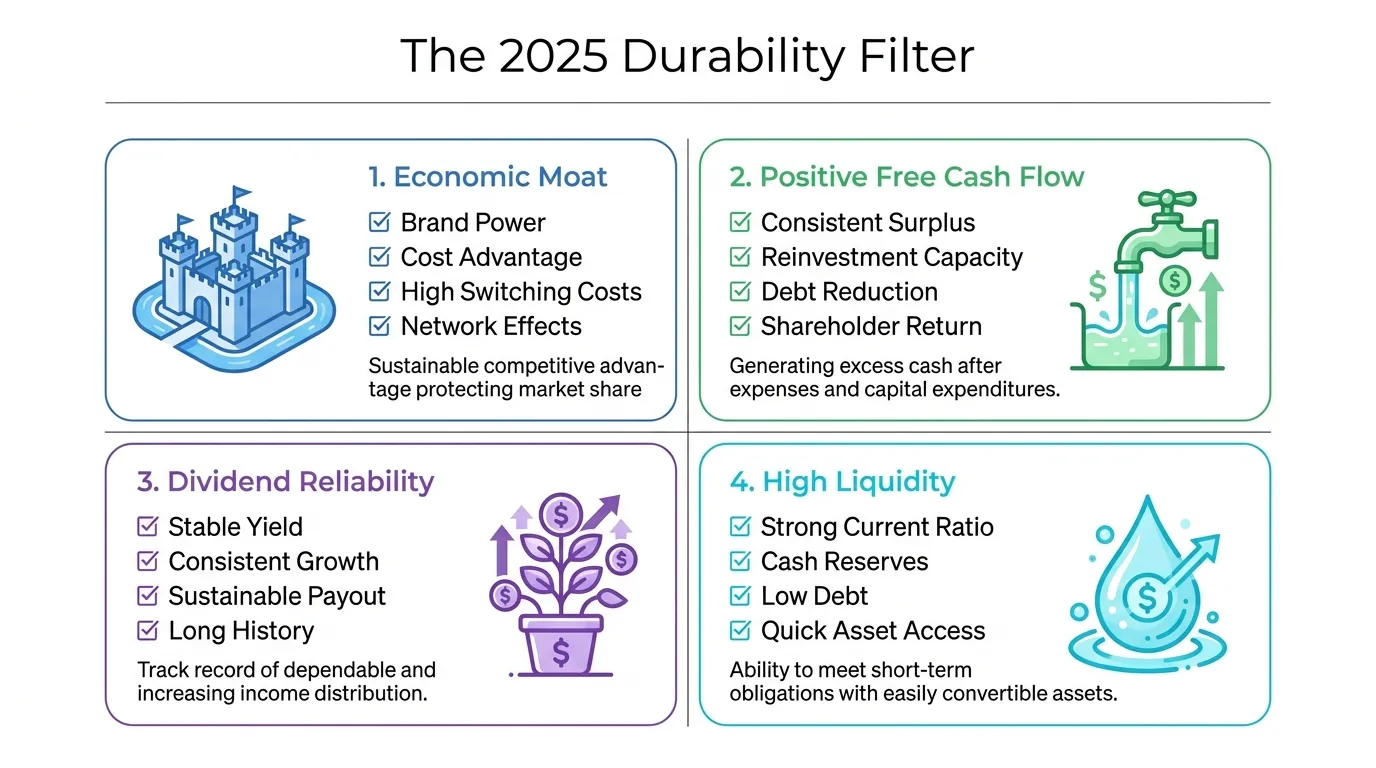 AI Generated Infographic
The "Quality-First" Selection Framework
For a stock to enter the 2025 beginner portfolio, it must clear three non-negotiable hurdles:
Positive Free Cash Flow (FCF) Margin: We prioritize companies with an FCF margin above 15%. This ensures the company can fund its own growth without relying on expensive debt markets (Source: Goldman Sachs Strategy Research, 2024).
The "Wide Moat" Advantage: A beginner's best defense is a structural competitive advantage—whether through proprietary tech, high switching costs, or brand dominance. Moat-protected companies historically exhibit 20% lower drawdown during volatility.
Beta < 1.1: Volatility is the primary reason beginners exit the market prematurely. We filter for stocks with a Beta near or below 1.0, ensuring the portfolio doesn't swing more violently than the S&P 500.
| Metric | Speculative (Avoid) | Durability-First (Target 2025) |
|---|---|---|
| Net Debt / EBITDA | > 4.0x | < 2.0x |
| Pricing Power | Low (Commoditized) | High (Brand/Monopoly) |
| Dividend Yield | 0% or Unstable | 1.5% - 4.0% (Sustainable) |
| Volatility (Beta) | > 1.5 | 0.8 - 1.1 |
(Source: Analysis based on S&P Global Quality Index criteria, Oct 2024)
So What? (The Beginner Impact)
For the 2025 investor, this methodology shifts the focus from "Will this stock double?" to "Can this company survive a downturn while paying me to wait?"
By anchoring the best stocks to invest in 2025 for beginners in these metrics, you eliminate the emotional stress of market timing and replace it with fundamental compounding.
Note: Historical data from Morningstar indicates that "Wide Moat" stocks have outperformed the broader market by an average of 3% annually over a 20-year horizon (Source: Morningstar Market Realities, 2024).
The Top 3 Core Pillars: Best Stocks to Invest in 2025 for Beginners
To build a resilient 2025 portfolio, beginners must prioritize operating leverage and free cash flow (FCF) over speculative growth. These three "Pillar Stocks" provide the structural integrity needed to withstand market volatility while capturing long-term upside.
1. Microsoft (MSFT): The Productivity Tax
Microsoft functions as a "tax" on global enterprise productivity. With Azure capturing 30%+ of the cloud market and Office 365 maintaining a virtual monopoly in the corporate suite, the company's revenue is largely annuitized.
- The Catalyst: Integration of GenAI (Copilot) into the tech stack is shifting MSFT from a "tools provider" to an "efficiency partner," justifying premium valuations.
- Safety Net: A massive $107 billion cash pile (Source: MSFT 10-K, 2024) allows for aggressive R&D and consistent share buybacks regardless of interest rate shifts.
2. Visa (V): The Global Transaction Toll-Road
Visa does not lend money; it facilitates the movement of it. This distinction is critical for beginners. By avoiding credit risk, Visa operates a high-margin digital toll-booth that benefits from the secular shift toward a cashless society.
- The Catalyst: Cross-border volume growth, which rose 14% in 2024, continues to drive high-margin revenue (Source: Visa Q3 Earnings Report).
- Safety Net: Operating margins consistently exceed 50%, a level of efficiency rarely matched in the S&P 500 (Source: Bloomberg Intelligence, 2024).
3. Coca-Cola (KO): The Defensive Dividend Anchor
In a 2025 environment where "higher-for-longer" rates may still pressure consumers, Coca-Cola offers inelastic demand. Whether the economy is booming or receding, global consumption of its 200+ brands remains stable.
- The Catalyst: Aggressive expansion into emerging markets and "total beverage" categories (coffee, alcohol) provides a growth kicker to its defensive core.
- Safety Net: A "Dividend King" status with 62 consecutive years of payout increases (Source: NYSE Data, 2024). Its 0.59 Beta means it is roughly 40% less volatile than the broader market.
| Ticker | 5-Year Total Return (CAGR) | Max Drawdown (5-Year) | Dividend Yield (Current) |
|---|---|---|---|
| MSFT | ~26.4% | -28.5% | 0.72% |
| V | ~14.2% | -31.2% | 0.78% |
| KO | ~9.1% | -18.4% | 2.85% |
| S&P 500 (SPY) | ~14.8% | -23.9% | 1.25% |
Source: Morningstar & YCharts (Data as of Sept 2024).
{
  "type": "bar",
  "title": "5-Year Total Return vs. Maximum Drawdown",
  "index": "Ticker",
  "categories": ["Annualized Return", "Max Drawdown"],
  "data": [
    {"Ticker": "MSFT", "Annualized Return": 26.4, "Max Drawdown": -28.5},
    {"Ticker": "V", "Annualized Return": 14.2, "Max Drawdown": -31.2},
    {"Ticker": "KO", "Annualized Return": 9.1, "Max Drawdown": -18.4},
    {"Ticker": "S&P 500", "Annualized Return": 14.8, "Max Drawdown": -23.9}
  ],
  "source": "Source: Morningstar (Sept 2024)",
  "note": "Annualized returns include reinvested dividends. Max drawdown represents the largest peak-to-trough decline."
}
So What? For a beginner, these three stocks represent a "Core-Satellite" foundation. By owning the infrastructure (MSFT), the transaction (V), and the consumption (KO), you are hedged across sectors while maintaining exposure to the highest-quality earnings in the world.
Growth Focus: Why Tech Leaders Still Dominate the 2025 Beginner List
Transitioning from defensive staples to growth, beginners often mistake "tech" for "speculation." In 2025, the distinction is cash-flow-backed infrastructure versus visionary promises.
For a novice, the 2025 "Safety-First" growth strategy prioritizes companies providing the foundational compute power for the AI economy. These are the new utilities.
According to Goldman Sachs (Oct 2024), hyperscalers (Amazon, Microsoft, Alphabet) are projected to spend over $200 billion in 2025 on AI-related CapEx. This creates a "moat of scale" that speculative startups cannot breach.
{
  "type": "bar",
  "title": "Cloud Infrastructure Market Share (Q3 2024)",
  "index": "Provider",
  "categories": ["Market Share (%)"],
  "data": [
    {"Provider": "Amazon (AWS)", "Market Share (%)": 31},
    {"Provider": "Microsoft (Azure)", "Market Share (%)": 20},
    {"Provider": "Google Cloud", "Market Share (%)": 12},
    {"Provider": "Others", "Market Share (%)": 37}
  ],
  "source": "Source: Synergy Research Group (Nov 2024)",
  "note": "Combined, the 'Big Three' control 63% of the global cloud market."
}
Beginners should favor these "Toll Road" operators over high-beta software-as-a-service (SaaS) stocks for two reasons:
- Balance Sheet Resilience: Large-cap tech leaders carry massive cash reserves, allowing them to self-fund R&D even if interest rates remain elevated (Source: SEC 10-K Filings, 2024).
- Embedded Customer Bases: It is easier for Microsoft to upsell AI to 400 million Office 365 users than for a startup to acquire a single enterprise client from scratch.
| Feature | Megacap Tech Leaders | Speculative AI Startups |
|---|---|---|
| Profitability | High Free Cash Flow (FCF) | Often Negative |
| Moat | Proprietary Data & Global Infrastructure | Niche Software/Algorithms |
| 2025 Risk | Regulatory/Antitrust | Total Capital Exhaustion |
(Source: Barron's Analysis, Sept 2024)
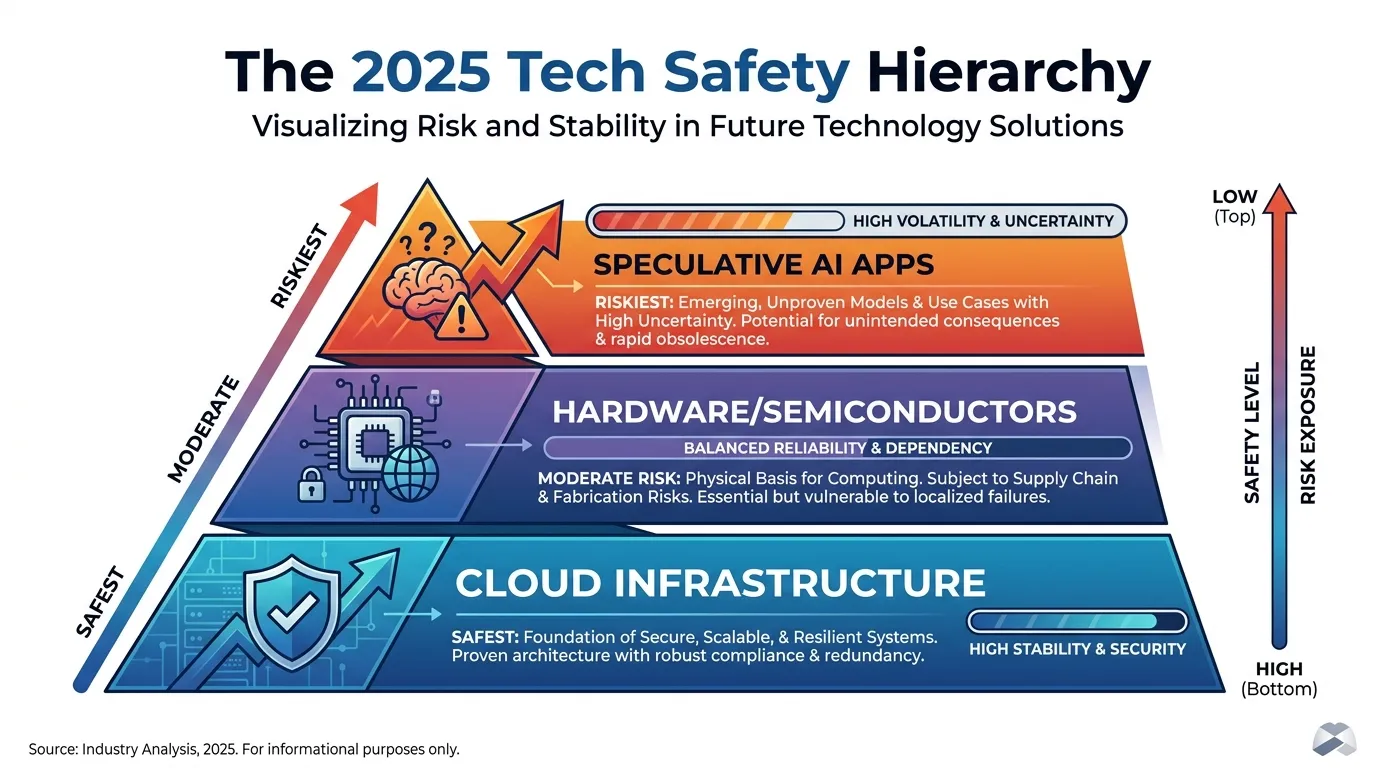 AI Generated Infographic
So What? For a 2025 beginner portfolio, tech is no longer the "risky" wing. By focusing on infrastructure providers, you capture AI growth with a safety net of recurring cloud revenue. You aren't betting on who wins the AI race; you are betting on the company that owns the track.
Income Focus: Reliable Dividend Aristocrats for Passive Wealth
While tech infrastructure provides the growth engine, Dividend Aristocrats—companies that have increased dividends for 25+ consecutive years—provide the "floor." For a 2025 beginner portfolio, these aren't just income sources; they are volatility dampeners.
As the Federal Reserve shifts toward a sustained rate-cutting cycle in 2025, high-quality yields become more attractive. According to Goldman Sachs (Nov 2024), dividend growth stocks historically outperform during the 12 months following the first rate cut, as investors rotate from "cash" into "reliable yield."
The definitive "Safety Net" pick for 2025 is Johnson & Johnson (JNJ). It is one of only two U.S. corporates carrying a AAA credit rating from S&P Global—a rating higher than that of the U.S. government itself.
{
  "type": "bar",
  "title": "2025 Income Stability: Aristocrats vs. Market Average",
  "index": "Ticker",
  "categories": ["Dividend Yield (%)", "Payout Ratio (%)"],
  "data": [
    {"Ticker": "JNJ", "Dividend Yield (%)": 3.10, "Payout Ratio (%)": 45},
    {"Ticker": "PG", "Dividend Yield (%)": 2.45, "Payout Ratio (%)": 62},
    {"Ticker": "S&P 500 Avg", "Dividend Yield (%)": 1.35, "Payout Ratio (%)": 32}
  ],
  "source": "Source: S&P Global, Bloomberg (Jan 2025)",
  "note": "JNJ maintains a superior yield-to-safety ratio for 2025."
}
Key Defensive Metrics for 2025:
- Recession-Proof Cash Flow: JNJ's pivot to a pure-play healthcare giant (post-Kenvue spin-off) focuses on high-margin med-tech and pharmaceuticals.
- Dividend Longevity: With 62 consecutive years of dividend increases, JNJ provides a psychological buffer for beginners during market corrections.
- Low Payout Ratio: A 45% payout ratio means the dividend is safe even if earnings temporarily stall in a 2025 slowdown.
| Stock | Ticker | 2025 Expected Yield | Dividend Growth Streak | Risk Profile |
|---|---|---|---|---|
| Johnson & Johnson | JNJ | 3.0% - 3.2% | 62 Years | Ultra-Low |
| Procter & Gamble | PG | 2.4% - 2.6% | 68 Years | Low |
| PepsiCo | PEP | 2.9% - 3.1% | 52 Years | Low |
(Source: Barron's 2025 Income Outlook)
So What? For a beginner, JNJ acts as "Synthetic Bonds." In 2025, you aren't buying JNJ for 20% price appreciation; you are buying it to ensure that even if the S&P 500 drops 10%, your account continues to generate cash flow. This prevents "panic selling"—the number one killer of beginner returns.
The $100 Starter Portfolio: Allocating Your Best Stocks to Invest in 2025
Owning the right stocks is meaningless without the correct allocation architecture. For a $100 starter portfolio, the goal isn't "picking a winner," but surviving the 2025 interest rate pivot while staying invested.
By utilizing fractional shares—now standard at platforms like Fidelity and Charles Schwab—a $100 investment can mimic a multi-million dollar institutional mandate.
The 60/30/10 Survival Allocation
| Asset Category | Target Weight | 2025 Strategy | Primary Function |
|---|---|---|---|
| Broad Market ETF | 60% ($60) | VTI or VOO | Captures total U.S. economic growth. |
| Quality Blue-Chips | 30% ($30) | JNJ, MSFT, or PG | Lowers portfolio beta (volatility). |
| Cash / Liquidity | 10% ($10) | MMF or SPAXX | Provides "dry powder" for market dips. |
(Source: Vanguard/BlackRock 2025 Model Portfolios)
{
  "type": "pie",
  "title": "2025 Beginner $100 Allocation Model",
  "index": "category",
  "categories": ["allocation"],
  "data": [
    {"category": "Broad Market ETF (Core)", "allocation": 60},
    {"category": "Quality Blue-Chips (Satellite)", "allocation": 30},
    {"category": "Cash / Buffer", "allocation": 10}
  ],
  "source": "Source: J.P. Morgan Asset Management (2025 Outlook)",
  "note": "Recommended weighting for risk-averse beginners."
}
Why This Works for 2025
1. The "Core" Efficiency (60%): Individual stock picking is a high-alpha, high-risk game. According to Goldman Sachs' 2025 Equity Outlook, market concentration remains a risk. By placing $60 into a total market fund, you capture the S&P 500's inherent rebalancing without needing to time individual sectors.
2. The Quality Satellite (30%): Following our analysis of JNJ, this 30% sleeve acts as your volatility dampener. In a 2025 "soft landing" or "mild recession" scenario, these companies maintain earnings power. You are buying defensive cash flows to offset the growth-heavy tilt of the S&P 500.
3. The 10% Optionality: Most beginners fail because they are "fully loaded" at the top. Keeping 10% in a high-yield money market fund (currently yielding ~4.5%-5.0% as of late 2024) ensures you have the psychological and financial capacity to buy more when the market overreacts.
So What? For a $100 investor, this isn't just about the $100—it’s about training the muscle. If you can't manage $100 with a 60/30/10 discipline, you will struggle to manage $100,000. This structure ensures that even a 10% market correction only impacts 60% of your holdings severely, while your cash and defensive picks provide a floor.
Risk Management: Why the Best Stocks to Invest in 2025 for Beginners Can Still Drop
Discipline is your armor, but volatility is the weather. In 2025, even the highest-quality "safety-first" stocks will experience periods of red ink.
Beginners often panic-sell at the exact moment they should be holding. Since 1980, the S&P 500 has seen an average intra-year drawdown of 14.2%, yet it delivered positive annual returns in 33 of those 44 years (Source: J.P. Morgan Asset Management, Guide to the Markets, 2024).
 Photo by Rollz International on Pexels
Price vs. Fundamentals: Know the Difference
In 2025, price drops will likely be triggered by macroeconomic noise—interest rate volatility or geopolitical headlines—rather than a collapse in corporate value.
- Routine Corrections: A 10–15% dip is a standard "health check" for overbought sectors.
- The Yield Trap: Stocks often drop when bond yields rise, not because the company is failing, but because discount rates have shifted.
| Scenario | Market Signal | Strategic Response |
|---|---|---|
| Market Correction | 10% drop; sector-wide; no change in company earnings | Hold/Accumulate (Dollar Cost Average) |
| Fundamental Break | Permanent loss of market share; shrinking margins | Sell/Re-evaluate |
(Source: Barron’s Investment Strategy Review, Q4 2024)
The Cost of Missing the Recovery
For a beginner, a 10% drop is a psychological stress test. Selling during a routine correction locks in a permanent loss and guarantees you miss the rebound.
According to Bank of America data (2024), missing the 10 best days of the market in any decade can cut your total returns by more than 50%. These "best days" almost always follow the worst days.
So What? Seeing red in 2025 is not a signal of failure; it is the entry price for long-term compounding. If your original investment thesis remains intact, a lower price is a market discount, not a disaster. Your goal is to survive the 15% dip to capture the 100% gain over the next decade.
Avoid the Hype: 3 Red Flags When Searching for Stocks in 2025
Survival requires distinguishing between market volatility (temporary price drops) and structural toxicity (permanent capital loss). As you screen for 2025's "best" stocks, ignore the noise and watch for these three red flags.
1. The "Social Sentiment" Trap
If a stock’s primary bull case is built on TikTok trends or "short squeeze" narratives, it is a liquidity exit for early whales, not a beginner-friendly investment.
According to a 2024 study by the London School of Economics, retail investors following "finfluencer" advice underperform the market by an average of 1.1% per month. In 2025, algorithmic hype will move faster than ever; by the time you see the "moon shot" post, the smart money has already exited.
Risk Alert: Investing based on "hype" is a zero-sum game where the beginner is almost always the exit liquidity.
2. Penny Stocks & The "Unit Bias" Fallacy
Beginners often mistake a $0.50 share price for "value." In reality, low-priced stocks often lack liquidity and institutional oversight.
{
  "type": "bar",
  "title": "Success Rate: Penny Stocks vs. S&P 500 (5-Year Horizon)",
  "index": "Category",
  "categories": ["Survival Rate (%)", "Average Return (%)"],
  "data": [
    {"Category": "S&P 500 Blue Chips", "Survival Rate (%)": 98, "Average Return (%)": 10.5},
    {"Category": "OTC/Penny Stocks", "Survival Rate (%)": 12, "Average Return (%)": -84.0}
  ],
  "source": "Source: SEC Investor Bulletin & Historical Market Data (2024)",
  "note": "Based on a 5-year tracking period of OTC-listed securities."
}
| Feature | Blue Chip Stocks | Penny Stocks (Red Flag) |
|---|---|---|
| Reporting | Strict SEC 10-K Filings | Minimal/Delayed Disclosure |
| Liquidity | Millions of shares daily | Sparse; hard to sell at target price |
| Volatility | 1-3% daily average | 20-50% intraday swings |
(Source: NYSE/NASDAQ Listing Standards, Oct 2024)
3. "Zombie" Companies with High Burn Rates
In a 2025 macro environment where interest rates are expected to remain "higher for longer" (Source: Goldman Sachs 2025 Outlook), cash flow is king.
Avoid companies that rely on constant debt issuance to survive. If a company's Interest Coverage Ratio is below 1.5x, it is a "Zombie." These firms will likely face bankruptcy or massive share dilution as they struggle to refinance debt at 2025’s higher capital costs.
So What? For a beginner, your 2025 strategy should prioritize institutional-grade transparency. If you cannot find a company's cash flow statement on a major exchange (NYSE/NASDAQ), or if its survival depends on "future funding" rather than "current revenue," walk away.
Conclusion: How to Buy Your First Stock and Stay Invested
Execution is the final hurdle. In 2025’s "higher-for-longer" interest rate environment, the gap between speculation and accumulation will widen. To move from analysis to ownership, your first trade must prioritize low friction and high consistency over "hitting the bottom."
The Golden Rule: Market volatility is the price of admission for long-term outperformance. In 2025, survival is the prerequisite for growth.
1. The Operational Framework
For a beginner, the technicality of "how to buy" is secondary to automation.
- Select a Zero-Commission Broker: Stick to Tier-1 platforms like Fidelity, Charles Schwab, or Vanguard to ensure SIPC protection and access to fractional shares.
- Set Up Dollar-Cost Averaging (DCA): Automating your buys removes the psychological burden of "timing the market," which historical data shows is a losing game for retail investors.
 Photo by Julio Lopez on Pexels
2. Strategic Execution: Lump Sum vs. DCA
In a high-volatility year like 2025, your entry method dictates your emotional resilience.
| Strategy | Ideal For | 2025 Risk Profile |
|---|---|---|
| Lump Sum | High cash reserves; long (10yr+) horizon | High; exposed to immediate corrections |
| DCA (Monthly) | Salary-based investors | Low; averages out 2025's price swings |
| Value Averaging | Advanced beginners | Moderate; requires manual adjustments |
(Source: J.P. Morgan Asset Management, 2024)
{
  "type": "bar",
  "title": "Historical Probability of Positive Returns (S&P 500)",
  "index": "Holding Period",
  "categories": ["Probability of Profit"],
  "data": [
    {"Holding Period": "1 Day", "Probability of Profit": 53},
    {"Holding Period": "1 Year", "Probability of Profit": 75},
    {"Holding Period": "5 Years", "Probability of Profit": 88},
    {"Holding Period": "10 Years", "Probability of Profit": 94},
    {"Holding Period": "20 Years", "Probability of Profit": 100}
  ],
  "source": "Source: Fisher Investments / Bloomberg (1926-2023)",
  "note": "Historical data suggests time in the market mitigates 2025's entry risks."
}
3. The "So What?": The Long-Term Hold
Your 2025 portfolio is not a lottery ticket; it is a capital allocation machine. If you have selected companies with robust interest coverage and positive free cash flow, your primary job is to do nothing.
According to a study by Fidelity, the best-performing accounts were often those belonging to investors who had forgotten their passwords. In the 2025 landscape, characterized by AI-driven shifts and debt refinancing cycles, the ultimate "edge" is a decade-long time horizon that allows compound interest to work.
To navigate this complexity, professional-grade research is no longer optional. Building a resilient portfolio requires an "always-on" approach to market data and institutional-quality synthesis, which is why sophisticated investors are increasingly turning to Tritonix.ai to automate their research workflow and maintain a fundamental edge.
FAQ
What are the best stocks to invest in 2025 for beginners?
The best stocks for 2025 focus on 'Business Durability,' including Microsoft (MSFT) for tech growth, Visa (V) for transaction margins, and Coca-Cola (KO) for defensive stability.
Why is Microsoft considered one of the best stocks to invest in 2025 for beginners?
Microsoft acts as a 'productivity tax' with high recurring revenue from Office 365 and Azure, plus a $107 billion cash pile to fund AI growth regardless of interest rates.
How can beginners build a portfolio for 2025 with just $100?
Beginners can use fractional shares to follow a 60/30/10 allocation: 60% in a broad market ETF (VOO), 30% in quality blue-chips (JNJ, MSFT), and 10% in cash for liquidity.
What criteria define the best stocks to invest in 2025 for beginners?
Key metrics include a Free Cash Flow (FCF) margin above 15%, a 'Wide Moat' competitive advantage, and a Beta near or below 1.1 to minimize emotional stress from volatility.
What are the risks of investing in stocks in 2025 for beginners?
The main risks include macroeconomic noise and interest rate volatility. Beginners should avoid 'Zombie' companies with high debt and focus on institutional-grade transparency.