Best Stock to Buy Now in November 2026: A Pullback Framework
Founder of Tritonix.ai. Former Hedge Fund Analyst with 10+ years of experience managing over $1B AUM across insurance portfolios and private funds. Specializes in institutional-grade fundamental analysis and long-term capital allocation.
Why the best stock to buy now is harder to name after the November pullback
The last official U.S. cash close, on Wednesday, November 18, 2026, left the S&P 500 at 7,323.63, down 16.90 points, or 0.23%, from Tuesday's 7,340.53, according to the Federal Reserve Bank of St. Louis FRED database. That print completed a fifth straight decline and a drop of about 3.5% from the 7,592.40 close on November 12.
The Associated Press recorded the same S&P 500 close, with the Dow Jones Industrial Average down 1.1% to 50,198.17 and the Nasdaq Composite up 0.4% to 24,429.88. The Russell 2000 gained 0.5% to 2,714.31. A split tape is a reminder that "the market" is no longer moving as a single trade.
A five-session drop does not automatically create a buy. It changes the prices, the sector leadership, and the questions a buyer has to answer.
Through Tuesday, November 17, FactSet data compiled by MarketWatch showed the S&P 500 down 3.2% in November and 4.1% in the fourth quarter, but still up 7.2% for 2026. The index's forward price-to-earnings ratio had compressed to 17.7 from 22.2 at the end of 2025, helped by rising earnings estimates as well as lower prices.
Information technology was the weakest group on that snapshot, down 8.6% in November and 14.9% in the fourth quarter, as investors questioned how much of the artificial-intelligence build-out is already in the price. Consumer staples and healthcare led, up 14.6% and 9.9% since September 30. That rotation is why a generic answer to "best stock to buy now" can age badly in a matter of sessions.
{
  "type": "line",
  "title": "S&P 500 Official Closes During the Five-Session Drop",
  "index": "Date",
  "categories": ["Close"],
  "data": [
    {"Date": "Nov 12", "Close": 7592.40},
    {"Date": "Nov 13", "Close": 7561.67},
    {"Date": "Nov 16", "Close": 7416.59},
    {"Date": "Nov 17", "Close": 7340.53},
    {"Date": "Nov 18", "Close": 7323.63}
  ],
  "source": "Source: Federal Reserve Bank of St. Louis, FRED series SP500, official daily closes.",
  "note": "November 14–15 were a weekend. The November 18 print is the last official U.S. cash close before this article."
}
| Index | Official close | Session change | As of |
|---|---|---|---|
| S&P 500 | 7,323.63 | -0.2% | Nov 18, 2026 |
| Dow Jones Industrial Average | 50,198.17 | -1.1% | Nov 18, 2026 |
| Nasdaq Composite | 24,429.88 | +0.4% | Nov 18, 2026 |
| Russell 2000 | 2,714.31 | +0.5% | Nov 18, 2026 |
Source: Associated Press recap of the November 18, 2026 session; S&P 500 level also matches FRED.
Yahoo Finance put the S&P 500's 52-week change at 10.51% as of the same close, a wider window than the year-to-date figure in the FactSet snapshot. Both numbers can be true at once: 2026 has still been a positive year, but the latest month has taken a visible bite out of that gain.
A four-step screen before you pick a ticker
The useful version of "best stock to buy now" is not a prediction of next week's winner. It is a test of which business you are willing to own through the next earnings season, at a price that still works if growth slows.
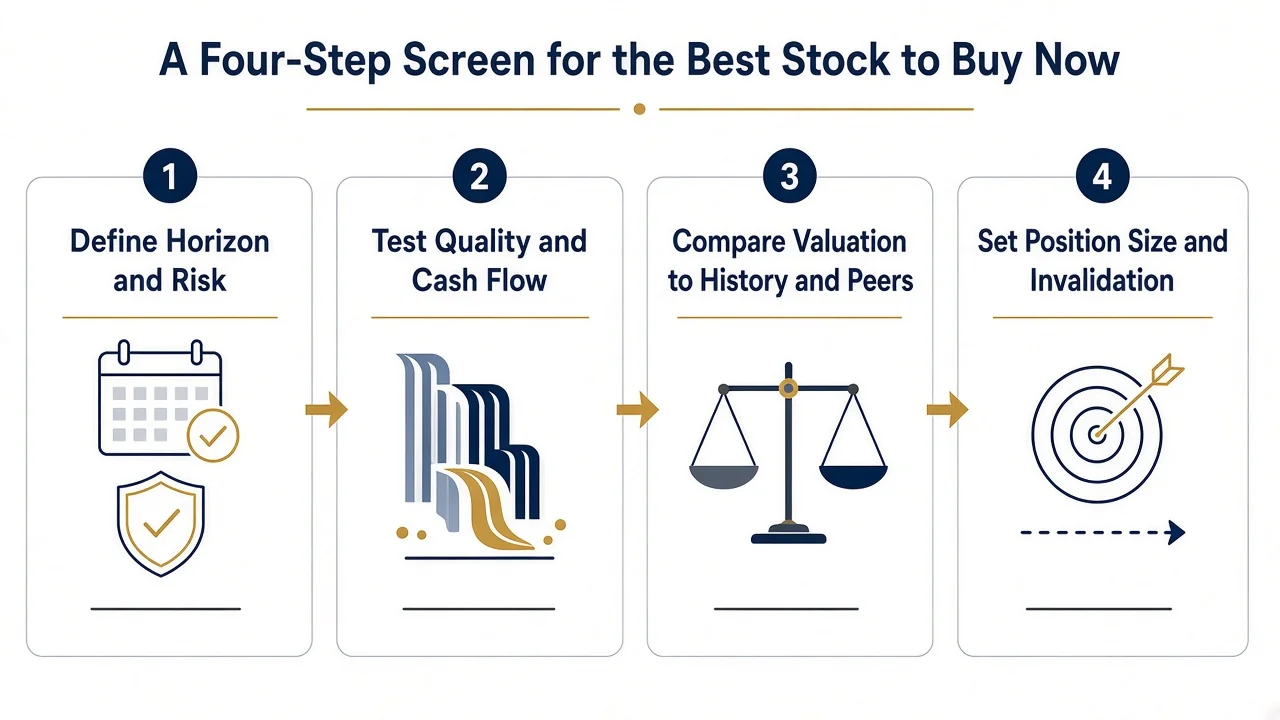 AI generated infographic of a four-step screen for choosing the best stock to buy now.
First, define the horizon and the risk you can actually bear. A name that looks attractive on a 10-year compounder math can be a poor fit if you may need the cash in six months, or if a 20% drawdown would force a sale.
Second, test quality and cash flow, not just revenue growth. Amazon's third-quarter results, released October 29, 2026, showed AWS sales up 39% to $46.0 billion, even as trailing-twelve-month free cash flow was an outflow of $42.4 billion after a $94.8 billion increase in net purchases of property and equipment. Growth and cash conversion are not the same test.
Third, compare valuation with the company's own history and with peers, using both trailing and forward multiples. A cheap-looking trailing price-to-earnings ratio can be flattered by a prior-year gain, while a low forward multiple can embed optimistic estimates that have not yet been earned.
Fourth, set a position size and write down what would invalidate the thesis — a missed margin, a regulatory rule, a failed product cycle — before the next headline arrives. A process like this is also how research tools such as Tritonix AI's investment agent are meant to be used: to keep the comparison honest, not to outsource the decision.
If you cannot state the horizon, the cash-flow test, the valuation comparison, and the exit condition in a few lines, you do not yet have a "best stock to buy now." You have a ticker.
What the November tape is pricing in
The November decline has not been a uniform markdown of every mega-cap. It has been a re-pricing of which businesses investors are still willing to pay a premium for, and which ones they now want to own only at a discount.
| Company | Nov 18 close | Day change | 52-week change | 52-week range | Trailing P/E | Forward P/E | Market cap |
|---|---|---|---|---|---|---|---|
| Apple (AAPL) | $352.45 | +0.15% | +31.04% | $243.42–$360.83 | 39.19 | 36.77 | $5.11T |
| Microsoft (MSFT) | $508.29 | +0.40% | — | — | 26.42 | 25.09 | $3.76T |
| Nvidia (NVDA) | $150.96 | -2.89% | -16.65% | $148.80–$243.37 | 19.65 | 9.84 | $3.75T |
| Alphabet (GOOGL) | $282.44 | +0.80% | -4.31% | $272.11–$408.61 | 14.63 | 18.81 | $3.43T |
| Amazon (AMZN) | $267.74 | +3.82% | +15.81% | $196.00–$287.20 | 20.85 | 23.89 | $2.79T |
Source: Yahoo Finance official quotes and key statistics as of the November 18, 2026 close. Microsoft's 52-week range is omitted because this table uses only fields confirmed on the cited Yahoo Finance statistics pages.
Apple closed 2.3% below its 52-week high of $360.83 and remains the clearest quality-premium story in the group. Nvidia closed only $2.16, or about 1.5%, above its 52-week low of $148.80, and 38% below its $243.37 high. Alphabet finished 31% below its $408.61 high and just 3.8% above its $272.11 low. Amazon, up 3.82% on the session, is closer to its high than to its low.
The valuation spread is as wide as the price paths. Apple's trailing multiple of 39.19 and forward multiple of 36.77 leave less room for a miss. Nvidia's forward multiple of 9.84 looks inexpensive only if the earnings the market is capitalizing actually arrive. Alphabet's trailing multiple of 14.63 is lower than its forward multiple of 18.81, a warning that trailing earnings may be a less clean guide than usual.
{
  "type": "bar",
  "title": "S&P 500 Sector Price Changes in the Fourth Quarter Through Nov. 17, 2026",
  "index": "Sector",
  "categories": ["Q4 through Nov. 17 (%)"],
  "data": [
    {"Sector": "Consumer staples", "Q4 through Nov. 17 (%)": 14.6},
    {"Sector": "Healthcare", "Q4 through Nov. 17 (%)": 9.9},
    {"Sector": "Utilities", "Q4 through Nov. 17 (%)": 9.8},
    {"Sector": "Financials", "Q4 through Nov. 17 (%)": 6.7},
    {"Sector": "Consumer discretionary", "Q4 through Nov. 17 (%)": 6.6},
    {"Sector": "Real estate", "Q4 through Nov. 17 (%)": 6.1},
    {"Sector": "Materials", "Q4 through Nov. 17 (%)": 3.6},
    {"Sector": "Energy", "Q4 through Nov. 17 (%)": 2.8},
    {"Sector": "Industrials", "Q4 through Nov. 17 (%)": -1.4},
    {"Sector": "Communication services", "Q4 through Nov. 17 (%)": -13.9},
    {"Sector": "Information technology", "Q4 through Nov. 17 (%)": -14.9},
    {"Sector": "S&P 500", "Q4 through Nov. 17 (%)": -4.1}
  ],
  "source": "Source: FactSet data compiled by MarketWatch, price change from Sept. 30 through Nov. 17, 2026, excluding dividends.",
  "note": "These figures end one session before the November 18 close. Healthcare's Q4 lead does not include the November 18 insurer selloff."
}
FactSet's sector snapshot also shows why "cheaper market, therefore buy technology" is too blunt. Information technology's forward price-to-earnings ratio had already fallen to 16.7 from 26.6 at the end of 2025, while consumer staples had become more expensive, at 25.0 times forward earnings versus 22.3. Energy, still up 41.2% for 2026 through November 17, had already dropped 9.8% in November and traded at 12.0 times forward earnings.
MarketWatch argued that the defensive lead, and the willingness to pay up for it, lined up with growing recession worries in both the stock and bond markets. That backdrop matters as much as any single ticker: the best stock to buy now in a soft-landing path is probably not the best stock to buy now in a profit-recession path.
Three setups worth examining, not a buy list
No screen produces a single "best" name for every investor. The November tape does, however, leave three distinct setups that are worth underwriting rather than chasing.
The first is the quality compounder that has barely been marked down. Apple closed at $352.45, with a market value of $5.11 trillion, a 52-week gain of 31.04%, and trailing revenue of $478.83 billion. Yahoo Finance lists a trailing profit margin of 27.60%, an operating margin of 33.01%, and levered free cash flow of $105.66 billion. Quarterly revenue and earnings were still growing, at 11.7% and 11.8% year over year. The attraction is durability. The risk is the multiple: at 39.19 times trailing earnings and 36.77 times forward earnings, Apple has to keep delivering to justify staying near a 52-week high while other mega-caps have already been cut.
The second setup is the discounted platform business whose growth is still visible in the operating results. Alphabet's third-quarter release, dated October 28, 2026, showed consolidated revenue of $127.6 billion, up 25%, and Google Cloud revenue of $30.7 billion, up 103% from $15.2 billion a year earlier. Cloud operating income rose to $11.1 billion from $3.6 billion. Search & other revenue grew 12% to $63.4 billion, and management said the year-over-year query growth rate was the highest in five years.
The income statement, though, is less clean than the cloud line. Net income available to common stockholders fell to $26.2 billion, or $2.12 a share, from $35.0 billion, or $2.87, because other income (expense), net swung to an $8.2 billion expense from $12.8 billion of income a year earlier. Yahoo Finance also shows levered free cash flow of -$1.16 billion over the trailing twelve months. Alphabet at $282.44 is no longer priced like a scarcity asset, but the buyer has to underwrite AI capital spending, not just the cloud growth rate.
Nvidia is the sharper version of the same question. On November 17, the company reported fiscal third-quarter revenue of $115.8 billion, up 103% from a year earlier and up 20% from the prior quarter, with data-center revenue of $107.6 billion, up 110%. GAAP earnings were $2.70 a share and non-GAAP earnings were $2.68. The fourth-quarter outlook, which includes an extra week, calls for revenue of $130.0 billion, plus or minus 3%, and gross margins of 71.0% to 72.0%, down from a GAAP gross margin of 74.8% in the third quarter. The company is not assuming any data-center compute revenue from China in that outlook, according to the November 17 press release.
The stock still fell 2.89% the next session, to $150.96, leaving it a sliver above the 52-week low. The market is also digesting a leadership change: Jensen Huang resigned as president, CEO, and a director effective November 11, 2026, and chief financial officer Colette Kress is serving as interim CEO, as confirmed in the earnings release and in Nvidia's transition announcement. Nvidia returned $28.1 billion to shareholders in the quarter and had about $227.3 billion remaining on its repurchase authorization. That is a real capital-return backstop. It does not settle the debate over succession, China, or whether the margin guide marks a turning point.
Amazon sits between those two platform stories. AWS's $46.0 billion quarter and $17.8 billion of segment operating income show the cloud engine is accelerating. The company's own free-cash-flow statement shows the cost of keeping that engine fed. Amazon's November 18 close of $267.74, at 20.85 times trailing earnings, is not as compressed as Alphabet or Nvidia, but the 3.82% bounce on a down day for the Dow is a reminder that the market is still willing to pay for visible cloud growth when the price is not already at a record.
The third setup is the defensive name that became cheaper in a single session. On November 17, the MarketWatch/FactSet screen of consumer-staples and healthcare stocks with at least 75% buy ratings showed UnitedHealth at $389.68, with a consensus target of $475.73 and 22% implied upside, and CVS Health at $85.81, with a target of $108.25 and 26% implied upside. On November 18, UnitedHealth closed at $349.91, down $39.77, or 10.21%, and CVS closed at $81.35, down 5.20%, after reports that the Centers for Medicare & Medicaid Services had proposed broader Medicare Advantage audit recoveries.
Yahoo Finance notes that UnitedHealth had raised 2026 adjusted earnings guidance to at least $20.50 a share, and that CVS traded at 9.45 times trailing earnings with a forward dividend yield of 3.10%. Those are not trivial figures. They also do not, by themselves, underwrite a new regulatory rule. A target calculated on November 17 should not be recycled as if November 18 never happened.
A cheaper quote after a policy headline is a starting point for research, not proof that the defensive trade just got better.
The risks that would invalidate a buy-now thesis
The first risk is that the AI infrastructure cycle slows faster than earnings estimates do. Nvidia's official outlook already excludes China data-center compute and points to lower gross margins. If hyperscaler capital spending pauses, or if customers delay deployments, a forward multiple of 9.84 will not stay low because the price fell first; the earnings in the denominator can fall with it.
The second risk is cash-flow duration. Alphabet's slightly negative levered free cash flow and Amazon's $42.4 billion trailing outflow are the price of the build-out. If those outflows persist after growth decelerates, the market can re-rate the shares again even if revenue is still rising.
The third risk is paying a quality premium at the wrong time. Apple's balance sheet and cash generation support a premium, but a 39 times trailing earnings multiple leaves less room for a product-cycle stumble or a weaker services quarter than the discounted platform names now do.
The fourth risk is regulatory and political shock in the very sectors that led the fourth-quarter rally. UnitedHealth's 10.21% drop on November 18, and CVS's 5.20% decline, show how quickly a "defensive" holding can trade like a policy stock. Healthcare's 9.9% fourth-quarter gain through November 17 did not include that session.
The fifth risk is a broader earnings recession. MarketWatch's reading of the defensive rotation was that investors were already paying up for staples and healthcare because they were worried about a slowdown. Staples at 25 times forward earnings are not a risk-free hiding place if that slowdown arrives and the premium multiples compress.
This article is not personalized investment advice, and none of the names above is a recommendation to buy or sell. Official closes move, estimates change, and a thesis that was valid at the November 18 close can be wrong at the next one.
How to monitor the decision from here
After a five-session drop, the work is less about catching the first bounce and more about tracking whether the November prices still make sense as the facts change.
Start with the official tape and the next set of earnings revisions, not with after-hours chatter. For Apple, the test is whether growth near 12% and cash flow above $100 billion continue to support a premium multiple. For Alphabet and Amazon, the tests are cloud growth, capital spending, and the path back to consistently positive free cash flow. For Nvidia, they are the $130 billion fourth-quarter revenue guide, the 71% to 72% margin range, China assumptions, and the CEO search. For UnitedHealth and CVS, they are the final shape of the Medicare audit proposals and whether earnings guidance holds.
Ownership changes can confirm or contradict a thesis as clearly as a price target can. 13F filings and other holder data, which Tritonix AI's smart-money tracking is built to surface, are most useful when they are read against those operating tests rather than used as a shortcut.
A broad fund such as an S&P 500 ETF remains a reasonable core holding for investors who do not want to turn a market-wide pullback into a single-stock bet. The narrower question — the best stock to buy now, at these November prices — is only worth asking if you are prepared to keep underwriting the business after the next close.
FAQ
What is the best stock to buy now in November 2026?
There is no single best stock to buy now for every investor. After the S&P 500's official close of 7,323.63 on November 18, 2026, the more useful approach is a four-step screen: define your horizon and risk, test quality and cash flow, compare valuation with history and peers, and set a position size and invalidation point. Apple, Alphabet, Nvidia, Amazon, UnitedHealth, and CVS illustrate different setups at those prices, not a one-size-fits-all pick.
Why did the stock market fall in November 2026?
Through November 17, FactSet data compiled by MarketWatch showed the S&P 500 down 3.2% in November and 4.1% in the fourth quarter, even though it was still up 7.2% for 2026. Information technology was the weakest sector, down 8.6% in November and 14.9% in the fourth quarter, as investors questioned the AI trade. The index then posted a fifth straight decline on November 18, closing at 7,323.63.
Is Nvidia a good buy after its November 2026 drop?
Nvidia closed at $150.96 on November 18, 2026, only $2.16 above its 52-week low of $148.80, even after reporting fiscal third-quarter revenue of $115.8 billion and guiding fourth-quarter revenue to $130.0 billion, plus or minus 3%. The stock also reflects a CEO transition after Jensen Huang's resignation effective November 11 and a gross-margin guide of 71% to 72%, below the third-quarter GAAP margin of 74.8%. Whether that price is attractive depends on whether those estimates and the China-free data-center outlook hold.
Are defensive stocks like UnitedHealth a better buy after the pullback?
Not automatically. A FactSet screen published on November 17 showed UnitedHealth at $389.68 with 22% implied upside to a $475.73 consensus target. The next session, UnitedHealth closed at $349.91, down 10.21%, and CVS Health closed at $81.35, down 5.20%, after reports of broader proposed Medicare Advantage audits. A cheaper quote after a policy headline still has to be underwritten against the new rule.
Should I buy an S&P 500 fund instead of trying to pick the best stock to buy now?
A broad S&P 500 fund can be a reasonable core holding if you do not want to turn a market-wide pullback into a single-stock bet. The narrower question is worth asking only if you are prepared to keep underwriting the business after the next official close. This article is not personalized investment advice.