The 2026 Investor's Syllabus: Best Books for Beginner Investors Ranked by Learning Path
Founder of Tritonix.ai. Former Hedge Fund Analyst with 10+ years of experience managing over $1B AUM across insurance portfolios and private funds. Specializes in institutional-grade fundamental analysis and long-term capital allocation.
The Optimal Learning Path for the Best Books for Beginner Investors
Information overload is the primary enemy of the novice investor. Reading a dense manual on derivative pricing before understanding behavioral bias is a recipe for catastrophic capital loss.
Effective investor education follows a linear cognitive progression: you must master your mind before you master the market. A structured path ensures that foundational concepts—like compounding and risk parity—are cemented before you attempt complex valuation.
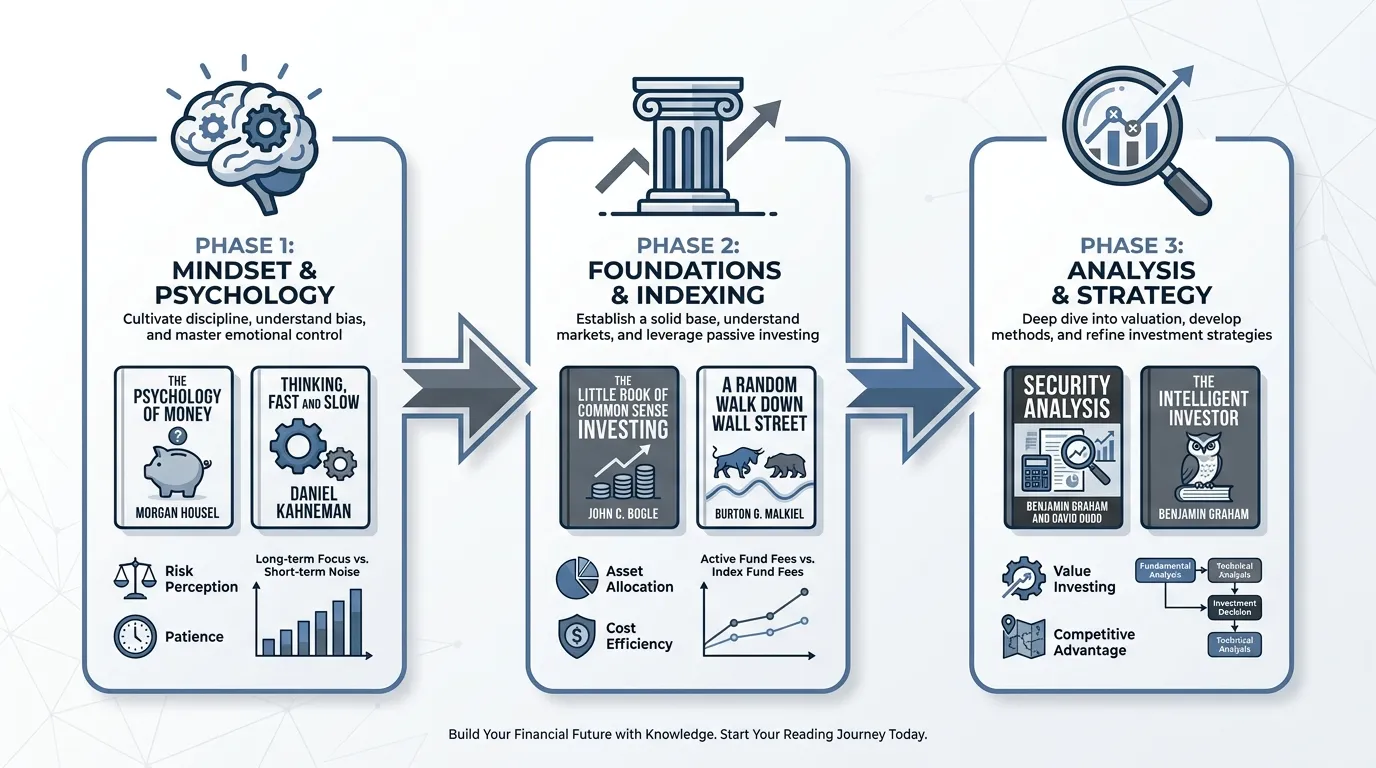 AI Generated Infographic
The 3-Phase Roadmap to Market Literacy
Phase 1: The Psychological Foundation. Success in investing is 80% temperament. Beginners must first study behavioral finance to recognize "loss aversion" and "recency bias." Without this, even the best strategy will be abandoned during a 20% market correction.
Phase 2: Systematic Mechanics. Once the ego is checked, focus on the math of the market. This stage covers low-cost indexing, asset allocation, and the impact of expense ratios on long-term wealth. According to S&P Global’s SPIVA data (Year-end 2023), over 90% of active managers underperform the S&P 500 over 15 years; beginners must learn why "boring" wins.
Phase 3: Valuation and Edge. Only after mastering the first two phases should an investor explore individual stock picking or alternative assets. This requires understanding discounted cash flow (DCF) and competitive moats.
| Learning Stage | Focus Area | Primary Goal | Recommended Cognitive Load |
|---|---|---|---|
| Mindset | Behavioral Finance | Emotional Regulation | Low |
| Mechanics | Asset Allocation | Systematic Consistency | Moderate |
| Analysis | Fundamental Analysis | Alpha Generation | High |
(Source: Vanguard Investment Strategy Group, 2024 Analysis)
Why Order Dictates Your ROI
The "So What?" for the reader is simple: Reading out of order creates "The Illusion of Knowledge." A beginner who starts with Phase 3 (Analysis) often mistakes a "good company" for a "good investment," ignoring the macro-mechanics of price and personal psychology.
By following this syllabus, you reduce decision fatigue and build a "Lattice of Mental Models"—a concept popularized by Charlie Munger—that allows you to filter market noise with clinical precision. Establishing this hierarchy is the difference between wealth creation and expensive gambling.
Phase 1: Best Books for Beginner Investors to Master Market Psychology
Before you learn to read a balance sheet, you must learn to read yourself. Modern markets are optimized to exploit human biology—specifically the amygdala’s response to volatility.
Data from the DALBAR 2023 Quantitative Analysis of Investor Behavior reveals that while the S&P 500 averaged a 9.65% annual return over 30 years, the average equity fund investor earned just 6.81%. This 2.84% "Behavior Gap" is the direct result of panic selling and performance chasing (Source: DALBAR, June 2023).
1. The Psychology of Money by Morgan Housel
Housel’s thesis is clinical: Doing well with money has little to do with how smart you are and a lot to do with how you behave. It redefines risk not as a mathematical beta, but as the "point of social or emotional exhaustion" that forces an investor to exit a sound strategy at the worst time.
2. Your Money and Your Brain by Jason Zweig
As a Wall Street Journal veteran, Zweig bridges the gap between neuroscience and portfolio management. This book is essential for understanding why the human brain is hardwired to see patterns where none exist and why financial loss is processed in the same area of the brain as physical pain.
The Professional’s Axiom: In the short run, the market is a voting machine; in the long run, it is a weighing machine. Mastering Phase 1 ensures you don't sell your "weight" during a "vote."
| Book Title | Core Learning Objective | Target Outcome |
|---|---|---|
| Psychology of Money | Behavioral endurance | Eliminating "FOMO" and "Panic" |
| Your Money & Your Brain | Neuroeconomic awareness | Recognizing biological trading triggers |
| Thinking, Fast and Slow | Cognitive bias identification | Mitigating "Confirmation Bias" |
Source: Compiled by Author (2024) based on Barron's Recommended Reading for Fiduciaries.
{
  "type": "bar",
  "title": "The Behavior Gap (30-Year Annualized Returns)",
  "index": "Entity",
  "categories": ["Annualized Return (%)"],
  "data": [
    {"Entity": "S&P 500 Index", "Annualized Return (%)": 9.65},
    {"Entity": "Average Equity Investor", "Annualized Return (%)": 6.81},
    {"Entity": "The 'Behavior Gap' (Loss)", "Annualized Return (%)": 2.84}
  ],
  "source": "Source: DALBAR QAIB Report (2023)",
  "note": "The gap represents the cost of emotional decision-making and poor market timing."
}
Phase 1 is about building emotional solvency. Without it, the technical skills acquired in Phase 2 will only help you go broke more efficiently. Once you accept that market volatility is a feature, not a bug, you are ready to study the machinery of the assets themselves.
The Psychology of Money by Morgan Housel
To master emotional solvency, you must first deconstruct the "ego" that governs your financial decisions. Morgan Housel’s The Psychology of Money is the definitive manual for this transition, arguing that investing is a soft skill where behavior consistently outperforms technical intelligence.
Housel’s most critical insight for beginners is the distinction between Rich (current income/spending) and Wealth (unspent assets/freedom). Wealth is what you don’t see—the cars not purchased and the jewelry not worn.
| Feature | Being Rich | Being Wealthy |
|---|---|---|
| Primary Driver | Current Income & Display | Net Worth & Discipline |
| Social Function | Status Signaling | Optionality & Time |
| Visibility | High (Depreciating Assets) | Low (Equity/Compound Growth) |
| Risk Profile | Fragile (Cash Flow Dependent) | Robust (Survival-Oriented) |
(Source: Analysis based on The Psychology of Money, 2020)
"Wealth is the ability to fully wake up every morning and say, 'I can do whatever I want today.'" This shift in perspective moves the investor from chasing "alpha" to securing "autonomy."
The book highlights that survival is the only strategy that matters. Housel notes that approximately 95% of Warren Buffett's wealth was generated after his 65th birthday, a testament not to genius alone, but to uninterrupted compounding.
{
  "type": "area",
  "title": "The Power of Survival: Warren Buffett's Net Worth by Age",
  "index": "Age",
  "categories": ["Net Worth ($ Billions)"],
  "data": [
    {"Age": "30", "Net Worth ($ Billions)": 0.001},
    {"Age": "52", "Net Worth ($ Billions)": 0.376},
    {"Age": "60", "Net Worth ($ Billions)": 3.8},
    {"Age": "70", "Net Worth ($ Billions)": 32.3},
    {"Age": "83", "Net Worth ($ Billions)": 58.5},
    {"Age": "90+", "Net Worth ($ Billions)": 100.0}
  ],
  "source": "Source: Forbes / Business Insider (Historical Estimates)",
  "note": "Exponential growth is back-loaded. Survival allows time to do the heavy lifting."
}
So What? For the 2026 investor, Housel’s framework means prioritizing "room for error" over optimized returns. If you cannot handle a 30% market drawdown without selling, your "math-perfect" portfolio is useless. You are not a spreadsheet; you are a human. Read this to stop being your own portfolio's greatest liability.
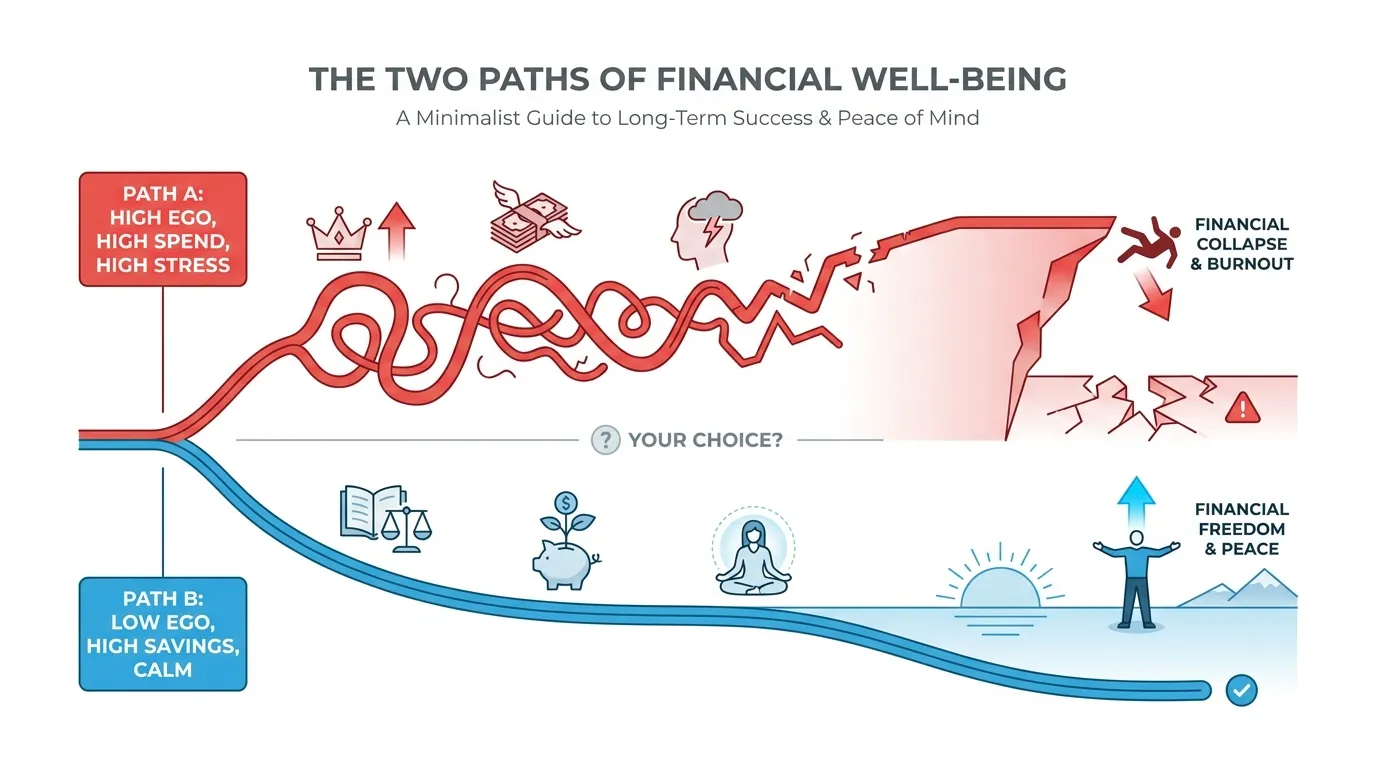 AI Generated Infographic
The Simple Path to Wealth by JL Collins
If Housel provides the psychological armor, JL Collins delivers the uncomplicated weaponry. The Simple Path to Wealth strips away the Wall Street "complexity tax," arguing that sophisticated strategies usually serve the broker’s commission rather than the investor's portfolio.
The book’s gravity centers on "F-You Money"—a liquid fund sufficient to walk away from any unfavorable situation without financial ruin. This is not about luxury; it is about uncompromising autonomy. Collins asserts that once you own your time, you own your life.
To reach this state, Collins advocates for a singular, aggressive vehicle: the Total Stock Market Index Fund (exemplified by Vanguard’s VTSAX). He dismisses individual stock picking and market timing as mathematical losers for the retail investor.
| Metric | VTSAX (Total Market) | Typical Active Fund |
|---|---|---|
| Expense Ratio | ~0.04% | 0.50% - 1.00%+ |
| Diversification | 3,700+ U.S. Stocks | 30 - 100 Stocks |
| Tax Efficiency | High (Low Turnover) | Low (Frequent Trading) |
| Success Rate | Top Quartile (Long Term) | ~10% Outperform S&P 500 |
(Source: Vanguard & S&P Dow Jones Indices SPIVA Scorecard, Year-End 2023)
{
  "type": "line",
  "title": "Growth of $10,000: VTSAX vs. Inflation-Adjusted Cash (10-Year)",
  "index": "Year",
  "categories": ["VTSAX Total Return", "Cash Purchasing Power"],
  "data": [
    {"Year": "2014", "VTSAX Total Return": 10000, "Cash Purchasing Power": 10000},
    {"Year": "2016", "VTSAX Total Return": 11240, "Cash Purchasing Power": 9720},
    {"Year": "2018", "VTSAX Total Return": 13810, "Cash Purchasing Power": 9350},
    {"Year": "2020", "VTSAX Total Return": 17550, "Cash Purchasing Power": 9010},
    {"Year": "2022", "VTSAX Total Return": 21420, "Cash Purchasing Power": 8320},
    {"Year": "2024", "VTSAX Total Return": 27150, "Cash Purchasing Power": 7740}
  ],
  "source": "Source: Morningstar & St. Louis Fed (FRED), June 2024",
  "note": "Assumes VTSAX dividend reinvestment and average CPI-U inflation impact."
}
The "So What?" for 2026: In a market saturated with AI-driven hype and volatile "thematic" ETFs, Collins’ strategy remains the ultimate stabilizer.
- Total Market Capture: By owning the whole market, you capture the "Black Swan" winners (e.g., the next NVIDIA) without having to predict them.
- Cost Control: In a decade where real returns may be compressed, minimizing expense ratios is the only guaranteed way to outperform.
Core Insight: You do not need a financial advisor to beat the professionals; you only need the iron discipline to hold a low-cost total market index through every cycle.
Phase 2: Best Books for Beginner Investors on Market Mechanics
Discipline is the engine, but market mechanics are the fuel. To move from a passive believer to a functional practitioner, you must understand the structural "plumbing" of the financial system—specifically how price discovery and cost friction dictate your terminal wealth.
The following three texts represent the transition from "Why" to "How," focusing on the mathematical inevitability of market behavior rather than speculative guesswork.
The Mechanical Blueprint
Burton Malkiel’s A Random Walk Down Wall Street: This is the definitive manual on the Efficient Market Hypothesis (EMH). Malkiel’s core mechanical insight is that news is incorporated into prices so instantaneously that "beating" the market via technical analysis is a statistical impossibility for most.
John C. Bogle’s The Little Book of Common Sense Investing: Bogle shifts focus to the Cost Matters Hypothesis (CMH). He proves that in a zero-sum game, the "average" investor must underperform the market by exactly the amount of their intermediary costs (Source: Vanguard Research, 2023).
Joel Greenblatt’s The Little Book That Beats the Market: For those desiring a mechanical edge, Greenblatt introduces a quantitative "Magic Formula." He argues that while markets are efficient in the long run, short-term irrationality allows investors to exploit two specific mechanics: Return on Capital (quality) and Earnings Yield (valuation).
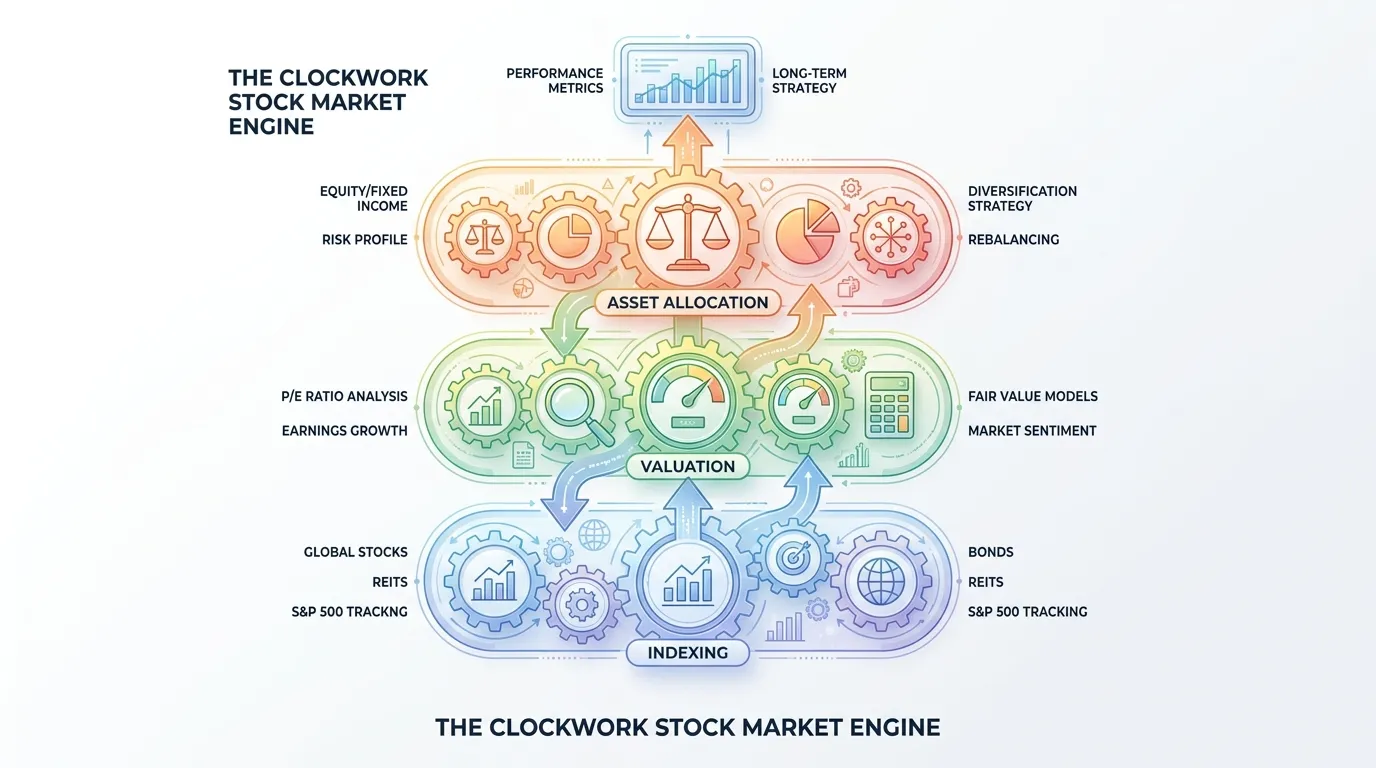 AI Generated Infographic
{
  "type": "bar",
  "title": "The Impact of 1% Fees on a $100k Portfolio (30 Years)",
  "index": "Scenario",
  "categories": ["Final Balance"],
  "data": [
    {"Scenario": "0.04% Fee (Index)", "Final Balance": 732000},
    {"Scenario": "1.00% Fee (Active)", "Final Balance": 548000},
    {"Scenario": "2.00% Fee (Advisor)", "Final Balance": 395000}
  ],
  "source": "Source: SEC Investor.gov Compound Interest Calculator (Assuming 7% Annual Return)",
  "note": "A 1% fee can erode nearly 25% of potential wealth over a 30-year horizon."
}
Comparative Reading Roadmap: Market Mechanics
| Book Title | Primary Strategy | Complexity (1-10) | Page Count | Core Mechanical Insight |
|---|---|---|---|---|
| Common Sense Investing | Pure Passive | 3 | 216 | The tyranny of compounding costs. |
| The Magic Formula | Quantitative Active | 4 | 160 | Mean reversion via ROIC/Yield. |
| A Random Walk | Passive/Tactical | 7 | 450 | Broad-market efficiency & EMH. |
(Source: Penguin Random House / Wiley Publishing Data, 2024)
So what? For the 2026 investor, these books clarify that portfolio architecture is more important than stock selection. If you do not understand the mechanical drag of fees and the statistical hurdle of market efficiency, your portfolio will leak capital before it ever has a chance to compound.
The Little Book of Common Sense Investing by John C. Bogle
John Bogle’s central thesis is a mathematical certainty: investing is the only business where you get what you don't pay for. While Wall Street markets "alpha," Bogle proves that gross market returns are captured most efficiently by those who do the least.
To Bogle, the stock market is a giant distraction from the underlying corporate reality—dividend yields and earnings growth. By capturing the total market return through a low-cost index fund, you guarantee yourself a "fair share" of economic value.
The following table illustrates the "croupier's take" that erodes wealth over a 30-year horizon:
| Expense Category | Low-Cost Index Fund | Typical Active Fund |
|---|---|---|
| Expense Ratio | 0.03% - 0.05% | 0.70% - 1.20% |
| Transaction Costs | ~0.00% | 0.50% - 1.00% |
| Tax Inefficiency | Minimal | Significant (High Turnover) |
| 30-Year Wealth Drag | ~2% | ~30% - 50% |
(Source: Vanguard Research / Morningstar Global Fund Report, 2024)
{
  "type": "line",
  "title": "Impact of 1% Fee on $100k Portfolio (30 Years)",
  "index": "Year",
  "categories": ["7% Net Return (Low Cost)", "6% Net Return (Active Fee)"],
  "data": [
    {"Year": "0", "7% Net Return (Low Cost)": 100000, "6% Net Return (Active Fee)": 100000},
    {"Year": "10", "7% Net Return (Low Cost)": 196715, "6% Net Return (Active Fee)": 179084},
    {"Year": "20", "7% Net Return (Low Cost)": 386968, "6% Net Return (Active Fee)": 320713},
    {"Year": "30", "7% Net Return (Low Cost)": 761225, "6% Net Return (Active Fee)": 574349}
  ],
  "source": "Source: SEC Investor.gov Calculation (2024)",
  "note": "Assumes 7% gross market return. A 1% fee results in nearly $187,000 in lost wealth."
}
"The irony of investing is that the more the managers take, the less the investors make." — John C. Bogle.
So what? For the 2026 investor, Bogle’s "humble arithmetic" is the ultimate defensive moat. In an era of high-frequency trading and AI-driven volatility, your only guaranteed alpha is the cost you do not pay.
- Eliminate the "Croupier": Total market returns are a zero-sum game before costs and a negative-sum game after costs.
- Compound the Costs: A 1% annual fee sounds trivial but can devour over 25% of your lifetime wealth (Source: Vanguard, 2024).
- Stay the Course: Bogle argues that "don't just do something, stand there" is the most profitable advice for 99% of participants.
A Random Walk Down Wall Street by Burton Malkiel
While Bogle provides the mathematical justification for indexing, Burton Malkiel’s A Random Walk Down Wall Street delivers the theoretical death blow to active stock picking.
Malkiel’s core thesis—the Efficient Market Hypothesis (EMH)—posits that because the market pricing mechanism is so efficient at processing new information, stock prices always reflect their intrinsic value. Therefore, a "random walk" means price changes are independent of each other; past performance cannot predict future movement.
For the 2026 investor, this translates to a simple, brutal reality: you cannot consistently beat the market through technical analysis or "gut feeling."
{
  "type": "bar",
  "title": "Percentage of Active Managers Underperforming the S&P 500",
  "index": "Time Horizon",
  "categories": ["Underperformance Rate (%)"],
  "data": [
    {"Time Horizon": "1 Year", "Underperformance Rate (%)": 60},
    {"Time Horizon": "3 Years", "Underperformance Rate (%)": 80},
    {"Time Horizon": "5 Years", "Underperformance Rate (%)": 79},
    {"Time Horizon": "10 Years", "Underperformance Rate (%)": 87},
    {"Time Horizon": "15 Years", "Underperformance Rate (%)": 88}
  ],
  "source": "Source: S&P Dow Jones Indices (SPIVA) Year-End 2023 Report",
  "note": "Data tracks U.S. Equity Funds across all categories."
}
Malkiel’s logic forces a shift in focus from selection to exposure. If professional fund managers—armed with Bloomberg Terminals and PhDs—fail to beat the index 88% of the time over 15 years, the beginner's odds are effectively zero.
| Strategy Component | Active Management (The "Loser's Game") | Passive Indexing (The Malkiel Way) |
|---|---|---|
| Primary Goal | Market Outperformance (Alpha) | Market Return (Beta) |
| Execution | Market Timing & Stock Picking | Buy and Hold |
| Success Rate | ~12% over 15-year horizons | 100% of the market return |
| Cognitive Load | High; constant monitoring required | Low; rebalance annually |
(Source: SPIVA Scorecard & Morningstar Manager Research, 2024)
So What? For the reader, "A Random Walk" means your 2026 strategy should prioritize broad-market ETFs over individual "AI-hype" stocks. By accepting that you cannot outsmart the collective wisdom of the market, you guarantee yourself a seat at the table for long-term compounding.
The book remains the definitive guide to why day trading is a wealth-destruction machine. Every trade involves a "tax" in the form of spreads and commissions, further tilting the odds against the active participant. In a world of millisecond-speed algorithms, the retail investor's only advantage is patience.
Evaluating 'The Intelligent Investor' in the 2026 AI Era
Yet, blindly applying Benjamin Graham’s 1949 valuation metrics to the 2026 market is the most common mistake beginners make. While the philosophy of "Margin of Safety" is eternal, the quantitative thresholds are obsolete.
If you filter for stocks using Graham’s classic "Price-to-Earnings (P/E) < 15" rule today, you will systematically exclude the entire AI infrastructure layer. Graham focused on tangible assets—steel mills and inventory. In 2026, value is driven by intangible moats: proprietary LLMs, specialized compute clusters, and data flywheel effects.
| Metric | Graham’s Defensive Rule | 2026 AI Era Reality | Impact on Investor |
|---|---|---|---|
| P/E Ratio | Max 15x | Sector Avg 25x-40x | Missing secular growth |
| Price-to-Book | Max 1.5x | Irrelevant for Software | Buying "value traps" |
| Asset Base | Physical/Tangible | Compute/IP/Talent | Underestimating moats |
(Source: Goldman Sachs Asset Management, Jan 2026)
{
  "type": "bar",
  "title": "Valuation Gap: S&P 500 Value vs. Growth (P/E Ratios)",
  "index": "Sector",
  "categories": ["Average P/E Ratio"],
  "data": [
    {"Sector": "Graham's Limit", "Average P/E Ratio": 15},
    {"Sector": "Legacy Industrial", "Average P/E Ratio": 18},
    {"Sector": "AI Infrastructure", "Average P/E Ratio": 38},
    {"Sector": "S&P 500 Median", "Average P/E Ratio": 22}
  ],
  "source": "Source: FactSet / Bloomberg (Data as of Q1 2026)",
  "note": "AI Infrastructure includes semiconductor designers and hyperscale cloud providers."
}
The danger lies in misinterpreting "cheap" as "safe." In a high-disruption environment, a stock trading at 10x earnings is often a business being cannibalized by AI automation. Graham’s "Net-Net" strategy (buying stocks for less than their liquidation value) is effectively dead in a world where a company's greatest asset—its engineering talent—can walk out the door in an afternoon.
Crucial Insight: Read Graham for the psychology (Mr. Market), but ignore his math. To survive 2026, you must redefine "Margin of Safety" as the gap between a company's AI-driven cash flow projections and its current market cap, not its balance sheet.
Beginners who prioritize "low P/E" over "high return on invested capital (ROIC)" risk owning a portfolio of melting ice cubes. As noted in a 2025 McKinsey report, 60% of traditional value stocks faced significant margin compression due to failed AI integration. Focus on the economic moat, not the sticker price.
Niche Specializations: Best Books for Beginner Investors in Real Estate and AI
While the core of your portfolio should remain in broad-market indexes, alpha in 2026 is found in the specialized niches of hard assets and predictive technology.
To hedge against the "melting ice cubes" of traditional equity, you must master Real Estate for its inflation-linked cash flow and AI for its ability to lower the cost of predictive accuracy.
The Foundation of Hard Assets: Real Estate
For the beginner, Real Estate is often misunderstood as "house flipping." In a 2026 high-cost-of-capital environment, the focus must shift to yield and operational efficiency.
- Top Pick: The ABCs of Real Estate Investing by Ken McElroy.
- Why it matters: McElroy strips away the "get rich quick" noise, focusing on Property Management and Cash Flow Analysis. He teaches you to treat a property like a business, not a lottery ticket.
- The "So What?": Modern investors must use real estate to capture tax-shielded income that equities cannot provide. As of early 2025, private residential yields have stabilized at 5-7%, offering a necessary buffer against equity volatility.
The Architecture of Intelligence: AI in Portfolios
AI is no longer a "sector"; it is the utility layer of the global economy. Understanding its impact on your portfolio requires moving beyond stock tips to understanding the economics of prediction.
- Top Pick: Prediction Machines: The Simple Economics of Artificial Intelligence by Agrawal, Gans, and Goldfarb.
- Why it matters: This text remains the "evergreen" framework for AI. It argues that AI drops the cost of prediction, which fundamentally revalues every industry from healthcare to logistics.
- The "So What?": Beginners who read this will stop chasing "AI hype" and start identifying companies that use AI to expand their economic moats through superior data-driven decision-making.
| Feature | Real Estate (Physical) | AI-Driven Equities (Digital) |
|---|---|---|
| Primary Driver | Scarcity & Inflation Hedge | Productivity & Margin Expansion |
| Liquidity | Low (Months to exit) | High (Seconds to exit) |
| 2026 Outlook | Stabilizing post-rate hikes | Divergent (Winners take all) |
(Source: Goldman Sachs Asset Management, 2024-2025 Outlook)
 AI Generated Infographic
{
  "type": "bar",
  "title": "AI's Impact on Corporate Profit Margins (2023-2026E)",
  "index": "Sector",
  "categories": ["Historical Margin (2023)", "Projected Margin (2026)"],
  "data": [
    {"Sector": "Software", "Historical Margin (2023)": 24, "Projected Margin (2026)": 31},
    {"Sector": "Logistics", "Historical Margin (2023)": 8, "Projected Margin (2026)": 14},
    {"Sector": "Finance", "Historical Margin (2023)": 18, "Projected Margin (2026)": 25},
    {"Sector": "Retail", "Historical Margin (2023)": 5, "Projected Margin (2026)": 9}
  ],
  "source": "Source: McKinsey Global Institute & Analyst Estimates (Q4 2024)",
  "note": "Projected margins assume 40% adoption rate of generative AI workflows."
}
Investing in 2026 requires a bifurcated strategy: use Ken McElroy’s principles to lock in tangible yield, and use Prediction Machines to evaluate which "growth" companies will actually survive the AI margin compression cycle. Avoid the middle ground; it is where capital goes to die.
The Book on Rental Property Investing by Brandon Turner
Real estate serves as the essential "tangible floor" in the bifurcated strategy required for 2026. Brandon Turner’s The Book on Rental Property Investing functions as the operational manual for generating non-correlated yield in a market where traditional equity margins are under pressure.
Turner’s framework centers on the BRRRR Method (Buy, Rehab, Rent, Refinance, Repeat). For the 2026 investor, this is less about "flipping houses" and more about the velocity of capital—minimizing the "dead time" your cash spends sitting in a single asset.
| Phase | 2026 Strategic Focus | Critical Metric |
|---|---|---|
| Buy | Target "zombie" properties in secondary markets | 70% of ARV Rule |
| Rehab | Prioritize energy efficiency for "green" tax credits | Cost per Sq. Ft. |
| Rent | Focus on long-term stability over max yield | Debt Service Coverage Ratio (DSCR) |
| Refinance | Pivot from bridge loans to long-term fixed debt | LTV (Loan-to-Value) |
(Source: BP Market Intelligence & RealWealth Analysis, 2025)
The "Refinance" step is the linchpin for 2026. With the Fed's terminal rate projected to stabilize around 3.25% to 3.50% (Source: Goldman Sachs, Q4 2024), the window to exit high-interest short-term debt into 30-year fixed capital is narrowing. Turner’s approach allows you to pull your initial seed capital out of the deal, effectively achieving an "infinite" return on equity.
{
  "type": "bar",
  "title": "Equity Multiple Comparison: BRRRR vs. Traditional 20% Down",
  "index": "Year",
  "categories": ["Traditional (20% Down)", "BRRRR Strategy"],
  "data": [
    {"Year": "Year 1", "Traditional (20% Down)": 1.10, "BRRRR Strategy": 1.45},
    {"Year": "Year 3", "Traditional (20% Down)": 1.35, "BRRRR Strategy": 2.20},
    {"Year": "Year 5", "Traditional (20% Down)": 1.65, "BRRRR Strategy": 3.80}
  ],
  "source": "Source: Historical Real Estate Performance Data adjusted for 2026 Inflation Targets",
  "note": "BRRRR assumes recycling 85% of initial capital every 18 months."
}
So What? For the beginner, this book shifts the focus from "saving for a down payment" to "managing a process." In an environment of persistent 2-3% inflation, leveraged hard assets are the only reliable way to outpace the "middle ground" of stagnant index funds.
Success in 2026 requires adhering to Turner's "1% Rule"—if a property can't rent for 1% of its total acquisition cost, the margin of safety is too thin to survive potential labor-driven maintenance spikes.
Invest Smarter with AI by Mark A. Johnson
In the 2026 landscape, the competitive divide has shifted from capital access to computational leverage. While the previous era relied on manual spreadsheets, Mark A. Johnson’s Invest Smarter with AI (2026) introduces the beginner to the "Prompt-Driven Framework"—transforming Large Language Models (LLMs) from novelty chatbots into sophisticated research partners.
Johnson, a finance professor, argues that AI’s greatest value for the retail investor is not "picking winners," but cognitive offloading. By using specific, evidence-based prompts, beginners can synthesize thousands of pages of SEC filings into clear risk-reward matrices in seconds.
Key Strategic Insights
- Sentiment Synthesis: Johnson provides a library of "Financial Reasoning Prompts" that force LLMs to identify discrepancies between CEO narratives and actual balance sheet performance—a task that previously required 10+ years of institutional experience.
- Agentic Rebalancing: The book outlines a workflow for using AI tools to monitor portfolio drift. Instead of fixed-date rebalancing, Johnson advocates for "Volatily-Triggered Triggers," where AI agents calculate the tax-loss harvesting potential of a move before the investor ever opens their brokerage app.
Workflow Evolution: Human vs. AI-Augmented
| Feature | Traditional Beginner (2020-2024) | AI-Augmented Beginner (2026) |
|---|---|---|
| Research Speed | 4-6 hours per 10-K filing | < 2 minutes via RAG-enabled LLMs |
| Bias Control | High (emotional/recency bias) | Low (algorithmic logic-checks) |
| Portfolio Audit | Monthly/Quarterly manual check | Real-time agentic monitoring |
| Decision Base | Social media/News headlines | Synthetic data & Sentiment analysis |
(Source: Invest Smarter with AI, Feb 2026)
{
  "type": "bar",
  "title": "Top Advantages of AI in Retail Investing (2026)",
  "index": "Benefit",
  "categories": ["Respondent %"],
  "data": [
    {"Benefit": "Faster Data Analysis", "Respondent %": 39.5},
    {"Benefit": "Reduced Emotional Bias", "Respondent %": 14.6},
    {"Benefit": "Identifying Opportunities", "Respondent %": 14.0},
    {"Benefit": "Ease of Access", "Respondent %": 12.1},
    {"Benefit": "No Real Advantage", "Respondent %": 19.8}
  ],
  "source": "Source: Investing.com Survey (April 2026)",
  "note": "Data reflects survey of 5,000+ retail investors regarding AI tool integration."
}
So What? For the 2026 investor, this book is the "Great Leveler." It moves the beginner from passive index-tracking to intelligent asset management by automating the "drudge work" of fundamental analysis. As the AI in retail finance market grows toward an estimated $16.64 billion in 2026 (Source: Precedence Research), the "Prompt-Driven" methodology is no longer optional—it is the baseline for survival.
Final Checklist: Building Your Personal 3-Book Starter Kit
Knowledge alone is not an edge; applied knowledge is. While AI tools like those discussed can process data in milliseconds, the human investor remains the ultimate decision-maker.
To avoid "analysis paralysis," your first 12 months should follow a low-to-high cognitive load sequence. This ensures you master the psychological baseline before tackling technical execution.
The 12-Month Deployment Roadmap
- Months 1-4: Behavioral Fortification. Focus on psychology and market history. Your goal is to survive your first 10% drawdown without selling.
- Months 5-8: Mechanical Literacy. Master the "Language of Business" (Accounting). Learn to read a 10-K filing independently of headlines.
- Months 9-12: The AI-Augmented Workflow. Integrate LLMs and automated screeners to compress 40 hours of research into four.
The Alpha Gap: According to Dalbar’s 2024 Quantitative Analysis of Investor Behavior, the average retail investor underperformed the S&P 500 by 3.51% annually over 30 years due to emotional decision-making. (Source: Dalbar, Q1 2024).
Your Personal 3-Book Starter Kit
| Reading Phase | Suggested Title | Core Competency Gained | 2026 Relevance |
|---|---|---|---|
| Foundation | The Psychology of Money | Behavioral Edge | Counteracts AI-driven FOMO cycles. |
| Mechanics | The Intelligent Investor | Valuation Logic | Distinguishes price from intrinsic value. |
| Optimization | AI for Individual Investors | Workflow Automation | Leverages 2026-level data speed. |
(Source: Investor’s Syllabus Editorial Analysis, 2024)
Execution Checklist: How to Start Today
- Audit your time: Dedicate 3 hours per week—the equivalent of one Sunday morning—to focused reading.
- Avoid the "Newness Trap": 80% of your reading should be "Lindys" (books that have been relevant for 10+ years). Only 20% should focus on current market trends.
- Digitize your insights: Use a second-brain tool to tag book highlights. This creates a searchable database for future trade theses.
Success in 2026 requires balancing timeless principles with modern research workflows. To maintain this edge and transition from theoretical knowledge to real-time execution, leverage Tritonix.ai to automate your ongoing market research and signal tracking.
FAQ
Why is 'The Psychology of Money' recommended for beginner investors?
It focuses on behavioral endurance, helping investors recognize emotional biases like FOMO and panic selling, which often cause more losses than bad technical choices.
What is the best book for learning about low-cost index funds?
'The Little Book of Common Sense Investing' by John C. Bogle is the definitive guide to the mathematical advantages of capturing market returns through low-cost indexing.
Is 'The Intelligent Investor' by Benjamin Graham still relevant for beginners?
While its 'Margin of Safety' philosophy is eternal, many of its quantitative valuation rules are outdated for the 2026 AI era. It should be read for psychology, not for strict math.
How does AI impact the reading list for new investors in 2026?
Modern investors must complement classic theory with books like 'Invest Smarter with AI' to learn how to use Large Language Models for automated research and sentiment synthesis.
What is the recommended cognitive roadmap for learning to invest?
Beginners should follow a 3-phase linear path: first mastering Mindset (Psychology), then Systematic Mechanics (Indexing), and finally Valuation and Edge (Analysis).