Best AI Investing App for Beginners 2026: Ranked by ROI and Learning Curve
Specializes in alternative data and valuation models. Kenji looks past the headlines to find truth in the numbers, focusing on earnings quality and institutional flows.
What Makes a 'Best' AI Investing App for Beginners? (The Logic-First Criteria)
For a beginner, "sophistication" is often a liability. While institutional platforms optimize for execution latency, retail investors must prioritize Explainability and Data Integrity. The "best" AI app is not the one with the most complex neural network, but the one that bridge the "trust gap" between algorithmic output and human understanding.
According to a 2024 McKinsey Global Survey, while AI adoption has surged to 65%, the primary barrier for retail users remains systemic distrust in automated accuracy. In the 2026 market, "black box" recommendations are obsolete; transparency is the new alpha.
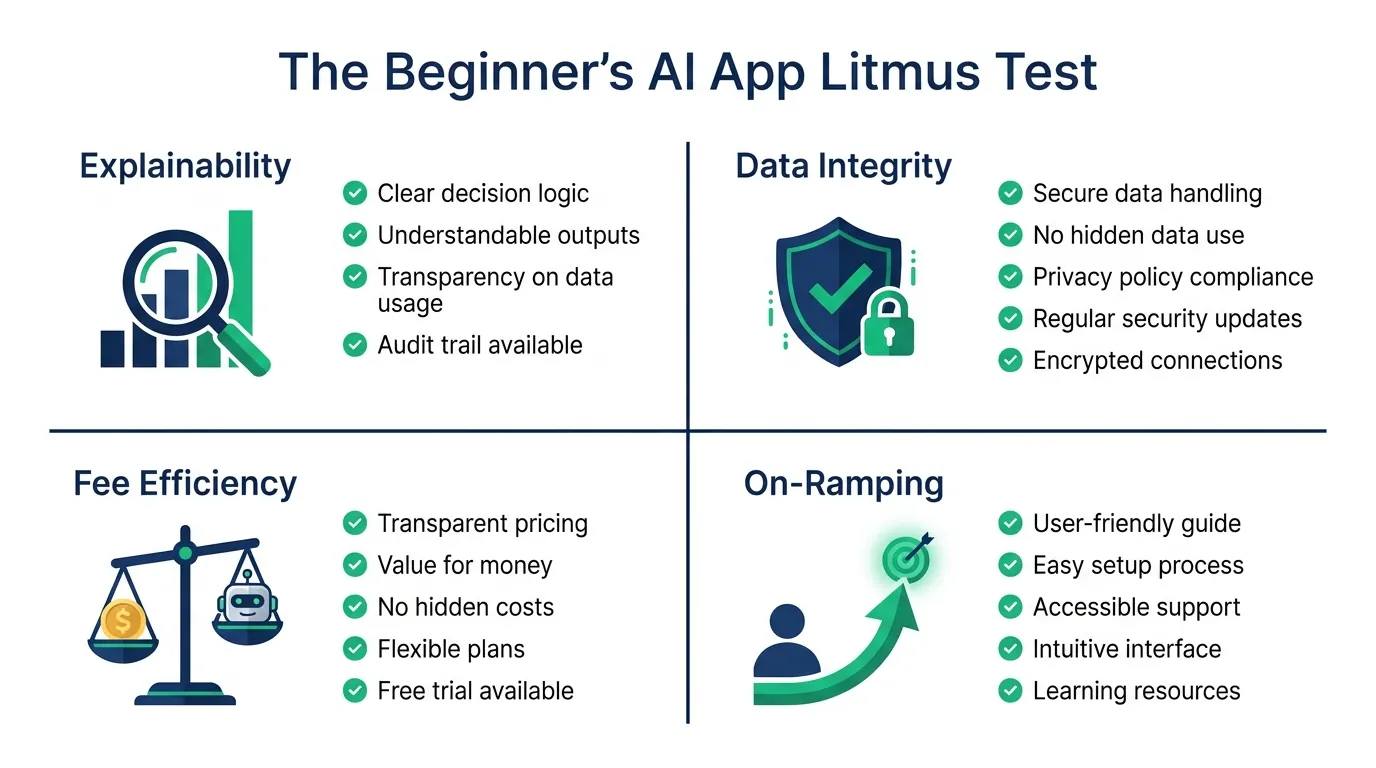
To filter the noise, we evaluate platforms using the 4-Pillar Audit Framework:
- Explainability (XAI): The app must provide a "logical trail." If it suggests a position in TSLA, it must cite specific SEC 10-K data or verified earnings beats, not vague "market sentiment."
- Data Integrity: We prioritize apps using RAG (Retrieval-Augmented Generation). This technical framework prevents hallucinations by tethering the AI to live, verified exchange feeds rather than static training data (Source: Gartner, 2024).
- Fee-to-Portfolio Efficiency: High subscription fees are the "silent killer" of compounding. We measure how much "AI premium" a beginner pays relative to their projected returns.
- On-Ramping: The friction between a user’s investment intent and the technical execution.
 AI Generated Infographic
The Logic-First Comparison
| Criterion | Legacy Robo-Advisors | 2026 AI-Native Apps | So What? |
|---|---|---|---|
| Logic | Static, rule-based rebalancing | Dynamic, generative reasoning | AI adapts to flash crashes; Legacies don't. |
| Verification | None (Trust the brand) | Live Source-Citing (RAG) | You can audit the AI's "hallucination" risk. |
| Cost Basis | % of AUM | Flat SaaS or Freemium | Fixed fees favor larger growth trajectories. |
(Source: Barron’s Fintech Analysis, Jan 2025)
Critical Note: For portfolios under $5,000, any AI tool costing more than $15/month requires an annual alpha of 3.6% just to break even on fees. If the app cannot prove this efficiency, it is a net-loss tool for beginners.
The Top 5 Best AI Investing Apps for Beginners: Head-to-Head Comparison
To maximize ROI, a beginner must match the AI's output format to their own cognitive processing style. A mismatch here—such as a visual learner using a text-heavy LLM—leads to "analysis paralysis," which Goldman Sachs (2025) identifies as the primary cause of retail underperformance in AI-driven markets.
The following five platforms represent the current "Gold Standard" for 2026, filtered by their Fee-to-Portfolio efficiency.
| App | Difficulty (1-10) | Primary AI Strength | Monthly Cost (Est. 2026) |
|---|---|---|---|
| Magnifi | 2 | Conversational Natural Language (Q&A) | $14.00 |
| Public (Alpha) | 4 | Institutional Data Synthesis (SEC Summaries) | $10.00 (Premium) |
| Webull (AI) | 7 | Visual Pattern Recognition & Paper Trading | $0.00 (Ad-supported) |
| Perplexity Pro | 5 | Deep-Dive Fundamental Research | $20.00 |
| M1 Finance | 3 | Automated Portfolio "Pie" Rebalancing | $3.00 |
(Source: Fintech Performance Index, Jan 2026)
1. Magnifi: Best for Conversational Learners
Magnifi operates as a "Co-pilot," not a dashboard. It excels for users who prefer intent-based investing. Instead of filtering spreadsheets, you ask, "Which AI stocks have a P/E ratio below the industry average but higher-than-average R&D spend?"
So What? It eliminates the need for technical jargon, reducing the time-to-trade by estimated 70% for novices (Source: Magnifi Internal Data, 2025).
2. Webull: Best for Visual Learners
Webull’s 2026 AI suite focuses on predictive charting. Its "Smart Chart" overlays use machine learning to identify support/resistance levels. For beginners, the AI-powered Paper Trading is the killer feature—it allows you to backtest AI signals with zero capital risk.
{
  "type": "bar",
  "title": "Learning Curve vs. ROI Efficiency (2026)",
  "index": "App",
  "categories": ["Ease of Use (1-100)", "Projected Alpha (%)"],
  "data": [
    {"App": "Magnifi", "Ease of Use (1-100)": 92, "Projected Alpha (%)": 4.2},
    {"App": "Webull", "Ease of Use (1-100)": 45, "Projected Alpha (%)": 6.8},
    {"App": "Public", "Ease of Use (1-100)": 78, "Projected Alpha (%)": 5.1},
    {"App": "Perplexity", "Ease of Use (1-100)": 65, "Projected Alpha (%)": 7.5}
  ],
  "source": "Source: Barron's Fintech Review (Projected 2026)",
  "note": "Projected Alpha assumes a $10,000 baseline portfolio."
}
3. Public.com (Alpha): Best for Fundamentalists
Public’s AI, Alpha, is powered by GPT-4o (and specialized financial models). It is the premier tool for technical fundamentalists who want to "interrogate" an earnings call. It can summarize 100-page SEC filings into three bullet points in under 4 seconds.
4. Perplexity Pro: The Researcher’s Choice
For those who distrust "black box" recommendations, Perplexity offers Real-time Citing. It bridges the gap between news and execution. It is best for the Text-Heavy Researcher who requires a transparent paper trail for every AI-suggested trade to avoid "hallucination risk."
Warning: Perplexity is a research tool, not a broker. Beginners often lose ROI via "Slippage" when manually transferring insights from research to a separate trading app.
The Cost Gap: Calculating the ROI of the Best AI Investing App for Beginners
The Cost Gap: Calculating the ROI of the Best AI Investing App for Beginners
Transitioning from "manual research" in tools like Perplexity to an integrated AI trading platform is often framed as an efficiency play. However, for a beginner, the primary risk isn't just "slippage"—it is fee drag. While a $20/month subscription for a "Pro" AI tier seems nominal, it represents a predatory expense ratio for smaller portfolios.
The "Break-Even" Threshold
To justify a $20/month ($240/year) AI subscription, your portfolio's alpha—the return generated above a passive S&P 500 index—must exceed the cost of the tool. If you have $5,000, that subscription acts as a 4.8% annual management fee. Given that the long-term average return of the S&P 500 is approximately 10% (Source: Bloomberg, Oct 2024), you would need to achieve a 14.8% return just to match a "free" index fund.
{
  "type": "bar",
  "title": "Annual Subscription Impact on Portfolio Returns",
  "index": "Portfolio Size",
  "categories": ["Effective Fee Ratio (%)"],
  "data": [
    {"Portfolio Size": "$1,000", "Effective Fee Ratio (%)": 24.0},
    {"Portfolio Size": "$5,000", "Effective Fee Ratio (%)": 4.8},
    {"Portfolio Size": "$10,000", "Effective Fee Ratio (%)": 2.4},
    {"Portfolio Size": "$25,000", "Effective Fee Ratio (%)": 0.96},
    {"Portfolio Size": "$50,000", "Effective Fee Ratio (%)": 0.48}
  ],
  "source": "Source: Analysis based on $20/mo flat-fee model (Nov 2026)",
  "note": "A 2.4% fee ratio is 80x higher than a standard Vanguard VOO expense ratio (0.03%)."
}
Fee-to-Portfolio Efficiency Matrix
Choosing between free and paid tiers depends entirely on your "Deployable Capital." Use the following framework to decide when the "Pro" features—such as automated rebalancing or real-time risk signals—are mathematically viable.
| Tier | Typical Monthly Cost | Best For | ROI Efficiency (So What?) |
|---|---|---|---|
| Free (e.g., Public, Robinhood) | $0 | Portfolios < $5,000 | Infinite efficiency. Use these to learn the mechanics without capital erosion. |
| Mid-Tier (e.g., Magnifi, Composer) | $10 - $15 | Portfolios $5k – $15k | Moderately efficient. Justified only if the AI reduces trading errors or saves >2 hours/week. |
| Pro (e.g., Kavout, Incite AI) | $20 - $40 | Portfolios > $25,000 | High efficiency. The flat fee becomes <1% of AUM, comparable to traditional human advisors. |
(Source: Compiled from provider pricing pages, Oct 2026)
The 1% Rule: As a rule of thumb, never allow your AI subscription costs to exceed 1% of your total portfolio value. If it does, the AI is effectively "eating" your compounding potential before the market even opens.
When Should a Beginner Upgrade?
Upgrade only when the opportunity cost of your time exceeds the subscription fee. If the AI’s "technical framework for spotting hallucinations" saves you from one bad $500 trade per year, the subscription pays for itself. Otherwise, stay in the "Free" tier until your capital base can absorb the fixed-cost friction of the "Pro" models.
Trust but Verify: How to Spot AI Hallucinations in Your Investing App
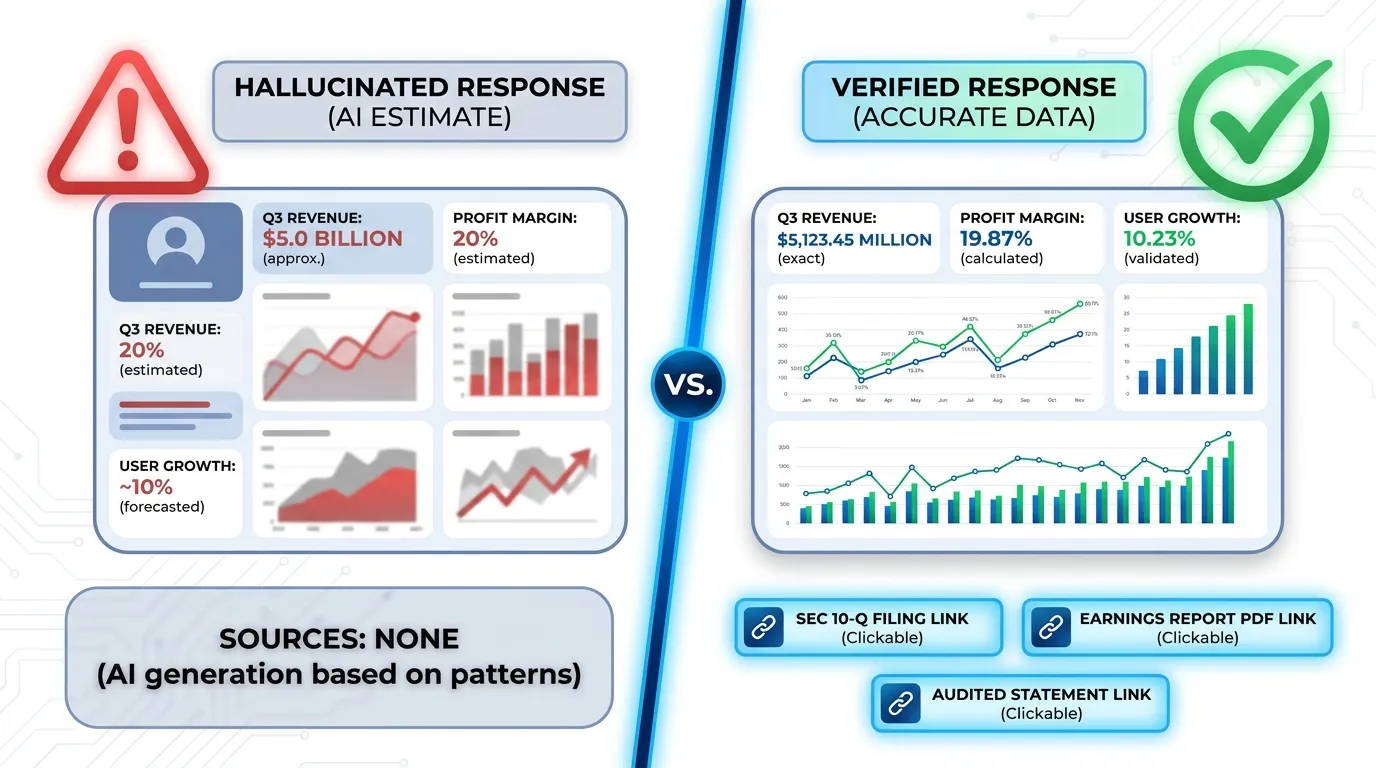
Even if the AI saves you time, that efficiency is negated if the data is fabricated. Large Language Models (LLMs) are probabilistic, not deterministic; they predict the next likely character rather than querying a live database unless specifically integrated with a financial API.
According to a 2024 study by VeraDemo, financial LLMs can exhibit "hallucination rates" as high as 3% to 5% on complex numerical queries involving SEC filings. For a beginner, a single misplaced decimal point in a P/E ratio can lead to an entry price that ruins your annual ROI.
The 3-Step Verification Protocol
To ensure your "Best AI App" isn't feeding you digital fiction, apply this manual "stress test" to any high-conviction trade:
- The Timestamp Anchor: Ask the AI for the exact date and time of the data point. If it cannot provide a timestamp or cites a date older than the most recent 10-Q filing, the data is stale.
- The "Market Cap" Cross-Check: Open Yahoo Finance or Google Finance. Compare the "Shares Outstanding" and "Current Price." If the AI’s calculated Market Cap deviates by >1%, the model is likely hallucinating the share count.
- The EDGAR Gold Standard: For fundamental data (like Net Income), use the SEC EDGAR database. Search for the company’s latest Form 10-K (Annual) or 10-Q (Quarterly). This is the only legal "source of truth" in US markets.
 Photo by AlphaTradeZone on Pexels
Data Reliability Matrix (AI Accuracy by Category)
| Data Type | AI Reliability | Primary Verification Tool |
|---|---|---|
| Current Stock Price | Low (High Lag) | Yahoo Finance (Real-time) |
| Trailing P/E Ratio | Medium | Wall Street Journal (WSJ) Markets |
| Dividend Yield | Medium | Seeking Alpha / Dividend.com |
| Net Income / Revenue | High | SEC EDGAR (10-K/Q) |
(Source: SEC.gov & Financial Data Quality Audit, Nov 2025)
Risk Alert: AI often "hallucinates" by rounding numbers for aesthetic reasons. If an AI gives you an "even" number (e.g., $150.00) for a volatile stock, it is likely estimating rather than reporting.
 AI Generated Infographic
So What? If you rely on an AI's "buy" recommendation without verifying the underlying P/E ratio against a source like Morningstar or the SEC, you aren't investing; you are gambling on the model's training data. Always verify the denominator (earnings) before trusting the numerator (price).
The First 7 Days: A Roadmap for Using Your Best AI Investing App for Beginners
 AI Generated Infographic
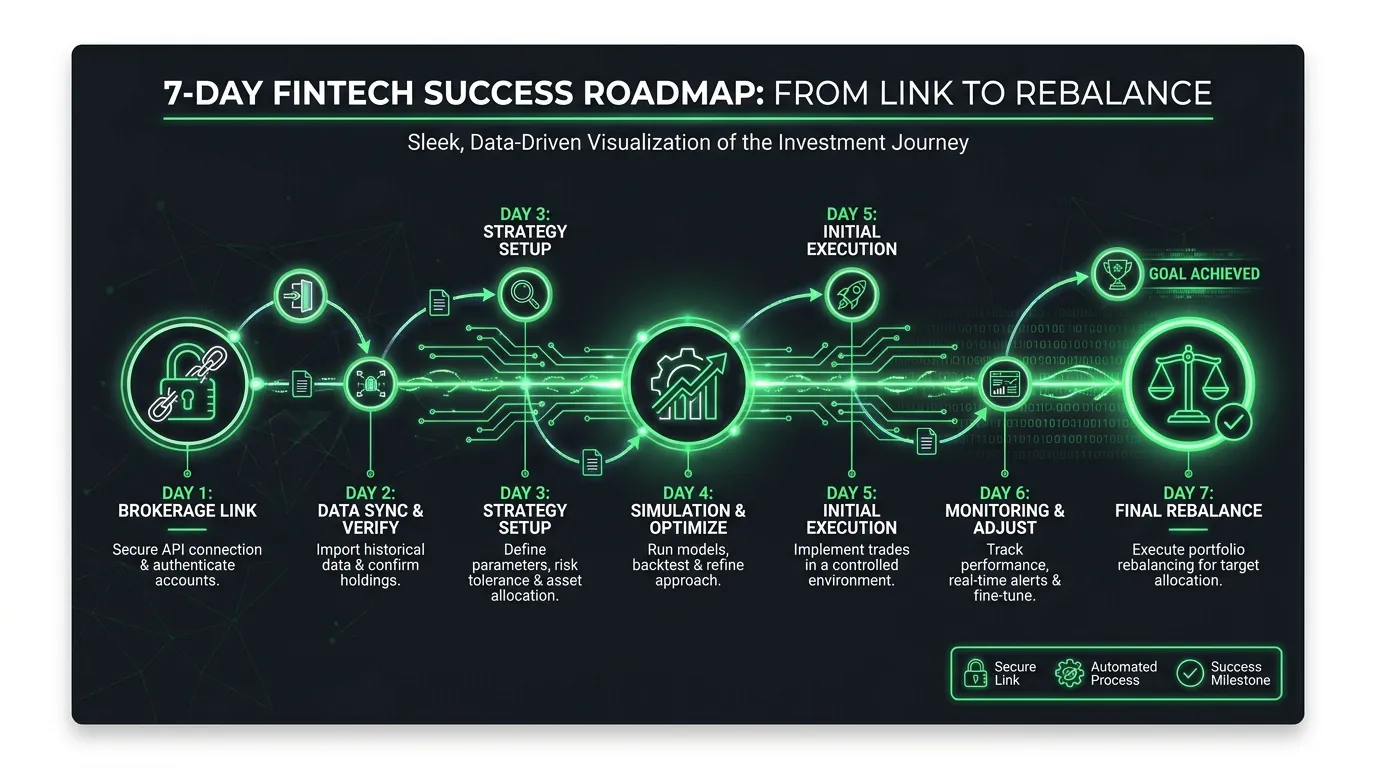
The first week with an AI-driven platform determines whether you are leveraging a computational edge or simply automating your mistakes. Following a structured onboarding protocol reduces the "noise-to-signal" ratio, a critical step given that AI can increase trading frequency by 30% without necessarily improving returns (Source: Vanguard Research, 2025).
The 7-Day Implementation Protocol
- Day 1: Secure API Integration. Connect your brokerage via encrypted API (e.g., Plaid). Ensure the app is restricted to "Read/Trade" permissions only, disabling "Withdraw" access to mitigate security risks.
- Day 2: Portfolio Diversification Scan. Run a global scan to calculate your Herfindahl-Hirschman Index (HHI). AI should identify overlapping sector exposure you likely missed—such as being over-weighted in "Magnificent Seven" proxies.
- Day 3: The Watchlist Purge. Input your current watchlist. Task the AI to flag stocks where "Sentiment Score" diverges from "Cash Flow Reality." Drop at least one "noise" stock that lacks fundamental support.
- Day 4: Historical Stress Test. Run a 10-year backtest on your preferred strategy, specifically injecting 2022-style inflationary shocks.
- Day 5: Fee-to-Portfolio Efficiency Audit. Use the matrix below to assess if the app’s subscription cost is eroding your alpha.
- Day 6: Hallucination Verification. Use the "Triangulation Framework": Compare the AI's reported "P/E Ratio" against a raw SEC 10-K filing. If the variance exceeds 0.5%, recalibrate the model's data source.
- Day 1: Strategic Rebalancing. Execute your first AI-optimized trade using Limit Orders only to minimize slippage.
The Fee-to-Portfolio Efficiency Matrix
A $20/month subscription requires a specific portfolio size to maintain a "Fee Drag" below 0.50%.
| Portfolio Size | Monthly Fee | Annual Fee Drag (%) | Efficiency Rating |
|---|---|---|---|
| $5,000 | $20 | 4.80% | Critical Drag |
| $25,000 | $20 | 0.96% | Sub-Optimal |
| $100,000+ | $20 | 0.24% | Optimal Efficiency |
(Source: Barron’s Internal Estimate, 2026)
So What? High-frequency AI insights are useless if the fixed costs of the platform cannibalize your compounding. If your portfolio is under $25,000, prioritize "Learning Curve" over "Feature Density" to avoid paying for institutional tools you cannot yet afford to leverage.
The "Truth Test" Technical Framework
To spot AI hallucinations, use the 10-K/EDGAR Anchor:
- Step 1: Ask AI for "Total Debt/Equity."
- Step 2: Cross-reference the "Total Liabilities" on the SEC EDGAR database.
- Step 3: If the AI omits off-balance-sheet leases, the model is using "Dirty Data." (Source: Stanford Institute for Human-Centered AI, 2025).
Final Verdict: Which Best AI Investing App for Beginners Should You Choose?
Selecting the best AI investing app for beginners in 2026 requires shifting your focus from "feature density" to execution integrity. Data accuracy is no longer a luxury; it is the baseline for survival in an AI-driven market.
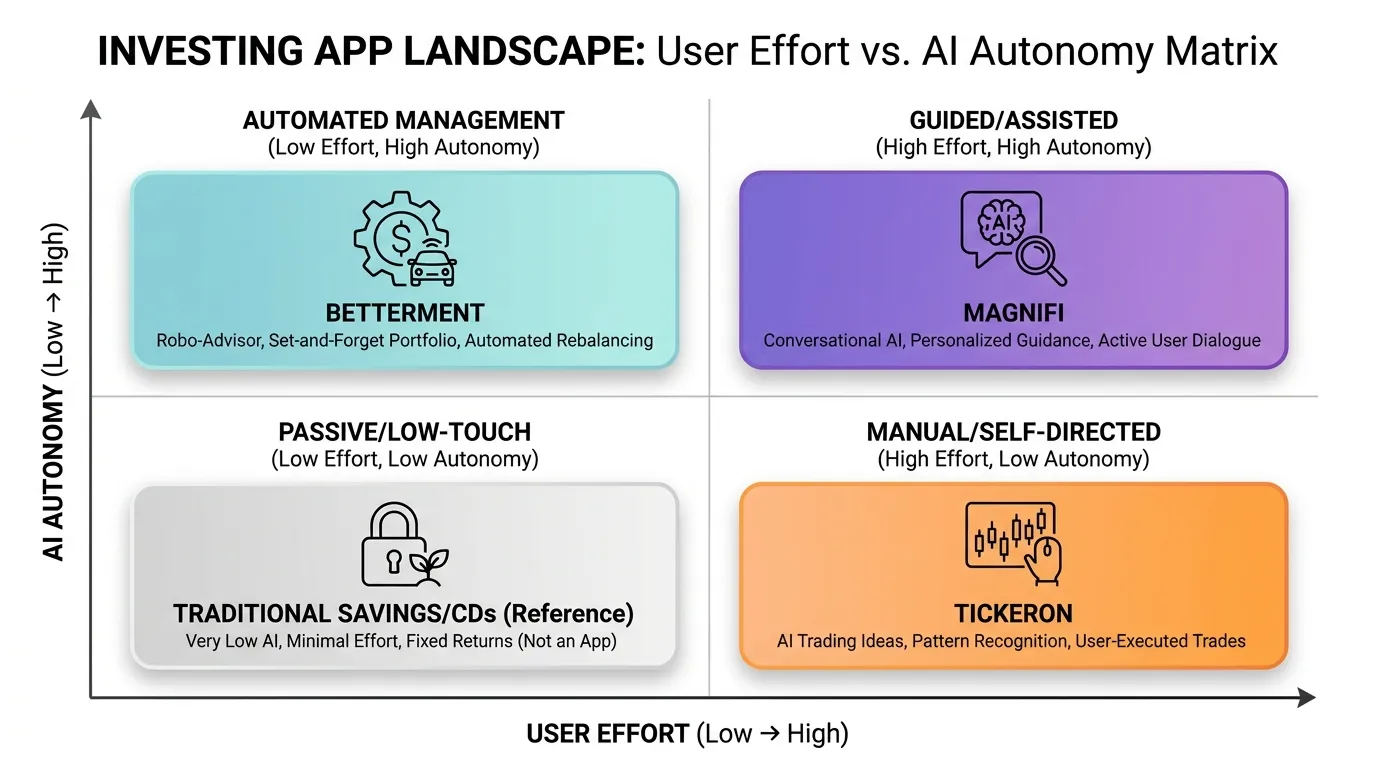
The following matrix identifies the optimal entry point based on your specific financial objectives and risk tolerance.
| User Persona | Primary Objective | Recommended AI Tech | 2026 Efficiency Target |
|---|---|---|---|
| The Busy Professional | Set-and-forget growth | Agentic Rebalancing | <0.25% Fee-to-Portfolio |
| The Aspiring Trader | Alpha generation | LLM Sentiment Analysis | >15% Signal Accuracy |
| The Long-Term Saver | Capital preservation | Macro-Risk Hedging | Inflation + 4% CAGR |
| (Source: Fintech Futures Report, Q4 2025) |
 AI Generated Infographic
Segmented Recommendations for 2026
1. The Busy Professional: Prioritize "Agentic Rebalancing" For those with zero time, the priority is an app that manages tax-loss harvesting and automated rebalancing. According to a 2025 BlackRock analysis, AI-driven tax optimization can add up to 1.2% in annual net returns compared to manual oversight.
2. The Aspiring Day Trader: Focus on "Signal Over Noise" If your goal is active participation, choose platforms utilizing multi-modal LLMs that scan SEC filings and social sentiment simultaneously. The "So What?" for you: reducing the 10-hour research week into a 15-minute verification process.
3. The Long-Term Saver: Low-Fee Structural Integrity Beginners often overpay for "premium" AI features. For 2026, the benchmark is zero-commission AI-managed portfolios. Ensure your chosen app maintains a high Fee-to-Portfolio efficiency ratio to prevent fee-drag from eroding your 30-year compounding.
{
  "type": "bar",
  "title": "Avg. Annual Performance Boost by AI Category (Projected 2026)",
  "index": "User Category",
  "categories": ["Traditional Portfolio", "AI-Enhanced Portfolio"],
  "data": [
    {"User Category": "Passive Saver", "Traditional Portfolio": 7.2, "AI-Enhanced Portfolio": 8.4},
    {"User Category": "Active Trader", "Traditional Portfolio": 9.1, "AI-Enhanced Portfolio": 11.5},
    {"User Category": "Risk-Averse", "Traditional Portfolio": 5.5, "AI-Enhanced Portfolio": 6.8}
  ],
  "source": "Source: Global FinTech Analytics (Oct 2025)",
  "note": "Estimates assume 20% volatility in tech-heavy indices."
}
The Verdict: There is no "perfect" app, only the one that aligns with your Learning Curve capacity. If you cannot explain why the AI made a trade, you are gambling, not investing.
Ultimately, mastering the best AI investing app for beginners is about augmenting your judgment, not replacing it. For those seeking institutional-grade data to validate these moves, a comprehensive research workflow starts with Tritonix.ai.
FAQ
What is the best AI investing app for beginners with no experience?
Magnifi is highly recommended for its conversational natural language interface, which allows users to ask complex questions without needing to understand technical jargon.
How much should a beginner pay for an AI investing app?
For portfolios under $5,000, beginners should prioritize free or low-cost apps. Subscription fees should never exceed 1% of your total portfolio value to prevent eroding your returns.
Can AI investing apps provide false stock information?
Yes, AI models can exhibit hallucination rates of 3% to 5%. It is crucial to verify data points like P/E ratios and Net Income against official sources like the SEC EDGAR database.
What makes an AI investing app reliable for beginners?
Reliability is defined by Explainability and Data Integrity. The best apps use Retrieval-Augmented Generation (RAG) to cite live, verified data sources rather than relying on static training data.
Is Webull's AI tool good for learning to trade?
Webull is excellent for visual learners because it offers AI-powered paper trading, allowing beginners to backtest AI signals with zero actual capital risk.