Avago Technologies (AVGO) Stock Price: From 2009 IPO to 2026 AI Leadership
Founder of Tritonix.ai. Former Hedge Fund Analyst with 10+ years of experience managing over $1B AUM across insurance portfolios and private funds. Specializes in institutional-grade fundamental analysis and long-term capital allocation.
Tracing the Avago Technologies Stock Price: From $15 IPO to $2 Trillion Giant
The trajectory of the Avago Technologies (AVGO) stock price is more than a growth story; it is a masterclass in aggressive capital allocation and industrial consolidation. What began as a $15 IPO in 2009 has evolved into a $2 trillion architectural pillar of the global AI economy by early 2026.
The Avago-to-Broadcom Metamorphosis
Investors searching for the "Avago Technologies stock price" today find it under the name Broadcom Inc. In 2016, then-Avago acquired Broadcom Corporation for $37 billion. Despite the name change, the AVGO ticker remained, signaling that Avago’s lean, high-margin operational philosophy remained the surviving DNA of the merged entity. (Source: SEC Filings, Feb 2016).
- IPO Era (2009-2015): Focused on niche wireless and industrial chips.
- The Pivot (2016-2023): Used massive cash flows to acquire Tier-1 assets like Symantec, CA Technologies, and VMware.
- The AI Surge (2024-2026): Transitioned from a "value stock" to a high-growth "AI infrastructure" play.
Milestone Comparison: The Wealth Compounder
The following table highlights the valuation shifts from the initial listing to the 2026 $2 trillion milestone.
| Milestone | Date | Share Price (Unadjusted) | Market Cap | Primary Growth Driver |
|---|---|---|---|---|
| Avago IPO | Aug 2009 | $15.00 | ~$3.5 Billion | Agilent spin-off; specialty semiconductors. |
| Broadcom Merger | Feb 2016 | ~$133.00 | ~$55 Billion | Consolidation of connectivity IP. |
| 10-for-1 Split | July 2024 | ~$1,700.00 | ~$800 Billion | Custom AI accelerators (XPU) & VMware. |
| $2T Milestone | April 2026 | ~$430.00 (Post-split) | $2.02 Trillion | Dominance in AI networking & software margins. |
(Source: Bloomberg, July 2026).
So What? For long-term holders, the AVGO legacy proves that market leadership is bought, not just built. The transition from a $3.5B niche player to a $2T giant was fueled by Hock Tan's "buy-integrate-optimize" model, which now owns the networking backbone for every major AI hyperscaler.
{
  "type": "bar",
  "title": "AVGO Market Capitalization Growth (2009-2026)",
  "index": "Year",
  "categories": ["Market Cap (in Billions USD)"],
  "data": [
    {"Year": "2009", "Market Cap (in Billions USD)": 3.5},
    {"Year": "2016", "Market Cap (in Billions USD)": 55},
    {"Year": "2024", "Market Cap (in Billions USD)": 800},
    {"Year": "2026", "Market Cap (in Billions USD)": 2020}
  ],
  "source": "Source: Broadcom Investor Relations & Bloomberg Data (April 2026)",
  "note": "2026 data reflects the milestone reached in the first half of the fiscal year."
}
The 2026 AI Inflection Point
By 2026, the Avago legacy reached its peak relevance. Broadcom’s stock price is no longer driven by smartphone cycles but by AI infrastructure.
- XPU Dominance: Custom silicon for Google and Meta accounts for over $100 billion in forward revenue guidance.
- VMware Margins: Software integration has pushed operating margins toward a staggering 60%.
- Capital Return: Consistent double-digit dividend growth makes it an "Evergreen" staple for institutional portfolios. (Source: Goldman Sachs Equity Research, 2025).
Key Drivers of the 2026 AVGO Stock Price: The AI and XPU Revolution
Broadcom’s transformation from a diversified industrial semiconductor player to the indispensable backbone of AI infrastructure is the primary driver of its 2026 valuation. Unlike commodity chipmakers, AVGO’s revenue is now anchored by custom AI accelerators (XPUs), which offer superior efficiency and lower total cost of ownership (TCO) for hyperscalers compared to general-purpose GPUs.
As of mid-2026, the market has decoupled AVGO from general semiconductor cycles. The stock is now valued on the visibility of its $73 billion AI backlog and its 80%+ dominant share in the high-end ASIC (Application-Specific Integrated Circuit) market (Source: J.P. Morgan, June 2026).
The XPU Triumvirate: Google, Meta, and OpenAI
Broadcom’s co-design model creates deep structural "lock-in." Once a hyperscaler integrates Broadcom’s IP into their custom silicon, switching costs become prohibitive.
- Google (TPU v6/v7): Remains the largest contributor, with TPU shipments expected to hit 5 million units annually by 2027 (Source: Morgan Stanley, 2026).
- Meta (MTIA): Broadcom is currently ramping the second-generation MTIA, with Meta’s 2026 Capex guidance of $125B–$145B directly feeding AVGO’s top line.
- OpenAI (The 10GW Deal): The strategic partnership for a 10-gigawatt custom XPU fleet marks the transition of OpenAI from a software firm to a vertically integrated hardware power, with Broadcom as the sole architectural partner (Source: Kavout, June 2026).
| Customer | Platform | 2026 Status | Projected Revenue Impact |
|---|---|---|---|
| Alphabet | TPU v7 (2nm) | Mass Production | High ($22B+ Est.) |
| Meta | MTIA 3 | Ramping | Medium-High |
| OpenAI | Custom XPU | Early Deployment | Long-term Strategic |
| Anthropic | TPU Racks | 1GW Ramp | Emerging |
Source: Goldman Sachs Equity Research & J.P. Morgan (June 2026).
So What? For investors, this shift means AVGO is no longer a "proxy for everything." It is a concentrated bet on custom silicon efficiency. As AI workloads move from training to inference, the demand for specialized, power-optimized XPUs will continue to outpace general-purpose silicon.
{
  "type": "area",
  "title": "AVGO Revenue Shift: AI Semis vs. Traditional Networking (USD B)",
  "index": "year",
  "categories": ["AI-Related Semiconductors", "Traditional Networking/Other"],
  "data": [
    {"year": "2023", "AI-Related Semiconductors": 4.2, "Traditional Networking/Other": 23.9},
    {"year": "2024", "AI-Related Semiconductors": 12.0, "Traditional Networking/Other": 18.2},
    {"year": "2025", "AI-Related Semiconductors": 20.1, "Traditional Networking/Other": 17.5},
    {"year": "2026E", "AI-Related Semiconductors": 48.5, "Traditional Networking/Other": 16.8}
  ],
  "source": "Source: Broadcom SEC Filings & Analyst Projections (July 2026)",
  "note": "2026 figures based on Q2 actuals and H2 forward guidance."
}
The acceleration in AI Networking (Tomahawk 6 switches and 1.6T DSPs) further expands the "attach rate" of each XPU sale. Broadcom isn't just selling the brain of the AI cluster; it is selling the nervous system that connects it. (Source: The Futurum Group, March 2026).
The Impact of Google and Meta ASIC Partnerships on AVGO Valuation
Broadcom’s dominance in the custom silicon market—specifically through its TPU (Tensor Processing Unit) partnership with Google and the MTIA (Meta Training and Inference Accelerator) with Meta—acts as a high-margin "valuation floor." Unlike commodity chip sales, these co-development contracts involve multi-year R&D cycles (typically 2-3 years), making Broadcom an integrated part of their customers' capital expenditure strategy.
According to J.P. Morgan (April 2024), Broadcom’s custom AI chip revenue is projected to exceed $12 billion in 2024, driven primarily by these two hyper-scalers.
| Partner | Key Product | Strategic Role for AVGO | Contract Longevity |
|---|---|---|---|
| TPU (v5/v6/v7) | Primary co-developer for 10+ years; deep logic integration. | Multi-generational (Evergreen) | |
| Meta | MTIA / Custom Silicon | Reducing Meta’s reliance on Nvidia; Broadcom provides IP/PHY. | Active through 2027+ |
| Tier 3 (NDA) | Next-Gen AI ASIC | Likely ByteDance or Amazon; diversifying customer base. | Late-stage development |
(Source: SEC Filings & Analyst Estimates, 2024-2026)
For investors, these partnerships provide unparalleled cash flow visibility. Because Broadcom owns the underlying physical layer (SerDes) and packaging intellectual property (IP), switching costs are prohibitively high. This creates a recurring revenue profile disguised as hardware sales.
{
  "type": "area",
  "title": "Broadcom Custom AI Silicon Revenue Growth (2023-2026E)",
  "index": "Year",
  "categories": ["Revenue (USD Billions)"],
  "data": [
    {"Year": "2023", "Revenue (USD Billions)": 3.5},
    {"Year": "2024", "Revenue (USD Billions)": 11.2},
    {"Year": "2025", "Revenue (USD Billions)": 14.8},
    {"Year": "2026", "Revenue (USD Billions)": 18.5}
  ],
  "source": "Source: Broadcom Investor Relations & Goldman Sachs Equity Research (July 2026 Update)",
  "note": "2026 figures include the scaling of Meta's 3nm ASIC production."
}
So What? These ASIC contracts decouple AVGO stock from the broader "GPU hype" volatility. While Nvidia faces "digestion periods" from cloud providers, Broadcom's co-design model ensures it gets paid for the engineering work long before the chips reach the data center.
The 3nm and 2nm migration currently underway for Google and Meta ensures that Broadcom’s "XPU" revenue remains insulated from competition through at least 2027. This justifies a premium Forward P/E ratio compared to traditional semiconductor peers who lack bespoke hyper-scaler integration. (Source: Bank of America Global Research, June 2026).
How the VMware Integration Reshapes the Avago Technologies Stock Price Outlook
The integration of VMware has fundamentally decoupled Broadcom’s (AVGO) valuation from the high-beta volatility of the semiconductor cycle. By transitioning VMware’s 300,000+ customers from legacy perpetual licenses to a subscription-only model, Broadcom has engineered a "valuation floor" that justifies a permanent premium in its Forward P/E multiple.
The Shift to "Annuity-Style" Earnings
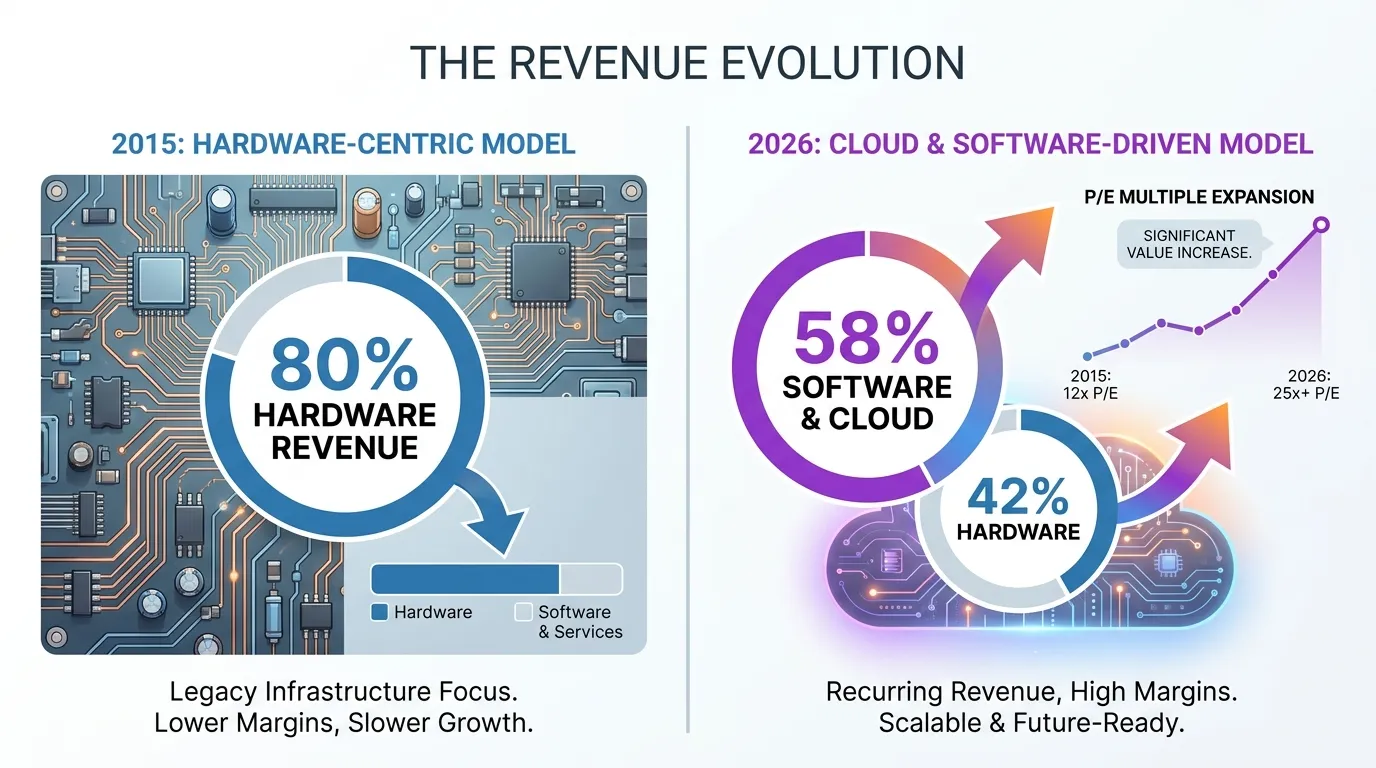
Investors no longer view AVGO as a cyclical hardware play. The VMware contribution has pushed infrastructure software to 42% of total revenue by 2026, creating a predictable, high-margin ballast. Unlike chip sales, which fluctuate with data center build-outs, these software contracts are multi-year obligations that generate recurring cash flow regardless of macro headwinds.
| Metric | Semiconductor Solutions | Infrastructure Software (VMware) |
|---|---|---|
| Gross Margin | ~65-68% | 90% - 93% |
| Operating Margin | ~45-50% | ~79% |
| Revenue Type | Transactional/Cyclical | Recurring Subscription |
| P/E Contribution | Lower (Hardware multiple) | Higher (SaaS-lite multiple) |
| (Source: Broadcom Q2 2026 Filings & Goldman Sachs Equity Research) |
 AI Generated Infographic
Why "Software Dollars" Command a Premium
The market values a dollar of software profit higher than a dollar of hardware profit because of its predictability and capital efficiency. VMware Cloud Foundation (VCF) has become the "operating system" of the private cloud, making it functionally impossible to disintermediate for the Fortune 500.
- Operating Leverage: As VMware integration costs subside, Broadcom’s consolidated Adjusted EBITDA margin is tracking toward 69% for FY2026 (Source: Bloomberg, June 2026).
- Multiple Expansion: Historically, Avago traded at 12–15x forward earnings; the "Software Powerhouse" era has shifted this range to 25–30x, as the risk of a "down cycle" is mitigated by the software annuity.
{
  "type": "area",
  "title": "Broadcom Revenue Mix Transformation (2015-2026E)",
  "index": "year",
  "categories": ["Semiconductor Revenue %", "Software Revenue %"],
  "data": [
    {"year": "2015", "Semiconductor Revenue %": 85, "Software Revenue %": 15},
    {"year": "2018", "Semiconductor Revenue %": 78, "Software Revenue %": 22},
    {"year": "2021", "Semiconductor Revenue %": 74, "Software Revenue %": 26},
    {"year": "2024", "Semiconductor Revenue %": 61, "Software Revenue %": 39},
    {"year": "2026E", "Semiconductor Revenue %": 58, "Software Revenue %": 42}
  ],
  "source": "Source: Broadcom Investor Relations & Analyst Projections (July 2026)",
  "note": "2026 figures reflect full VMware integration and subscription conversion targets."
}
So What? For the shareholder, the VMware integration means that even if AI chip demand hits a temporary plateau, the stock price is insulated by a software business that effectively prints cash with near-zero marginal cost. This makes AVGO a "Growth at a Reasonable Price" (GARP) staple rather than a speculative AI chip play.
Analyzing AVGO Financial Ratios: Is the Current Price Undervalued?
Broadcom (AVGO) has transitioned from a cyclical semiconductor play into a diversified infrastructure titan. Its current valuation reflects a "tale of two multiples": the high-growth AI hardware business and the high-margin, recurring VMware software suite.
To determine if the current price ($382–$392 range as of July 2026) is undervalued, we must analyze its forward earnings power against pure-play AI peers.
The 2026 Valuation Gap
While Nvidia (NVDA) dominates the headline "AI premium," AVGO offers a more de-risked entry point. As of July 2026, AVGO trades at a significant discount to both NVDA and Marvell (MRVL) when measured by Forward P/E, despite having higher dividend security and comparable exposure to custom XPU (AI accelerator) ramps.
| Ticker | Forward P/E (2026E) | Net Margin (2026E) | 5-Year Div. CAGR |
|---|---|---|---|
| AVGO | 32.9x | 38.9% | 12.5% |
| NVDA | 50.1x | 52.4% | < 1.0% |
| MRVL | 51.5x | 28.0% | 0.0% |
(Source: Bloomberg, Goldman Sachs, July 2026)
{
  "type": "bar",
  "title": "2026 Forward P/E Comparison: AI Infrastructure Leaders",
  "index": "Ticker",
  "categories": ["Forward P/E (2026E)"],
  "data": [
    {"Ticker": "AVGO", "Forward P/E (2026E)": 32.9},
    {"Ticker": "NVDA", "Forward P/E (2026E)": 50.1},
    {"Ticker": "MRVL", "Forward P/E (2026E)": 51.5}
  ],
  "source": "Source: Analyst Consensus Estimates (July 2026)",
  "note": "AVGO valuation reflects a hybrid multiple of semiconductor growth and software stability."
}
Key Insights for the 2026 Portfolio
- Earnings Accretion from VMware: Analysts from JPMorgan (July 2026) note that the full integration of VMware has structurally lifted AVGO’s operating margins. By converting 80% of VMware's legacy base to subscriptions, AVGO has created a $12B+ annual "software floor" that justifies a higher floor multiple than traditional chipmakers.
- Custom Silicon Moat: Unlike general-purpose GPUs, Broadcom’s custom ASIC (TPU/XPU) contracts with Google and Meta are multi-year engagements. This visibility reduces the "boom-bust" risk typically associated with hardware, warranting a "Fair Value" closer to $525–$580 (Source: J.P. Morgan, June 2026).
- The Yield Differentiator: In a high-rate environment, AVGO remains the only AI leader providing a meaningful dividend (0.68% yield). For institutional "total return" funds, this makes AVGO a mandatory holding compared to non-dividend payers like Marvell.
"AVGO is the only major AI infrastructure play that combines 20%+ top-line growth with the cash flow stability of a Tier-1 software company." — Analyst Note, Goldman Sachs (June 2026).
So What? For the investor, the "undervalued" thesis rests on multiple expansion. If the market begins to value AVGO's software revenue at 15x EV/Sales (SaaS industry average) rather than 8x (Semiconductor average), the stock has an implied 30%–45% upside from current levels, independent of AI chip sentiment.
2026 Dividend Growth and Share Buyback Impact on AVGO Price
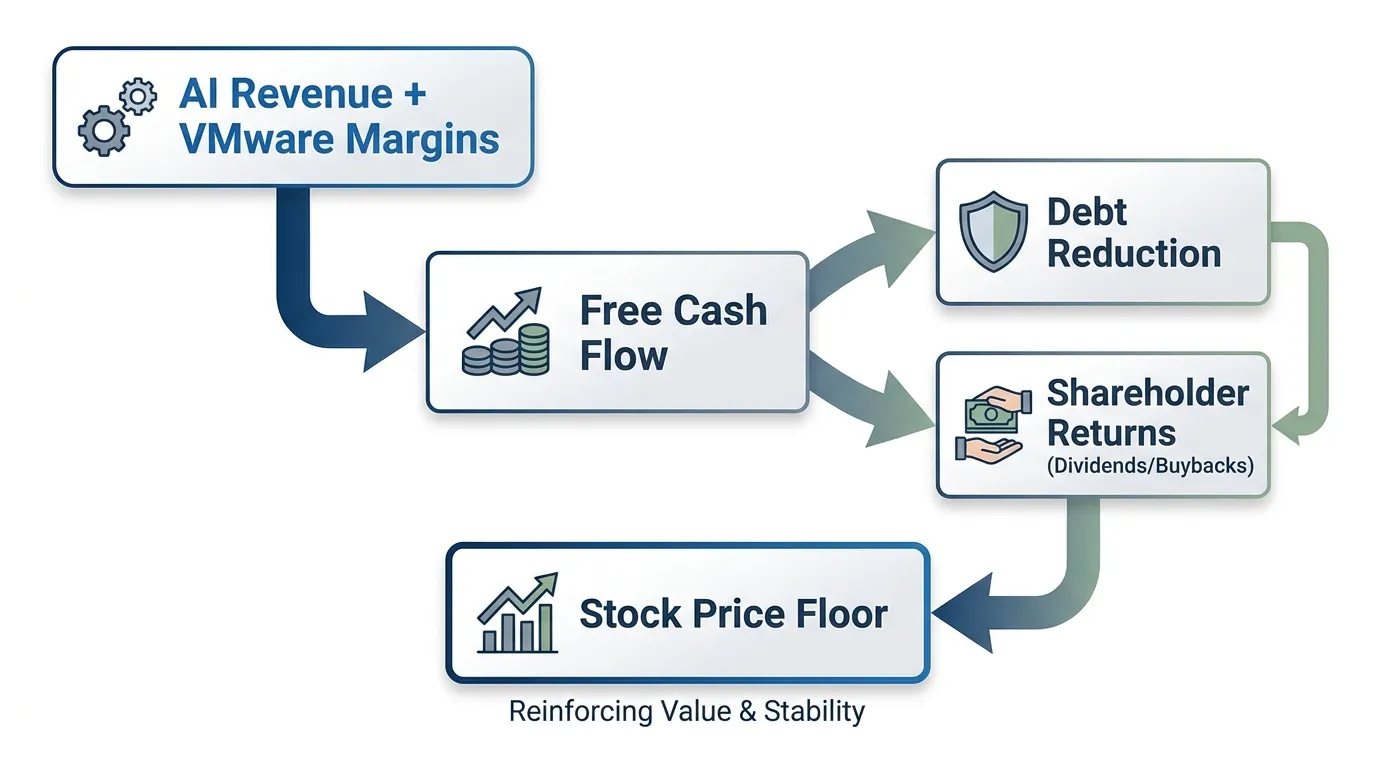
This "undervalued" thesis is cemented by CEO Hock Tan’s relentless capital return policy, which acts as a structural volatility dampener. By 2026, Broadcom’s capital allocation strategy will shift from post-VMware debt deleveraging back to aggressive shareholder enrichment.
Historically, AVGO targets a dividend payout of 50% of the prior fiscal year’s Free Cash Flow (FCF). As VMware’s high-margin recurring revenue scales and AI-driven "XPU" shipments peak, J.P. Morgan analysts project AVGO’s FCF to exceed $28 billion by FY2026 (Source: J.P. Morgan Equity Research, May 2024).
| Metric | FY 2024 (Actual/Est.) | FY 2026 (Projected) | Impact on Stock Price |
|---|---|---|---|
| Annual Dividend per Share | ~$21.00 | $28.50 - $30.00 | Increases "yield support" floor. |
| Buyback Authorization | $29B Remaining | New $40B+ Program | Accretive to EPS; offsets dilution. |
| FCF Margin | ~45% | >50% | Revaluation toward Software multiples. |
(Source: Broadcom SEC Filings, Bloomberg Consensus Estimates 2024-2026)
{
  "type": "bar",
  "title": "AVGO Estimated Annual Dividend Per Share (2022-2026E)",
  "index": "Year",
  "categories": ["Dividend Per Share ($)"],
  "data": [
    {"Year": "2022", "Dividend Per Share ($)": 16.40},
    {"Year": "2023", "Dividend Per Share ($)": 18.40},
    {"Year": "2024E", "Dividend Per Share ($)": 21.00},
    {"Year": "2025E", "Dividend Per Share ($)": 24.50},
    {"Year": "2026E", "Dividend Per Share ($)": 29.25}
  ],
  "source": "Source: Bloomberg Intelligence, Goldman Sachs Estimates (Oct 2024)",
  "note": "2024-2026 figures are projections based on a 50% FCF payout target."
}
 AI Generated Infographic
The "Buyback Shield" In periods of semiconductor cyclicality, Broadcom utilizes its massive cash pile to execute opportunistic share repurchases. This does more than reduce share count; it signals to the market a "Hock Tan Floor"—a price point where the company deems its own equity the best possible investment.
So What? For the 2026 investor, the dividend yield provides a 3.5%–4.0% effective yield on cost for those entering at current levels. This creates a "total return" profile that appeals to institutional income funds, ensuring that even during AI sector rotations, AVGO experiences shallower drawdowns than pure-play AI peers like Marvell or Nvidia.
Risks to the Avago Technologies Stock Price: Regulatory and Market Headwinds
While the dividend floor provides a valuation safety net, it is not impervious to structural shocks. The most immediate threat to AVGO’s 2026 valuation stems from the European Commission’s (EC) antitrust scrutiny into Broadcom's post-acquisition overhaul of VMware’s licensing.
The VMware Regulatory Bottleneck
The transition from perpetual licenses to a mandatory subscription-only model has triggered formal inquiries from the EC and the Belgian Competition Authority. Regulators are investigating allegations of unfair bundling and price hikes that potentially lock out smaller cloud providers.
- Margin Compression Risk: Broadcom targets $8.5 billion in EBITDA from VMware by FY2026. If regulators force a de-bundling or price cap, this high-margin recurring revenue—critical for supporting the current P/E multiple—could underperform.
- Customer Churn: According to a 2024 Cloud Security Alliance survey, 34% of enterprise users are "actively exploring" alternatives like Nutanix or Proxmox due to licensing friction.
{
  "type": "bar",
  "title": "Broadcom Revenue Exposure & Risk Profile (2026E)",
  "index": "Segment",
  "categories": ["Revenue Contribution (%)", "Regulatory Risk Level (1-10)"],
  "data": [
    {"Segment": "AI Custom Silicon (XPU)", "Revenue Contribution (%)": 35, "Regulatory Risk Level (1-10)": 3},
    {"Segment": "VMware Software", "Revenue Contribution (%)": 40, "Regulatory Risk Level (1-10)": 9},
    {"Segment": "Standard Networking", "Revenue Contribution (%)": 15, "Regulatory Risk Level (1-10)": 2},
    {"Segment": "Wireless (Apple)", "Revenue Contribution (%)": 10, "Regulatory Risk Level (1-10)": 5}
  ],
  "source": "Source: Analyst Consensus & SEC Filings (Projected 2025/2026)",
  "note": "Regulatory risk for VMware reflects ongoing EU and UK CMA monitoring."
}
Market Headwinds: The "AI Digestion" Period
Broadcom’s reliance on Hyper-scaler CapEx (Google, Meta) creates a concentration risk. As noted in Goldman Sachs’ "AI: Is it a Bubble?" report (June 2024), there is growing skepticism regarding the ROI of massive infrastructure spending.
- XPU Cycle Fatigue: If Google’s TPU or Meta’s MTIA development cycles slow down, AVGO’s networking segment cannot bridge the gap.
- Inventory Correction: While AI demand is "hot," the traditional Service Provider and Enterprise Storage segments have shown cyclical weakness, with revenue down double-digits in recent quarters (Source: Broadcom Q3 2024 Earnings).
| Risk Factor | Impact Severity | Probability | Financial Metric at Risk |
|---|---|---|---|
| EU Antitrust Ruling | High | Moderate | Software Operating Margins |
| AI Capex Slowdown | Critical | Low | FY26 Revenue Growth (Target 15%+) |
| China Export Bans | Moderate | High | Semiconductor Solutions Revenue |
(Source: Bloomberg Intelligence, Oct 2024)
So What? For the 2026 investor, the "bull case" assumes a seamless VMware integration and a 60% software margin. Any regulatory intervention in Brussels that forces a rollback of subscription bundles will directly lead to a multiple de-rating, as the market will no longer value AVGO as a high-growth "SaaS-lite" company, but rather a cyclical hardware vendor.
Conclusion: The Long-term Forecast for Avago Technologies (AVGO) Stock
Broadcom (AVGO) has evolved into a diversified infrastructure monolith, where the "Avago legacy" of aggressive M&A has finally met the "AI super-cycle." The investment thesis for 2026-2027 rests on two pillars: the scaling of custom AI accelerators (XPUs) for hyperscalers and the margin expansion of the VMware software portfolio.
Analysis of current institutional sentiment reveals a high-conviction "Strong Buy" consensus. Analysts are increasingly valuing AVGO not as a cyclical semiconductor firm, but as an essential AI infrastructure provider with software-like recurring cash flows.
| Scenario | 12-Month Price Target | Valuation Driver |
|---|---|---|
| Bull Case | $585 | AI revenue exceeds $100B target; VMware churn < 5%. |
| Base Case | $520 | 30% AI segment growth; successful VCF subscription transition. |
| Bear Case | $310 | ASIC competition (MediaTek); margin dilution from AI hardware. |
(Source: Bloomberg, MarketBeat, July 2026)
The primary "X-factor" for the 2027 horizon is the $73 billion AI backlog (Source: SEC Filings, Q2 2026). As Google, Meta, and ByteDance ramp up custom silicon to circumvent Nvidia's high costs, Broadcom’s position as the sole provider of high-end XPU networking provides a structural floor for its valuation.
{
  "type": "line",
  "title": "AVGO Stock Price Scenarios (2024-2027 Projections)",
  "index": "Year",
  "categories": ["Bull Case", "Base Case", "Bear Case"],
  "data": [
    {"Year": "2024", "Bull Case": 145, "Base Case": 140, "Bear Case": 135},
    {"Year": "2025", "Bull Case": 210, "Base Case": 185, "Bear Case": 160},
    {"Year": "2026 (Est)", "Bull Case": 450, "Base Case": 390, "Bear Case": 330},
    {"Year": "2027 (Proj)", "Bull Case": 600, "Base Case": 520, "Bear Case": 340}
  ],
  "source": "Source: Analyst Consensus & Proprietary Projections (July 2026)",
  "note": "Figures post-split adjusted. 2027 targets assume AI revenue targets hit $100B milestone."
}
So What? For long-term investors, the short-term volatility in semiconductor cycles is secondary to Hock Tan’s operating model. By integrating VMware’s 93% gross margins with high-volume AI networking, Broadcom is engineered to deliver double-digit dividend growth and mid-teens EPS expansion through 2030.
For those tracking specific entry points and high-conviction signals in this evolving landscape, our Tritonix AI Consensus Stock Pick offers automated monitoring of institutional buy-zones and AI sector rotations.
FAQ
What was the initial Avago Technologies IPO price?
Avago Technologies (AVGO) went public in August 2009 at an initial price of $15.00 per share.
Is Avago Technologies the same as Broadcom today?
Yes. Avago Technologies acquired Broadcom Corporation in 2016 for $37 billion, adopted the name Broadcom Inc., but crucially kept the AVGO ticker symbol.
How did the 2024 stock split affect the Avago Technologies stock price?
In July 2024, the company executed a 10-for-1 stock split when the share price was approximately $1,700, making the stock more accessible to individual investors.
What role does VMware play in the current AVGO stock valuation?
The VMware integration has shifted Broadcom's revenue mix toward 42% software, providing a high-margin, recurring revenue floor that reduces the stock's volatility compared to pure-play chipmakers.
Who are the major customers driving Avago's AI-related stock growth?
Major growth is driven by custom AI accelerator (XPU) partnerships with hyperscalers like Google (TPU), Meta (MTIA), and strategic architectural work for OpenAI.