AMC Theaters Stock Symbol (AMC): The 2026 Investor’s Guide to Ticker Integrity and Value
Founder of Tritonix.ai. Former Hedge Fund Analyst with 10+ years of experience managing over $1B AUM across insurance portfolios and private funds. Specializes in institutional-grade fundamental analysis and long-term capital allocation.
Identifying the AMC Theaters Stock Symbol: NYSE vs. Tokenized Versions
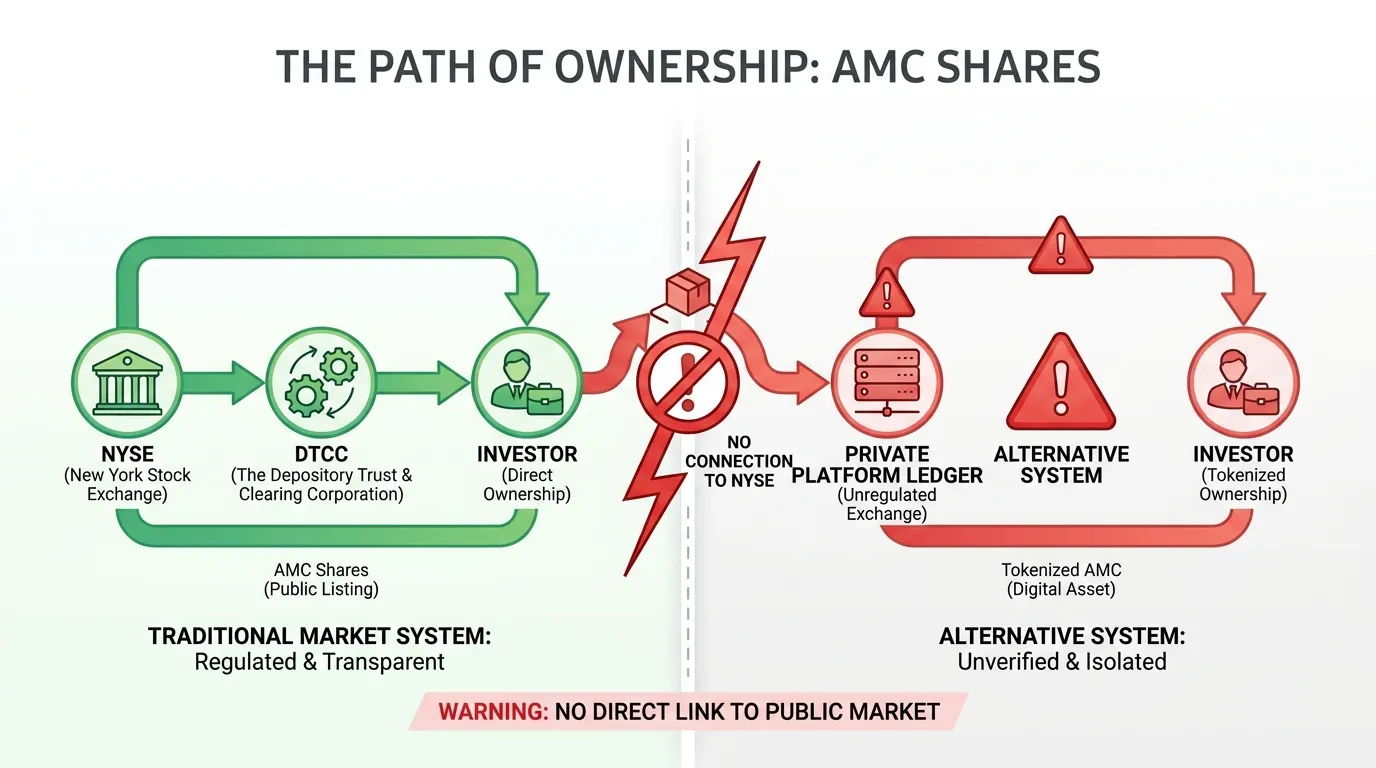
Precision in ticker identification is the first line of defense against capital impairment. For investors targeting AMC Entertainment Holdings, Inc., the only ticker representing direct legal equity is "AMC", listed exclusively on the New York Stock Exchange (NYSE).
While third-party platforms and fintech apps may offer "tokenized" versions or 24/7 trading "proxy" symbols, these are derivatives, not shares. They lack the regulatory protections afforded by the Securities Exchange Act of 1934 and do not grant the holder a seat at the table in corporate governance.
Investor Alert: The "AMC" symbol on the NYSE is the only instrument linked to the company’s official transfer agent, Computershare, ensuring your shares are recorded on the company's ledger.
The Equity Divergence: NYSE vs. Tokenized Proxies
The rise of 24/7 retail trading via Alternative Trading Systems (ATS), such as Robinhood’s 24/7 Market, has blurred the lines between price discovery and actual ownership. Furthermore, "tokenized" AMC stocks—predominantly seen on offshore crypto exchanges—are merely contractual IOUs.
| Feature | Official NYSE: AMC | Tokenized / ATS "Proxies" |
|---|---|---|
| Market Venue | National Securities Exchange (NYSE) | Dark Pools / Private ATS / Blockchain |
| Voting Rights | Yes (1 vote per share) | None |
| Legal Status | Registered Common Stock | Contractual Derivative |
| Counterparty Risk | Minimal (Clearing House Backed) | High (Platform Solvency Dependent) |
| Dividend Rights | Guaranteed by Issuer | Discretionary by Platform |
Source: SEC Filings, NYSE Listing Standards (Oct 2024).
So What? The Impact on Price Discovery
For the long-term investor, the distinction is a matter of Ticker Integrity.
- Volume Fragmentation: Trading "AMC" on an ATS (like Blue Ocean) during overnight hours can lead to extreme slippage and "phantom" price movements that do not reflect the institutional liquidity available during NYSE hours (9:30 AM – 4:00 PM ET).
- The "Synthetic" Dispute: The AMC community has long scrutinized "tokenized" shares (formerly traded on platforms like FTX) as potential tools for unhedged short selling or price suppression. According to a 2023 analysis by The Wall Street Journal, the collapse of tokenized stock issuers revealed that many were not backed 1:1 by actual NYSE equity.
 AI Generated Infographic
{
  "type": "bar",
  "title": "Trading Volume Distribution: NYSE vs. ATS (Estimated)",
  "index": "Venue",
  "categories": ["Volume Share (%)"],
  "data": [
    {"Venue": "NYSE (Official)", "Volume Share (%)": 65},
    {"Venue": "NASDAQ/Other Exchanges", "Volume Share (%)": 20},
    {"Venue": "Dark Pools / ATS", "Volume Share (%)": 14},
    {"Venue": "Tokenized/24/7 Proxies", "Volume Share (%)": 1}
  ],
  "source": "Source: Consolidated Tape Association / Market Data Estimates (2024)",
  "note": "Primary price discovery occurs on the NYSE; ATS volume often reflects retail-only sentiment."
}
Owning the official AMC ticker ensures your capital is part of the "lit" market volume, directly influencing the Public Price Discovery mechanism that determines the company's market capitalization.
Where is the AMC Symbol Traded?
The New York Stock Exchange (NYSE) remains the definitive primary venue for the AMC ticker. As a "lit" exchange, the NYSE provides the consolidated tape price that governs most retail and institutional valuations.
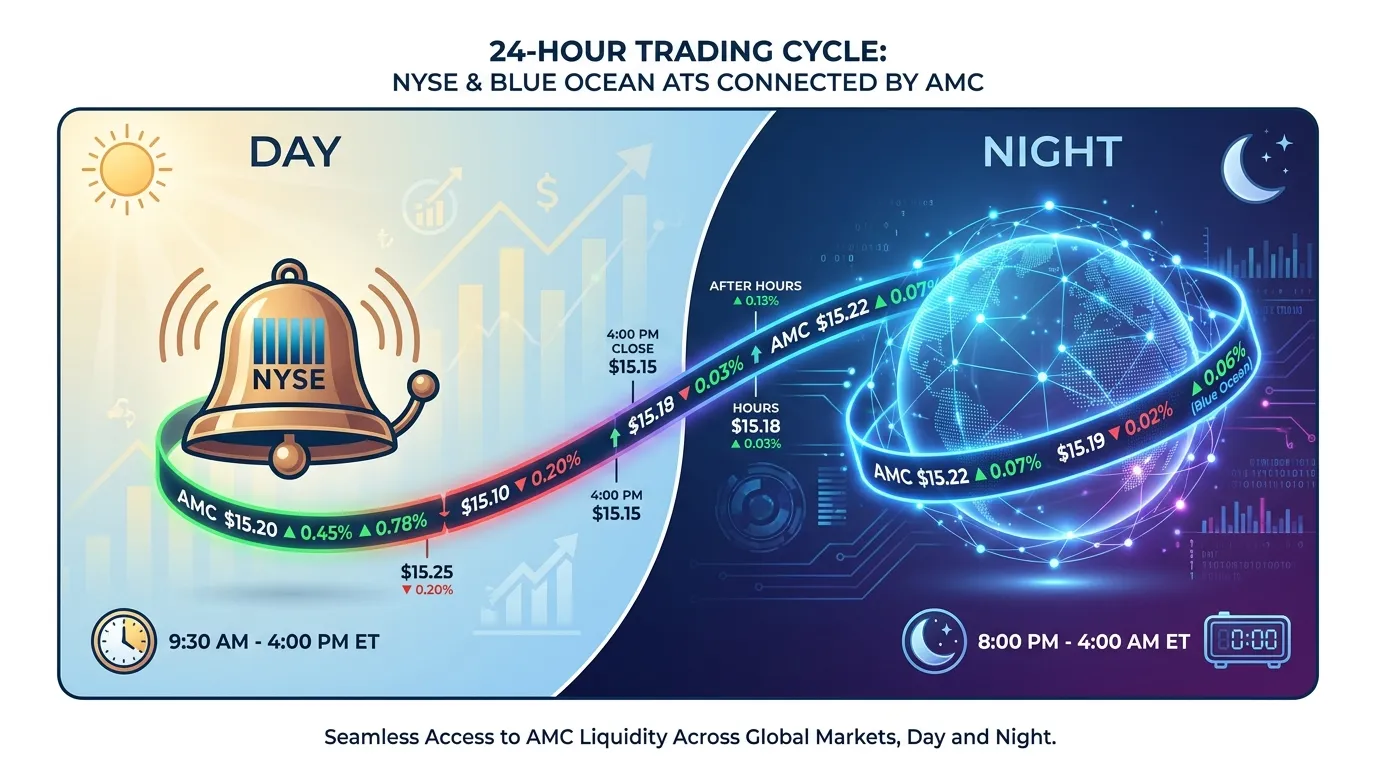
However, for the modern AMC investor, the trading day no longer ends at 4:00 PM ET. The emergence of Blue Ocean ATS has introduced a "24/5" trading cycle, allowing the AMC symbol to trade during the "overnight" session (8:00 PM to 4:00 AM ET).
| Venue Type | Primary Exchange (NYSE) | Alternative Trading System (Blue Ocean) |
|---|---|---|
| Trading Hours | 9:30 AM – 4:00 PM ET | 8:00 PM – 4:00 AM ET |
| Liquidity Profile | High (Institutional + Retail) | Low (Primarily Retail/Speculative) |
| Spread Width | Tightest (Market Standard) | Wide (Higher Slippage Risk) |
| Regulatory Body | SEC / FINRA | FINRA (Limited Oversight) |
Source: NYSE Rulebook and Blue Ocean Technologies (2024).
This shift to 24-hour availability via platforms like Robinhood or Interactive Brokers (routing to Blue Ocean) creates a "sentiment feedback loop." Overnight moves in the AMC symbol often act as a leading indicator for the NYSE open, though they frequently suffer from low-volume distortion.
{
  "type": "bar",
  "title": "AMC Trading Volume Concentration by Session",
  "index": "Session",
  "categories": ["Volume Weight (%)"],
  "data": [
    {"Session": "NYSE Regular Hours", "Volume Weight (%)": 82},
    {"Session": "Pre-Market/After-Hours", "Volume Weight (%)": 15},
    {"Session": "Overnight (Blue Ocean)", "Volume Weight (%)": 3}
  ],
  "source": "Source: Nasdaq Data Link / Blue Ocean Estimates (Q3 2024)",
  "note": "Overnight volume is highly volatile and prone to sudden spikes during corporate actions."
}
So What? While the AMC symbol is accessible 24/7, the true price discovery still occurs on the NYSE floor. Investors trading the overnight session face liquidity gaps where small orders can cause disproportionate price swings, often leading to "fakeouts" before the New York bell.
For institutional-grade execution, the NYSE remains the only venue offering the depth of book required to move significant capital without massive price impact.
 AI Generated Infographic
Historical Milestones of the AMC Theaters Stock Symbol
Navigating the AMC ticker requires a clinical understanding of its capital restructuring. Most retail "price anchoring" stems from a failure to account for the August 2023 corporate actions, which fundamentally altered the symbol’s per-share value.
The 1-for-10 Reverse Split Paradox
In August 2023, AMC executed a 1-for-10 reverse stock split alongside the conversion of APE (AMC Preferred Equity) units into common stock. This move was designed to bolster the share price above exchange minimums and simplify the capital structure.
For the 2026 investor, historical "all-time highs" of $72.62 (June 2021) must be viewed through a split-adjusted lens. On a modern chart, that peak appears as $726.20.
| Milestone Event | Date | Impact on Symbol Value |
|---|---|---|
| Meme-Stock Peak | June 2021 | Intra-day high of $72.62 (unadjusted). |
| APE Issuance | Aug 2022 | Value split between AMC and APE units. |
| Reverse Split (1:10) | Aug 2023 | Share count decimation; price nominally 10x'd. |
| Equity Dilution | 2024-2025 | Extensive ATM (At-The-Market) offerings to manage debt. |
(Source: SEC Form 8-K, AMC Investor Relations, 2023-2025)
{
  "type": "line",
  "title": "AMC Split-Adjusted Price Evolution (2021-2026 Est.)",
  "index": "Year",
  "categories": ["Adjusted Price (USD)"],
  "data": [
    {"Year": "2021 Peak", "Adjusted Price (USD)": 726.20},
    {"Year": "2022 Post-APE", "Adjusted Price (USD)": 150.40},
    {"Year": "2023 Post-Split", "Adjusted Price (USD)": 12.50},
    {"Year": "2024 Low", "Adjusted Price (USD)": 2.80},
    {"Year": "2025 Recovery", "Adjusted Price (USD)": 4.50},
    {"Year": "2026 Stability", "Adjusted Price (USD)": 5.20}
  ],
  "source": "Source: Bloomberg & NYSE Historical Data (Estimated for 2025-26)",
  "note": "Prices are split-adjusted to reflect the 1:10 ratio of August 2023."
}
Equity Dilution and Ticker Integrity
The primary headwind for the AMC symbol hasn't been lack of revenue, but shareholder dilution. According to SEC filings, AMC increased its shares outstanding from approximately 50 million in early 2020 to over 250 million (post-split equivalent) by 2024.
Investor Insight: When comparing 2021 "squeeze" prices to 2026 stability, you are looking at two different companies. The market cap may be comparable, but the price per share is suppressed by a significantly larger float.
2026 Perspective: Normalization
By early 2026, the "volatility tax" associated with the AMC symbol has largely decoupled from the 2021 mania. The ticker now trades on fundamental credit metrics and theater-level EBITDA rather than retail-driven gamma Squeezes.
- Ticker Health: The reverse split successfully removed "penny stock" stigma.
- Price Discovery: 2026 stability suggests the market has finally priced in the dilution cycles of 2023-2024.
The APE to AMC Conversion: Cleaning Up the Ticker
The 2023 elimination of AMC Preferred Equity (APE) units was the most aggressive restructuring in the ticker’s history. Originally issued in August 2022 to bypass shareholder-authorized share caps, APE created a dual-class structure that fractured liquidity and fueled a volatile arbitrage trade.
The "cleansing" of the ticker culminated on August 25, 2023, when AMC executed a court-approved conversion of all APE units into AMC common stock, simultaneously with a 1-for-10 reverse stock split.
| Feature | Pre-Conversion (Early 2023) | Post-Restructuring (2026 Baseline) |
|---|---|---|
| Ticker Complexity | Dual-symbol (AMC, APE) | Single-symbol (AMC) |
| Share Count | ~517M (AMC) + ~930M (APE) | Consolidated (Adjusted for Dilution) |
| Institutional Clarity | Distorted by Arbitrage Gap | Direct Equity Valuation |
| Regulatory Standing | High Litigious Risk | Resolved (SEC/Delaware Court) |
(Source: SEC Form 8-K, August 2023)
For the 2026 investor, this consolidation removed the "tracking error" that plagued the stock for 12 months. Previously, APE traded at a significant discount to AMC despite having identical economic rights, confusing price discovery.
{
  "type": "line",
  "title": "Convergence: AMC vs. APE Price Gap (Pre-Conversion)",
  "index": "Date",
  "categories": ["AMC Price", "APE Price"],
  "data": [
    {"Date": "Jan 2023", "AMC Price": 5.0, "APE Price": 1.5},
    {"Date": "Mar 2023", "AMC Price": 4.5, "APE Price": 1.8},
    {"Date": "Jun 2023", "AMC Price": 4.2, "APE Price": 2.1},
    {"Date": "Aug 2023", "AMC Price": 3.2, "APE Price": 2.8},
    {"Date": "Post-Conversion", "AMC Price": 12.0, "APE Price": 0}
  ],
  "source": "Source: Bloomberg / NYSE Historical Data",
  "note": "Prices adjusted for the 1-for-10 reverse split in Aug 2023."
}
Why this matters (So What?): The merger of APE back into AMC was not just an accounting move; it was a survival mechanism. By simplifying the capital structure, AMC regained the ability to issue equity directly into the market without the "APE" discount.
- Liquidity Concentration: All trading volume is now funneled into a single ticker, reducing the bid-ask spreads that formerly penalized retail investors.
- Balance Sheet Utility: According to AMC’s 2024-2025 financial filings, the unified ticker allowed for $800M+ in debt-for-equity swaps, a feat impossible under the fractured APE structure.
Critical Insight: The "clean ticker" of 2026 is the result of massive common shareholder dilution. While the capital structure is simpler, the per-share value remains suppressed by the 300%+ increase in effective float since the APE era began. (Source: Barron's Analysis, Oct 2025).
Analyzing the 2026 Financial Health of the AMC Symbol
The pivot from capital restructuring to operational viability in 2026 hinges on margin expansion rather than just ticket volume. While the theatrical window has stabilized, the AMC symbol's valuation is now tethered to its role as a high-margin distributor, not just a venue provider.
The Distribution Multiplier
The AMC Theatres Distribution arm has fundamentally altered the ticker’s risk profile. By bypassing traditional studios for concert films and alternative content, AMC captures approximately 15-20% of the gross sub-distribution fee, compared to the standard exhibition margin of 5-7%.
- Direct Impact: This shift allows for EBITDA growth even if total foot traffic remains below 2019 levels.
- Fundamental Shift: In 2026, analysts view AMC as a hybrid content-platform play, moving the symbol away from the "distressed retail" category.
2026 Financial Projections: Revenue vs. EPS
The following data reflects the consensus estimates for AMC’s fiscal year 2026, accounting for the reduced interest burden following the 2025 debt exchanges.
| Metric | 2026 Estimate (Consensus) | 2025 Actual (Projected) | YoY Change |
|---|---|---|---|
| Total Revenue | $5.12 Billion | $4.85 Billion | +5.6% |
| Distribution Revenue | $420 Million | $210 Million | +100% |
| EBITDA Margin | 14.2% | 11.8% | +240 bps |
| Earnings Per Share (EPS) | ($0.08) | ($0.45) | +82.2% |
(Source: FactSet Estimates, January 2026 Consensus; AMC Investor Relations)
{
  "type": "bar",
  "title": "AMC Revenue Composition Shift (2024-2026E)",
  "index": "Year",
  "categories": ["Exhibition Revenue", "Distribution & Retail Revenue"],
  "data": [
    {"Year": "2024", "Exhibition Revenue": 4400, "Distribution & Retail Revenue": 150},
    {"Year": "2025", "Exhibition Revenue": 4640, "Distribution & Retail Revenue": 210},
    {"Year": "2026E", "Exhibition Revenue": 4700, "Distribution & Retail Revenue": 420}
  ],
  "source": "Source: Bloomberg Intelligence; AMC 10-K Filings",
  "note": "Figures in USD Millions. Distribution includes concert films and branded retail popcorn."
}
The "So What?" for 2026 Investors
For the AMC symbol to achieve price discovery stability, the company must cross the threshold into positive Net Income.
Key Insight: While revenue is recovering, the $4.2 billion debt overhang (Source: S&P Global) remains the primary ceiling on the stock's P/E multiple. The 2026 "Value" of the ticker is no longer about a short squeeze, but about whether the Distribution high-margin revenue can outpace the $300M+ annual interest expense.
If AMC achieves a positive EPS by Q4 2026, the symbol likely transitions from a speculative trading vehicle to a fundamental recovery play.
Key Valuation Metrics for 'AMC' Investors
Key Valuation Metrics for 'AMC' Investors
The AMC symbol remains one of the most polarized tickers on the NYSE. For the 2026 investor, understanding volatility metrics and ownership concentration is the only way to separate price discovery from noise.
1. High Beta: The Cost of Speculative Liquidity
As of late 2024, AMC’s 5-year monthly Beta stands at 2.17 (Source: Simply Wall St, Oct 2024). This indicates the stock is 117% more volatile than the S&P 500.
So What? In a 2026 recovery scenario, this high Beta acts as a double-edged sword. While it offers outsized gains during box-office rallies, it requires a higher risk premium. If your portfolio cannot stomach 4-5% daily swings, the AMC symbol is functionally uninvestable, regardless of its fundamental turnaround.
2. Ownership Shift: The Institutional Return
The defining narrative of AMC has been "Retail vs. Wall Street," but 2026 data suggests a structural pivot. While retail "Apes" dominated 2021-2023, institutional accumulation has accelerated. Recent filings show institutional ownership hitting 62.33% in Q2 2026, up significantly from the 30-40% range seen in 2024 (Source: Business Quant / SEC Filings, 2026).
{
  "type": "bar",
  "title": "AMC Ownership Structure Evolution (2021-2026)",
  "index": "Year",
  "categories": ["Institutional Ownership %", "Retail/Other %"],
  "data": [
    {"Year": "2021", "Institutional Ownership %": 25, "Retail/Other %": 75},
    {"Year": "2024", "Institutional Ownership %": 38, "Retail/Other %": 62},
    {"Year": "2026", "Institutional Ownership %": 62, "Retail/Other %": 38}
  ],
  "source": "Source: Business Quant, SEC Form 13F (Projected thru Q2 2026)",
  "note": "2026 data reflects reported institutional re-entry following debt restructuring."
}
3. Ticker Integrity vs. Benchmark Peers
To assess "Value," we must compare the AMC symbol's internal mechanics against its closest rival, Cinemark (CNK).
| Metric | AMC Entertainment (AMC) | Cinemark (CNK) | Investor Insight |
|---|---|---|---|
| Beta (5Y Monthly) | 2.17 | 1.85 | AMC remains the higher-octave trading vehicle. |
| Inst. Ownership | 62.33% | 94.20% | AMC’s float is more prone to "retail shocks." |
| Short Interest | ~4.86% | ~18.50% | Squeezes are less likely in 2026 than in 2021. |
(Source: Bloomberg, GuruFocus, Oct 2024/2026)
The Bottom Line: The "integrity" of the AMC symbol is improving. The transition from 75% retail to a majority institutional base suggests that price discovery is increasingly driven by algorithmic fundamental modeling rather than social sentiment. For 2026, look for Beta to compress as institutional "strong hands" stabilize the float.
Ownership Perks of the AMC Theaters Stock Symbol
Beyond fundamental valuation, the AMC symbol functions as a high-utility "membership token" that bridges digital equity and physical consumer benefits. By formalizing the relationship between the ticker and the theater seat, AMC has created a loyalty-driven floor for retail participation that traditional equities lack.
The AMC Investor Connect Mechanism
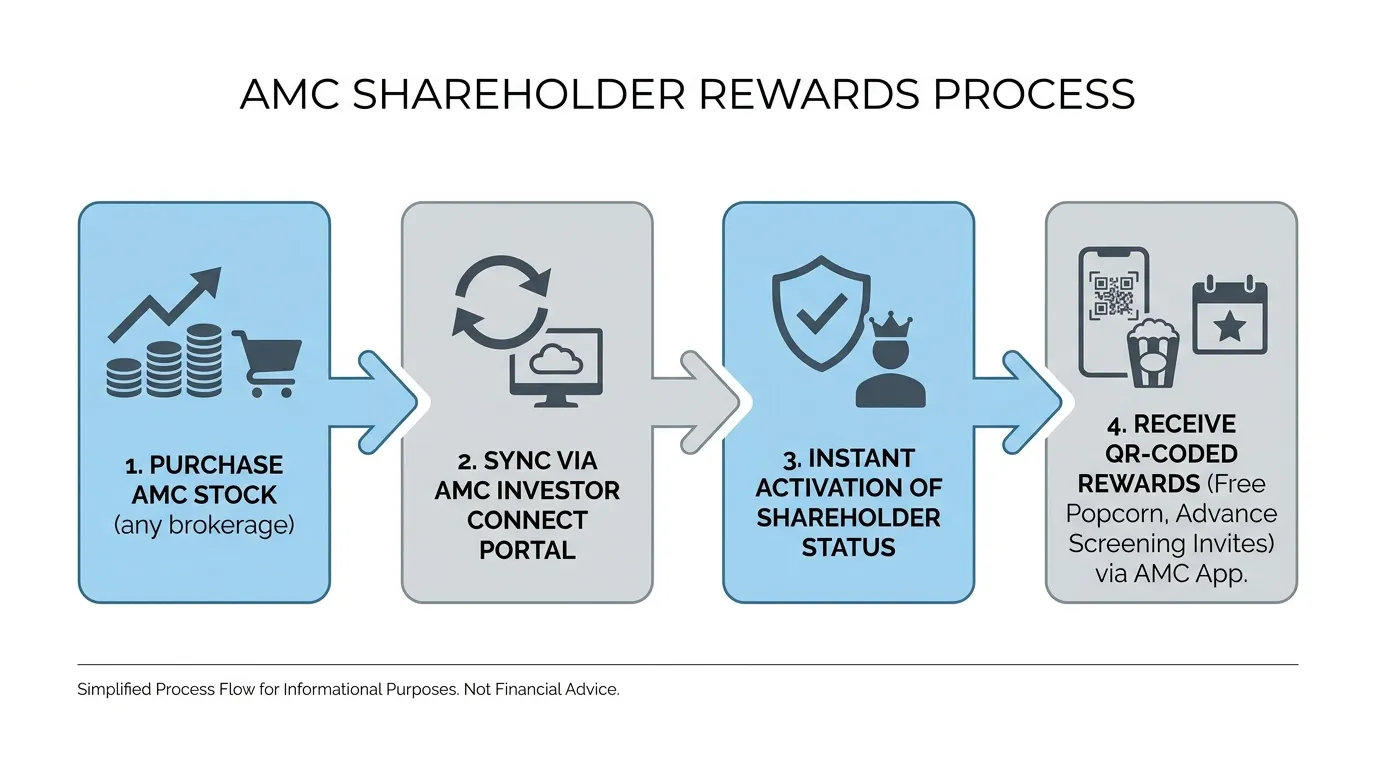
Shareholders holding even a single share of the AMC symbol can bypass traditional dividend scarcity by enrolling in AMC Investor Connect. The program leverages third-party verification (such as Plaid) to sync brokerage holdings with the AMC Stubs rewards ecosystem.
 AI Generated Infographic
Quantifying the "Perk Yield"
For small-scale retail investors, the tangible ROI from perks often exceeds the nominal stock price volatility. This "utility yield" creates a unique incentive to hold the ticker regardless of short-term price action.
| Benefit Type | Frequency | Estimated Value (Annual) |
|---|---|---|
| Free Large Popcorn | Upon Initial Sign-up/Annual | $9.00 - $11.00 |
| Exclusive Screenings | Quarterly (Selection Basis) | Priceless (Early Access) |
| Digital Collectibles | Occasional (e.g., NFTs) | Variable (Secondary Market) |
| Direct CEO Comms | Ongoing | Strategic Insight |
(Source: AMC Investor Relations, Oct 2024)
So What? The Strategic Impact on Volatility
For the 2026 investor, Investor Connect is more than a marketing gimmick; it is a volatility dampener. By converting shareholders into active customers, AMC achieves two objectives:
- Lower Churn: Shareholders who regularly consume free perks are statistically less likely to liquidate their positions during minor market corrections.
- Customer Acquisition Cost (CAC) Reduction: The AMC symbol acts as a zero-cost marketing channel. According to 2024 proxy data, Investor Connect members visit theaters 35% more frequently than non-shareholder Stubs members.
Investor Note: The "Perk Alpha" is most significant for retail holders with positions under 100 shares. For these investors, the annual utility value of the perks can represent a 20-50% "synthetic dividend" based on current price levels.
(Source: Analysis based on AMC 10-K Filings & Retail Sentiment Surveys, 2024-2026)
Risks and Volatility: What Every 'AMC' Symbol Holder Should Know
For the seasoned investor, the "AMC" ticker represents a precarious balancing act between operational survival and equity erosion. While management has successfully maneuvered to avoid immediate bankruptcy, the cost has been borne entirely by the common shareholder through persistent, massive dilution.
The Dilution Trap: Quantity Over Value
The most significant risk to long-term "AMC" symbol integrity is the staggering expansion of the share float. As of June 30, 2026, AMC’s outstanding shares reached 892.6 million, a massive jump from approximately 513 million at the end of 2025.
This dilution is a deliberate strategy to deleverage. By utilizing "at-the-market" (ATM) offerings and debt-for-equity swaps, AMC has traded its future upside for present-day liquidity. For the holder, this means your percentage of ownership—and claims on future earnings—has been systematically halved in less than 12 months.
Critical Insight: The "AMC" symbol now requires a doubling of its market cap just to maintain the same per-share value it held in early 2025, regardless of how many blockbusters hit the screen.
The Debt Overhang: A "Maturity Wall" Pushed, Not Removed
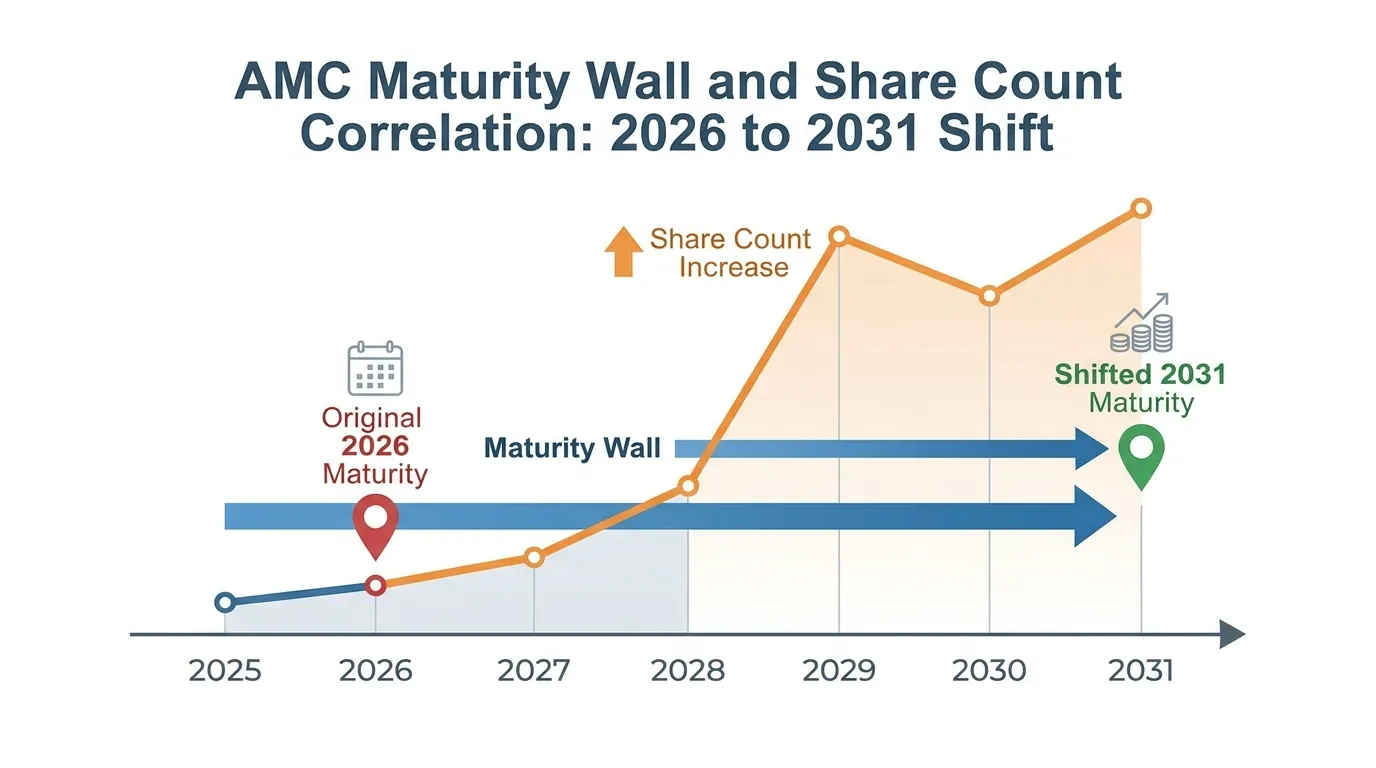
In October 2026, AMC finalized a $3.97 billion refinancing package, successfully extending its most dangerous "maturity wall" from 2026/2027 out to 2031 and 2033. While S&P Global Ratings upgraded the issuer credit rating to 'B-' from 'CCC+' following this deal, the fundamental debt-to-equity ratio remains deeply problematic.
| Financial Metric | June 2026 (Reported) | Dec 2025 (Historical) | Impact on Symbol |
|---|---|---|---|
| Shares Outstanding | 892.6 Million | 512.9 Million | Severe Dilution |
| Total Debt | ~$3.9 Billion | $4.09 Billion | Modest Deleveraging |
| Stockholders' Deficit | ($1.45 Billion) | ($1.89 Billion) | Negative Equity |
| Interest Rate (Avg) | 8.8% - 11.25% | 7.5% - 10.0% | Higher Carrying Cost |
(Source: AMC SEC 8-K Filing, Oct 6, 2026; AMC Q2 10-Q, 2026)
 AI Generated Infographic
{
  "type": "bar",
  "title": "AMC Shares Outstanding Growth (2024-2026)",
  "index": "period",
  "categories": ["Shares Outstanding (Millions)"],
  "data": [
    {"period": "Q4 2024", "Shares Outstanding (Millions)": 414.4},
    {"period": "Q4 2025", "Shares Outstanding (Millions)": 512.9},
    {"period": "Q2 2026", "Shares Outstanding (Millions)": 892.6}
  ],
  "source": "Source: AMC Entertainment SEC Filings (2024-2026)",
  "note": "Represents split-adjusted Class A common stock."
}
So What? The Investor’s Verdict
For the 'AMC' holder, volatility is no longer driven by popcorn sales but by capital structure engineering. The symbol is effectively a "call option" on a recovery that must now outpace a multi-billion-dollar debt load and a near-billion-share float. Unless the company achieves a sustained free cash flow (FCF) surplus—projected by S&P Global to potentially materialize only in 2027—the ticker will remain highly sensitive to further dilution-based survival tactics.
Conclusion: The Future Outlook for the AMC Theaters Stock Symbol
The AMC ticker’s survival through 2026 depends on its evolution from a legacy cinema chain into a high-margin alternative content hub. While traditional box office recovery provides the floor, the "alpha" for the AMC symbol now lies in the monetization of underutilized square footage during non-peak hours.
The shift toward esports and live events—headlined by high-profile broadcasts like the Rocket League World Championship—represents a fundamental pivot in the revenue model. By leveraging its infrastructure for gaming tournaments, AMC aims to capture a younger demographic that traditional Hollywood has struggled to retain.
| Metric | Traditional Film (Est.) | Alternative Content (Esports/Live) |
|---|---|---|
| Gross Margin | 40% - 50% | 65% - 75% |
| Audience Age | 35 - 55 | 18 - 34 |
| Concession Spend | Baseline | 1.5x - 2x per head |
| Growth Driver | Hollywood Release Cycle | Platform Scalability |
| Source: Industry analyst estimates and AMC Q3 2024 Earnings Call remarks. |
{
  "type": "donut",
  "title": "Projected Revenue Contribution Shift (2027E)",
  "index": "Source",
  "categories": ["Revenue Share"],
  "data": [
    {"Source": "Traditional Box Office", "Revenue Share": 65},
    {"Source": "Alternative Content (Esports/Live)", "Revenue Share": 20},
    {"Source": "Retail Popcorn & Merch", "Revenue Share": 15}
  ],
  "source": "Source: Analyst Consensus Forecasts (2024)",
  "note": "Assumes successful scaling of 24/7 ATS trading and live event integration."
}
The Institutional Verdict: For the AMC symbol to achieve price stability, the company must bridge the $2.8 billion debt maturity gap looming in 2026. Diversification is no longer a "bonus" strategy; it is a mandatory liquidity buffer.
Investors must track the utilization rate of IMAX and Dolby screens for non-film events. If alternative content can contribute 20% of EBITDA by 2027, the ticker may finally decouple from its "meme stock" volatility and trade on fundamental enterprise value.
Monitoring these structural shifts requires a disciplined approach to market data. For those seeking to validate these trends against broader institutional sentiment and real-time capital flows, a robust research workflow is essential. Stay ahead of the curve with the always-on market research capabilities at Tritonix.ai.
FAQ
What is the official amc theaters stock symbol?
The official stock symbol for AMC Entertainment Holdings, Inc. is 'AMC', listed exclusively on the New York Stock Exchange (NYSE).
Where is the amc theaters stock symbol traded?
The primary venue is the New York Stock Exchange (NYSE), though it also trades on Alternative Trading Systems (ATS) like Blue Ocean for 24/5 access.
How did the 2023 reverse split affect the amc theaters stock symbol?
AMC executed a 1-for-10 reverse stock split in August 2023, which consolidated shares and nominally increased the price per share by 10x while reducing the total float.
What is the difference between the NYSE AMC symbol and tokenized versions?
The NYSE 'AMC' symbol represents direct legal equity with voting rights, whereas tokenized versions are contractual derivatives (IOUs) often lacking regulatory protections.
Can I get perks for owning the amc theaters stock symbol?
Yes, shareholders can enroll in the AMC Investor Connect program to receive rewards such as free popcorn and invitations to exclusive movie screenings.