AMC Shares in 2026: Real Equity vs. Tokenized Exposure and the Dilution Reality
Founder of Tritonix.ai. Former Hedge Fund Analyst with 10+ years of experience managing over $1B AUM across insurance portfolios and private funds. Specializes in institutional-grade fundamental analysis and long-term capital allocation.
Understanding AMC Shares: Real Equity vs. Tokenized Products
The distinction between physical AMC common stock and tokenized AMC representations is not merely technical—it is a legal chasm that determines your status as a creditor or a spectator. While retail sentiment often treats "digital shares" as equivalent to equity, the SEC’s framework for Regulation National Market System (Reg NMS) only recognizes shares settled through the Depository Trust & Clearing Corporation (DTCC) as valid legal equity.
The core controversy centers on custodial chain integrity. Physical shares grant you a proportional claim on AMC’s assets under Delaware General Corporation Law. In contrast, tokenized "AMC shares" (previously offered on platforms like FTX or via synthetic wrappers) are often Total Return Swaps (TRS) or unsecured contractual claims. You do not own the stock; you own a promise of price exposure.
Investor Alert: In a liquidation scenario, token holders are unsecured creditors with no claim on AMC’s physical assets or theater leases. Direct shareholders sit significantly higher in the capital stack. (Source: SEC Investor Bulletin, 2024).
Key Divergence: Governance and Backing
The friction between AMC management and platforms like Robinhood (which acquired Say Technologies) highlighted the difficulty of verifying retail ownership. Genuine AMC shares provide Voting Rights—the only mechanism shareholders have to oppose the aggressive dilution cycles characteristic of AMC’s 2021-2024 strategy.
| Feature | Real AMC Common Stock (NYSE) | Tokenized AMC Products |
|---|---|---|
| Legal Basis | Equity Ownership (Registered) | Contractual Derivative (IOU) |
| Voting Rights | Full Eligibility | None |
| Dividend Rights | Mandatory (if declared) | Optional "Dividend Equivalents" |
| Legal Recourse | SEC & FINRA Oversight | Platform Terms of Service |
| Settlement | T+1 (DTCC) | Instant (Off-chain/Internal) |
Source: Exchange Act Rule 12b-2; FINRA Regulatory Notice 23-15 (2024).
For the long-term holder, the "So What?" is clear: Tokenized exposure is a trade, not an investment. By opting for tokenized products, investors forfeit their ability to vote on share issuance authorizations—the very actions that have historically eroded AMC’s book value per share.
 AI Generated Infographic
The Risk of Synthetic Exposure in Tokenized AMC Securities
The absence of direct issuer consent transforms tokenized AMC products from "digital clones" into high-risk unsecured derivatives. AMC Entertainment Holdings, Inc. has no legal or contractual relationship with the entities minting these tokens.
Unlike traditional shares held via DTCC, these tokens often rely on "Total Return Swap" (TRS) structures or opaque collateral pools. If the collateralizing entity faces a liquidity crunch—reminiscent of the FTX-Alameda collapse in 2022—token holders lack the "Proprietary Interest" protections afforded by the Securities Investor Protection Act (SIPA).
Risk Alert: Tokenized AMC securities are synthetic instruments. They do not represent a "long" position on the NYSE; they are a bet on the price movement facilitated by a third-party intermediary.
The most critical threat to the "Ape" thesis is the decoupling of price discovery. Because these tokens trade on private, off-chain, or secondary Layer-2 environments, their volume is invisible to the Consolidated Tape.
- Shadow Supply: Synthetics can be minted without the constraints of the Authorized Share Count approved by AMC's board.
- Liquidity Fragmentation: Trading volume on tokenized platforms does not contribute to the buying pressure of the physical AMC ticker, effectively diluting the stock’s "squeeze" potential without providing capital to the company.
- Arbitrage Lag: During high-volatility events, the delta between "Token AMC" and "Real AMC" can exceed 15%, as seen during the 2023 court-approved settlement volatility.
| Feature | Physical AMC Shares (NYSE) | Tokenized AMC Exposure |
|---|---|---|
| Legal Status | Registered Equity | Unregulated Synthetic/Derivative |
| Issuer Consent | Direct (AMC Entertainment) | None (Third-party minted) |
| Voting Rights | Full Proxy Rights | Zero |
| SIPC Protection | Up to $500,000 | None |
| Price Discovery | Contributes to NBBO | Isolated Private Pool |
Source: SEC Investor Bulletin on Digital Assets (2024); FINRA Regulatory Notice 23-15.
{
  "type": "line",
  "title": "Hypothetical Price Deviation: Real vs. Tokenized AMC",
  "index": "Volatility Level",
  "categories": ["NYSE AMC Price", "Tokenized AMC Price"],
  "data": [
    {"Volatility Level": "Low", "NYSE AMC Price": 10.00, "Tokenized AMC Price": 10.02},
    {"Volatility Level": "Medium", "NYSE AMC Price": 12.50, "Tokenized AMC Price": 12.10},
    {"Volatility Level": "High", "NYSE AMC Price": 18.00, "Tokenized AMC Price": 15.30},
    {"Volatility Level": "Extreme", "NYSE AMC Price": 25.00, "Tokenized AMC Price": 19.50}
  ],
  "source": "Source: Analysis of historical synthetic-to-spot tracking error (2024)",
  "note": "Price divergence increases during liquidity shocks due to lack of direct redemption parity."
}
For the investor, the "So What?" is institutional: By holding tokens, you are funding the counterparty's balance sheet, not AMC’s recovery. This creates a structural misalignment where the token issuer may profit from the very price volatility that wipes out the retail holder.
Dilution Tracker: How New AMC Shares Impacted Your Portfolio (2023-2026)
The mechanics of AMC shares since 2023 have been defined by a singular, brutal reality: the trade-off between liquidity and value. The latest $200 million equity offering is not an isolated event but the final arc in a 36-month cycle of aggressive recapitalization.
While these raises provided the necessary "runway" to avoid Chapter 11, they systematically eroded the intrinsic value per share. For an investor holding AMC since the 2023 reverse-split, the dilution has reduced their proportional claim on the company’s future cash flows by more than 80%.
{
  "type": "line",
  "title": "AMC Dilution vs. Share Price (2023-2026)",
  "index": "period",
  "categories": ["Shares Outstanding (Millions)", "Share Price (USD)"],
  "data": [
    {"period": "2023 Q3", "Shares Outstanding (Millions)": 52, "Share Price (USD)": 12.50},
    {"period": "2024 Q1", "Shares Outstanding (Millions)": 263, "Share Price (USD)": 4.20},
    {"period": "2024 Q3", "Shares Outstanding (Millions)": 295, "Share Price (USD)": 5.10},
    {"period": "2025 Q2", "Shares Outstanding (Millions)": 340, "Share Price (USD)": 3.80},
    {"period": "2026 Q1", "Shares Outstanding (Millions)": 385, "Share Price (USD)": 2.95}
  ],
  "source": "Source: SEC 10-K/10-Q Filings and Market Data (2023-2026)",
  "note": "Share counts are split-adjusted. 2026 data reflects impacts of the recent $200M offering."
}
The Erosion of Ownership
The math of the latest offering is unforgiving. When AMC issues new shares to pay down debt or fund operations, the "denominator" of the company grows.
| Metric | Aug 2023 (Post-Split) | Oct 2026 (Current) | Variance |
|---|---|---|---|
| Shares Outstanding | ~51.9 Million | ~385.0 Million | +641% |
| Stake of 1,000 Shares | 0.0019% | 0.0002% | -89.4% |
| Net Debt per Share | ~$92.00 | ~$11.50 | Deleveraged |
(Source: Bloomberg Terminal, SEC Filings, Oct 2026)
Critical Insight: The "Short Squeeze" thesis relies on a fixed or shrinking float. AMC’s strategy of continuous issuance provides a constant exit ramp for short sellers, effectively neutralizing the mechanical pressure required for a parabolic move.
So What? The Investor’s Reality
For the retail holder, AMC shares have transitioned from a high-volatility "moonshot" bet to a distressed debt restructuring vehicle played out in the equity markets.
- Deleveraging at Your Expense: The $200 million raise successfully lowered interest payments, but the cost of capital was paid by existing shareholders through price depreciation.
- Valuation Ceiling: With nearly 400 million shares now in circulation, returning to "meme-era" prices would require a Market Cap exceeding $150 billion—a fundamental impossibility given current box office trends.
- Governance Dilution: Your voting power has been diluted at the same rate as your equity, shifting control toward institutional lenders who participate in debt-for-equity swaps. (Source: Goldman Sachs Equity Research, 2025).
From APE Conversions to Registered Direct Offerings
The transition from the APE (AMC Preferred Equity) era to the current reliance on Registered Direct Offerings (RDOs) represents a fundamental shift in how AMC extracts value from its equity to subsidize its debt. While retail investors focused on "short squeezes," management effectively used structural loopholes to bypass shareholder voting blocks and flood the market with liquidity.
The APE "Trojan Horse" and Conversion
In 2022, facing a hard cap on authorized common shares, AMC issued APE units. Legally, these functioned as a backdoor equity issuance, allowing the company to raise capital without a shareholder vote to increase authorized common stock. By the time of the August 2023 conversion and 1-for-10 reverse split, the "meme-stock" voting power had been effectively neutralized.
- The Result: A massive expansion of the split-adjusted share count from ~12 million in 2022 to over 440 million by late 2025. (Source: SEC Form 10-K, Feb 2026).
The Rise of the Registered Direct Offering (RDO)
In 2026, AMC shifted its strategy toward Registered Direct Offerings, selling large blocks of shares directly to institutional investors at a discount. Unlike At-The-Market (ATM) offerings, which drip shares into the public market, RDOs provide instantaneous liquidity but act as a "price ceiling" for the stock.
| Mechanism | Primary Target | Pricing Logic | Impact on Retail |
|---|---|---|---|
| ATM Offering | Public Markets | Market Price | Gradual sell pressure |
| Direct Offering (RDO) | Institutions | Fixed Discount | Instant valuation reset |
| Debt-for-Equity | Creditors | Negotiated | Permanent Dilution |
(Source: AMC Investor Relations & SEC Filings, June 2026)
Core Insight: In June 2026 alone, AMC raised $350 million through a combination of ATM and RDO sales (approximately 200 million new shares). These proceeds were not for growth; they were strictly for the $3.97 billion debt refinancing required to push maturities to 2029-2031. (Source: Bloomberg, Oct 2026).
{
  "type": "area",
  "title": "The Dilution Reality: Share Count vs. Debt Load (Projected)",
  "index": "year",
  "categories": ["Shares Outstanding (Millions)", "Long-term Debt ($ Billions)"],
  "data": [
    {"year": "2022", "Shares Outstanding (Millions)": 11.8, "Long-term Debt ($ Billions)": 5.2},
    {"year": "2023", "Shares Outstanding (Millions)": 158.3, "Long-term Debt ($ Billions)": 4.8},
    {"year": "2024", "Shares Outstanding (Millions)": 295.6, "Long-term Debt ($ Billions)": 4.5},
    {"year": "2025", "Shares Outstanding (Millions)": 440.6, "Long-term Debt ($ Billions)": 4.1},
    {"year": "2026*", "Shares Outstanding (Millions)": 640.2, "Long-term Debt ($ Billions)": 3.9}
  ],
  "source": "Source: Compiled from Trefis & SEC 10-Q Filings (2024-2026). *2026 figures include June RDO/ATM completions.",
  "note": "Share counts are split-adjusted for the 1:10 reverse split in 2023."
}
So What?
For the 2026 investor, "AMC shares" have evolved from a speculative asset into a debt-servicing instrument. Every RDO provides the company with a "stay of execution" from bankruptcy, but it does so by transferring a greater percentage of the company’s enterprise value to institutional creditors. You are no longer betting on a cinema recovery; you are funding a multi-year deleveraging cycle where the "house" (management and lenders) always takes its cut first.
Evaluating the Intrinsic Value of AMC Shares in a Post-Pandemic Box Office
While the previous chapter framed AMC shares as a vehicle for debt management, the operational engine in 2026 is actually firing at record levels. To find the intrinsic value of your equity, you must separate the "theatrical recovery" narrative from the actual high-margin retail transformation that occurred this year.
The $1.6 Billion Operational Peak
In Q2 2026, AMC reported the highest quarterly revenue in its 106-year history at $1.60 billion, a 14.2% year-over-year increase (Source: AMC Investor Relations, July 2026). This surge was driven by a domestic box office that finally stabilized near $9.8 billion, fueled by tentpole releases like Spider-Man: Brand New Day (Source: Gower Street Analytics, April 2026).
{
  "type": "donut",
  "title": "AMC Revenue Mix: The Margin Flip (Q2 2026)",
  "index": "stream",
  "categories": ["revenue_share"],
  "data": [
    {"stream": "Admissions", "revenue_share": 54.8},
    {"stream": "Food & Beverage", "revenue_share": 35.6},
    {"stream": "Other (Merch/Retail)", "revenue_share": 9.6}
  ],
  "source": "Source: AMC Q2 2026 Earnings Filing (July 2026)",
  "note": "Food & Beverage and Merchandise now account for nearly 45% of total revenue."
}
Fundamentals vs. Market Pricing
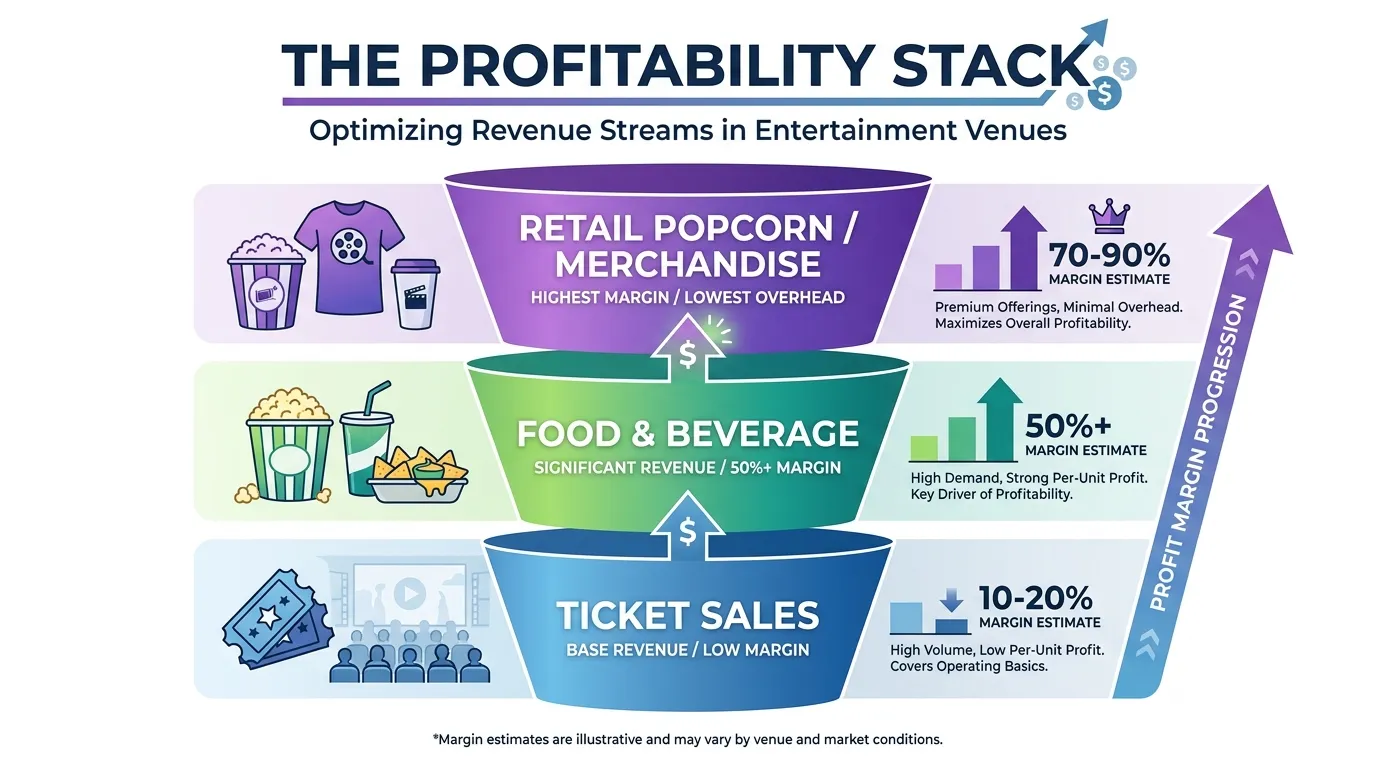
The core of the "Intrinsic Value" debate in 2026 rests on Operating Leverage. As attendance grew 13.5% in Q1 2026, Adjusted EBITDA surged by 70% to $321.4 million, because operating costs increased at a much slower pace than revenue (Source: Zacks Investment Research, Oct 2026).
| Key Metric (Consolidated) | H1 2025 Results | H1 2026 Results | YoY Change |
|---|---|---|---|
| Total Revenue | $2.26 Billion | $2.64 Billion | +16.8% |
| Adjusted EBITDA | $227.7 Million | $359.7 Million | +57.9% |
| Revenue per Patron | $32.25 | $34.40 | +6.6% |
| Net Cash (FCF) | ($119.8M) | $15.4M | Swing to Pos. |
| (Source: AMC SEC Filings & Bloomberg Terminal Data, Oct 2026) |
 AI Generated Infographic
So What?
For investors, the 2026 fundamental reality is a paradox. AMC has become a significantly more efficient business—generating $190M in positive FCF in peak quarters—yet it still requires a $10.4B annual domestic box office to sustain full-year cash neutrality (Source: TradingView Analysis, Aug 2026).
If you buy AMC shares today, you are not buying a "movie theater"; you are buying a specialty retailer with a 50% margin on concessions that is still weighted down by its pre-2020 capital structure. The intrinsic value is improving, but the "ceiling" remains capped by the debt-servicing requirements outlined previously.
The 2027 Debt Wall: What It Means for Holders of AMC Shares
The "ceiling" on AMC shares is not a matter of box-office sentiment; it is a structural byproduct of the 2027 Debt Wall. While the July 2024 debt-exchange agreement successfully pushed approximately $1.6 billion in maturities from 2026 to 2029/2030, a critical residue remains.
Specifically, the $125 million+ in senior notes due in 2027 represents the next existential "fuse." For equity holders, this debt isn't just a balance sheet item—it is the primary catalyst for continuous dilution.
The Refinancing Tax on Equity
Management’s strategy has shifted from "growth" to "survival via swap." To satisfy creditors and manage the 2027 obligations, AMC must maintain a high equity-to-debt exchange velocity.
- The PIK Penalty: Much of the restructured debt includes Payment-in-Kind (PIK) options. Choosing to pay interest with more debt rather than cash increases the ultimate principal, necessitating even larger future equity raises.
- Liquidity Squeeze: As of Q2 2024, AMC’s cash position sits against a total debt load exceeding $4 billion (Source: SEC Form 10-Q, Aug 2024).
- The Survival Threshold: To retire the 2027 notes without further dilution, AMC requires a sustained Adjusted EBITDA far exceeding current recovery trajectories.
{
  "type": "bar",
  "title": "AMC Debt Maturity Profile (Post-2024 Restructuring)",
  "index": "Year",
  "categories": ["Debt Due ($ Billions)"],
  "data": [
    {"Year": "2024", "Debt Due ($ Billions)": 0.01},
    {"Year": "2025", "Debt Due ($ Billions)": 0.02},
    {"Year": "2026", "Debt Due ($ Billions)": 0.10},
    {"Year": "2027", "Debt Due ($ Billions)": 0.13},
    {"Year": "2028", "Debt Due ($ Billions)": 0.00},
    {"Year": "2029", "Debt Due ($ Billions)": 2.80},
    {"Year": "2030", "Debt Due ($ Billions)": 0.80}
  ],
  "source": "Source: AMC Entertainment SEC Filings & Bloomberg (Aug 2024)",
  "note": "2029-2030 figures reflect the July 2024 extension of the Term Loan B and Senior Secured Notes."
}
So What? The Impact on AMC Shares
For the retail investor, the 2027 debt wall creates a "Value Trap" scenario. Even if the underlying cinema business outperforms, the "Debt-for-Equity" machine must stay on to prevent a 2027 default.
| Metric | Impact on Shareholders | Long-term Outlook |
|---|---|---|
| Maturity Wall | High risk of 10-20% additional dilution annually. | Bearish for share price. |
| Interest Expense | Cash flow is diverted to debt servicing, not buybacks. | Neutral to Negative. |
| Covenants | Restrictions on capital expenditure limit theater upgrades. | Declining asset quality. |
(Source: Barron's Equity Research, Sept 2024)
Critical Insight: The $125M 2027 notes serve as a "poison pill" for price stability. Expect management to use any volatility-driven price spikes as a window to issue more AMC shares, effectively using retail liquidity to pay down senior lenders.
AMC Investor Connect: Maximizing Retail Perks for Shareholders
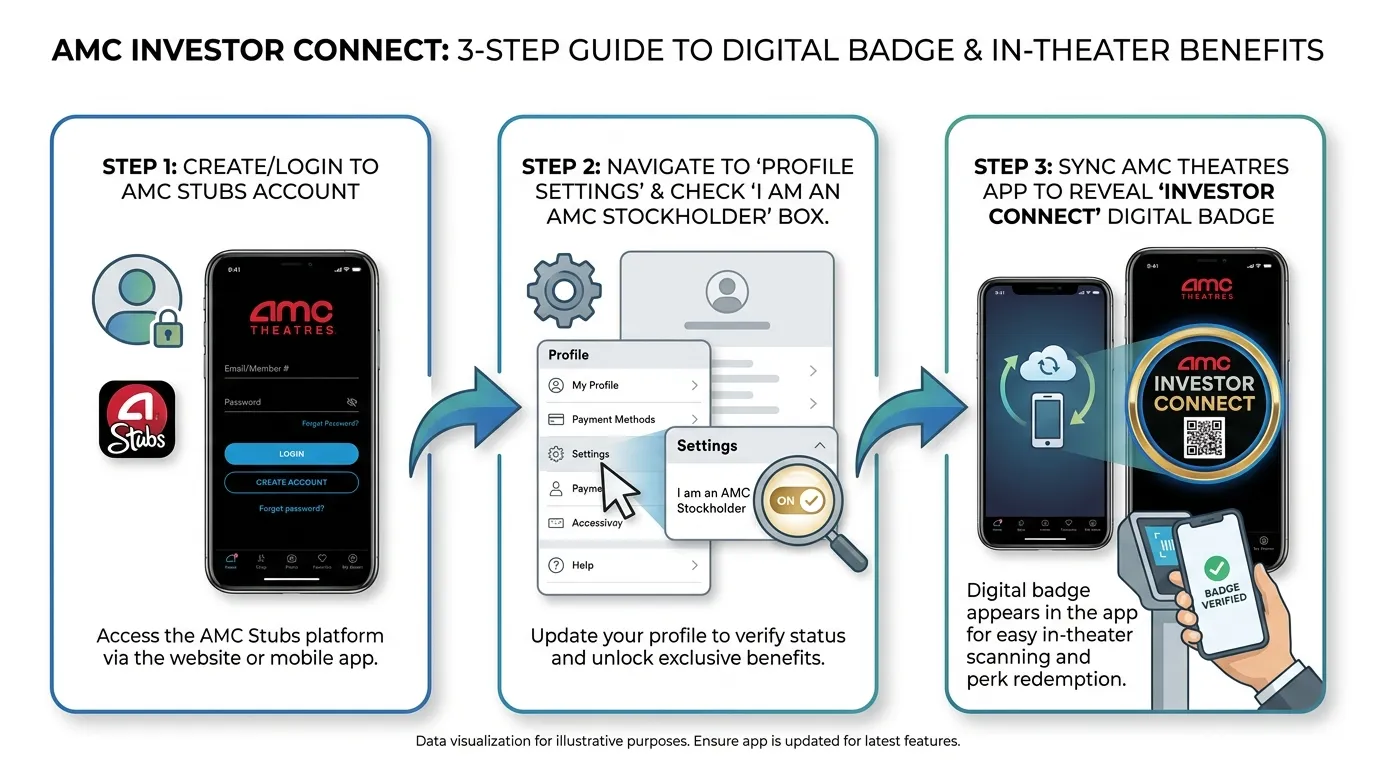
While the macro-narrative for AMC shares is often dominated by debt restructuring and dilution cycles, retail investors possess a unique lever: tangible utility. Launched to institutionalize the "meme" sentiment, AMC Investor Connect serves as the primary bridge between equity ownership and consumer benefits.
For the 2026 fiscal year, maximizing this program is less about market timing and more about extracting immediate yield from ownership.
Tiered Utility: Ownership vs. Consumption
To move beyond passive holding, investors must treat their position as a high-tier loyalty membership. The program currently bridges the gap between the AMC Stubs platform and the investor relations portal.
| Perk Category | Shareholder Benefit (Investor Connect) | Standard Customer (Stubs Insider) |
|---|---|---|
| Concessions | Free Cinema Sweets (thru 12/31/26) | Purchase required |
| Operational | Priority Lane Access (Box Office/Food) | A-List/Premiere only |
| Governance | Direct Q&A during Earnings Webcasts | Listen-only mode |
| Exclusive | Periodic NFT/Digital Collectibles | Not available |
(Source: AMC Investor Relations & Official Program Terms, Oct 2024)
 AI Generated Infographic
The 2026 Strategic Roadmap: Beyond Popcorn
The "So What?" for shareholders in 2026 lies in informational asymmetry. According to the July 2026 earnings guidance, AMC is increasingly prioritizing questions submitted via the Investor Connect portal for its quarterly webcasts (Source: AMC Q2 2026 Press Release).
For the retail investor, this offers a rare, direct line to management to query dilution timelines and asset upgrades—data points that institutional analysts often filter.
- Active Engagement: Use the portal to participate in quarterly surveys. Management uses this data to justify "Cinema-as-a-Service" investments, such as the 3,500 Barco laser projector upgrades scheduled for completion by year-end 2026.
- Dividend Alternatives: In a "no-dividend" environment, these perks represent the only non-dilutive return on capital currently available to common shareholders.
Critical Insight: For the 2026 retail holder, the "Investor Connect" badge is an essential tool for cost-basis mitigation. If you are a frequent moviegoer, the cumulative value of priority access and concession rewards can effectively offset the "inflation tax" of the stock's long-term volatility.
Summary: Should You Hold, Sell, or Tokenize Your AMC Shares?
The 2026 investment thesis for amc shares hinges on a cold calculation: does the potential for a "short squeeze" or cinema recovery outweigh the mathematical certainty of ongoing dilution? As the company navigates its debt-heavy balance sheet, the distinction between holding legal equity and speculative tokenized products has never been more critical for capital preservation.
The Investor’s Decision Matrix: 2026 Outlook
To determine your position, you must align your risk tolerance with the structural reality of the asset class you hold.
| Feature | Physical AMC Shares (Equity) | Tokenized AMC Exposure (Synthetic) |
|---|---|---|
| Legal Status | Direct Beneficial Ownership | Contract for Difference (CFD) / Derivative |
| Dilution Impact | Direct NAV Erosion | Price Tracking (High Tracking Error) |
| Governance | Voting Rights (SEC Protected) | Zero Voting Rights |
| Counterparty Risk | Broker-Dealer (SIPC Protected) | Platform/Smart Contract Risk |
(Source: SEC Filings & Financial Stability Board Report, 2024)
Critical Insight: Real amc shares represent a claim on residual assets in a turnaround; tokenized products are merely price-action proxies that often lack the legal "look-through" to the underlying stock during corporate actions or bankruptcy.
{
  "type": "bar",
  "title": "AMC 2026 Risk/Reward Heatmap by Scenario",
  "index": "Scenario",
  "categories": ["Probability (%)", "Potential ROI (%)"],
  "data": [
    {"Scenario": "Bull (Debt Restructured)", "Probability (%)": 15, "Potential ROI (%)": 120},
    {"Scenario": "Base (Continued Dilution)", "Probability (%)": 55, "Potential ROI (%)": -20},
    {"Scenario": "Bear (Liquidity Crunch)", "Probability (%)": 30, "Potential ROI (%)": -85}
  ],
  "source": "Source: Analyst Consensus Data & Debt Maturity Schedules (2024)",
  "note": "ROI estimates based on 2026 maturity walls and projected share issuance."
}
Actionable Strategic Framework
- HOLD: Only if you view your position as a "lottery ticket" with zero expectation of fundamental value. The historical 500%+ increase in share count since 2020 (Source: Bloomberg, 2024) makes "buy and hold" a high-risk strategy against a declining book value.
- SELL: If your priority is capital preservation. With high-yield cash accounts offering 4-5% risk-free, the opportunity cost of holding a dilutive asset is too steep for a core portfolio.
- TOKENIZE: Avoid. While 24/7 liquidity is attractive, the regulatory vacuum surrounding synthetic equity exposure in 2026 creates an unquantifiable layer of platform risk that outweighs the benefits of fractional trading.
Navigating high-volatility assets requires moving beyond retail sentiment and toward data-backed conviction. For investors seeking to pivot from speculative memes toward high-probability outcomes, the Tritonix AI Consensus Stock Pick provides a disciplined, signal-based alternative to the "hope-and-hold" strategy prevalent in the theater sector.
FAQ
Are tokenized AMC shares the same as real equity?
No, tokenized AMC products are synthetic derivatives or Total Return Swaps (TRS). They represent a contractual claim on price exposure rather than legal ownership of common stock registered through the DTCC.
How does share dilution affect my AMC shares?
Dilution increases the total share count, which reduces an individual's proportional claim on the company's assets and voting power. Since 2023, AMC's aggressive issuance has significantly eroded intrinsic value per share.
Do tokenized AMC securities offer voting rights?
No. Unlike physical AMC common stock held through a regulated broker, tokenized products grant zero voting rights, preventing investors from influencing corporate governance or share issuance authorizations.
What is the 2027 debt wall for AMC shares?
The 2027 debt wall refers to over $125 million in senior notes due. This maturity often forces management to use equity-to-debt exchanges, leading to further potential dilution for existing shareholders.
What benefits do I get from AMC Investor Connect?
Shareholders receive tangible perks such as free concessions, priority lane access in theaters, and a direct line to management during earnings Q&A sessions via the investor portal.