AI Intelligence Stocks After Nvidia's CEO Shock: How to Read the November 2026 Tape
Founder of Tritonix.ai. Former Hedge Fund Analyst with 10+ years of experience managing over $1B AUM across insurance portfolios and private funds. Specializes in institutional-grade fundamental analysis and long-term capital allocation.
What “AI intelligence stocks” actually means in late 2026
“AI intelligence stocks” is the phrase investors type when they want the public companies that design, manufacture, power, host, or apply large-scale artificial intelligence. It is a stack, not a single ticker, and the November tape made that distinction expensive to ignore.
At the bottom sit the foundries and memory suppliers that turn designs into silicon. In the middle are the accelerator, networking, and custom-chip vendors that sell the actual training and inference hardware. Above them are the cloud platforms that convert that hardware into contracted compute, and the application and advertising companies that try to earn a return on the spending.
That is why a search that used to resolve to a handful of semiconductor names now spans Taiwan Semiconductor Manufacturing (NYSE: TSM), Micron Technology (NASDAQ: MU), NVIDIA (NASDAQ: NVDA), Broadcom (NASDAQ: AVGO), Advanced Micro Devices (NASDAQ: AMD), Microsoft (NASDAQ: MSFT), Alphabet (NASDAQ: GOOGL), Amazon (NASDAQ: AMZN), Oracle (NYSE: ORCL), Palantir Technologies (NASDAQ: PLTR), and Meta Platforms (NASDAQ: META). Some of those businesses already collect cash from AI. Others are still paying to build the plants, racks, and models.
U.S. cash markets were closed on Saturday, November 14, and Sunday, November 15, 2026. The latest official prices are Friday’s New York closes, not weekend prints or after-hours flickers. Those Friday quotes arrived in the middle of a leadership shock at the industry’s most important supplier and just four sessions before NVIDIA reports fiscal third-quarter results.
AI intelligence stocks are not one trade. In 2026 they have split into a memory-and-challenger boom, a cloud-platform grind, and a sharp derating of NVIDIA and Oracle — even as the underlying demand numbers have kept rising.
The November 13 quote sheet: a two-speed AI tape
The official session was messy, not collapsed. The S&P 500 closed at 7,561.67, down 30.73, or 0.40%, from 7,592.40. The Nasdaq Composite finished at 25,136.27, down 229.83, or 0.91%. Inside the AI complex, the dispersion was much wider than those index moves imply.
NVIDIA closed at $162.85, down $3.34, or 2.01%, from Thursday’s $166.19. The session opened at $169.89, traded between $158.39 and $170.00, and changed hands on about 363 million shares, more than twice Yahoo Finance’s three-month average of 146 million. After-hours trade near $161 should not replace that official close.
Microsoft was the rare large platform that finished higher, closing at $523.88, up $0.88, or 0.17%. Meta rose 2.90% to $641.69. Alphabet slipped 0.98% to $295.77, and Amazon eased 0.29% to $266.66. The damage concentrated in semiconductors: Broadcom fell 4.76% to $347.01, Micron dropped 2.52% to $778.31, TSMC’s New York-listed shares lost 1.67% to $398.73, and AMD sank 8.75% to $534.06 after a session that stretched from $520.01 to $571.14.
| Ticker | Nov. 13 close | Day change | Market cap | Trailing P/E | Forward P/E | 52-week range | 2026 YTD |
|---|---|---|---|---|---|---|---|
| NVDA | $162.85 | −2.01% | $3.93T | 20.59 | 13.46 | $148.80–$243.37 | −12.5% |
| MSFT | $523.88 | +0.17% | $3.89T | 27.35 | 25.24 | $349.20–$559.15 | +8.3% |
| GOOGL | $295.77 | −0.98% | $3.64T | 15.44 | 21.45 | $270.70–$408.61 | −5.5% |
| AMZN | $266.66 | −0.29% | $2.88T | 21.55 | 26.97 | $196.00–$287.20 | +15.5% |
| TSM | $398.73 | −1.67% | $2.07T | 25.84 | 19.04 | $266.82–$487.47 | +31.2% |
| AVGO | $347.01 | −4.76% | $1.66T | 44.29 | 19.94 | $289.77–$495.00 | +0.3% |
| META | $641.69 | +2.90% | $1.64T | 21.88 | 19.48 | $520.26–$779.82 | −2.8% |
| MU | $778.31 | −2.52% | $880.6B | 10.47 | 4.41 | $192.59–$1,255.00 | +172.7% |
| AMD | $534.06 | −8.75% | $875.9B | 115.76 | 35.48 | $188.22–$658.52 | +149.4% |
| PLTR | $167.99 | −2.09% | $404.8B | 118.34 | 73.10 | $106.37–$212.94 | −5.5% |
| ORCL | $125.35 | −1.38% | $390.8B | 19.65 | 14.68 | $109.21–$250.25 | −35.7% |
Source: Official November 13, 2026 closes, market caps, trailing and forward P/E ratios, and 52-week ranges from Yahoo Finance and StockAnalysis quote pages (TSM market cap and trailing P/E from Yahoo Finance; other valuation columns from StockAnalysis). Year-to-date changes are unadjusted price returns from December 31, 2025, as compiled by Silicon Floor against the same Friday closes; NVIDIA’s year-end close of $186.06 is from StatMuse, implying a 12.5% year-to-date decline.
The year-to-date column is the real story. Micron is up 172.7% in 2026 and AMD is up 149.4%. TSMC has added 31.2%, and Amazon 15.5%. NVIDIA, still a $3.93 trillion company, is down 12.5% from last year’s close and sits 33.1% below its $243.37 52-week high, printed on October 6. Oracle has been cut nearly in half from its $250.25 high and is down 35.7% year to date. Palantir, Alphabet, and Meta are all slightly negative for the year even after years of being treated as core AI compounds.
Friday did not invent the split in AI intelligence stocks. It only made it louder: memory and the challenger accelerator are still up triple digits in 2026, while NVIDIA and Oracle are being repriced long before the demand has disappeared.
Nvidia’s CEO transition and the test on November 17
The price action has a timestamp. On November 12, NVIDIA’s board said it had accepted the resignation of Jensen Huang as president, chief executive, and a director, effective immediately. The company appointed longtime chief financial officer Colette Kress as interim CEO, with Kress also remaining CFO, and named director Harvey C. Jones as its first board chair. The company statement and a Form 8-K filed with the SEC both date the board’s action to November 11. Jones said the board expects “operations, customer commitments and product roadmap to continue without interruption,” and Kress said the company would “continue advancing the work that has made NVIDIA a leader in accelerated computing and AI.”
The stock had already been sliding from early October. The official close then did what leadership transitions often do: it forced a liquidity event into a market that was already unloading the shares.
{
  "type": "line",
  "title": "NVIDIA Closing Price From the October High Through the CEO Transition",
  "index": "Date",
  "categories": ["Close"],
  "data": [
    {"Date": "2025-12-31", "Close": 186.06},
    {"Date": "2026-09-30", "Close": 228.38},
    {"Date": "2026-10-06", "Close": 239.24},
    {"Date": "2026-10-13", "Close": 228.52},
    {"Date": "2026-10-21", "Close": 221.97},
    {"Date": "2026-10-30", "Close": 204.64},
    {"Date": "2026-11-06", "Close": 186.64},
    {"Date": "2026-11-11", "Close": 173.73},
    {"Date": "2026-11-12", "Close": 166.19},
    {"Date": "2026-11-13", "Close": 162.85}
  ],
  "source": "Yahoo Finance historical prices, official unadjusted closes through November 13, 2026; December 31, 2025 close from StatMuse",
  "note": "The $243.37 52-week high on October 6 and the $148.80 52-week low on November 12 were intraday prints; the chart uses official closes."
}
On October 6, NVIDIA tagged the $243.37 high and closed at $239.24. By October 30 the close was $204.64. It finished November 6 at $186.64, back at the prior year-end area, and November 11 — the effective date of Huang’s resignation — at $173.73. On November 12, the day of the public announcement, the shares opened at $151.01, printed the 52-week low of $148.80, and closed at $166.19 on 747.7 million shares, more than five times the three-month average. Friday’s $162.85 close left the stock 9.4% above that low and 24.1% below the $214.65 50-day moving average, with the $204.19 200-day average also well overhead. Yahoo Finance shows a 52-week price change of −12.73%, versus +13.33% for the S&P 500.
Those are technical facts, not a verdict on the franchise. Trailing twelve-month revenue is still $303.0 billion, quarterly revenue was up 105.9%, and quarterly earnings were up 125.9%, with a 65.2% operating margin, according to Yahoo Finance. Fiscal 2026 revenue, for the year ended January 25, 2026, was $215.94 billion, up 65.5%. The next test is already on the calendar: third-quarter fiscal 2027 results are due Tuesday, November 17, after the close, with the call at 2 p.m. Pacific, as previously scheduled.
For investors who think in chart levels rather than slogans, the practical map is straightforward. The $148.80 low is the line the market just defended on huge volume. The 50-day and 200-day averages are the first evidence that the selling has exhausted itself. A research workflow that pairs those levels with the earnings guide — including any comment on customer concentration, export policy, and whether gross margins hold — is more useful than treating the CEO change as a binary. Tools such as Tritonix AI technical analysis are built for that kind of markup, not as a substitute for reading the 8-K.
The leadership change does not, by itself, invalidate NVIDIA’s demand. It does mean the November 17 report must carry more of the argument than a founder-CEO’s presence used to carry.
Follow the cash: foundry, memory, accelerators, and cloud
The cleaner way to sort AI intelligence stocks is by where the cash is actually landing.
TSMC remains the bottleneck at the base of the stack. In its October revenue report, the company posted consolidated net revenue of NT$586.89 billion, up 14.7% from September and 59.7% from a year earlier. The New York-listed shares have still gained 31.2% this year and closed Friday at $398.73, or about 25.8 times trailing earnings, with a 21-analyst average target of $586.69 on StockAnalysis.
Memory has been the 2026 surprise. Micron reported record fiscal 2026 revenue of $133.19 billion, up from $37.38 billion in fiscal 2025, and GAAP net income of $84.97 billion, or $74.33 a share. At $778.31, the stock trades at only 10.47 times trailing earnings and 4.41 times forward earnings — after a 172.7% year-to-date surge and a drawdown from the $1,255.00 52-week high. That combination is not a bargain because the stock is unloved. It is a cyclical AI supplier whose earnings have exploded faster than the multiple has contracted.
AMD is the challenger accelerator that has already been paid for in the multiple. On November 3 the company reported third-quarter revenue of $13.38 billion, up 45% year over year, with Data Center revenue a record $8.5 billion, up 97%, on demand for EPYC processors and Instinct MI450 GPUs. GAAP diluted earnings were $1.46 a share; non-GAAP earnings were $2.09. CEO Lisa Su said the company expects growth to accelerate in the fourth quarter as it scales Helios and “Venice” production. The market believed that story for most of the year — the shares are up 149.4% and peaked at $658.52 — which is why Friday’s 8.75% drop still left AMD at 115.8 times trailing earnings and 35.5 times forward earnings, a much richer ticket than NVIDIA’s 20.6 times and 13.5 times.
The cloud platforms are where the spending is supposed to become a contract. Microsoft, reporting fiscal first-quarter results on October 28, posted revenue of $92.3 billion, up 19%, operating income of $45.9 billion, up 21%, and Microsoft Cloud revenue of $63.9 billion, up 30%. Azure revenue increased 48%, and commercial remaining performance obligations rose 73% to $677 billion. The stock, at $523.88, is 6.3% below its $559.15 52-week high and trades at 27.4 times trailing earnings, the dearest large-platform multiple in the group.
Alphabet’s third quarter showed how wide the operating-versus-reported gap can be. In its October 28 release, revenue rose 25% to $127.6 billion, Google Cloud jumped 103% to $30.7 billion, and operating income increased 30% to $40.6 billion, for a 31.8% operating margin. Search & other revenue grew 12% to $63.4 billion, and CEO Sundar Pichai said query growth was the strongest in five years, with the Gemini app at one billion users. Net income available to common stockholders still fell to $26.2 billion, or $2.12 a share, from $35.0 billion, or $2.87, because other income (expense), net swung to an $8.2 billion loss from a $12.8 billion gain. The $295.77 close is 27.6% below the $408.61 high and only 15.4 times trailing earnings.
Amazon closed at $266.66, up 15.5% this year and still within sight of its $287.20 high, at 21.6 times trailing earnings. Oracle is the damaged cloud-infrastructure name: remaining performance obligations were reported at $664 billion as of August 31, 2026, yet the shares have fallen 35.7% this year and closed at $125.35, only 14.8% above the $109.21 52-week low, with a trailing multiple of 19.7 and a forward multiple of 14.7. Palantir, by contrast, is still priced as a scarce software compounder. Third-quarter revenue was $2.313 billion, up 96%, and U.S. commercial revenue rose 148% to $984 million, topping U.S. government revenue for the first time. The $167.99 close still implies 118.3 times trailing earnings.
Mapping those businesses onto one stack is the point of the work. A reader who wants a structured pass through filings, earnings, and positioning — rather than a single-name slogan — can use an AI investment research agent as a workflow, then go back to the primary documents.
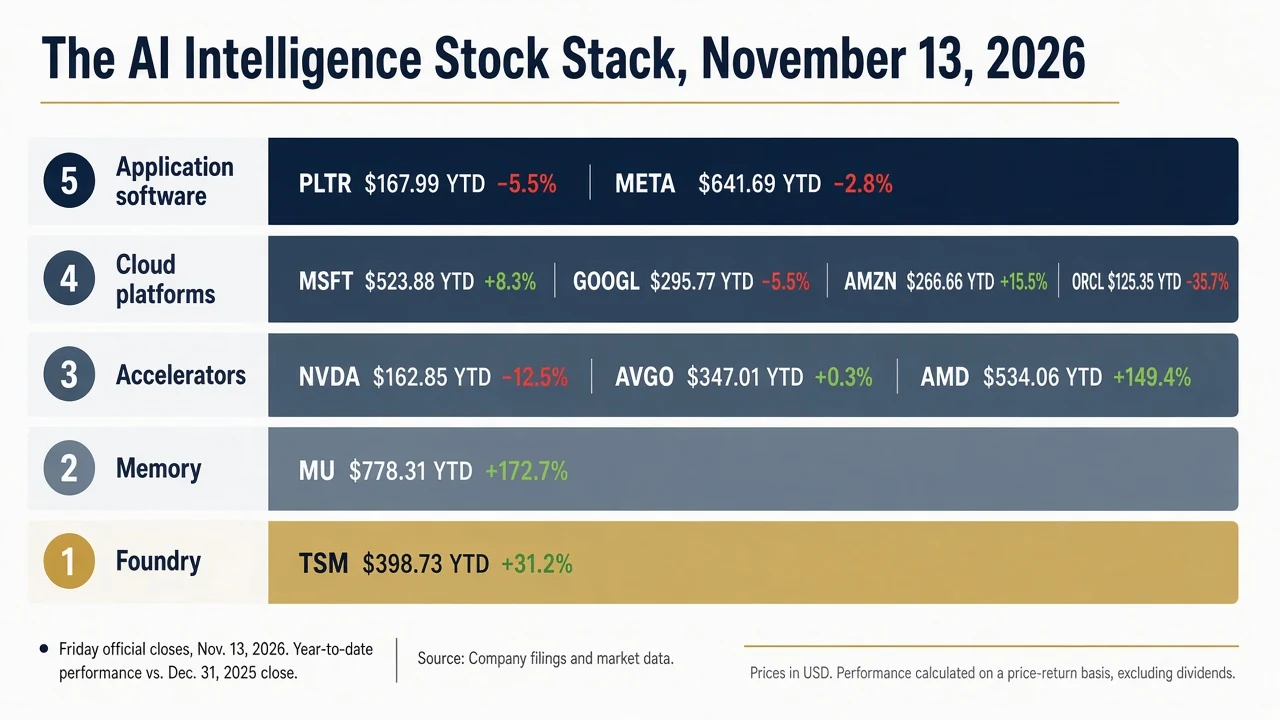
The AI intelligence stock stack as of the official November 13, 2026 close. Year-to-date figures are unadjusted price returns from December 31, 2025.
Valuation after the drawdown: cheap growth, expensive growth, and a damaged compounder
The useful question is not whether AI intelligence stocks are “cheap” as a group. They are not a group anymore.
NVIDIA’s trailing multiple has already compressed from 47.3 times at the January 31, 2026, quarter-end to 20.6 times on Friday, according to Yahoo Finance’s valuation table, even as trailing revenue reached $303 billion. StockAnalysis puts the forward multiple at 13.46, with a 61-analyst average target of $279.63, 71.7% above the close. That is the math of a franchise that is still growing quickly and has already been cut 33% from its high. It is not a promise that November 17 will be gentle, or that a 2.25 beta name sitting 20% below its 200-day average has finished falling.
Micron and, to a lesser extent, Oracle are the other compressed multiples, for different reasons. Micron’s 10.5 times trailing and 4.4 times forward earnings reflect an earnings spike that investors do not fully capitalize because memory cycles fade. Oracle’s 14.7 times forward earnings come after a 50% drawdown from the high; the $664 billion obligation book only matters if it converts on time and on cash. Broadcom sits in between: 44.3 times trailing earnings looks rich until the 19.9 times forward multiple and December 9 report are in view, and Friday’s 4.76% drop shows how quickly that gap can be debated.
The expensive side of the ledger is not hidden. AMD at 116 times trailing earnings and Palantir at 118 times are paying up for 45% and 96% revenue growth, respectively. Those can be the right stocks in a compounding cycle and still be the wrong stocks if the multiple is the entire thesis. Microsoft’s 27.4 times trailing and 25.2 times forward multiples are the quality premium for 48% Azure growth and $677 billion of commercial obligations; at 6% below the high, the shares have not been thrown out with NVIDIA.
Alphabet is the awkward hybrid. The trailing multiple of 15.4 looks like value among AI platforms, and the $400.37 average target is 35.4% above Friday’s close. The forward multiple of 21.5 is higher than the trailing figure, which is a reminder that last year’s net income included a large other-income contribution that did not repeat in the third quarter. Operating momentum and reported earnings are not the same snapshot.
After this drawdown, the valuation work is a sort, not a slogan: NVIDIA and Alphabet now price more like cash-generating platforms, Micron prices like a cycle, and AMD and Palantir still price like scarce growth.
What to watch next — and the risks that still cut both ways
The near-term calendar is short and unforgiving. NVIDIA reports on November 17. Broadcom follows on December 9, and Oracle is due around mid-December. Those three prints will test whether Friday’s semiconductor selloff was an overreaction to a leadership headline or the start of a wider reset in AI capital spending.
The risks are already visible in the documents. Customer concentration and export policy sit over NVIDIA’s franchise even when the product cycle is intact. The large cloud platforms are also exposed to a small number of frontier-model customers, even when the rest of the franchise looks diversified. Power, financing, and the conversion of remaining performance obligations — especially at Oracle — matter more now that the easy multiple expansion is gone. Memory’s earnings boom can reverse. AMD and Palantir can keep executing and still deliver poor holding-period returns if 100-times earnings is the starting point. A permanent NVIDIA CEO has not been named, and the board said it will consider internal and external candidates.
None of that argues for abandoning AI intelligence stocks as a category. It argues for holding them as a map: foundry and memory for the physical constraint, accelerators for the compute cycle, cloud platforms for contracted demand, and application software only when the price leaves room for error. The November 13 tape already told investors that those layers no longer move together.
FAQ
What are AI intelligence stocks?
AI intelligence stocks are the public companies that design, manufacture, power, host, or apply large-scale artificial intelligence. In late 2026 that stack includes foundry and memory suppliers such as TSMC and Micron, accelerator vendors such as NVIDIA, Broadcom, and AMD, cloud platforms such as Microsoft, Alphabet, Amazon, and Oracle, and application or advertising companies such as Palantir and Meta. It is a group of businesses with different economics, not a single ticker.
Why did AI intelligence stocks fall in November 2026?
The official November 13, 2026 session was only modestly lower for the indexes — the S&P 500 closed at 7,561.67, down 0.40%, and the Nasdaq Composite at 25,136.27, down 0.91% — but semiconductors were hit harder. NVIDIA fell 2.01% to $162.85, Broadcom 4.76% to $347.01, and AMD 8.75% to $534.06. That selling followed NVIDIA’s November 12 announcement that the board had accepted Jensen Huang’s resignation and appointed CFO Colette Kress as interim CEO, and it landed on a stock that had already dropped from an October 6 52-week high of $243.37.
Is NVIDIA still the core AI intelligence stock after the CEO change?
NVIDIA remains the largest pure accelerator franchise in the group, with a $3.93 trillion market cap, trailing twelve-month revenue of $303.0 billion, quarterly revenue growth of 105.9%, and a 65.2% operating margin. The official close of $162.85 is 33.1% below the $243.37 high and 12.5% below the December 31, 2025 close of $186.06. Interim CEO Colette Kress and the operating team are still in place, and fiscal third-quarter results are due November 17. The leadership change is a risk to underwrite, not an automatic reason to abandon the shares or to assume the selling is finished.
Which AI intelligence stocks look cheaper or more expensive now?
Valuation has split. NVIDIA trades at 20.59 times trailing earnings and 13.46 times forward earnings. Alphabet is at 15.44 times trailing earnings after a 27.6% drop from its high. Micron, up 172.7% this year, still trades at only 10.47 times trailing and 4.41 times forward earnings. Oracle, down 35.7% year to date, is at 19.65 times trailing and 14.68 times forward. The expensive names are AMD at 115.76 times trailing earnings after a 149.4% year-to-date gain, Palantir at 118.34 times trailing earnings, and Microsoft at 27.35 times trailing earnings, still close to its 52-week high.
What should investors watch next for AI intelligence stocks?
The next hard test is NVIDIA’s fiscal third-quarter report on Tuesday, November 17, after the close. Broadcom reports on December 9, and Oracle is due around mid-December. Investors will be watching guidance, customer concentration, export policy, gross margins, and whether remaining performance obligations at Microsoft ($677 billion) and Oracle ($664 billion as of August 31) convert on time. The technical levels on NVIDIA itself are the $148.80 November 12 low, the $204.19 200-day average, and the $214.65 50-day average.