1964 US Nickel Value Guide: Rare Errors and 'Full Steps' Worth Thousands
Founder of Tritonix.ai. Former Hedge Fund Analyst with 10+ years of experience managing over $1B AUM across insurance portfolios and private funds. Specializes in institutional-grade fundamental analysis and long-term capital allocation.
Evaluating the 1964 US Nickel Value: Circulated vs. Uncirculated
To understand the 1964 nickel’s potential, one must first confront its overwhelming ubiquity. With a combined mintage of 2,815,919,922 coins between Philadelphia and Denver, it remains the highest-mintage year in the entire Jefferson series. (Source: PCGS CoinFacts, Sept 2026).
This astronomical volume was a byproduct of the "Great Coin Shortage" of the mid-1960s. To discourage hoarding, the U.S. Mint implemented a "date freeze," striking 1964-dated nickels well into 1966. For investors, this means scarcity is non-existent at the base level; roughly one in every 100 nickels currently in circulation still bears this date.
The Silver Reality Check
A common misconception among novice collectors is that 1964 nickels contain silver, similar to the quarters and dimes of that year.
- Composition: 75% Copper, 25% Nickel.
- Silver Content: 0%.
- Intrinsic Value: Currently roughly $0.06 based on base metal melt value. (Source: NGC Melt Value, Sept 2026).
Critical Insight: Unless your coin is a "War Nickel" (1942–1945), which is identifiable by a large mint mark above the Monticello dome, it contains no precious metal. The 1964 nickel's value is derived entirely from conditional rarity.
Price Grading: From Face Value to Premium
For most 1964 nickels, the market value remains at $0.05. However, the "So What?" for readers lies in the jump from About Uncirculated (AU) to Mint State (MS) grades, where original luster and strike clarity begin to command a premium.
| Grade | Description | Estimated Value (Raw) |
|---|---|---|
| Circulated | Heavy wear, dull grey surface | $0.05 |
| AU50–AU58 | Trace wear on high points; some luster | $0.15 – $0.50 |
| MS63 | Uncirculated; minor bag marks | $1.00 – $3.00 |
| MS65 | Strong luster; few marks | $15.00 – $35.00 |
| MS66+ | Near-perfect strike; high-end luster | $100.00+ |
(Source: NGC & PCGS Price Guides, Sept 2026)
{
  "type": "bar",
  "title": "1964 Nickel Value Growth by Grade",
  "index": "grade",
  "categories": ["value_usd"],
  "data": [
    {"grade": "Circulated", "value_usd": 0.05},
    {"grade": "AU58", "value_usd": 0.50},
    {"grade": "MS63", "value_usd": 2.00},
    {"grade": "MS65", "value_usd": 25.00},
    {"grade": "MS66", "value_usd": 120.00}
  ],
  "source": "Source: PCGS & Heritage Auctions (Sept 2026)",
  "note": "Excludes 'Full Steps' and SMS varieties which command significantly higher premiums."
}
The threshold for high-stakes investing begins at MS65. While billion-coin mintages ensure plenty of survivors, the "rushed" nature of 1964 production means coins with clean surfaces and sharp details are statistically rare. (Source: Gainesville Coins Analysis, 2024).
Philadelphia vs. Denver Mint Mark Impact
While both mints produced over a billion coins to combat the 1960s coin shortage, the 1.78 billion output from Denver (D) significantly dwarfs Philadelphia’s 1.02 billion. In the numismatic world, volume is the enemy of value.
The 75% higher mintage in Denver led to rapid die deterioration. Consequently, finding a 1964-D with sharp, crisp details is mathematically more difficult than finding a comparable Philadelphia strike.
{
  "type": "bar",
  "title": "1964 Jefferson Nickel Mintage Comparison",
  "index": "Mint Location",
  "categories": ["Mintage (in Billions)"],
  "data": [
    {"Mint Location": "Philadelphia (No Mark)", "Mintage (in Billions)": 1.02},
    {"Mint Location": "Denver (D)", "Mintage (in Billions)": 1.78}
  ],
  "source": "Source: U.S. Mint Annual Report (1964/1965)",
  "note": "Combined production exceeded 2.8 billion units to suppress coin hoarding."
}
The Condition Rarity Divide
For the standard investor, the difference between a Philadelphia and Denver nickel at MS65 is negligible—often a matter of a few dollars. However, the spread widens at the MS66 and MS67 tiers.
- Philadelphia (No Mint Mark): Generally exhibits better luster. An MS67 specimen can command $150 to $300.
- Denver (D): Suffers from "mushy" strikes. An MS67 Denver nickel is a true rarity, often fetching $400+ at auction. (Source: PCGS Price Guide, Sept 2024).
| Feature | Philadelphia (1964) | Denver (1964-D) |
|---|---|---|
| Mint Mark Location | None (Plain) | Reverse, right of Monticello |
| Total Mintage | 1,024,672,000 | 1,787,297,160 |
| Strike Quality | Average to Sharp | Generally Poor/Weak |
| MS66 Value (Est.) | $40 - $60 | $30 - $50 |
| Full Steps (FS) Rarity | High | Extreme |
(Source: Heritage Auctions & NGC Census Data, 2024)
Investor Insight: Do not confuse volume with availability. While Denver produced more coins, it produced fewer high-grade coins. For a long-term hold, a 1964-D in MS66 or higher offers superior "condition rarity" compared to its Philadelphia counterpart.
The "So What?": If you are cherry-picking raw rolls, prioritize Denver coins with sharp horizontal lines on the Monticello steps. Because of the massive mintage and poor die maintenance, a well-struck Denver nickel is a statistical anomaly that carries a massive market premium.
The 'Full Steps' (FS) Designation: The Secret to 1964 Nickel Rarity
The 'Full Steps' (FS) designation is the single most important metric for valuing a 1964 Jefferson nickel. In the world of numismatics, it represents the difference between a common pocket-change filler and a $5,000+ investment-grade asset.
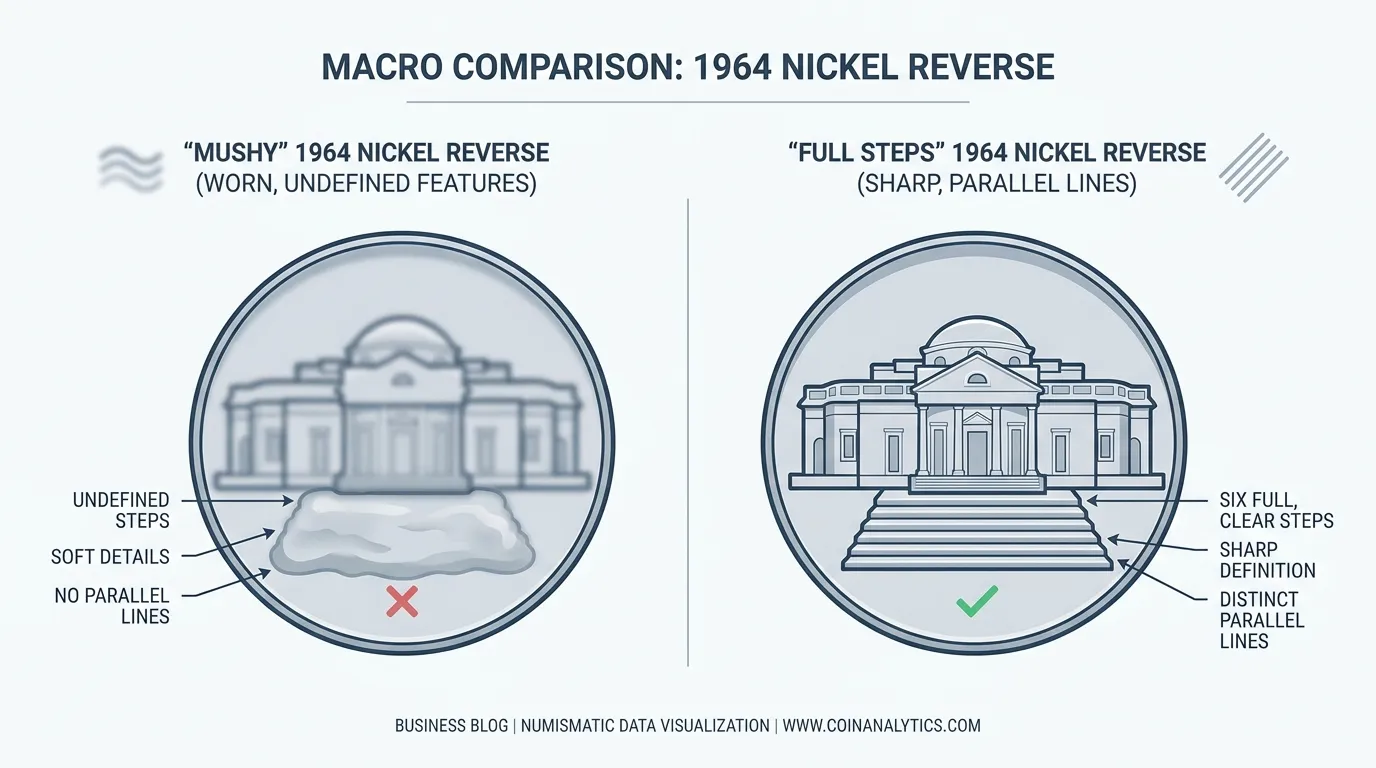
The rarity of the 1964 FS is a byproduct of history. To solve a national coin shortage, the U.S. Mint froze the 1964 date and ran dies long past their intended lifespan. The result was a "mushy" strike where the horizontal steps of Monticello—Jefferson's Virginia home—collapsed into a flat, featureless ramp. Finding crisp, distinct lines on these steps today is a statistical anomaly.
 Photo by Pixabay on Pexels
The FS Grading Criteria
To receive the Full Steps (FS) designation from PCGS or NGC, a coin must meet rigid strike requirements. This is not about wear; it is about metal flow and die pressure at the moment of creation.
- PCGS Standards: Requires at least five complete horizontal lines at the base of Monticello. Any bridge, nick, or contact mark that breaks a line disqualifies the coin.
- NGC Standards: Offers two tiers: 5FS (five steps) and 6FS (six steps). A 6FS 1964 nickel is the ultimate "Holy Grail," as the sixth step is almost always obliterated by die fatigue.
- The Threshold: The coin must also be in Mint State (MS60 or higher). A circulated coin with visible steps is rare but will never carry the "FS" price premium reserved for uncirculated specimens.
Market Value: The FS Multiplier
The financial impact of this designation is staggering. While a standard 1964-D nickel in MS65 grade might trade for under $20, the addition of the "FS" suffix acts as a valuation multiplier of 100x or more.
| Grade & Designation | 1964 (Philly) Value | 1964-D (Denver) Value | Rarity Factor |
|---|---|---|---|
| MS65 (No FS) | $10 - $15 | $12 - $20 | Common |
| MS65 FS | $150 - $450 | $350 - $800 | High |
| MS66 FS | $1,200 - $2,500 | $1,800 - $3,500 | Elite |
| MS67 FS | $14,100+ | $6,300+ | Statistical Miracle |
(Source: PCGS & Heritage Auctions, 2024-2026 Price Data)
{
  "type": "bar",
  "title": "1964 Nickel Value: The FS Premium",
  "index": "Grade",
  "categories": ["Standard Strike", "Full Steps (FS)"],
  "data": [
    {"Grade": "MS64", "Standard Strike": 5, "Full Steps (FS)": 65},
    {"Grade": "MS65", "Standard Strike": 15, "Full Steps (FS)": 550},
    {"Grade": "MS66", "Standard Strike": 45, "Full Steps (FS)": 2300},
    {"Grade": "MS67", "Standard Strike": 935, "Full Steps (FS)": 14100}
  ],
  "source": "Source: NGC & PCGS Price Guides (2026 Estimates)",
  "note": "Values reflect average auction realizations for Philadelphia strikes."
}
So What? If you are hunting through mint sets or rolls, ignore the luster and focus on the steps. A shiny coin with flat steps is worth five cents. A duller coin with five razor-sharp lines is a four-figure payday.
Why MS66 Full Steps Command a Premium
The market valuation for the 1964 nickel is defined by a binary outcome: a coin either possesses "Full Steps" (FS) or it is a common circulation strike. While the US Mint produced over 1 billion nickels in 1964, the quality of the dies was notoriously poor, resulting in a microscopic survival rate for sharply struck specimens.
The price disparity is driven by strike scarcity, not luster. In MS66, a standard 1964 nickel is a commodity; an MS66 FS is a "condition rarity."
The Price Gap: Strike vs. Surface
According to PCGS (Professional Coin Grading Service), a standard MS66 specimen displays clean surfaces but lacks the five or six clear horizontal lines at the base of Monticello. In contrast, the FS designation requires zero interruptions in these lines, a feat nearly impossible given the distended dies used in 1964.
| Grade | Standard Strike Price | Full Steps (FS) Price | Value Multiplier |
|---|---|---|---|
| MS64 | $10 | $150 | 15x |
| MS65 | $15 | $450 | 30x |
| MS66 | $25 | $1,250+ | 50x |
| MS67 | $950 | $14,000+ | 14.7x |
(Source: PCGS Price Guide & Heritage Auctions, Sept 2024)
{
  "type": "bar",
  "title": "1964 Nickel: Value Premium for Full Steps (MS66)",
  "index": "Strike Type",
  "categories": ["Market Value ($)"],
  "data": [
    {"Strike Type": "Standard MS66", "Market Value ($)": 25},
    {"Strike Type": "Full Steps MS66", "Market Value ($)": 1250}
  ],
  "source": "Source: PCGS & Heritage Auctions (2024)",
  "note": "The 50x premium is a direct result of the extreme scarcity of Full Step dies in 1964."
}
Why the Premium Persists
The 1964-P is widely considered one of the hardest dates in the Jefferson series to find with Full Steps. Most dies were used far beyond their intended lifespan to meet massive demand, leaving the reverse of the coin "mushy."
- Population Density: The PCGS census shows thousands of MS66 non-FS coins, but fewer than 50 examples with the FS designation.
- Registry Set Demand: Elite collectors competing for the #1 "Jefferson Nickel Registry Set" must have the FS strike to maximize their score.
- Liquidity Risk: While a standard MS66 is easy to sell at $20, an MS66 FS is an illiquid trophy asset that typically requires a major auction house (e.g., Heritage or GreatCollections) to realize its full 4-figure potential.
Investor Insight: Buying a standard MS66 is a bet on inflation. Buying an MS66 FS is a bet on the permanent scarcity of mid-century industrial quality control.
 AI Generated Infographic
High-Value 1964 US Nickel Errors to Look For
While the 1964 nickel's mintage exceeded 1.7 billion units, the extreme pressure to meet demand led to significant die fatigue and production errors that now command massive premiums. For the investor-collector, the "treasure" lies in microscopic anomalies created by compromised dies.
The 1964-D/D Repunched Mint Mark (RPM) FS-501
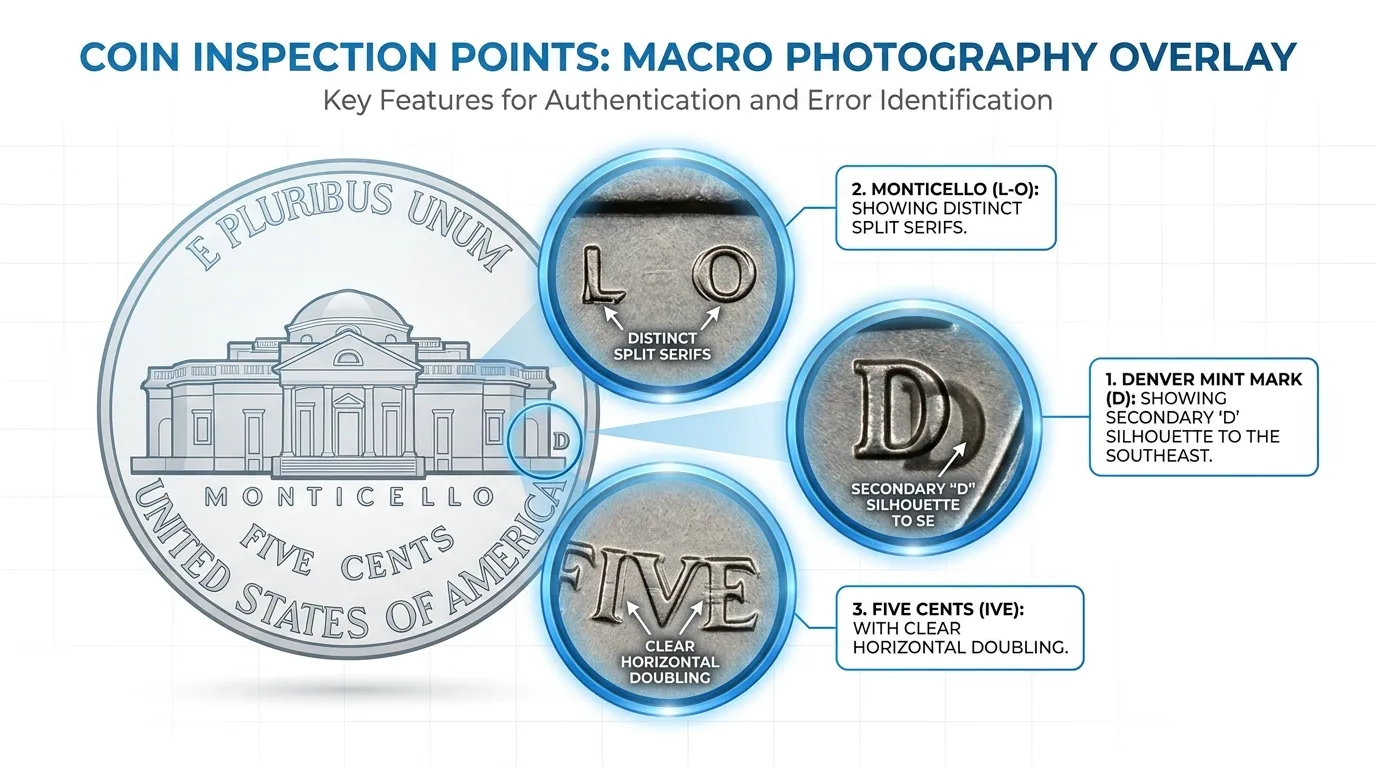
The 1964-D/D FS-501 is the undisputed king of business-strike errors for this year. This variety occurs when the "D" mint mark was punched into the die twice, with the secondary impression clearly visible to the south/southeast of the primary mark.
- Visual Cue: Look for a clear "shelf" or secondary curve at the bottom of the "D" using a 10x loupe.
- The "So What?": While a standard 1964-D is worth five cents, an MS66 FS-501 specimen realized $19,800 at Heritage Auctions in July 2022 (Source: Heritage Auctions).
1964 Doubled Die Reverse (DDR)
While most prominent on proof strikes (often cataloged as the FS-801 Tripled Die), business-strike DDRs are rare finds. Doubling is most evident in the lettering of "MONTICELLO" and "FIVE CENTS."
- Visual Cue: Check for "split serifs"—notches at the corners of the letters—rather than the flat, shelf-like appearance of common "machine doubling."
- Investment Grade: A high-grade PR67 (Proof) Tripled Die Reverse can fetch approximately $855, while elusive Mint State business strikes can easily break the $1,000 threshold if they carry the "Full Steps" designation (Source: PCGS, Sept 2024).
 AI Generated Infographic
| Error Type | Grade | Recent Market Value | Auction Record / Source |
|---|---|---|---|
| 1964-D/D RPM (FS-501) | MS66 | $19,800 | Heritage Auctions (July 2022) |
| 1964-D/D RPM (FS-501) | MS65 | $4,140 | PCGS Price Guide (Sept 2024) |
| 1964 DDR (Proof) | PR67 | $855 | GreatCollections (July 2021) |
| 1964-D/D RPM (FS-501) | AU58 | $85 - $110 | Average Dealer Ask (2024) |
(Source: PCGS, Heritage Auctions, Variety Vista)
{
  "type": "line",
  "title": "Value Escalation: 1964-D/D RPM (FS-501) by Grade",
  "index": "grade",
  "categories": ["Market Value (USD)"],
  "data": [
    {"grade": "AU58", "Market Value (USD)": 87},
    {"grade": "MS62", "Market Value (USD)": 150},
    {"grade": "MS64", "Market Value (USD)": 730},
    {"grade": "MS65", "Market Value (USD)": 4140},
    {"grade": "MS66", "Market Value (USD)": 19800}
  ],
  "source": "Source: PCGS Price Guide & Heritage Auctions (2022-2024)",
  "note": "The exponential jump at MS65+ reflects the extreme scarcity of high-grade error survival."
}
Expert Alert: Do not confuse Machine Doubling (caused by a loose die vibrating during strike) with a true Doubled Die. Machine doubling looks flat and "smeared," adding zero value. True hub doubling shows clear, distinct separation of the design elements.
Identifying the 1964-D Repunched Mint Mark (RPM)
While the 1964-D Jefferson Nickel is the most common date in the series with over 1.78 billion strikes, the Repunched Mint Mark (RPM) variety transforms a high-volume commodity into a targeted numismatic asset. Unlike Doubled Dies, which occur during the hubbing process, an RPM happens when the letter punch leaves two or more distinct impressions on the working die.
For the 1964-D, the most coveted varieties are the FS-501 (D/D North) and FS-502 (D/D West). Identifying these requires a disciplined three-point inspection:
- Primary Serif Separation: Use a 10x or 20x loupe to inspect the top and bottom serifs of the "D." You are looking for a clear "split" or "notching" rather than a blurred edge.
- Vertical Bar Doubling: Look for a secondary vertical line either to the left (West) or slightly above (North) the primary mint mark.
- Internal Loop Integrity: In premium RPMs, the "D" opening will often show a distinct secondary curve inside the main loop.
 Photo by Nic Wood on Pexels
Market Value: Common Strike vs. RPM Variety
The "So What?" for investors lies in the valuation delta. While a standard 1964-D is worth face value in circulated grades, a certified RPM commands a significant premium even at the mid-state level.
| Grade (MS) | Standard 1964-D Value | 1964-D RPM (FS-501/502) | Premium Multiplier |
|---|---|---|---|
| MS64 | $1.00 | $35.00 | 35x |
| MS65 | $15.00 | $115.00 | 7.6x |
| MS66 | $40.00 | $450.00+ | 11.2x |
(Source: PCGS Price Guide & Heritage Auctions, Sept 2024)
The "So What?" for Your Portfolio
For the high-frequency cherrypicker, the 1964-D RPM represents an asymmetric return profile. Because the 1964-D is often dismissed as "junk" by casual collectors, these varieties frequently hide in unsearched original bank-wrapped rolls.
Expert Insight: Focus exclusively on Redbook-listed varieties (like FS-501). While minor RPMs exist, only those recognized by major grading services (PCGS/NGC) carry the liquidity necessary for a rapid exit at a premium price.
{
  "type": "bar",
  "title": "Value Comparison: Standard 1964-D vs. RPM FS-501",
  "index": "Grade",
  "categories": ["Standard ($)", "RPM Variety ($)"],
  "data": [
    {"Grade": "MS63", "Standard ($)": 0.05, "RPM Variety ($)": 20},
    {"Grade": "MS64", "Standard ($)": 1, "RPM Variety ($)": 35},
    {"Grade": "MS65", "Standard ($)": 15, "RPM Variety ($)": 115},
    {"Grade": "MS66", "Standard ($)": 40, "RPM Variety ($)": 450}
  ],
  "source": "Source: PCGS & Variety Vista (2024)",
  "note": "RPM varieties maintain a value floor even when the spot price of base metals fluctuates."
}
The 1964 Special Mint Set (SMS) Mystery
While standard 1964 nickels are common commodities, the Special Mint Set (SMS) variant is the market's ultimate "black swan." These coins were never intended for public release, surfacing only in 1993 through the estate of former Mint Director Eva Adams.
Numismatists classify these as Specimen (SP) strikes, likely produced as high-quality trials for the transition to the 1965-1967 SMS era. With an estimated population of only 20 to 50 examples extant, they represent the absolute ceiling of the 1964 US nickel value.
Distinguishing the SMS from Circulation Strikes
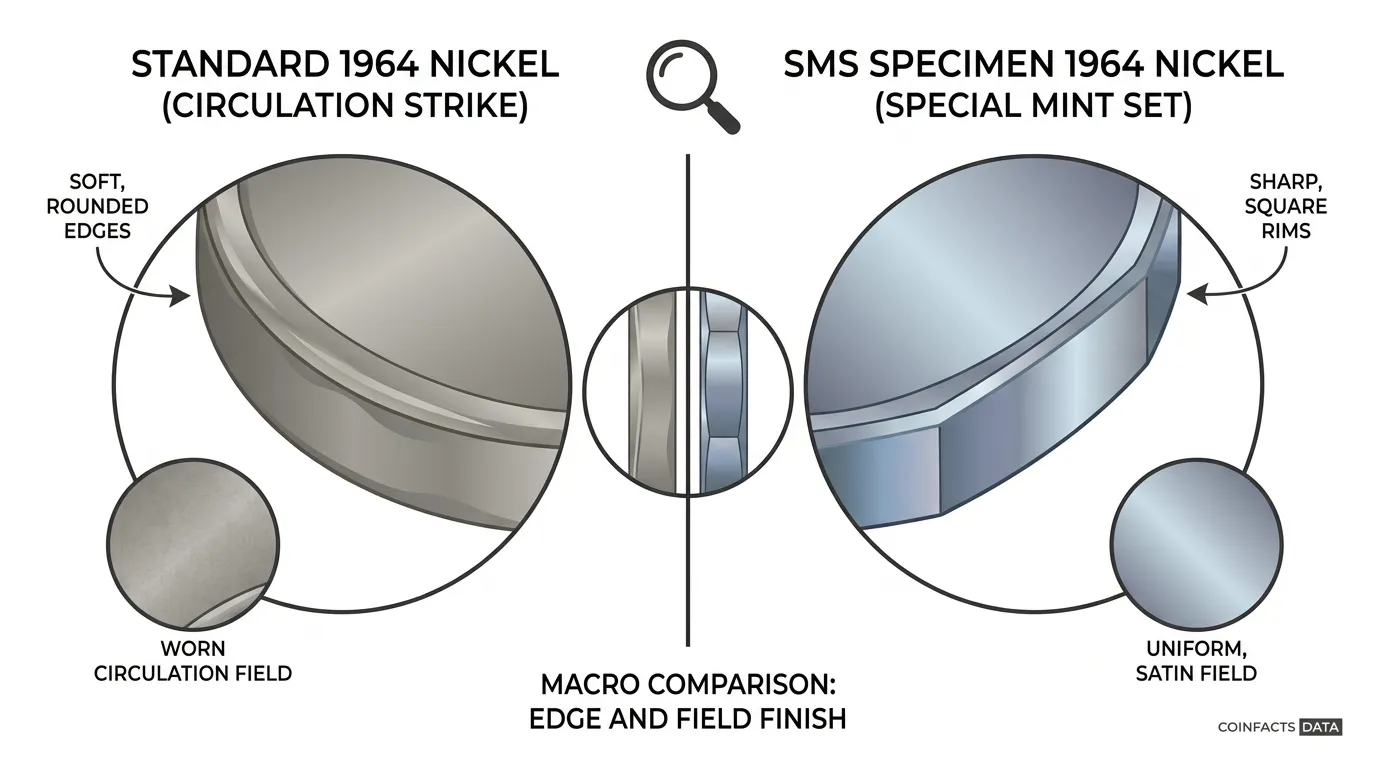
Identifying an SMS nickel requires a professional eye. Unlike the "mushy" details of high-mintage Philadelphia strikes, SMS nickels exhibit:
- Satin Finish: A smooth, non-reflective luster that lacks the mirror-like finish of a Proof coin.
- Razor-Sharp Rims: Perfectly square, upright edges that result from high-pressure experimental striking.
- Die Striations: Fine, horizontal polishing lines in the fields, a hallmark of specially prepared dies.
 AI Generated Infographic
Auction Performance & Market Value
The 1964 SMS nickel is a trophy asset. Its value is decoupled from the base metal or standard collector market, behaving more like a rare piece of fine art. The inclusion of the "Full Steps" (FS) designation on an SMS coin can push the premium into the mid-five-figure range.
| Grade | Designation | Realized Price | Auction House | Date |
|---|---|---|---|---|
| SP68 | Full Steps | $32,900 | Heritage Auctions | Jan 2016 |
| SP68 | Full Steps | $31,200 | Stack's Bowers | Aug 2021 |
| SP67 | Standard | $14,100 | Heritage Auctions | Sep 2014 |
| SP67 | Standard | $6,463 | Heritage Auctions | Jan 2010 |
(Source: PCGS & Heritage Auctions, 2024)
{
  "type": "line",
  "title": "Value Appreciation: 1964 SMS Nickel (SP68 FS)",
  "index": "Year",
  "categories": ["Auction Price ($)"],
  "data": [
    {"Year": "2009", "Auction Price ($)": 8625},
    {"Year": "2016", "Auction Price ($)": 32900},
    {"Year": "2021", "Auction Price ($)": 31200},
    {"Year": "2024 (Est.)", "Auction Price ($)": 35000}
  ],
  "source": "Source: Heritage Auctions & Stack's Bowers Records (2009-2024)",
  "note": "Valuations for SP68 FS are highly illiquid due to extreme rarity; prices reflect outlier collector demand."
}
The "So What?" for Investors
For the average collector, the 1964 SMS is a lottery ticket. The likelihood of finding one in a "junk silver" bin is near zero, as almost all known examples trace back to a single 1993 auction. However, for high-net-worth numismatists, these coins offer a low-correlation hedge; their value is driven by historical enigma and extreme scarcity rather than broader economic shifts.
Crucial Tip: Never buy a "raw" 1964 nickel claimed to be SMS. Only coins authenticated and encapsulated by PCGS or NGC carry the SP/SMS premium. (Source: PCGS CoinFacts, 2024).
How to Properly Grade and Sell Your 1964 Nickels
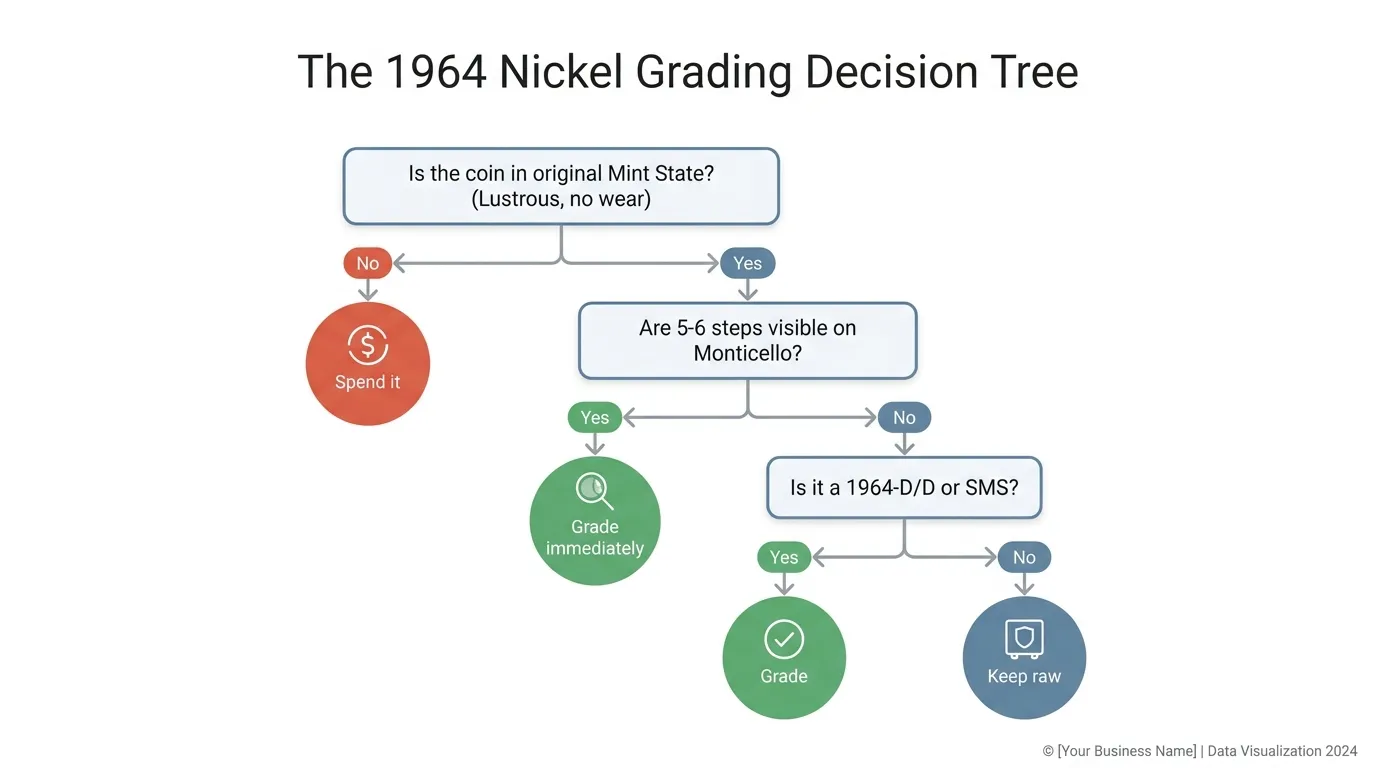
The decision to pay for professional grading (PCGS or NGC) is a pure capital allocation play. With over 2.8 billion 1964 nickels struck, the vast majority are "pocket change" with zero premium. To justify the ~$50–$100 all-in cost of grading (membership, tier fees, and insured shipping), your coin must realistically project a market value exceeding $150.
The Grading ROI Threshold
Professional grading is only rational if the coin hits "Condition Rarity" or "Variety" status. For the 1964 issue, this is a narrow window. Most "uncirculated" rolls found today grade MS63 to MS64, which trade for less than the cost of the plastic holder they are in.
| Condition/Feature | Estimated Value (Raw) | Grading Decision | Logic/ROI |
|---|---|---|---|
| Circulated | $0.05 – $0.20 | Hard No | Net loss of $50+ per coin. |
| MS60 – MS65 (Common) | $1.00 – $15.00 | No | Grading fees exceed coin value. |
| MS66+ (Brilliant) | $30.00 – $80.00 | Marginal | Only if part of a bulk submission. |
| Full Steps (FS) MS65+ | $150.00 – $5,000+ | Strong Yes | Mandatory for liquidity and premium. |
| 1964 SMS or D/D Error | $500.00 – $20,000+ | Mandatory | Required for authentication. |
(Source: NGC/PCGS Price Guides, Sept 2024)
 AI Generated Infographic
Strategic Selling: Liquidity vs. Premium
Once graded, your exit strategy depends on the final tier of rarity. High-value assets require different venues than mid-tier collectibles.
- Top-Pop & SMS ($1,000+): Consign to Heritage Auctions or Stack’s Bowers. These venues attract institutional collectors and high-net-worth individuals who pay "moon money" for Registry Set-quality coins.
- Mid-Tier MS66/FS ($100–$1,000): Use eBay or GreatCollections. These platforms offer the highest liquidity and transparent bidding for the "working class" of rare nickels.
- Raw Varieties: Never sell a "potential" 1964-D/D or SMS raw. The market discounts unverified rarities by 60–80% due to the high risk of environmental damage or misattribution.
{
  "type": "bar",
  "title": "Grading Cost vs. 1964 Nickel Market Value",
  "index": "Grade",
  "categories": ["Market Value", "All-in Grading Cost"],
  "data": [
    {"Grade": "MS64", "Market Value": 15, "All-in Grading Cost": 65},
    {"Grade": "MS65", "Market Value": 25, "All-in Grading Cost": 65},
    {"Grade": "MS66", "Market Value": 80, "All-in Grading Cost": 65},
    {"Grade": "MS65 FS", "Market Value": 180, "All-in Grading Cost": 65},
    {"Grade": "MS67 FS", "Market Value": 5250, "All-in Grading Cost": 125}
  ],
  "source": "Source: PCGS CoinFacts & NGC Price Guide (Sept 2024)",
  "note": "Grading cost includes $25 economy fee plus estimated $40 for shipping/insurance/handling."
}
Expert Insight: Before submitting, use a 10x loupe to inspect the "Steps." If there is a single bridge (scratch or hit) connecting two steps, it will fail the Full Steps (FS) designation, potentially dropping the value from $5,000 to $50 instantly. (Source: PCGS Grading Standards, 2024).
Best Platforms for Selling Rare 1964 Nickels
The strategic decision of where to liquidate a 1964 nickel depends entirely on its certified grade. For a common-strike MS63 coin worth $15, a high-end auction is a net loss; for a 1964 SMS (Special Mint Set) specimen, eBay is a dangerous undervaluation of the asset's liquidity.
The Liquidity-to-Value Matrix
Selling in the numismatic market requires matching the platform’s audience sophistication with the coin's rarity.
| Platform | Best For | Typical Fees | Time to Cash |
|---|---|---|---|
| eBay | Raw coins, MS64 or lower | ~13.25% + $0.30 | 3–7 Days |
| GreatCollections | MS65+ and FS certified | 0–5% Seller / 10% Buyer | 2–4 Weeks |
| Heritage Auctions | SMS Varieties / $5,000+ lots | Negotiable / 20% Buyer | 3–6 Months |
| Stack's Bowers | Elite Registry Sets | Negotiable / 20% Buyer | 3–6 Months |
(Source: PCGS Marketplace Research & Auction House Fee Schedules, 2024)
1. eBay: The Retail Volume Play
eBay remains the primary venue for raw (unslabbed) 1964 nickels or those with minor errors. Its strength lies in sheer volume and immediate liquidity. However, for "Full Steps" (FS) nickels, the "retail" nature of eBay often fails to trigger the bidding wars seen at specialized houses.
- Insight: Use eBay only for assets valued under $500. Above this threshold, the risk of "buyer's remorse" returns and the lack of an institutional audience can lead to a 20-30% "liquidity discount" compared to professional venues.
2. Specialized Auctions: The Premium Realization
For 1964 SMS nickels or MS67 Full Steps specimens, Heritage Auctions and GreatCollections are mandatory. These platforms provide professional photography and access to "Registry Set" collectors who are willing to pay irrational premiums to complete their collections.
{
  "type": "bar",
  "title": "Avg. Price Realization: MS66 Full Steps Nickel",
  "index": "Platform",
  "categories": ["Net Seller Proceeds"],
  "data": [
    {"Platform": "eBay (Retail)", "Net Seller Proceeds": 420},
    {"Platform": "GreatCollections", "Net Seller Proceeds": 585},
    {"Platform": "Major Auction House", "Net Seller Proceeds": 610}
  ],
  "source": "Source: Heritage Auctions & eBay Sold Listings (2023-2024)",
  "note": "Net proceeds after estimated commissions and shipping. High-grade rarities show wider variance."
}
So What? If your 1964 nickel has 5+ clear steps and a "special" finish, do not list it yourself. Consigning to a specialist like GreatCollections significantly reduces your liability and ensures the coin is seen by the 1% of collectors who actually drive the five-figure prices.
Maximizing returns on niche numismatic assets requires constant monitoring of auction trends and institutional buyer appetite. For those managing a broader portfolio of high-conviction assets beyond collectibles, professional-grade market research is essential. Stay ahead of market shifts with Tritonix.ai.
FAQ
Does a 1964 nickel contain silver?
No, 1964 nickels are composed of 75% copper and 25% nickel. Only 'War Nickels' (1942–1945) contain silver; the 1964 issue is a base metal coin.
What is the 1964 US nickel value for circulated coins?
Most circulated 1964 nickels are only worth their face value of $0.05 because over 2.8 billion were minted.
How much is a 1964 nickel with Full Steps worth?
A 1964 nickel with the 'Full Steps' (FS) designation is very rare. Values range from $150 in MS65 to over $14,000 for an MS67 specimen.
What is the rarest 1964 nickel error to look for?
The 1964-D/D Repunched Mint Mark (FS-501) is the most coveted error; a high-grade MS66 specimen sold for $19,800 at auction.
How can I identify a 1964 Special Mint Set (SMS) nickel?
SMS nickels feature a satin finish, razor-sharp rims, and fine die striations. They are extremely rare and should be authenticated by PCGS or NGC.