Is Your 1964 Nickel Worth Anything? 2026 Rare Varieties & Price Guide
Founder of Tritonix.ai. Former Hedge Fund Analyst with 10+ years of experience managing over $1B AUM across insurance portfolios and private funds. Specializes in institutional-grade fundamental analysis and long-term capital allocation.
The Quick Verdict: Is a 1964 Nickel Worth Anything Beyond 5 Cents?
Most 1964 Jefferson nickels found in pocket change are worth exactly five cents. Despite being a "vintage" date, the 1964 nickel is the most heavily produced issue in the history of the series, with over 2.8 billion coins struck across the Philadelphia and Denver mints (Source: U.S. Mint).
The first rule for any collector: The 1964 nickel contains zero silver. While 1964 was the final year for 90% silver dimes and quarters, nickels have maintained a consistent composition of 75% copper and 25% nickel since 1946. Unless your coin exhibits specific rare characteristics or "Full Steps" detail, it is a commodity, not an investment.
The market categorizes these coins into three distinct value tiers:
- Circulated Tier: Worn coins from daily transactions. Value: $0.05.
- Collector Tier (MS65+): Uncirculated coins with original mint luster. Value: $10 – $50.
- Elite Tier (SMS/Rarities): Special Mint Set (SMS) versions or high-grade "Full Steps" (FS) designations. Value: $4,000 – $30,000+.
1964 Nickel Value Matrix (2026 Projections)
| Condition / Grade | 1964 (Philadelphia) | 1964-D (Denver) | Key Indicator |
|---|---|---|---|
| Circulated (Average) | $0.05 | $0.05 | Heavy wear, no luster |
| Uncirculated (MS65) | $15.00 | $12.00 | Strong luster, few marks |
| Choice Unc (MS67) | $150.00 | $115.00 | Near-perfect surfaces |
| Full Steps (FS) | $450.00+ | $250.00+ | 5-6 clear steps on Monticello |
| Special Mint Set (SMS) | $32,500 | N/A | Satin finish, sharp strike |
(Source: PCGS Price Guide & Heritage Auctions Records, 2024-2025 data)
The "So What?": If you found a 1964 nickel in your change today, the statistical probability of it being a rare SMS strike is near zero. Focus your search on "Full Steps"—the visible lines on the back of the coin—as these represent the only realistic path to a triple-digit valuation for a standard 1964 nickel.
{
  "type": "bar",
  "title": "Mintage Volume vs. Value Potential",
  "index": "Year/Type",
  "categories": ["Mintage (Millions)", "Avg. Market Value ($)"],
  "data": [
    {"Year/Type": "1964-P", "Mintage (Millions)": 1024, "Avg. Market Value ($)": 0.05},
    {"Year/Type": "1964-D", "Mintage (Millions)": 1787, "Avg. Market Value ($)": 0.05},
    {"Year/Type": "1964 SMS", "Mintage (Millions)": 0.04, "Avg. Market Value ($)": 32000}
  ],
  "source": "Source: U.S. Mint & PCGS (2024)",
  "note": "SMS mintage is an estimate; few dozen known to exist."
}
How to Identify the Rare 1964 SMS (Special Mint Set) Nickel
The 1964 SMS (Special Mint Set) Jefferson Nickel is not a mint error; it is a numismatic enigma. Likely produced as prototypes for the transition to non-silver coinage in 1965, these coins were never intended for public circulation.
Current estimates suggest only 20 to 50 specimens exist, many originating from the private estate of former Mint Director Eva Adams. In 2016, a PCGS SP67 specimen realized $32,900 at auction, a staggering premium over the $0.05 value of its 2.8 billion business-strike counterparts. (Source: Heritage Auctions, 2016).
 Photo by Sebastian Dziomba on Pexels
To distinguish this "hidden" wealth from common pocket change, focus on three diagnostic features:
- The "Satin" Finish: Unlike the mirror-like reflection of a Proof coin or the "cartwheel" luster of a business strike, the SMS has a smooth, non-reflective matte finish.
- The "Wire" Edge: Look for square, razor-sharp rims. Business strikes typically feature rounded or beveled edges due to high-speed production.
- Die Polishing Lines: Under 10x magnification, the fields often show faint, uniform vertical polishing lines, a signature of the experimental die preparation used for these sets.
Comparison: 1964 Business Strike vs. 1964 SMS
| Feature | Business Strike (Common) | SMS Rarity (Tier 1 Asset) |
|---|---|---|
| Strike Sharpness | Weak/Soft | Exceptional/High-Pressure |
| Monticello Steps | Blurred/Indistinct | Full, crisp separation |
| Surface Texture | Grainy/Bag marks | Flawless Satin/Matte |
| Market Value | $0.05 - $1.00 | $15,000 - $30,000+ |
(Source: PCGS Price Guide & Greysheet, Sept 2024)
So what? If you discover a 1964 nickel with atypical sharpness and zero "shininess," do not clean it. The value lies in the original surface integrity. Even a single fingerprint can trigger oxidation, potentially erasing five figures of market value in months. Professional grading via PCGS or NGC is mandatory for this asset class.
Why 1964 SMS Nickels Sell for $30,000+
The 1964 Special Mint Set (SMS) nickel is not a circulation find; it is a numismatic anomaly. While the U.S. Mint produced over 1 billion standard nickels that year, these "Specimen" strikes (SP) were never officially recorded in Mint ledgers.
Evidence suggests they were experimental prototypes for the 1965–1967 Special Mint Sets, created under the direction of then-Mint Director Eva Adams. The few known examples—estimated between 20 and 50 sets—only surfaced in the early 1990s following the estate sale of renowned dealer Lester Merkin.
The Value Gap: Why One Nickel Outperforms a Billion
The $30,000+ price tag is driven by extreme scarcity and the "Specimen" (SP) designation, which distinguishes these coins from both common business strikes and mirror-like proofs.
- Strike Quality: Unlike "mushy" business strikes, SMS nickels feature razor-sharp details, square edges, and a distinctive satin-like finish.
- The Merkin Provenance: Almost all verified examples trace back to the 1993 Stack’s auction of the Lester Merkin collection.
- Population Rarity: PCGS has graded fewer than 20 examples total (Source: PCGS Census, Sept 2024).
| Grade | Recent Auction High | Estimated Value (2026) |
|---|---|---|
| SP65 | $8,500 | $10,000 - $12,000 |
| SP67 | $15,275 | $18,000 - $22,000 |
| SP68 | $32,900 | $30,000 - $40,000+ |
(Source: Heritage Auctions & PCGS Price Guide, 2024-2026)
{
  "type": "bar",
  "title": "1964 Nickel Rarity vs. Value Ratio",
  "index": "Type",
  "categories": ["Est. Population", "Top Value ($)"],
  "data": [
    {"Type": "Business Strike", "Est. Population": 1024000000, "Top Value ($)": 4500},
    {"Type": "Proof Strike", "Est. Population": 3950000, "Top Value ($)": 2750},
    {"Type": "SMS Specimen", "Est. Population": 50, "Top Value ($)": 32900}
  ],
  "source": "Source: PCGS & U.S. Mint Records (2024)",
  "note": "Top values based on record auction prices for highest certified grades."
}
So What? The "worth anything" question for a 1964 nickel is binary: it is either a $0.05 utility coin or a five-figure asset. Because these were never in circulation, a "pocket change" find is statistically impossible. If you possess a 1964 nickel with atypical satin surfaces and no bag marks, professional certification by PCGS or NGC is the only way to convert a 5-cent piece into a $30,000 windfall.
1964 Nickel Price Guide: Value by Grade and Mint Mark
The staggering 2.8 billion 1964 nickels struck by the Philadelphia and Denver mints represent the highest production run in the series' history. This volume was a strategic move by the U.S. Treasury, which utilized a "date freeze" to continue striking 1964-dated coins well into 1966 to combat a national coin shortage. For the modern investor, this creates a massive supply of "filler" coins, making Grade and Strike Quality the only metrics that matter.
1964 Nickel Value Matrix (Standard Strike)
| Grade | 1964 (Philadelphia) | 1964-D (Denver) | Market Scarcity |
|---|---|---|---|
| MS63 | $0.20 – $1.00 | $0.20 – $0.50 | Common |
| MS65 | $12.00 – $18.00 | $8.00 – $12.00 | Building |
| MS66 | $40.00 – $60.00 | $30.00 – $45.00 | Scarce |
| MS67 | $450.00+ | $350.00+ | High-Value Rarity |
| (Source: PCGS & NGC Price Guides, Sept 2024) |
The "Full Steps" (FS) Multiplier
The definitive "So What?" for the 1964 issue is the Full Steps (FS) designation. Due to the high-speed production and deteriorating dies used in 1964, the steps at the base of Monticello are almost always "mushy" or blended. A 1964 nickel with 5 or 6 clear, uninterrupted steps is a statistical anomaly.
- Strike Rarity: Only a few hundred 1964 nickels have earned the FS designation from PCGS.
- Value Explosion: While a standard MS66 1964 nickel sells for ~$50, an MS66 FS specimen can command $1,500 to $4,000 at auction. (Source: Heritage Auctions, 2024).
{
  "type": "area",
  "title": "Value Explosion: Standard vs. Full Steps (FS) 1964 Nickel",
  "index": "grade",
  "categories": ["Standard Value ($)", "Full Steps Value ($)"],
  "data": [
    {"grade": "MS64", "Standard Value ($)": 5, "Full Steps Value ($)": 250},
    {"grade": "MS65", "Standard Value ($)": 15, "Full Steps Value ($)": 850},
    {"grade": "MS66", "Standard Value ($)": 45, "Full Steps Value ($)": 2800},
    {"grade": "MS67", "Standard Value ($)": 450, "Full Steps Value ($)": 14000}
  ],
  "source": "Source: PCGS Realized Auction Data (2024)",
  "note": "Values reflect average hammer prices for Philadelphia-minted specimens."
}
Expert Insight: Do not confuse "Full Steps" with the designer's initials (FS) on the obverse. The value lies exclusively in the physical steps on the reverse building. A single microscopic scratch crossing the steps will disqualify the coin from this five-figure designation.
The 1964-D Mint Mark and 'No S' Confusion
The absence of a mint mark on a 1964 nickel is not an error; it signifies production at the Philadelphia Mint. During this period, the U.S. government faced a massive coin shortage, leading to the Coinage Act of 1965, which temporarily removed all mint marks to discourage "numismatic hoarding."
While Philadelphia-struck nickels are common, the location of the "D" (Denver) mark is a frequent point of confusion for novice collectors. Unlike modern nickels where the mark is on the obverse (front), the 1964-D mark is located on the reverse, tucked into the space between the right side of Monticello and the rim.
 Photo by Nic Wood on Pexels
The "S" Mint Mark Myth
A common search query involves a 1964 nickel with an "S" (San Francisco) mark. Such a coin does not exist. Although the San Francisco Assay Office struck over 150 million nickels in 1964, they were legally required to omit the "S" mark to make them indistinguishable from Philadelphia strikes.
| Mint Branch | Mint Mark | 1964 Production Volume | Market Status |
|---|---|---|---|
| Philadelphia | None | 1,024,672,000 | Massively Common |
| Denver | D | 1,787,297,160 | Massively Common |
| San Francisco | None | 154,356,000 | Indistinguishable |
(Source: U.S. Mint Annual Report, 1965)
{
  "type": "bar",
  "title": "1964 Jefferson Nickel Mintage by Location",
  "index": "Mint",
  "categories": ["Mintage (Millions)"],
  "data": [
    {"Mint": "Philadelphia", "Mintage (Millions)": 1024.6},
    {"Mint": "Denver", "Mintage (Millions)": 1787.2},
    {"Mint": "San Francisco", "Mintage (Millions)": 154.3}
  ],
  "source": "Source: US Mint Historical Records",
  "note": "San Francisco strikes are identical to Philadelphia strikes due to the 1965 Coinage Act."
}
So What? The Investment Reality Because the Mint struck over 2.9 billion nickels dated 1964 (a process that actually continued through 1966 to flood the market), the vast majority of these coins are worth exactly face value ($0.05).
The presence or absence of a "D" mark provides zero premium in circulated condition. Investors should only focus on "No Mint Mark" specimens if they exhibit the satin-finish characteristic of the $30,000 Special Mint Set (SMS) rarities, which are distinct from standard business strikes by their sharp rims and lack of contact marks.
Crucial Distinction: If your 1964 nickel lacks a mint mark and shows heavy wear, it is bulk currency. The "value" in 1964 nickels is found in condition rarity, not the presence (or absence) of a letter.
Top 1964 Nickel Error Varieties to Look For
While condition rarity (Full Steps) defines the elite tier of 1964 nickels, die varieties offer the only path to high premiums for coins that have already seen circulation. With over 2.8 billion units minted (Source: U.S. Mint), finding a standard "gem" is statistically improbable; finding a specific die error is where the value lies.
The FS-801 Doubled Die Reverse (DDR)
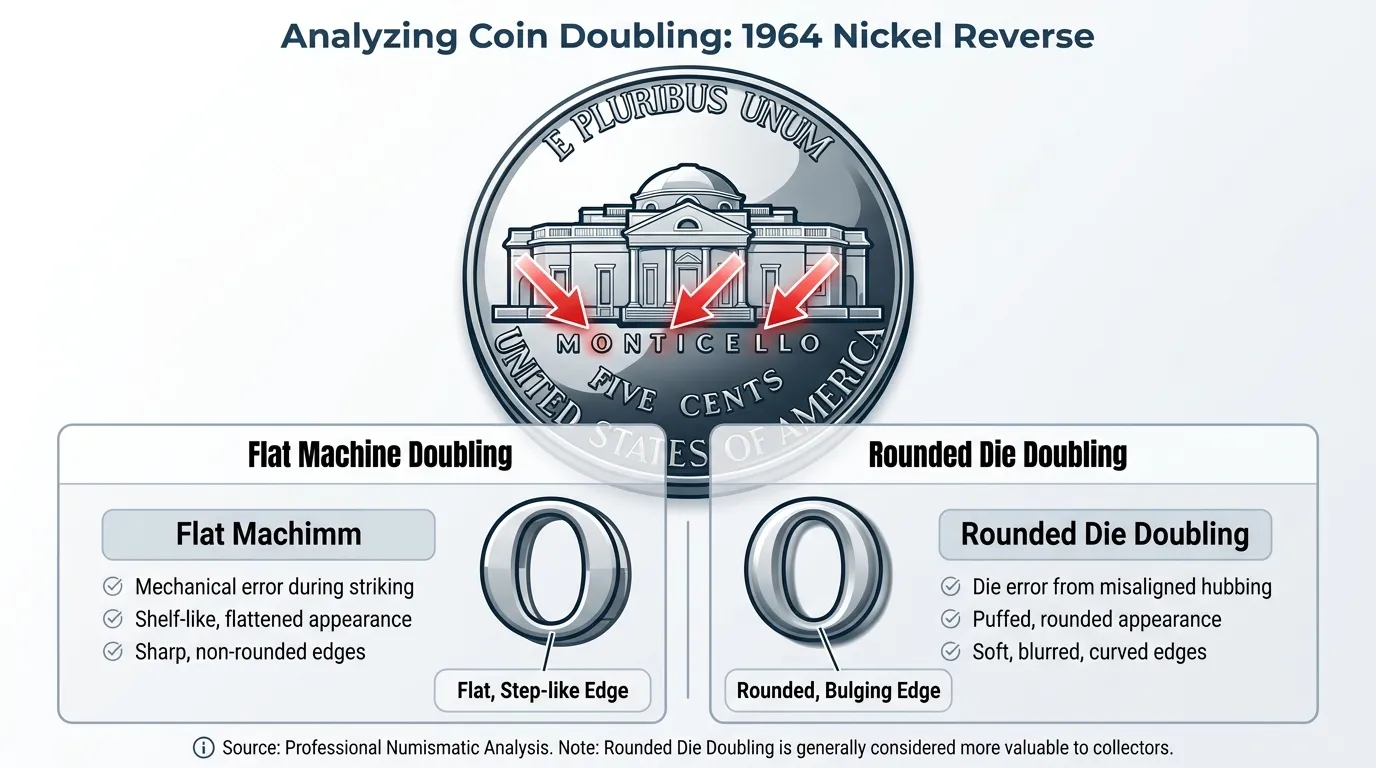
The most coveted variety for the 1964 Philadelphia issue is the FS-801 DDR. Unlike common machine doubling (which is worthless), this is a "true" doubled die created during the hubbing process.
- What to look for: Dramatic doubling on the words "MONTICELLO" and "FIVE CENTS."
- The Key Tell: Look at the "R" in "PLURIBUS" and the "O" in "MONTICELLO." If the doubling is thick and rounded rather than flat and shelf-like, you have a winner.
- Market Value: High-grade Proof examples (PR67) have recently traded for $40–$100, but "Business Strike" versions in MS65 can command $300+ due to their extreme scarcity (Source: GreatCollections, 2026).
 AI Generated Infographic
The FS-802 Triple Die Reverse (TDR)
Rarer than the DDR, the FS-802 TDR features three distinct impressions on the reverse die. This variety is most frequently found on Proof strikes but is often overlooked by casual collectors.
- Identification: Focus on the letters "UNITED STATES OF AMERICA." You will see a "tripled" effect on the vertical bars of the letters and the windows of the building.
- Value: A PR68 TDR sold in early 2026 for approximately $460 (Source: Coleccionistas de Monedas).
1964-D Repunched Mint Mark (FS-501)
For Denver-minted nickels, the "D" mint mark provides the primary error target. Because mint marks were hand-punched into dies in 1964, the FS-501 RPM (D over D) occurred when the punch shifted between strikes.
| Variety | Grade | Market Value (2026 Est.) | Identifying Feature |
|---|---|---|---|
| DDR (FS-801) | MS65 | $350 | Strong doubling on "MONTICELLO" |
| TDR (FS-802) | PR67 | $280 | Tripling on "UNITED STATES" |
| RPM (FS-501) | MS64 | $125 | Clear second "D" below the primary |
| Standard '64 | MS65 | $1.50 | No doubling; standard strike |
(Source: PCGS Price Guide & PriceCharting, Sept 2026)
{
  "type": "bar",
  "title": "1964 Nickel Error Premiums (MS65 Grade)",
  "index": "Variety",
  "categories": ["Market Value ($)"],
  "data": [
    {"Variety": "Standard (No FS)", "Market Value ($)": 1.5},
    {"Variety": "RPM (FS-501)", "Market Value ($)": 185},
    {"Variety": "DDR (FS-801)", "Market Value ($)": 350},
    {"Variety": "SMS (Specimen)", "Market Value ($)": 4500}
  ],
  "source": "Source: Heritage Auctions & PCGS (2026)",
  "note": "Values assume professional certification by PCGS/NGC."
}
Expert Insight: 99% of "doubling" found on 1964 nickels is mechanical doubling—a byproduct of a loose die during the strike. It adds zero value. If the doubling looks like a "shadow" or a thin shelf, it is mechanical. True varieties (FS-801/802) show increased thickness in the letters themselves.
Summary: Determining if Your 1964 Nickel is Worth Selling
The decision to move from "pocket change hunter" to "professional seller" hinges on a cold calculation of liquidity versus overhead. For a 1964 Jefferson Nickel, the threshold for profitability is exceptionally high due to the 2.8 billion coins minted—the highest production run in the series' history (Source: U.S. Mint, 1964 Annual Report).
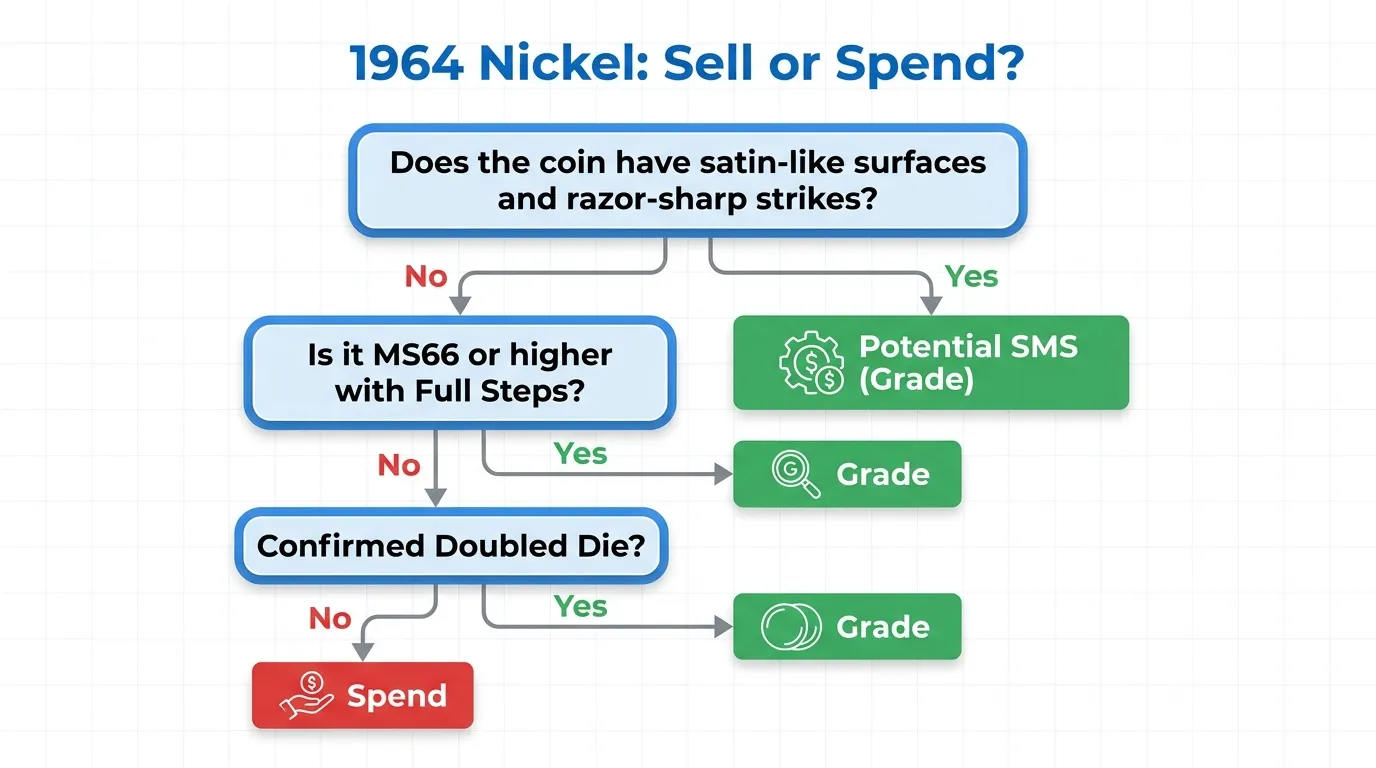
The "Grade or Spend" Economic Reality
Professional grading (PCGS/NGC) costs approximately $30 to $60 per coin when factoring in shipping, insurance, and membership fees. Unless your coin’s market value exceeds $100, the math favors spending it or keeping it raw.
| Condition/Variety | Market Value (2026 Est.) | Recommendation |
|---|---|---|
| Circulated (Average) | $0.05 | Spend |
| Uncirculated (MS60-64) | $1.00 – $5.00 | Keep Raw |
| High Grade (MS66 Full Steps) | $120.00+ | Grade |
| Confirmed FS-801/802 DDR | $250.00 – $1,500.00 | Grade |
| Special Mint Set (SMS) | $5,000.00 – $30,000.00 | Immediate Submission |
| (Source: PCGS Price Guide & Heritage Auctions, 2026) |
 AI Generated Infographic
Final Verification Checklist
Before committing capital to a grading submission, verify these three non-negotiables:
- Step 1: The Luster Test. If the coin has circular "wear" marks or looks dull, it is circulated. Even a "perfect" looking coin from a jar is likely MS63 at best, which is worth less than its shipping cost.
- Step 2: The Full Steps (FS) Requirement. Use a 10x loupe. If the five steps on the base of Monticello are merged or scratched, the value drops by 85%.
- Step 3: Genuine vs. Mechanical Doubling. Re-examine the "1964" and "TRUST." If the doubling is flat/stepped, it’s a machine error with zero premium.
Expert Verdict: For 99.9% of collectors, a 1964 nickel is a "spend." You are looking for the statistical anomaly—the SMS strike or a flawless MS67. If your coin doesn't exhibit the mirror-like satin finish characteristic of the 1964 SMS, it is almost certainly a common strike intended for circulation.
For those tracking broader market shifts and institutional interest in alternative assets like rare numismatics, leveraging high-level data is essential for Tritonix.ai.
FAQ
Is a 1964 nickel made of silver?
No, the 1964 nickel contains zero silver; it has maintained a consistent composition of 75% copper and 25% nickel since 1946.
How much is a common 1964 nickel worth?
Most circulated 1964 nickels found in pocket change are worth exactly five cents because over 2.8 billion were produced.
What is a 1964 SMS nickel and why is it valuable?
The 1964 Special Mint Set (SMS) nickel is a rare specimen strike with a satin finish and sharp edges. Only 20 to 50 exist, making them worth up to $32,900.
How do I identify a Full Steps (FS) 1964 nickel?
Check the reverse of the coin for 5 or 6 clear, uninterrupted steps at the base of Monticello. These rare, high-quality strikes can be worth thousands of dollars.
Does a 1964 nickel have a mint mark?
Nickels from the Denver mint have a 'D' on the reverse. Philadelphia and San Francisco strikes from 1964 have no mint mark due to the Coinage Act of 1965.